




5 alternative arguments against TTIP
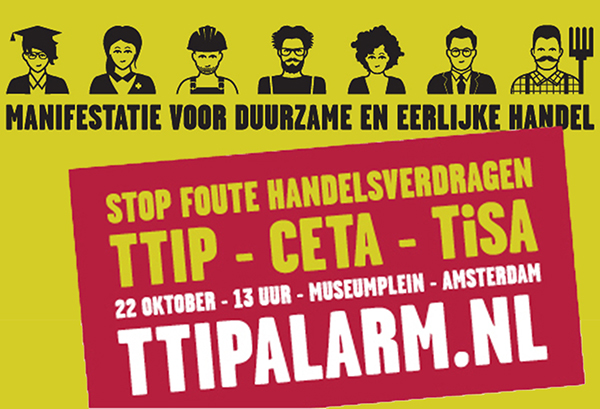
Both ENDS will join the protest against trade treaties TTIP, CETA and TiSA on Saturday October 22nd in Amsterdam. These treaties will have negative impacts, not only in the Netherlands and Europe, but also - and maybe even more so - in developing countries.
The reasons why trade treaties like TTIP, CETA and TiSA can be bad for developing countries are less well known than the impacts on the Netherlands. These are the five main reasons:
1. Weaker environmental regulations lead to more climate change
TTIP and CETA will put Europe's quite stringent environmental laws under pressure. Due to the softer legislation in the US and Canada, many products can be produced more cheaply there. This leads to unfair competition and to a greater pressure from companies to lower the European standards. Moreover, EU standards have already been adjusted for CETA.
Weakening of environmental standards, however, runs counter to the commitment to promote sustainable development and combat climate change. Climate change is a global problem that disproportionately affects the poorest people in developing countries.
2. TTIP and CETA are a threat to policy coherence
In all decisions, the Netherlands should take the effects on developing countries, on the environment or on human rights into account. This policy coherence will be impossible under the rules of TTIP and CETA. New government measures, such as new environmental legislation, may lead to substantial investment claims under ISDS (see point 5). This thereat will have a stronghold on the implementation of new regulation, even if the latter has a societal purpose. This is known as 'regulatory chill'. In other words, because of ISDS, countries possibly will not implement certain regulations for social or environmental protection due to expected damage claims.
3. CETA threatens worldwide food security
With CETA, Canada and the EU agree to comply with and promote the UPOV 1991 Convention. This controversial convention prohibits farmers to save and reuse farm saved seeds and propagating material. They must buy new seeds each season. This is a great disadvantage especially for small farmers in developing countries, which play a major role in food security in these countries. Probably also TTIP contains such an article. As not only complying with, but also promoting the 1991 UPOV Convention is part of CETA, Canada and the EU must persuade other countries to join the convention.
4. TTIP and CETA limit market access for developing countries
TTIP and CETA prioritise products from the US, Canada and EU countries, limiting the access of developing countries to the markets of these countries. This way, developing countries will see a decline of their exports to TTIP and CETA countries, and thus of their income.
5. CETA sets the wrong example for future agreements
CETA contains several articles that might be less controversial for rich countries, but which can lead to huge problems and increased inequality when implemented in trade agreements between the EU and African, Asian, Latin American and Caribbean regions:
- CETA and TiSA state that services like health care, electricity and drinking water should be further liberalized. In developing countries, this would seriously threaten access to these facilities.
- CETA prohibits export taxes. For developing countries, export taxes are an important way to diversify their economies and become less dependent on primary commodities, as export taxes are an incentive to process raw materials within the country before exporting them.
- CETA, TTIP and TiSA forbid governments to impose requirements on foreign investors who want to establish themselves in a country. For example, national laws and regulations that make sure a new tourist resort creates new local jobs will not be allowed.
- Much of our resistance to TTIP and CETA is caused by the 'Investor to State Dispute Settlement' mechanisms (ISDS). This mechanism enables American and Canadian companies to directly sue our governments in the case of (potential) loss of profits as a result of that government's policy. But on the other side, international agreements on human rights or environmental protection lack such a formal judicial system. TTIP and CETA therefore put the rights of businesses above the rights of people. Many current trade agreements between rich and poor countries contain an ISDS mechanism. For this reason, India has decided to terminate these treaties.
Chances are high that future trade agreements with developing countries also contain articles like the above, as CETA, TTIP and TiSA are seen as the new standard for trade agreements. Therefore the current debate is about more than just CETA, TTIP and TiSA: it shapes the future of global trade.
Come to Museumplein!
Both ENDS will be present at the event 'Stop Wrong Trade agreements - Manifestation for sustainable and fair trade "on Saturday, October 22 at the Museumplein in Amsterdam. The event is organized by the FNV, Food Watch, Greenpeace, Friends of the Earth NL, SOMO and TNI. Will you be there?
Read more about this subject
-
 Dossier /
Investment treaties
Investment treaties must be inclusive, sustainable and fair. That means that they must not put the interests of companies before those of people and their living environment.
-
 Dossier /
Seeking justice for the affected communities of Vale’s mining disasters in Mariana and Brumadinho
In 2015 and 2019, the Brazilian state of Minas Gerais experienced two severe mining tragedies in Mariana and Brumadinho, due to the same mining company: Vale. Since then, the affected communities have been seeking justice, via the criminal punishment of the responsible parties, and a fair compensation for the loss of their loved ones, their homes and their livelihoods. Both ENDS supports local CSOs by amplifying their quest for justice within an international audience and, more specifically, by raising awareness amongst Dutch investors in Vale about the high risks this company’s activities pose for people and the environment.
-
 News / 22 januari 2026
Shell files new arbitration against the Netherlands over Groningen gas field closure
Shell is suing the Netherlands in yet another attempt to evade its responsibility for decades of gas extraction in Groningen. For years, gas production has triggered earthquakes, damaged over a hundred thousand homes, and left residents living in prolonged insecurity, still waiting for repairs, reinforcement, and justice.
-
 Blog / 11 december 2025
Reflections on working on Dutch finance for Mozambique LNG
Last Tuesday, I received a short text message with big news: the minister had just announced that the financing policy for the Mozambique LNG project was stopped. It was a decision that I – along with so many others – have fought for for years. Only now, more than a week later, it is slowly sinking in that we have really won. The years of perseverance, frustration, discussions and investigations have finally led to this result. It still feels a bit surreal.
-
 Dossier /
Rights for People, Rules for Corporations – Stop ISDS!
Indigenous communities in Paraguay saw their attempts to regain their ancestral lands thwarted by German investors. In Indonesia, US-based mining companies succeeded to roll back new laws that were meant to boost the country’s economic development and protect its forests. This is the level of impact that investment treaties can have on social, environmental and economic development and rights. Why? Because of the ‘Investor-to-State Dispute Settlement’ clauses that are included in many such treaties.
-
 Blog / 25 november 2025
COP30 shows why dismantling ISDS is essential for real climate action
Standing in Belém during COP30, I felt the weight of the moment. We came to the Amazon hoping for decisive progress on phasing out fossil fuels, yet the final outcome fell far short of the ambition science and justice demand. The agreement brought welcome commitments on adaptation finance and global indicators, but it refused to confront the structural forces that make climate action so difficult.
-
 Dossier /
Trade agreements
International trade agreements often have far-reaching consequences not only for the economy of a country, but also for people and the environment. It is primarily the most vulnerable groups who suffer most from these agreements.
-
 News / 5 november 2025
Another ISDS claim hits the Netherlands: Petrogas sues over solidarity contribution and royalty regulations
SOMO and Both ENDS strongly condemn the newly revealed investor-state dispute settlement (ISDS) case filed by Petrogas, an Omani oil and gas company operating two shallow-water gas fields in the Dutch North Sea, against the Netherlands under the Netherlands-Oman bilateral investment treaty (BIT).
-
 News / 5 november 2025
Interview: Both ENDS at COP30 for Climate Justice and Systemic Change
Both ENDS is present at COP30 to advocate for genuine access to climate finance for locally led, gender-just climate solutions and the mechanisms that facilitate this, including those for farmer-led restoration. Furthermore, the organisation participates to ensure the crucial connection between the climate negotiations and the trade and investment frameworks that shape them.
Learn more about the Both ENDS team at COP30 below, and find all the activities and side-events in which Both ENDS will participate.
-
 News / 5 november 2025
Overview of Both ENDS events at COP30 in Belem, Brazil
Both ENDS is present at COP30 to advocate for genuine access to climate finance for locally led, gender-just climate solutions, and for the mechanisms that make these possible, including those supporting farmer-led restoration. The organisation also engages to highlight the crucial connection between climate negotiations and the trade and investment frameworks that shape them.
Below is an overview of the Both ENDS team at COP30 and a detailed look at the activities and side-events in which Both ENDS will participate.
-
Publication / 16 oktober 2025
-
Publication / 16 oktober 2025
-
 Dossier /
International trade and investment with respect for people and planet
The network of international trade and investment treaties is large and complex. The Netherlands alone has signed more than 70 bilateral investment treaties (BITs) and is party to the trade and investment agreements concluded by the EU, like the EU-Mercosur and EU-Indonesia trade deals.
-
 News / 6 oktober 2025
From Entebbe to Accra: civil society is rewriting the rules of investment
By Fernando Hernández Espino and Bart-Jaap Verbeek
Almost a year after African civil society gathered in Uganda to adopt the Entebbe Declaration, the call to transform international investment governance continues to gain strength. From the 6th to the 9th of October, over 50 civil society organisations from across West Africa, including from Ghana, Senegal, Nigeria, Côte d’Ivoire, Cameroon, Gambia, Sierra Leone, as well as from Kenya and Latin America, are convening in Accra to deepen and operationalise the Declaration’s vision.
-
 Dossier /
Towards a socially and environmentally just energy transition
To address the climate crisis we need to urgently transition away from fossil fuels towards clean, renewable energy. However, this transition is not only about changing energy sources. It requires an inclusive and fair process that tackles systemic inequalities and demanding consumption patterns, prioritizes environmental and social justice, and which does not repeat mistakes from the past.
-
 Dossier /
Fair Green and Global Alliance (FGG)
Together with civil society organisations from all over the world, the Fair Green and Global (FGG) Alliance aims for socially just, inclusive and environmentally sustainable societies in the Netherlands and the Global South.
-
Publication / 1 juli 2025
-
 News / 6 juni 2025
Both ENDS at the UN Ocean Conference: voicing our environmental justice concerns about the “Blue Economy”
Next week, the United Nations Ocean Conference will take place in Nice, France. This conference is focused on the conservation and sustainable use of coasts, seas and marine resources. Both ENDS colleague Murtah Shannon will be attending. We’ve asked him to explain a bit more about his plans.
-
 Blog / 3 juni 2025
A food forest as an inspiring oasis between monoculture fields
Recently, we visited food forest Ketelbroek with a group of colleagues. This project was initiated by food forest pioneer Wouter van Eck and our own Pieter Jansen. What a beautiful place! Located between monocrop fields of ryegrass, beetroot and potatoes, the food forest is a green oasis. Birdsong fills the air and there is a constant buzz and fluttering all around. Hares, badgers, foxes and wild boars are regular visitors. And let's not forget the beavers.
-
 News / 21 maart 2025
Dutch Royal couple visits Thogoto Forest: a green oasis on the outskirts of Nairobi
This week, King Willem-Alexander and Queen Máxima visited Thogoto Forest as part of their state visit to Kenya. They were able to see the impact of the work of our partner MCDI in the area: a restored forest, clean water and farmers who can earn a living by selling their agro-ecological products.



