




Mermaids and mermen
This year's climate conference had a lot of side-events about gender. Gender is about women and men, not their biological differences, but the differences in for example their roles, their needs, their rights and their access to decision making.

FCAM side event, Marrakech 2016
Climate change affects women differently
The poorest people of this world are hit the hardest by climate change, because most effects of climate change can be seen in poor tropical countries. Poor people have little or no means to restore after losing their harvest, home or family. They have no savings and no insurances. Of the poorest, a majority is female. Therefore women are affected worse by climate change.
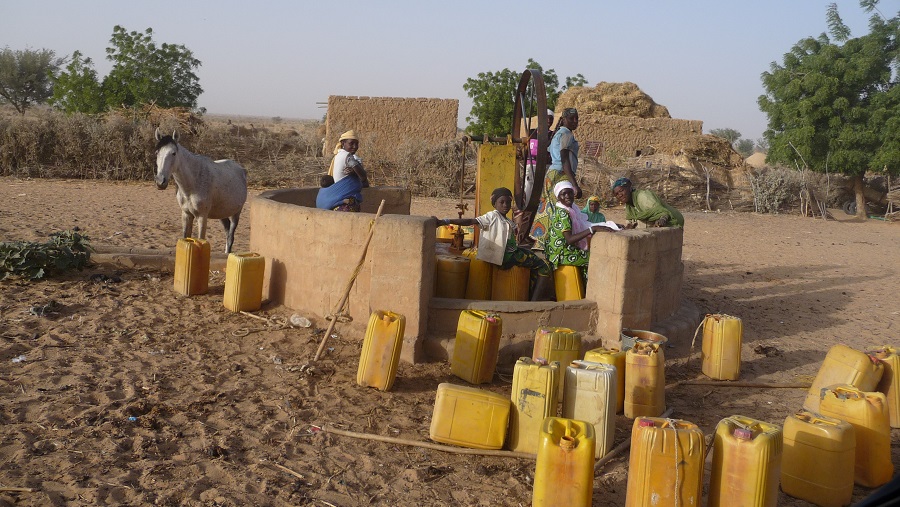
In addition, women and men feel climate change in different ways. For example, less rain means women and girls have to walk longer distances to fetch water, which is often their task. Girls have less time to go to school or do their homework. Sometimes women have to walk 4 hours a day to fetch water.
In the climate treaty of 1992, which was followed by the Kyoto protocol, this gender aspect was not taken into account at all. It did not mention people at all, let alone men and women. It only mentioned todays and future generations.
Later on, gender became a topic in the climate process, culminating in a working program about gender that was introduced on the conference in Lima in 2014. There were a workshop and a report. Here in Marrakech, this working program was prolonged for another 3 years and an action plan will be set up.
Gender needs more than just ticking the box
But is this going to help? In one of the many side events I heard someone say that gender often is added in the end: "Ticked the box, done, that's it."
If you really want to take the differences between men and women into account, if you want to make sure that both men's and women's are heard in decisions about their land, their future and climate actions, you have to ask them what they need. Women have to be involved in the decisions that affect them.
Because women have other roles and tasks than men, like for example producing food crops for their families, picking the seeds for next year, making traditional medicine from herbs and plants, they have other knowledge than men. This knowledge can be a crucial element for climate action. This is a second reason to listen to women more often.
Are we all mermaids?
|
Last week I was also invited to attend the 'high level event for women leaders'. There, I would meet strong and powerful women, like Hilda Heine, president of the Marshall Islands, UN's clean energy champion Rachel Kyte, and Mary Robinson, Ireland's former president and now leading her own Foundation focusing on huan rights and climate justice.
The woman next to me explained: because we women are caretakers, we are connected to the fate of the earth. In our bodies, we feel the pain the earth also feels. |
Mary Robinson |

Boom! Suddenly I woke up. Women the caretakers? Isn't that one of those gender roles that is imposed upon us? My husband is a good caretaker as well. Will he also get a fishtail now? I was confused.
Connected to earth
I believe that all human beings - women and men, are connected tot he earth. Dutch scientist André Kuipers flew to the moon, saw our beautiful blue planet from space and felt terrible. He realized that he needed to be on earth, the ecosystem that we belong in as humans. Women and men. We can't live without the earth.
So let's take good care of the earth and of ourselves, of mermaids and mermen.
Read more about this subject
-
 News / 16 July 2025
The challenges of climate change, gender inequality, and conflict
This FCDO-supported project, part of the GAGGA programme, brought together 6 women-led community-based organisations from around the world to explore how they navigate the combined challenges of climate change, gender inequality, and conflict. Through a Feminist Participatory Action Research approach, the organisations documented strategies ranging from land rights advocacy to climate-resilient agriculture, highlighting how extractive industries, militarisation, and patriarchal systems drive exclusion and insecurity. Their findings are now informing donors and policymakers on the need to support grassroots women’s leadership. In the following interview, the project lead shares more about the research, key insights, and its broader impact.
-
 External link / 1 August 2018
Briefing paper: Gender and Climate Change
This paper by Prakriti Resources Center (Nepal) sheds light on the gender and climate change nexus, gender mainstreaming as a tool to address gender inequality, gender and climate change policy landscape both at international and national level, gaps and way forward.
-
Letter / 23 August 2021
Reflecting the duality of gender and climate in the EIB’s Environmental and Social Sustainability Framework’s Standard 5 on Climate Change
This briefing of Eurodad, co-authored by Pieter Jansen, Both ENDS aims to outline recommendations on how the European Investment Bank should address the interconnected issue of gender inequity and the climate crisis in the newly proposed environmental and social policy.Severe climate change has consequences for human rights, including the right to life. As such, under the European convention on human rights the EIB has a duty to stop carbon-emissions related investments. The EIB and project promoters must monitor a project's greenhouse gas emissions and the climate risks of the project on the natural environment, and the women possibly affected by the project. The newly proposed policy should ensure that project promoters, who apply for EIB funding, submit a gender and social inclusion plan, and full participation and engagement of women, local communities and stakeholders in the Climate Risk Vulnerability Assessment methodology.
-
 External link / 19 June 2020
Nepalese women lead local advocacy on climate change (Annual Report 2019)
In 2019, Karambot Women's Agriculture Group (Nepal) convinced their municipality to fund its proposed irrigation plan, after they followed a planning and budgeting training.
-
 Event / 7 November 2016
COP22: Marrakech Climate Change Conference
From 7 to 18 november, the Climate Change COP22 will take place in Marrakech, Morrocco. This '22nd Conference of the Parties to the United Nations Framework Convention on Climate Change (UNFCCC)' as it is called officially, is the annual meeting of the 195 countries which have signed and ratified the convention.
-
 Event / 4 December 2015
COP21: Climate Change Conference Paris
During the COP21 in Paris, Both ENDS will be cooperating and presenting with partners on a number of events. If you plan on going, please consider visiting one or more of these sessions:
-
Event / 30 April 2024
CBA18: International Conference on Community-based Adaptation to Climate Change
Already for the 18th time, the International Conference on Community-based Adaptation to Climate Change (CBA18) will take place from May 6-9 In Arusha, Tanzania. In this conference practitioners, civil society organisations, donors, and representatives from governments and multilateral agencies come together to learn from each other and explore opportunities for collaboration.
-
 News / 11 January 2019
JWHI-grantee Clive receives Gender Just Climate Solutions Award
Clive Chibule from Zambia won the Gender Just Climate Solutions Award at the climate conference in Katowice, Poland. His project "Community strategies for climate-resilient livelihoods" aims at training rural women on leadership and climate resilience. A very important project, as Zambia is already feeling the effects of climate change, and rural women are affected most.
-
 News / 29 November 2023
An Urgent Call for Gender Just Climate Finance
The climate crisis continues to escalate, and the urgency for meaningful solutions has never been more palpable. As world leaders gather for the 2023 United Nations Climate Change Conference or Conference of the Parties of the UNFCCC (COP28), it's crucial that grassroots voices are not just heard but leading on the solutions we craft. We must recognise the climate leadership of the self-led groups of women, girls, trans and intersex within the Indigenous, Afrodescendant and rural communities that have been structurally excluded and silenced as the world grapples with climate change.
-
Publication / 4 November 2022
-
 News / 16 July 2025
Case Study: Women Advocating for Gender and Climate Justice in Burkina Faso
The Women Environmental Programme Burkina Faso (WEP BF or WEP) is leading the way in gender-just climate solutions, putting the power of advocacy directly into the hands of women farmers. “In Burkina Faso, women play a crucial role in food production and natural resource management, yet they continue to face systemic barriers to land ownership,” explains a WEP team member. “Despite legal provisions, deeply ingrained customary norms remain dominant, restricting women’s access to land as user rights only, which need to be mediated through male family members.” Without secure access to land, they face significant obstacles in sustaining their agricultural activities, improving local food security, and fully participating in their communities.
-
Publication / 18 June 2018
-
 Dossier /
Small Grants Big Impacts
Small grants funds offer an effective, alternative way to channel big money from large donors and funds to local groups and organisations that are striving for a sustainable and just society everywhere around the world.
-
 News / 19 March 2019
Ana di Pangracio: "Degradation of wetlands, worsened by climate change, is a recipe for disaster"
We asked three of our partner organisations to tell us how climate change is already affecting the daily lives of the people they work with, what they are doing to turn the tide and if they think the Climate Court Case against Shell can be important in the context of climate change. Ana di Pangracio, working for FARN (Argentina) tells us about climate threats to large wetlands, while these same wetlands are crucial in mitigating global climate change.
-
 News / 12 April 2019
Sara Crespo Suarez: "Agriculture in Bolivia is severely impacted by climate change"
We asked three of our partner organisations to tell us how climate change is already affecting the daily lives of the people they work with, what they are doing to turn the tide and if they think the Climate Court Case against Shell can be important in the context of climate change. Sara Crespo Suarez of our Bolivian partner Probioma explains how the effects are already being felt in her country.
-
 News / 21 December 2021
Two generations fighting against climate change in Ghana: meet our partners Richard and Kenneth
In Ghana, the effects of climate change are already tangible, just like in many countries around the world. How to ensure that these different experiences are heard and known by the Ghanaian government so that it will take actions that have a positive effect on people and their environment? And how to make local communities aware that they can hold the government accountable - and even have the responsibility to do so? During COP26 in Glasgow we spoke with Kenneth Nana Amoateng (47) and Richard Matey (30). Kenneth works at the AbibiNsroma Foundation, a local NGO, and took it as his mission to advocate for a healthy environment, climate change, and to give young people opportunities. Richard is part of that younger generation and works at the Alliance for Empowering Rural Communities in Ghana.
-
 News / 19 September 2011
[New movie] Dialogue on Forests, Governance and Climate Change
Both ENDS' deputy director Paul Wolvekamp attended the 10th Dialogue on Forests, Governance and Climate Change which was hosted by the Rights and Resources Initiative (RRI) and Oxfam Novib and took place in The Hague on the 7th of september.
-
 Blog / 2 February 2019
“Poldering” to face climate change
Last week Mark Rutte met with Ban Ki Moon, Bill Gates and World Bank Director Kristalina Georgieva in Davos. They are the chairpersons of the Global Commission on Adaptation, which was also founded by the Netherlands. This is an important organisation because, as Rutte wrote on Twitter, "climate change is the biggest challenge of this century," and as an international community we should "pay attention to the problems of the countries that are being threatened by climate change."
-
Publication / 28 January 2010
-
 News / 26 September 2012
Adaptation to climate change? A practical guide from Vietnam
How do local people already arm themselves against the consequences of climate change? And what can other local communities and policy makers learn from them? The Centre for Social Research and Development (CSRD), a CSO from Vietnam and a partner of Both ENDS, produced an easy-to-read, practical guide to implementing various local adaptation measures.



