




Shutter the lives of the affected communities
Shutter the lives of the affected communities
The loss of the usually fertile riverine soils land and rich biodiversity vegetation combined with changes in climate have made their present lives even worse, wishing they had known what was about to befall them before they lost their livelihoods by giving their fertile rich soils land for the dam.
Having been thrown away from the river, unable to easily access water and wood from the rich riverine vegetation and rich soils, women are now struggling to be able to cultivate and produce enough to feed their families from the poor, stony, erosion prone hillsides plots of land they received in place of their down the river Nile rich soils. They use so much energy and so much time and need much land of those poor soils to produce so little - not enough to support their families.
They walk long distances and take more time with many resulting social and health problems to get water home. Less rain and long droughts mean that they have to look for water most of the time in the year. Maintaining their hygiene is becoming difficult.
They also walk long distances and take a lot more time to the only "nearby'' Mabira forest (5km) to get fire wood to cook their food. Fewer meals are now cooked and easy to cook but less nutritive value foods are preferred due to lack of energy to cook the would be nutritive foods. "Given chance to go back to my former land, I would go running. I would rather live in my earlier grass thatched house than live in this brick house with a lot of suffering I am now going through" say Christine Nabwire one of the Naminya resettled community.
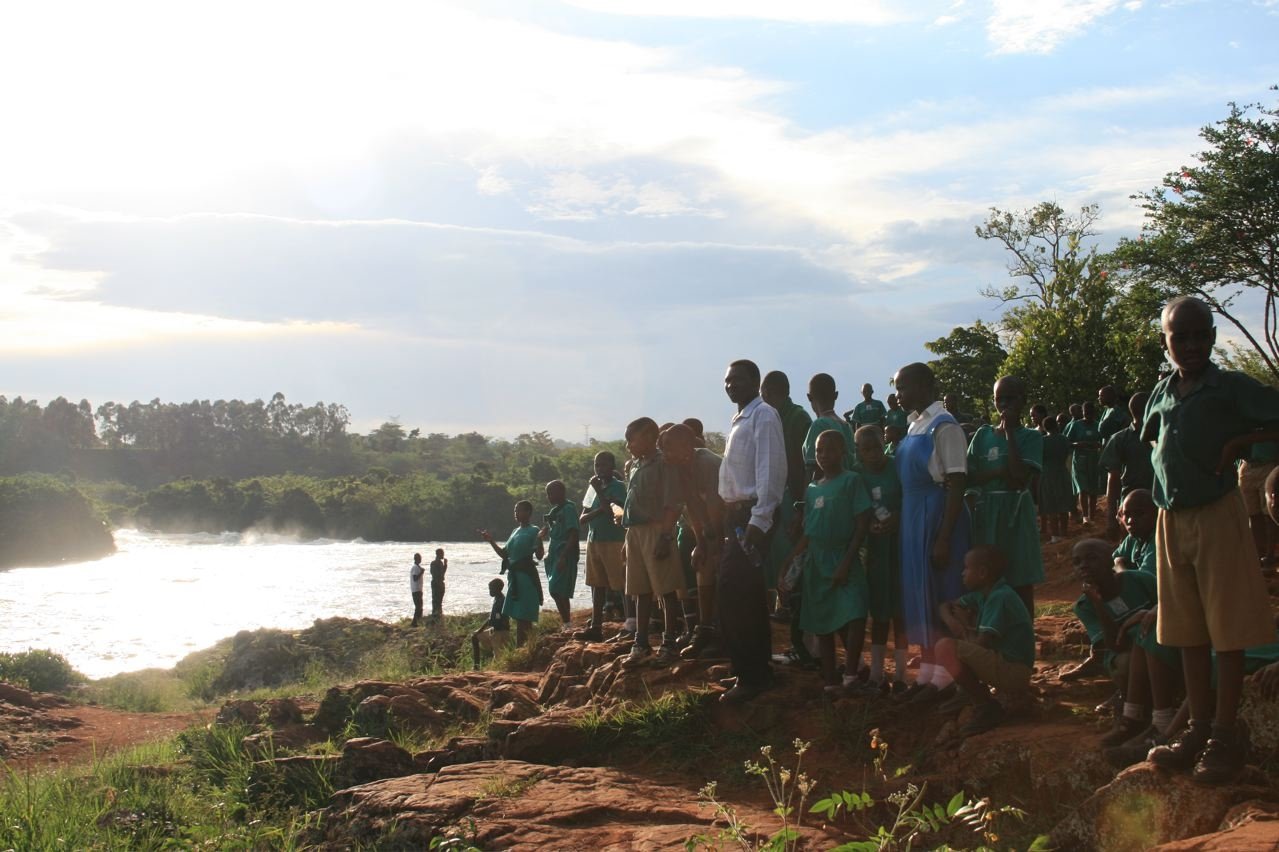
Women and girl children in the affected communities of Naminya resettlement, Malindi, Buloba and Kikubamutwe, have while on these long distances through thick and isolated sugarcane plantations to get firewood, experienced untold suffering. They have been raped, young girl children defiled, some times beaten if they resist and their firewood confiscated by the forest rangers or bad elements a long the long way between them and the forest.
Consequently they have suffered STDs in this era of HIV/AIDS, produced fatherless children, girl children dropping out of school due to pregnancies of rape and defilement and forced to become mother children (children mothering children.)
The Bujagali dam forcing them to poor stony easily eroded hillside soils, together with the prevailing harsh climate change conditions (less rain and long droughts) have only aggravated their conditions from bad to worse - an opposite of what they were told and promised by the Bujagali dam promoters. For sure, this is not the development to be - the dam claims to bring to the people.
Worse still, they don't see a ray of hope ahead. The electricity they were promised since 8 years now, the piped water among others never seem to come their way and climate changes are becoming worse each day that passes.
To these peoples life will never be the same again, it's lost and their livelihoods crushed. The search for energy should not come at this cost.
By Robert Kugonza - robertk@nape.or.ug
Coordinator, - African Rivers Network
c/o NAPE, P.O.Box, 29099, Kampala.
National Association of Professional Environmentalists (NAPE) is a NGO partner of Both ENDS
www.nape.or.ug
Posted by Both ENDS:
In addition to this article, please watch this artistic movie that tells the story of a local who lives on one of the beautiful islands in the Nile. This man is forced to leave his home, because of the constructions of the Bujagali dam in Uganda. A documentary from Baobabconnections:
Read more about this subject
-
 Dossier /
Trade agreements
International trade agreements often have far-reaching consequences not only for the economy of a country, but also for people and the environment. It is primarily the most vulnerable groups who suffer most from these agreements.
-
 Dossier /
International trade and investment with respect for people and planet
The network of international trade and investment treaties is large and complex. The Netherlands alone has signed more than 70 bilateral investment treaties (BITs) and is party to the trade and investment agreements concluded by the EU, like the EU-Mercosur and EU-Indonesia trade deals.
-
 Dossier /
Rights for People, Rules for Corporations – Stop ISDS!
Indigenous communities in Paraguay saw their attempts to regain their ancestral lands thwarted by German investors. In Indonesia, US-based mining companies succeeded to roll back new laws that were meant to boost the country’s economic development and protect its forests. This is the level of impact that investment treaties can have on social, environmental and economic development and rights. Why? Because of the ‘Investor-to-State Dispute Settlement’ clauses that are included in many such treaties.
-
 News / 15 October 2026
ISDS infringement complaint filed with the European Commission
The Netherlands and Portugal join four other EU countries facing such a complaint.
-
 Press release / 15 October 2026
Dutch and Portuguese organisations file EU complaint over investment treaties that let companies and sanctioned Russian oligarchs sue EU countries for compensation
The Netherlands and Portugal join four other EU countries facing such a complaint, as the Global Days of Action against Investor-State Dispute Settlement (ISDS) begin.
-
 Dossier /
Dare to Trust: the power of unconditional funding
At Both ENDS we cherish our long-term relationships with partners in our global network. These relationships are based on equality and built on trust. The trust we have in each other has developed from years of strategic cooperation, including joint advocacy around common agendas, knowledge sharing, networking, and mobilising and sharing resources to advance environmental justice.
-
 Dossier /
Global Alliance for Green and Gender Action (GAGGA)
GAGGA rallies the collective power of the women's rights and environmental justice movements to realize a world where women can and do access their rights to water, food security, and a clean, healthy and safe environment.
-
 News / 5 October 2026
Rural Women's Assembly wins Right Livelihood Award
We are thrilled to share that our partner the Rural Women's Assembly (RWA) is one of this year's Right Livelihood Laureates! The award, often called the "Alternative Nobel Prize", honours RWA for bringing together more than 178,000 women farmers in eleven Southern African countries. Together, these women stand up for their land, their seeds and their right to make decisions about their own lives and bodies.
-
 News / 29 September 2026
Summary - Both ENDS complaint under the EU-New Zealand trade agreement
On 29 September 2026, Both ENDS lodged the first complaint on climate grounds with the European Commission's Single Entry Point. It asks the Commission to examine whether Aotearoa New Zealand has broken two promises both sides made in the EU-New Zealand Free Trade Agreement: not to weaken or set aside environmental laws in order to encourage trade or investment, and to effectively implement the Paris Agreement.
-
Publication / 29 September 2026
-
Publication / 29 September 2026
-
 News / 29 September 2026
Q&A: New Zealand's climate rollback and the EU trade agreement
On 29 September 2026 / 30 September in Aotearoa New Zealand, Both ENDS lodged a complaint with the European Commission under the EU-New Zealand Free Trade Agreement. These are the questions we are asked most often, and our answers. The complaint summary, the case explainer and the key public sources are linked at the end of this page.
-
 News / 29 September 2026
What happens now? A timeline of the SEP Case
What happens now? On 29 September 2026 / 30 September in Aotearoa New Zealand, Both ENDS lodged a formal complaint with the European Commission. It is the first complaint to the EU's Single Entry Point on environmental and climate grounds. It asks the Commission to hold New Zealand to two promises it made in its trade agreement with the EU: not to weaken environmental protection to encourage trade or investment, and not to undermine the Paris Agreement on climate change.
-
 Press release / 29 September 2026
New Zealand faces its first climate complaint under EU trade rules
UTRECHT / WELLINGTON, 29 September 2026 /30 September in Aotearoa New Zealand
Both ENDS, a Dutch environmental justice organisation, has lodged a formal complaint with the European Commission arguing that New Zealand has broken the climate promises it made in its free trade agreement with the European Union. It is the first complaint on environmental and climate grounds under the Commission's Single Entry Point, the mechanism that lets civil society ask the EU to enforce the sustainability commitments in its trade agreements.
-
 News / 10 September 2026
Rutu Foundation receives UNESCO Literacy Prize for multilingual education
Both ENDS’ partner the Rutu Foundation for Intercultural Multilingual Education has been awarded the 2026 UNESCO King Sejong Literacy Prize for its language friendly school programme. This prestigious prize recognises the importance of multilingual education and the right of children to learn in an environment where their home languages are valued.
-
 News / 7 September 2026
Unprecedented criminal conviction in the Mariana disaster case breaks mining industry's cycle of impunity
A Brazilian federal court has, for the first time, criminally convicted a mining company and three of its managers for their role in the 2015 collapse of the Fundão dam, one of the worst environmental disasters in Brazil's history. Our partner Instituto Cordilheira, which represented victims as assistant prosecutors in the case, calls it a historic breakthrough after years of impunity.
-
 Dossier /
Communities Regreen the Sahel
In various countries in the Sahel, vast tracts of land have been restored by the local population by nurturing what spontaneously springs from the soil and protecting the sprouts from cattle and hazards.
-
 News / 3 September 2026
Restoring Land, Restoring Hope: Both ENDS at UNCCD COP17 in Mongolia
From 17 to 28 August, governments gathered in Ulaanbaatar, Mongolia, for COP17 of the UN Convention to Combat Desertification (UNCCD). At stake was more than how the world responds to land degradation and drought. It was also a question of who gets to shape land restoration, whose knowledge counts, and where the money goes.
-
Letter / 14 July 2026
Statement on CAO Cambodia Microfinance Case
The independent complaints mechanism of the International Finance Corporation (IFC) and the World Bank Group found that the IFC violated its own Environmental and Social Sustainability Framework by investing in six banks providing microfinance in Cambodia.
-
 News / 6 July 2026
Strengthening Women's Land Rights Across the Rio Conventions
From 29 June – 2 July 2026, Tamara Mohr, GAGGA coordinator at Both ENDS participated in the 4th convening of the Women's Land Rights Initiative (WLRI) in Nairobi, Kenya.Hosted by the Robert Bosch Stiftung, TMG Research and the Huairou Commission, the event brought together grassroots organisations, (inter)national NGOs, government institutions and donors from around the world.


