




Strengthening Women's Land Rights Across the Rio Conventions
From 29 June – 2 July 2026, Tamara Mohr, GAGGA coordinator at Both ENDS participated in the 4th convening of the Women's Land Rights Initiative (WLRI) in Nairobi, Kenya.Hosted by the Robert Bosch Stiftung, TMG Research and the Huairou Commission, the event brought together grassroots organisations, (inter)national NGOs, government institutions and donors from around the world.
The Women's Land Rights Initiative is a network of more than 60 partners dedicated to systematically anchoring women's land rights within the three UN Rio Conventions on biodiversity, desertification and climate change. Its goal is to strengthen coordination across the Conventions, safeguard women's land rights, enhance gender equality in land governance, and ensure women can fully contribute to climate action.
A triple COP year
2026 is a so-called triple COP year, as the governing bodies of the three Rio Conventions convene their Conferences of the Parties within months of each other.
For Both ENDS, the convening connected two important areas of our work: GAGGA – Women Leading Climate Action, where we advocate for access to climate finance for women-led, locally led climate solutions, and Drynet, a global network of CSOs working to ensure that local initiatives in drylands influence global processes such as the UNCCD.
Grassroots organisations need recognition and resources
The WLRI was created in response to the lack of attention for women's land rights within the Rio Conventions. The convening provided a unique opportunity for grassroots organisations, national focal points, convention secretariats and civil society organisations to exchange knowledge and jointly strategise on implementation and finance.
One message came through clearly: grassroots organisations already play an active role in implementing the Conventions, but their contribution remains largely invisible. At the same time, there is a huge gap between the financial resources available globally and the long-term, flexible core funding needed to strengthen grassroots organisations and enable their participation in national and international decision-making processes.
For Both ENDS, these discussions reinforced our long-standing call for direct local access to climate finance.
Why women's land rights matter
Esther Mwaura-Muiru (Landesa/Stand4HerLand) explained to Tamara why women's land rights are the common thread connecting all three Rio Conventions.
"Women are the custodians and users of the environment, but without secure land rights they cannot fully contribute to biodiversity conservation, land restoration or climate action. Across Africa, women often have access only to degraded land, despite legal frameworks that should protect their rights. The challenge is no longer only policy, but implementation. We also need to address social norms, behavioural change and religious practices. That is why grassroots women's leadership, voice and agency are essential to making women's land rights a reality."
Securing women's land rights is therefore not only a matter of justice—it is fundamental to achieving the commitments under all three Rio Conventions.
Read more about this subject
-
 Event / 7 maart 2018, 15:00 - 16:30
Women's Rights & Climate Finance Webinar: getting the money to the people
Join us for the third session of this five-part series on women's rights and climate finance, aimed at building knowledge and power to ensure finance flows benefit local women's groups, respond to community needs and respect human rights.
-
 Video / 31 mei 2016
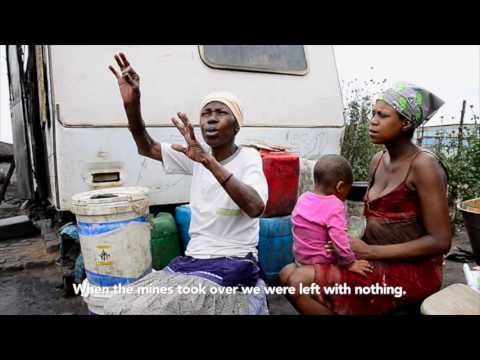
Women's rights undermined in South Africa
The population of the informal settlement Masakhane, South Africa is highly affected by the pollution and environmental damage caused by the the coal-fired Duvha power station. Before the mining and power station developments, families had access to and control over the land, even if they did not own it. Farming used to be the main source of livelihood. Today, mining companies and investors own most of the land, and as a direct consequence people have lost a lot of their farming and grazing land. This video shows testimonies of victims and their efforts to turn the tide.
-
Publication / 10 december 2018
-
 External link / 20 juli 2021
Women’s rights and Non-Timber Forest Products (Annual Report 2020)
As a source of food, water and income, and for their cultural and spiritual meaning, forests and Non-Timber Forest Products (NTFPs) help ensure community resilience. Both ENDS has a long history of collaboration with partners such as the Non-Timber Forest Products Exchange Programme (NTFP-EP) and Keystone Foundation, which support forest communities in promoting the NTFP concept for forest conservation and livelihood enhancement.
-
 News / 2 juli 2019
Indonesia: Women’s Right to Water
The water quality of East Java's largest river, the Brantas River, is increasingly deteriorating due to a combination of industrial and household waste. This environmental pollution has a disproportionate impact on women. Yet, their participation in decision-making remains lacking. ECOTON is working to improve the situation.
-
 External link / 19 juni 2020
Connecting women’s rights and IFI experts (Annual Report 2019)
When destructive projects are seen through the eyes of local women, it is clear that International financial Institutions (IFIs) are one piece of a large and complicated puzzle. Therefore, in 2019 we brought together experts in women's rights and IFIs to learn from each other.
-
 Video / 14 juni 2018
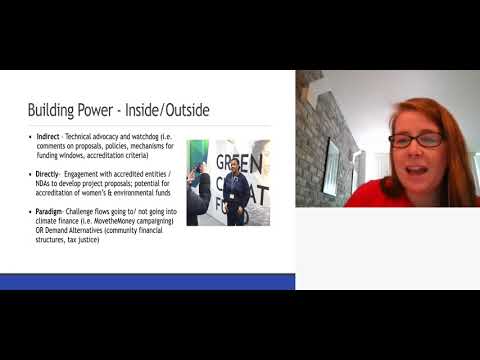
Webinar series: women’s rights and climate finance, #4
The fourth webinar of a five part series on women's rights and climate finance: Strategies for Organizing to Influence, Monitor, and Track Climate Finance (from Global to Local), focused on strategies to engage with various actors to both facilitate and advocate for the meaningful inclusion of the perspectives and experiences of women's groups, affected communities, and other civil society stakeholders in the design and implementation of projects and programs.
-
 Video / 7 maart 2018
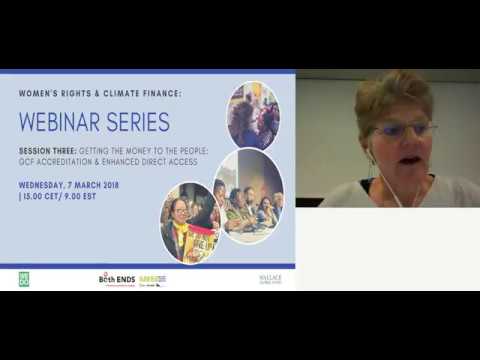
Webinar series: women’s rights and climate finance, #3
The third session of our five part series on women's rights and climate finance, Getting the Money to the People: GCF Accreditation and Enhanced Direct Action, focused on accessing the Green Climate Fund through working with stakeholders at the country level (engaging with the National Designated Authority), utilizing Enhanced Direct Access, and seeking accreditation.
-
 Video / 1 februari 2018
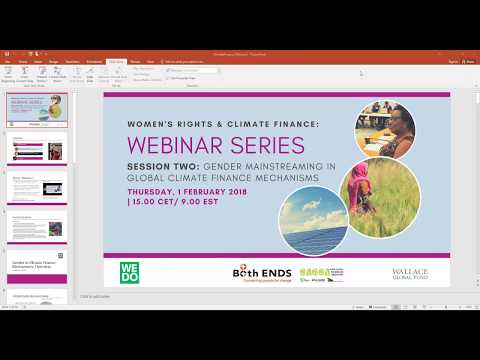
Webinar series: women’s rights and climate finance, #2
The second session of our five part series on women's rights and climate finance, Gender Mainstreaming in Climate Finance Mechanisms, provided an overview of how gender equality has been mainstreamed into global climate finance mechanisms, including a deep dive on gender considerations under the Green Climate Fund by Liane Schalatek of the Heinrich Boell Foundation - North America.
-
 Video / 14 december 2017
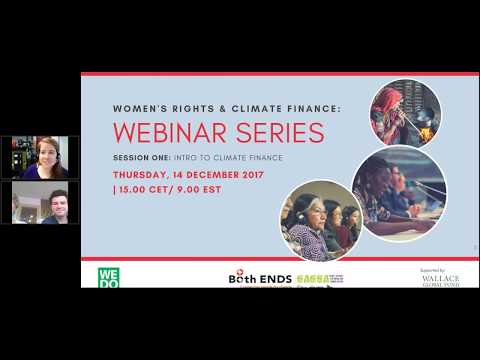
Webinar series: women’s rights and climate finance, #1
This Introduction to Climate Finance is the first of a five part series on women's rights and climate finance, aiming to build knowledge and power to ensure finance flows are benefiting local women's groups, responding to community needs and respecting human rights. This session will outline the climate finance landscape, as well as the key challenges and opportunities we hope to explore in this webinar series.
-
 Video / 28 augustus 2018
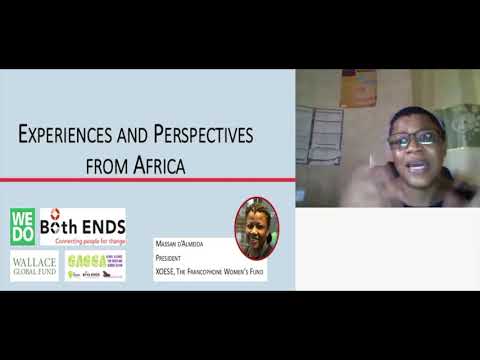
Webinar series: women’s rights and climate finance, #5
The fifth session of our five part series on women's rights and climate finance, Experiences and Perspectives of Women Engaging in Climate Finance, shared the insights of three activists who have been serving as GCF Monitors as part of the "Women Demand 'Gender-Just' Climate Finance" initiative. They spoke about their processes of learning about climate finance and connecting with others to monitor climate finance in their communities and regions, discussed the value they have found in this work, and answered questions from webinar participants.
-
 External link / 31 mei 2018
Harnessing the power of the women’s rights and environmental justice movements (Annual Report 2017)
It was minus 20 degrees Celsius when 2.000 women gathered at the main square of Ulaanbaatar, Mongolia, to voice their distress about the terrible smog in the city caused by three large power plants. Soon after, the women were invited to speak about the problem of air pollution with the minister of environment.
-
 Event / 14 juni 2018, 15:00 - 17:00
Webinar: Strategies For Organizing To Influence, Monitor And Track Climate Finance
Join us for the fourth session of this five-part series on women's rights and climate finance, aimed at building knowledge and power to ensure finance flows benefit local women's groups, respond to community needs and respect human rights. The webinar will be conducted in English with simultaneous translation in Spanish and French.
-
 Dossier /
Global Alliance for Green and Gender Action (GAGGA)
GAGGA rallies the collective power of the women's rights and environmental justice movements to realize a world where women can and do access their rights to water, food security, and a clean, healthy and safe environment.
-
 News / 4 maart 2025
Feminist March 2025: let's take to the streets for gender justice
Women's rights are under pressure worldwide, and hard-fought rights and freedoms are being dismantled. Whereas until recently the Netherlands was a champion of emancipation, women's rights and gender justice, the current cabinet is breaking with this policy and abandoning millions of women and girls. That is why Both ENDS, together with many other allies, will be taking to the streets on 8 March. It is time to make a strong stand against the dismantling of gender policy and to stand up for gender equality and social justice.
-
Publication / 26 november 2020
-
Letter / 19 oktober 2022
Both ENDS' input to the 'Consultation Feminist Foreign Policy' of Ministry of Foreign AffairsZa
In May 2022, Minister Hoekstra of Foreign Affairs and Minister Schreinemacher for International Trade and Development Cooperation announced that also The Netherlands will work towards implementing a Feminist Foreign Policy (FFP). This means that within its Foreign Policy, the Netherlands will pay more attention to inclusivity in general and specifically to women's rights and gender equality, including LGBTIQ+. This feminist lens will be central to all aspects of foreign policy; security, trade, diplomacy and international cooperation.
To foster an inclusive process and acquire insights in what a Dutch FFP should look like, the Ministry of Foreign Affairs opened an internet consultation. Both ENDS welcomes the FFP and therefore gladly shares its input and suggestions.
-
 News / 8 maart 2017
International Women's day is still urgently needed
Today is International Women's Day. A day originating from women's strikes against poor working conditions in the textile industry, some 100 years ago. Since then, a lot has improved for women but, unfortunately, men and women obviously still don’t have equal rights. In 1949, Simone de Beauvoir already warned that ‘women’s rights will never be vested. You have to stay vigilant your whole life’. Recent developments such as the tightening of abortion laws in some countries confirm this view and show that even in the ‘free West’ women’s rights are still far from self-evident.
-
 News / 15 oktober 2018
Analog Forestry: empowering women and restoring forests
Last September, approximately 30 women and men from community based organizations of Honduras and El Salvador learned the tool of analog forestry which uses natural forests as guides to create ecologically stable and socio-economically productive landscapes.
-
 News / 7 augustus 2018
Indigenous women fight dams in Guatemala
Communities from Northern Guatemala have filed a complaint this week against the Inter-American Development Bank (IDB). They bear the brunt of the construction of two large hydropower dams in the Ixquisis region, that are co-financed by the IDB. This is against the bank's own policies on environment and sustainability, indigenous people, gender, and information disclosure.


