Women at the frontlines of climate action: local power for global change
By
Tamara Mohr
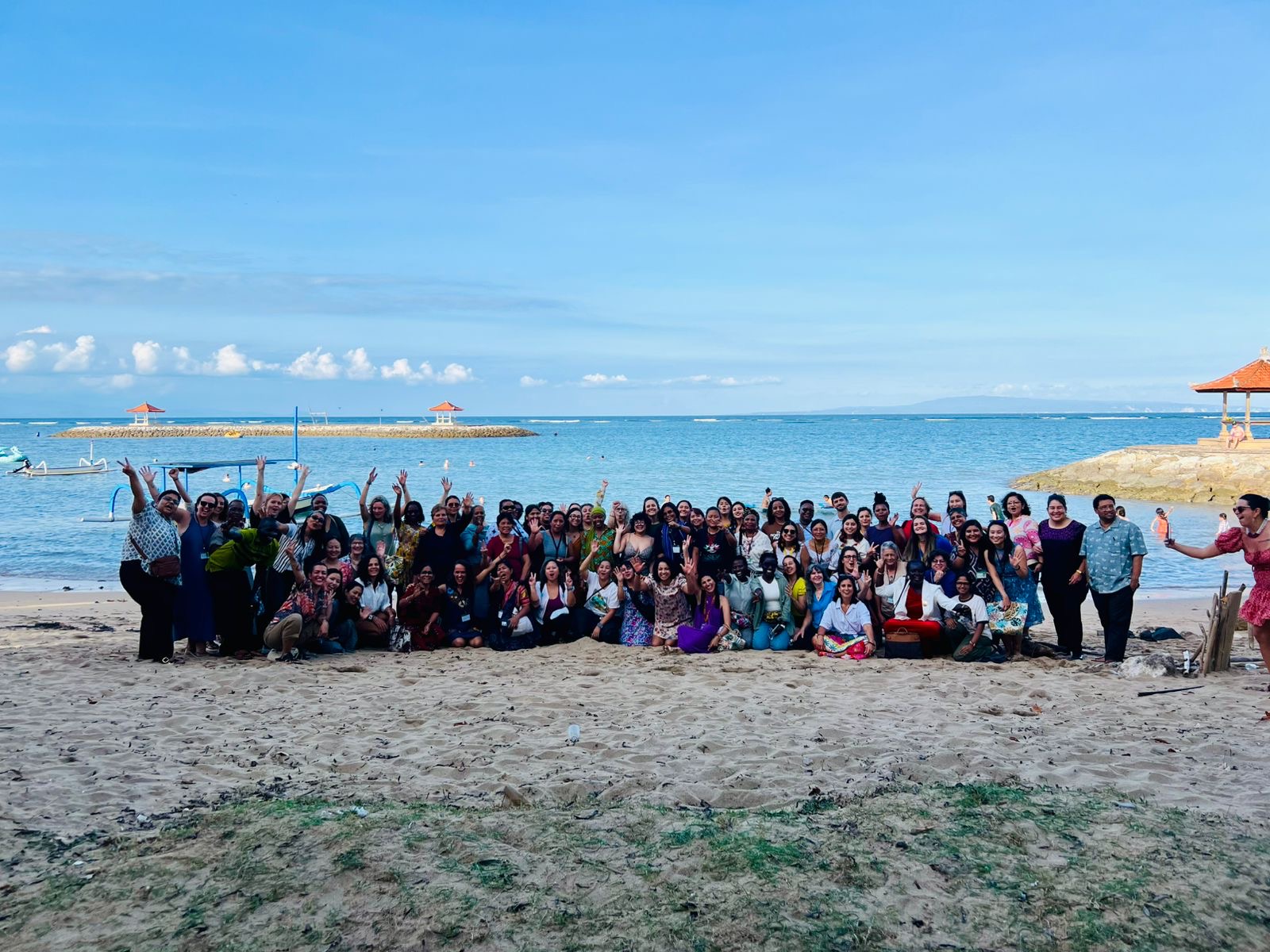
Last week, GAGGA, the Global Alliance for Green and Gender Action, with Both ENDS as one of the Alliance members, together with FCAM and Mama Cash, organised its Global Meeting in Indonesia. The goal of this meeting was to recognise, celebrate and look ahead at cross-movement and cross-regional connections, to strengthen the collective power of gender, climate and environmental justice movements.
We welcomed 80 partners from 27 countries around the world. 96% of them were girls, women, and trans, intersex and non-binary people. They represent community-based organisations, non-governmental organisations, environmental justice groups and women’s funds working at the forefront of the intersection between women’s rights, and environmental and climate justice.
Shared struggles and strategies
It was amazing to see, hear and feel the strength, commitment and resilience of this group that is so diverse, yet so aligned in their struggles, strategies and proposals. Both ENDS has been engaging with some of them for more than the 10 years of GAGGA. Others I met for the first time, including community-based organisations from Ecuador, Peru, Mozambique and India, women who have strengthened their knowledge, actions and solutions related to climate change.
In our discussions on the impact of their work over the past years, many realised they tend to underestimate what they have already achieved, simply because there is still so much more to do. But achieving local climate policy changes, budget allocations, improved or new legislation, or the protection and restoration of forests and mangroves takes many years.
Women become leaders
GAGGA shows us that the impact of the work of these women is on another level. It is essential for long-term change at the intersection of women’s rights and environmental and climate justice. Women are realising the role they can play. They gain strength, become leaders, connect with other groups to jointly build knowledge, grow confident in decision-making processes and mobilise their communities.
It starts at the local level, in their communities and in their municipalities. They speak out, share ideas, and lead by example. Many women told me how they were not taken seriously before, but are now approached as a reference. Their contributions are requested at all levels. They are seen, respected, and they cannot be ignored.
That, to me, is the foundation for system change. These women are growing stronger with every step. They speak directly with donors, institutions and governments. And all of this takes time. It requires the kind of long-term, flexible support that GAGGA provides.
As one of the partners beautifully said during the meeting: “When women are strong, it is also a form of self-care and protection among each other, collective care. We cannot move forward alone. We have resisted men and they have realised that we are strong, and now they are looking for women as allies.”
From local solutions to global influence
Supporting these powerful local groups and linking their struggles and solutions to global-level policymaking has led to key achievements. These range from the withdrawal of development banks from harmful dam projects and efforts to ensure a responsible exit, to the prevention of new mining projects, avoiding further harm to the environment and communities. Existing and new climate initiatives have also been improved as a result of women’s leadership. One powerful example is the promotion of gender-just climate solutions such as Analog Forestry, now supported by more than 40 women across the globe who lead ecological restoration efforts.
The role of GAGGA and Both ENDS
GAGGA’s and Both ENDS’ key role lies in both financial and non-financial support to women’s rights and environmental justice groups working on climate-related issues. For many groups, the support provided by GAGGA, flexible and long-term, is the only funding with these essential characteristics. Most other funding is tied to fixed themes or predefined activities, which is difficult to manage in a world where change is constant.
Beyond funding, GAGGA creates space for learning and exchange. The conversations at the Global Meeting made clear there is a huge appetite to learn from one another. Both ENDS also brings in advocacy expertise, helping to shape and implement joint agendas with partners. For example, over the past ten years, Both ENDS and partners have successfully advocated for increased local access to funding from the Green Climate Fund, which currently fails to reach the grassroots level.
Furthermore, GAGGA promotes gender-just climate solutions that deserve far more visibility, political recognition and financial support, because these are real climate solutions.
A commitment to continue
I am aware that these are challenging times. But experiencing the dynamics, the proposals and the energy at the Global Meeting gives me a renewed sense of commitment and responsibility. We must search for all possible ways to continue, expand and deepen this work.
Because for me, this is the perfect example of what Both ENDS aims to achieve: Connecting People for Change.
For more information
Read more about this subject
-
 Dossier /
Global Alliance for Green and Gender Action (GAGGA)
GAGGA rallies the collective power of the women's rights and environmental justice movements to realize a world where women can and do access their rights to water, food security, and a clean, healthy and safe environment.
-
 News / 27 October 2026
Both ENDS at COP31: Locally led climate finance and gender-just climate action
At COP31, Both ENDS advocates for climate finance that reaches women-led and community-based organisations at the forefront of climate action, while challenging the economic rules that obstruct the transition away from fossil fuels. Together with partners in the Global Alliance for Green and Gender Action (GAGGA) and the PAPeS programme, we push for locally led adaptation, gender-just climate action and greater accountability for governments and companies.
We asked our colleagues Daan Robben and Fernando Hernandez why they are going to COP31, what messages they want to bring to negotiators, and what a positive outcome would look like.
-
 News / 25 October 2026
Meet Sarah Adongo: “The soil remembers those who cry and defend it”
By Sarah Adongo, Lawyer, Witness Radio, Uganda
Sarah Adongo is one of the three winners of the 2026 Irene Dankelman Young Ecofeminist Award, presented on 21 October at the UN Biodiversity Conference (CBD COP17) in Yerevan, Armenia. A lawyer working with Witness Radio Uganda, Sarah works with women affected by gender-based violence and communities affected by land dispossession and large-scale investments. In this piece, she shares what the award means to her and why gender and environmental justice must go hand in hand.
-
 News / 25 October 2026
Meet Yemi Knight: “Your experience is expertise”
By Yemi Knight (they/them), Founder and Executive Director, AnchorBridge Environmental Inc., Barbados
Yemi Knight is one of the three winners of the 2026 Irene Dankelman Young Ecofeminist Award, presented on 21 October at the UN Biodiversity Conference (CBD COP17) in Yerevan, Armenia. Yemi founded AnchorBridge Environmental, a youth-led organisation that combines policy advocacy with climate education across the Caribbean. We asked them what the award means to them, what they are working on, and what they would tell other young ecofeminist leaders.
Yemi is also part of the network of the Joke Waller-Hunter Initiative, powered by Both ENDS. With a JWH grant, Yemi followed courses in Social, Environmental and Economic Impact Assessment and in Risk, Crisis and Disaster Management at the University of the West Indies, Cave Hill Campusc, as well as a Level 1A Spanish course at the Centre for Language Learning at the university’s St. Augustine Campus.
-
 News / 5 October 2026
Rural Women's Assembly wins Right Livelihood Award
We are thrilled to share that our partner the Rural Women's Assembly (RWA) is one of this year's Right Livelihood Laureates! The award, often called the "Alternative Nobel Prize", honours RWA for bringing together more than 178,000 women farmers in eleven Southern African countries. Together, these women stand up for their land, their seeds and their right to make decisions about their own lives and bodies.
-
 News / 3 September 2026
Restoring Land, Restoring Hope: Both ENDS at UNCCD COP17 in Mongolia
From 17 to 28 August, governments gathered in Ulaanbaatar, Mongolia, for COP17 of the UN Convention to Combat Desertification (UNCCD). At stake was more than how the world responds to land degradation and drought. It was also a question of who gets to shape land restoration, whose knowledge counts, and where the money goes.
-
 News / 6 July 2026
Strengthening Women's Land Rights Across the Rio Conventions
From 29 June – 2 July 2026, Tamara Mohr, GAGGA coordinator at Both ENDS participated in the 4th convening of the Women's Land Rights Initiative (WLRI) in Nairobi, Kenya.Hosted by the Robert Bosch Stiftung, TMG Research and the Huairou Commission, the event brought together grassroots organisations, (inter)national NGOs, government institutions and donors from around the world.
-
Publication / 3 July 2026
-
 Dossier /
Finance for agroecology
The lion's share of public budgets for climate, agriculture and development still goes to conventional agroindustrial projects that contribute to the current climate, food and biodiversity crises. Both ENDS and our partners are calling for a transition to agroecological practices that are people- and environment-friendly.
-
Publication / 12 May 2026
-
 News / 27 February 2026
Both ENDS strengthens the resilience of female environmental defenders worldwide thanks to multi-year contribution from the Postcode Lottery
In recent years, Both ENDS has received an additional contribution of €875,000 from the Postcode Lottery for the Autonomy & Resilience Fund (2022–2025), implemented in collaboration with the Global Alliance for Green and Gender Action (GAGGA). This support was essential because female environmental rights defenders around the world are increasingly facing climate change, repression and shrinking civil space. With this contribution, Both ENDS supports female activists and their communities with flexible, trust-based funding, enabling them to develop their own solutions to urgent environmental and climate problems.
-
 Dossier /
Agua Zarca: indigenous fight against dam costs lives
Indigenous Hondurans are resisting the construction of the Agua Zarca hydrodam. Their fight has cost several lives, including that of Berta Cáceres. After considerable public pressure, Dutch development bank FMO withdrew from the project.
-
 Environmentally Just Practice /
A Negotiated Approach for Inclusive Water Governance
A Negotiated Approach envisages the meaningful and long-term participation of communities in all aspects of managing the water and other natural resources on which their lives depend. It seeks to achieve healthy ecosystems and equitable sharing of benefits among all stakeholders within a river basin. This inclusive way of working is an essential precondition for the Transformative Practices that are promoted by Both ENDS and partners.
-
 Environmentally Just Practice /
Non-Timber Forest Products (NTFPs)
About one in every six people, particularly women, directly rely on forests for their lives and livelihoods, especially for food. This shows how important non-timber forest products (NTFPs) and forests are to ensure community resilience. Not only as a source of food, water and income, but also because of their cultural and spiritual meaning.
-
 News / 5 November 2025
Interview: Both ENDS at COP30 for Climate Justice and Systemic Change
Both ENDS is present at COP30 to advocate for genuine access to climate finance for locally led, gender-just climate solutions and the mechanisms that facilitate this, including those for farmer-led restoration. Furthermore, the organisation participates to ensure the crucial connection between the climate negotiations and the trade and investment frameworks that shape them.
Learn more about the Both ENDS team at COP30 below, and find all the activities and side-events in which Both ENDS will participate.
-
 News / 5 November 2025
Overview of Both ENDS events at COP30 in Belem, Brazil
Both ENDS is present at COP30 to advocate for genuine access to climate finance for locally led, gender-just climate solutions, and for the mechanisms that make these possible, including those supporting farmer-led restoration. The organisation also engages to highlight the crucial connection between climate negotiations and the trade and investment frameworks that shape them.
Below is an overview of the Both ENDS team at COP30 and a detailed look at the activities and side-events in which Both ENDS will participate.
-
Publication / 9 October 2025
-
 News / 6 October 2025
From Entebbe to Accra: civil society is rewriting the rules of investment
By Fernando Hernández Espino and Bart-Jaap Verbeek
Almost a year after African civil society gathered in Uganda to adopt the Entebbe Declaration, the call to transform international investment governance continues to gain strength. From the 6th to the 9th of October, over 50 civil society organisations from across West Africa, including from Ghana, Senegal, Nigeria, Côte d’Ivoire, Cameroon, Gambia, Sierra Leone, as well as from Kenya and Latin America, are convening in Accra to deepen and operationalise the Declaration’s vision.
-
Publication / 2 October 2025
-
 Dossier /
Soy: trade in deforestation
The rising demand for soy is having negative consequences for people and the environment in South America. Both ENDS reminds Dutch actors in the soy industry of their responsibilities and is working with partners on fair and sustainable alternatives.