




Unemployed Youth Regain their Pride as City Farmers: Green rooftops in Cairo
Unemployed Youth Regain their Pride as City Farmers: Green rooftops in Cairo
The Cairo House, that is Emad Adly's first thought when we ask him about his dreams. A dream that has become a reality, though it was later nipped in the bud by the authorities.
An ecocentre, where Cairo's youth could learn to deal with the urban setting in an environmentally friendly manner. A catalyst for the necessary transformation of Egyptian society in a sustainable direction. That was Adly's aim with the Cairo House. Courses on efficient water management, renewable energy and sustainable building; demonstration projects and leadership trainings; debates about the future: it was all going to come together in the new centre. By Western standards, this doesn't sound overly revolutionary, but in the Egypt under the old regime it was. The new building made of sustainable materials was located on the border of the Christian and Jewish neighbourhoods in the old centre. For Adly, the Cairo House symbolised the new Egypt: an inspirational meeting place to build a shared vision of the future. "That is what Egypt needs: a shared dream, a vision of where we want to go. This is how we can step into the future together with the young generations."
Dangerous dreams, the authorities concluded, and they took over the Cairo House before its official inauguration. The centre became part of the Ministry of the Environment and now houses public servants. "It is no longer the ideal place for changes in behaviour and inspiration," says Adly, who claims he has been "literally ill" for a long time because of this state of affairs. A good friend of his who works for the government explained that the independent centre's success posed a threat. People were saying: those activists are doing better than the government. That was unacceptable, and so the authorities took over. Adly: "I told them: you have to create your own dreams, not take away those of others."
Effervescent Cairo
To no avail - the Cairo House dream fell apart. Adly found new inspiration in the Egyptian Revolution, the successful uprising of mainly young people. Many changes still need to be made in the country, but the seed of revolution has been planted and will bear fruit. The visible result today is that young people have regained their self-confidence, which had been paralysed until recently by the hopelessness of their situation. Cairo is bubbling with many new initiatives, many of which focus on the introduction of urban agriculture and horticulture in the metropolis. Youth organisation AOYE (Arab Office for Youth and Environment) - which Emad Adly created when he was a student together with some fellow students - is hosting the GEF Small Grants Programme that is experimenting with this initiative and has a couple of demonstration projects. Under the name Food Sovereignty Project, they work with another group of young people to spread knowledge, e.g., through an online platform where aspiring and beginning city farmers can exchange experiences and tips. The goal, they say, is to break through the city dwellers' dependence on the poorly regulated commercial agriculture, horticulture and food industries, and, in turn, to reconnect the people who live in the densely populated city neighbourhoods to Mother Earth.
Greenies, or hippies, yearning for a time that will never return? Not at all, Adly insists. He talks about creative and promising initiatives. In the background stands the debate surrounding food security for the rapidly growing Egyptian population. The country largely depends on one single water source, the Nile River. Adly: "The current situation is that there's not enough water to satisfy the needs of 85 million Egyptians. So what will happen in the future, when there are 100, 120 or even up to 150 million inhabitants? We must get to work at once or things will go terribly wrong." He is looking for solutions in three directions: education, a mix of traditional values and new techniques such as drip irrigation and urban agriculture, and intensive cooperation amongst the Nile governorates.
A Gift from God
So how will all this pan out in, say, 20 years from now? Adly outlines well-organised societies, based on strong local communities that make optimal use of the natural resources such as water and fertile soils. In the Nile Commission, the river governorates work closely together, following the model of the European Union (Adly adds laughing: "Though without the euro"). 'One Nile, One Family', is their slogan. This strong state community - which cannot be compared to the current, relatively powerless consultative body - shares the Nile water equitably. There is enough for everyone. It is clear that agriculture, which from time immemorial has been using some 80 percent of the available water, can manage with much less. The starting point is to maximise reuse. By applying techniques such as drip irrigation, the farmers no longer waste water. They know that water is a gift from God.
One of the characteristics of the new society is the dominant mix of traditional values and state-of-the-art technologies. They work very well together, says Adly. "There are no contradictions whatsoever between the values and ethics of an Arab Muslim society and new techniques and initiatives. They go hand in hand." Is it not the Koran that stresses the need for carefully managing vulnerable natural resources such as soil and water, and for sparing nature? And the Holy Book is also clear on the use of new methods. Adly: "The Prophet Mohammed himself said that it is every Muslim's duty to gather new knowledge. Even if it comes from a non-Muslim country such as China. The message, in other words, is to work with everyone. In brief, the Koran can be used perfectly well when one is training local communities and working towards achieving sustainability."
Everyone takes part in the new society, Adly stresses, and everyone will receive his or her fair share. To realise this, however, it is essential that we engage the youth. They are the agents of change, a source of transformation and the engine behind revolutions. Look at the Egyptian Revolution. While it may initially be about more freedom and less corruption, in the future, the youth will fight for a more sustainable society. Their energy and skills are decisive in this struggle to be successful. In the absence of an active government, nongovernmental organisations (NGOs) have the important task of educating young people on how to discuss the challenges their country faces and developing a shared vision of the future. Adly: "Instead of being participants in a programme, they then become active players who use their skills to build a better future."
Small Companies Rent the Rooftops of Buildings
For example, people will rent rooftops as city farmers. In the new Egypt of let's say 20 years from now, young people will have mastered the art of rooftop farming. They have probably learned from young people in Gaza who, forced to do so as a result of the Israeli blockade, have started this initiative some time ago. Through their pioneering work, they have clearly shown that urban agriculture offers great promise for the entire Middle East. There are many other places in the world where people who lack space become creative, and these people also serve as a source of inspiration. Thus, the city-states of Hong Kong and Singapore are already producing 20 percent of all of the meat and vegetables they need to feed their inhabitants. And this percentage will only continue to increase, they believe. In turn, Adly is convinced that urban agriculture and horticulture in Cairo are a potential gold mine. He dreams of thousands of young people setting up small businesses and closing deals with flat owners for leasing their rooftops. Balconies, fallow land and neglected parks would be used for productive ends as well. With limited means but a dynamic exchange of experiences, poor city dwellers would be able to earn an (additional) income from growing vegetables and fruit.
Idealistic trainers from NGOs will discover that it doesn't make much sense to try to convince today's youth of the environmental benefits of urban agriculture, even though there are many. Poverty amongst the young is such that their main motivation will be earning an income. But, as the success of urban agriculture grows - Adly is convinced that at least one-quarter of the food needed to feed Cairo can be grown in this way in the future - so too will the understanding of the other benefits. The liveability of the city will improve since fewer trucks will be needed to transport fruit and vegetables from rural areas to the city, thus leading to a significant decrease in the suffocating air pollution - which is notorious in big Middle Eastern cities such as Cairo - that is a direct result of the traffic congestion. This will be further curbed by the purifying action of all those new green spaces. Urban agriculture also has a cooling effect during the hot summer days while, during the cold winter months, the green rooftops will retain the warmth. And, perhaps the most beautiful result, according to Adly, will be the return of the birds, bees and insects that abandoned the city long ago and this will be to the delight of many an inhabitant.
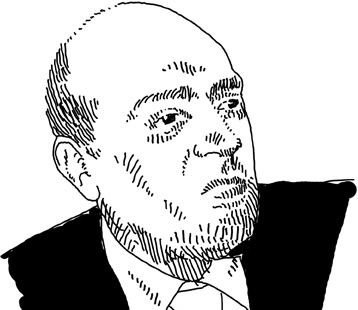
Urban agriculture is obviously not the only strategy necessary to solve all of the Middle East's problems, Adly is quick to point out. But it is an important part of the solution. "It helps the cities and their dwellers to become less dependent on industrial food production elsewhere. And it makes them more resilient. This is important, also with regarding climate change. Let's get to work fast, then, so our dream can become reality."| Emad Adly, doctor and activist While he was a first-year medical student at Cairo University, Emad Adly (1957) joined the 'medical caravans', an initiative to bring medical services to the city slums. He soon realised that the lack of hygiene and environmental problems were at the root of the most common diseases in the deprived neighbourhoods, which led to his slogan: 'Treat the causes, not the symptoms'. Ever since then, Adly has been active in environmental issues. During his student days, he helped set up the Arab Office for Youth and Environment; more than ten years later, the Arab Network for the Environment and Development followed. In 1996, Adly was one of the founders of the Mediterranean Information Office for Environment, Culture and Sustainable Development, headquartered in Athens. Like all Egyptians, Adly has a special bond with the Nile. He lived for years on the island of Manial, located in the Nile where he set up many environmental and communal projects. In 2001, this led to yet another new organisation, the Nile Basin Discourse Forum, which he has since chaired. Adly is also a member of various national and regional water organisations, and he is the national coordinator of the GEF/UNDP Small Grants Programme and the Local Initiative Facility for Urban Environment. Since the 1992 Earth Summit in Rio, he has been involved in the international discussions surrounding sustainable development. Emad Adly has written several books about the environment and sustainable development in Egypt and the Middle East, and he is the editor in chief of Montada Al Biaa (Environment Forum Newsletter) and the Sustainable Mediterranean Newsletter. |
Read more about this subject
-
 Dossier /
Dare to Trust: the power of unconditional funding
At Both ENDS we cherish our long-term relationships with partners in our global network. These relationships are based on equality and built on trust. The trust we have in each other has developed from years of strategic cooperation, including joint advocacy around common agendas, knowledge sharing, networking, and mobilising and sharing resources to advance environmental justice.
-
 Dossier /
Global Alliance for Green and Gender Action (GAGGA)
GAGGA rallies the collective power of the women's rights and environmental justice movements to realize a world where women can and do access their rights to water, food security, and a clean, healthy and safe environment.
-
 News / 5 October 2026
Rural Women's Assembly wins Right Livelihood Award
We are thrilled to share that our partner the Rural Women's Assembly (RWA) is one of this year's Right Livelihood Laureates! The award, often called the "Alternative Nobel Prize", honours RWA for bringing together more than 178,000 women farmers in eleven Southern African countries. Together, these women stand up for their land, their seeds and their right to make decisions about their own lives and bodies.
-
 News / 29 September 2026
Summary - Both ENDS complaint under the EU-New Zealand trade agreement
On 29 September 2026, Both ENDS lodged the first complaint on climate grounds with the European Commission's Single Entry Point. It asks the Commission to examine whether Aotearoa New Zealand has broken two promises both sides made in the EU-New Zealand Free Trade Agreement: not to weaken or set aside environmental laws in order to encourage trade or investment, and to effectively implement the Paris Agreement.
-
Publication / 29 September 2026
-
Publication / 29 September 2026
-
 News / 29 September 2026
Q&A: New Zealand's climate rollback and the EU trade agreement
On 29 September 2026 / 30 September in Aotearoa New Zealand, Both ENDS lodged a complaint with the European Commission under the EU-New Zealand Free Trade Agreement. These are the questions we are asked most often, and our answers. The complaint summary, the case explainer and the key public sources are linked at the end of this page.
-
 News / 29 September 2026
What happens now? A timeline of the SEP Case
What happens now? On 29 September 2026 / 30 September in Aotearoa New Zealand, Both ENDS lodged a formal complaint with the European Commission. It is the first complaint to the EU's Single Entry Point on environmental and climate grounds. It asks the Commission to hold New Zealand to two promises it made in its trade agreement with the EU: not to weaken environmental protection to encourage trade or investment, and not to undermine the Paris Agreement on climate change.
-
 Press release / 29 September 2026
New Zealand faces its first climate complaint under EU trade rules
UTRECHT / WELLINGTON, 29 September 2026 /30 September in Aotearoa New Zealand
Both ENDS, a Dutch environmental justice organisation, has lodged a formal complaint with the European Commission arguing that New Zealand has broken the climate promises it made in its free trade agreement with the European Union. It is the first complaint on environmental and climate grounds under the Commission's Single Entry Point, the mechanism that lets civil society ask the EU to enforce the sustainability commitments in its trade agreements.
-
 Dossier /
Trade agreements
International trade agreements often have far-reaching consequences not only for the economy of a country, but also for people and the environment. It is primarily the most vulnerable groups who suffer most from these agreements.
-
 News / 10 September 2026
Rutu Foundation receives UNESCO Literacy Prize for multilingual education
Both ENDS’ partner the Rutu Foundation for Intercultural Multilingual Education has been awarded the 2026 UNESCO King Sejong Literacy Prize for its language friendly school programme. This prestigious prize recognises the importance of multilingual education and the right of children to learn in an environment where their home languages are valued.
-
 News / 7 September 2026
Unprecedented criminal conviction in the Mariana disaster case breaks mining industry's cycle of impunity
A Brazilian federal court has, for the first time, criminally convicted a mining company and three of its managers for their role in the 2015 collapse of the Fundão dam, one of the worst environmental disasters in Brazil's history. Our partner Instituto Cordilheira, which represented victims as assistant prosecutors in the case, calls it a historic breakthrough after years of impunity.
-
 Dossier /
Communities Regreen the Sahel
In various countries in the Sahel, vast tracts of land have been restored by the local population by nurturing what spontaneously springs from the soil and protecting the sprouts from cattle and hazards.
-
 News / 3 September 2026
Restoring Land, Restoring Hope: Both ENDS at UNCCD COP17 in Mongolia
From 17 to 28 August, governments gathered in Ulaanbaatar, Mongolia, for COP17 of the UN Convention to Combat Desertification (UNCCD). At stake was more than how the world responds to land degradation and drought. It was also a question of who gets to shape land restoration, whose knowledge counts, and where the money goes.
-
Letter / 14 July 2026
Statement on CAO Cambodia Microfinance Case
The independent complaints mechanism of the International Finance Corporation (IFC) and the World Bank Group found that the IFC violated its own Environmental and Social Sustainability Framework by investing in six banks providing microfinance in Cambodia.
-
 News / 6 July 2026
Strengthening Women's Land Rights Across the Rio Conventions
From 29 June – 2 July 2026, Tamara Mohr, GAGGA coordinator at Both ENDS participated in the 4th convening of the Women's Land Rights Initiative (WLRI) in Nairobi, Kenya.Hosted by the Robert Bosch Stiftung, TMG Research and the Huairou Commission, the event brought together grassroots organisations, (inter)national NGOs, government institutions and donors from around the world.
-
Publication / 3 July 2026
-
 News / 2 July 2026
Land restoration can help mitigate and resolve conflict - but only if everyone has a seat at the table
Can restoring degraded land also help reduce conflict? According to experts from Niger, Ghana, the Netherlands and other regions, the answer is yes - but only when restoration is rooted in inclusive land governance, local ownership and social cohesion.
-
 Dossier /
Gas in Mozambique
In 2011 one of the world’s largest gas reserves was found in the coastal province of Cabo Delgado, in the north of Mozambique. A total of 35 billion dollars has been invested to extract the gas. Dozens of multinationals and financiers are involved in these rapid developments. It is very difficult for the people living in Cabo Delgado to exert influence on the plans and activities, while they experience the negative consequences. With the arrival of these companies, they are losing their land.
-
 Dossier /
Finance for agroecology
The lion's share of public budgets for climate, agriculture and development still goes to conventional agroindustrial projects that contribute to the current climate, food and biodiversity crises. Both ENDS and our partners are calling for a transition to agroecological practices that are people- and environment-friendly.



