




What did Both ENDS do at the World Water Forum?
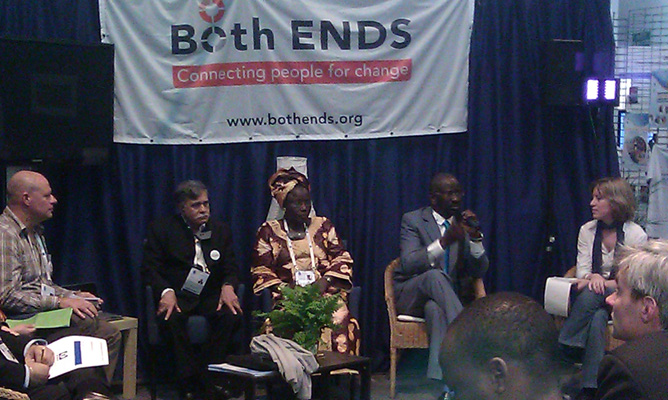
Halls filled with booths, stands, professionally set up corners, wifi-spots. Big rooms where lectures, interactive sessions and workshops are held. People from all corners of the world and from different kinds of sectors (companies, government, and social organisations) are gathering here for five days. They have one thing in common: they are talking about water. The sixth World Water Forum in Marseille is about 'solutions'. For water issues, that is. Almost a billion people worldwide have to cope without clean drinking water.
Many of the numerous NGO's that are represented have united in the 'Butterfly effect', a temporary cooperation, which gives a strong message to policy makers and companies. Through communal sessions at the forum, a common meeting spot and jointly press conferences, the message is being reinforced.
1% mechanism
But the organisations also organise individual activities. Tobias Schmitz, expert of water and sanitation at Both ENDS, is giving a couple of presentations on the so-called 1% mechanism, which enables water companies to use 1% of their profits for development projects on water and sanitation.
Dry areas
The Drynet network, in which Both ENDS is also represented, has a very important role at the WWF. Situated between the big halls of the forum terrain is a sunny square where Drynet has put up a couple of tents. Meetings are being held here and information is exchanged. When entering the tents, you feel like you're in a dessert landscape: a welcome change after the square halls on the forum terrain.
NGO's and donors
Both ENDS has also started the 'Citizens' Forum on Participatory Integrated Water Resource Management'. Here, examples of successful water management in river basins, where all stakeholders (and especially the local community) are involved and consulted are presented. After these presentations, present deputies of governments are asked the following questions: would you invest in these projects? Why or why not?
Declaration
Both ENDS has invited partner organisations from Latin-America, Africa and Asia to support and be a part of the so-called 'Declaration of Commitment'. The undersigned declare to do everything to keep applying this 'Participatory Integrated Water Resource Management' in the 15 river basins they work and to make it even more successful. Other organisations are also encouraged to commit to this promise.
Its working
Despite the early hours at which the Citizens Forum is held, it's continually visited: some observers have to stand because all the seats are taken. The examples of successful participatory water management from places like Senegal, India and Mexico, where cooperation with the (local) government is very intense, appeals very strongly to the audience. "We have similar problems, but it's good to see how others deal with it, that gives us insight in our next steps", says Jane Lingbawa of CPA from the Philippines. "They key remains information: explaining plans and problems of the area and making sure that the input of the locals is being integrated into policy making. There are a lot of different ways of doing that, and it's good to learn from each other".
Read more about this subject
-
 Environmentally Just Practice /
A Negotiated Approach for Inclusive Water Governance
A Negotiated Approach envisages the meaningful and long-term participation of communities in all aspects of managing the water and other natural resources on which their lives depend. It seeks to achieve healthy ecosystems and equitable sharing of benefits among all stakeholders within a river basin. This inclusive way of working is an essential precondition for the Transformative Practices that are promoted by Both ENDS and partners.
-
 News / 27 February 2026
Both ENDS strengthens the resilience of female environmental defenders worldwide thanks to multi-year contribution from the Postcode Lottery
In recent years, Both ENDS has received an additional contribution of €875,000 from the Postcode Lottery for the Autonomy & Resilience Fund (2022–2025), implemented in collaboration with the Global Alliance for Green and Gender Action (GAGGA). This support was essential because female environmental rights defenders around the world are increasingly facing climate change, repression and shrinking civil space. With this contribution, Both ENDS supports female activists and their communities with flexible, trust-based funding, enabling them to develop their own solutions to urgent environmental and climate problems.
-
 News / 27 November 2025
Communities and International Consortium Present Community-Led Plan for Nature-Based Adaptation to Sea-Level Rise in Coastal Bangladesh
Local communities in the southwestern coastal region of Bangladesh—together with an international consortium including Uttaran, CEGIS, and Both ENDS—have presented a community-led plan to confront climate change and accelerating sea-level rise through nature-based adaptation. The People’s Plan for Upscaling Ecosystem-Based Adaptation outlines a scalable strategy rooted in local ownership and generations of lived experience. At its centre is Community-Based Tidal River Management (CBTRM), a proven approach that reduces waterlogging, raises land elevation, and restores ecological balance by working with natural tidal and sediment dynamics.
-
 Dossier /
Wetlands without Borders
With our Wetlands without Borders program, we work towards environmentally sustainable and socially responsible governance of the wetlands system of the La Plata Basin in South America.
-
Letter / 14 November 2025
Letter: TPAC’s report “Final Judgement Detailed Research MTCS’’
A coalition of Malaysian and international NGOs has released a memorandum in response to the recent TPAC report on the Malaysian Timber Certification Scheme (MTCS). The organisations express serious concerns about the independence, quality, and credibility of the assessment carried out by the Timber Procurement Assessment Committee (TPAC).
-
Publication / 9 October 2025
-
 Dossier /
Amplifying environmentally just practices
Because of the close relationship with their living environment, local communities often have the best ideas for the sustainable and equitable use and governance of land, water and forests. These environmentally just practices and processes successfully protect and restore ecosystems and address climate change. They are essential in the light of the multiple crises the world faces, but are in dire need of financial and policy support.
-
Publication / 1 July 2025
-
 News / 23 June 2025
Who benefits from better protection of our oceans?
The ocean emerged strengthened from the UN Ocean Conference in Nice. More countries are supporting a ban on deep-sea mining, more marine protected areas are being established, and more pledges are being made to fight pollution. The question now is whether countries will follow through on their commitments. Because the ocean movement faces a camp of powerful interests.
This article was originally posted in Dutch on MO*Magazine.
-
 Dossier /
Inclusive ways to sustainable and healthy food for all
All around the world small-scale farmers are using sustainable and inclusive methods to produce food. Working together with nature and each other, they provide their families and communities with sufficient and healthy food. But their production methods are under pressure from large-scale agriculture and the globally dominant system of industrial food production. Together with our partners, Both ENDS is trying to turn the tide in favour of sustainable, local practices that are mostly known as 'agro-ecological' or 'nature-inclusive'. Why are we focusing on these methods? Agro-ecological practices are climate-proof and inclusive and increase the opportunities for communities around the world to produce their food sustainably.
-
 News / 21 March 2025
Dutch Royal couple visits Thogoto Forest: a green oasis on the outskirts of Nairobi
This week, King Willem-Alexander and Queen Máxima visited Thogoto Forest as part of their state visit to Kenya. They were able to see the impact of the work of our partner MCDI in the area: a restored forest, clean water and farmers who can earn a living by selling their agro-ecological products.
-
Publication / 16 January 2025
-
 News / 2 December 2024
Ten recommendations for the UNCCD COP16 to strengthen its efforts in combating desertification, land degradation, and drought
For decades, our local partner organisations have been developing and promoting effective ways to combat land degradation, desertification, and drought. This includes regions like the drylands, as well as forests, and wetlands. Supporting these locally-led actions is essential to reversing negative trends. For COP16, Drynet has developed 10 recommendations to strengthen the implementation of the UNCCD. Success at COP16 would mean turning these recommendations into action, fostering inclusive land governance and sustainable land management practices globally. By enabling locally-led actions—particularly those led by women, youth, pastoralists, and Indigenous Peoples—we can build a more resilient future.
-
Publication / 25 November 2024
-
 Blog / 25 November 2024
The Need for Civic Space in Global Policymaking
and Kyra Pohlan
In today’s interconnected world, international forums play a pivotal role in shaping policies and strategies that impact communities and the environment worldwide. These gatherings, whether they focus on climate change, water resources, or biodiversity, are critical venues where decisions are made that affect the lives of billions of people and species. However, for these decisions to be truly inclusive and effective, they must be informed by the voices of those most affected by climate change and environmental degradation.
-
Publication / 24 September 2024
-
 External link / 2 July 2024
 -
Publication / 2 July 2024
-
 Pathway /
Advocating for just governance worldwide
Our goal is to achieve systemic change at all levels of social, political and economic institutions, to ensure that these unconditionally respect human rights and planetary boundaries. This requires policy coherence and consistent decision-making across all sectors - from trade, finance and energy to food production, agriculture, climate action and water management - and across all sections of society - from individual to family, farm, neighbourhood, city, province and national levels.
-
 News / 5 June 2024
Appeal by 70 parties: The Netherlands’ strategy for global food security works!
A broad coalition of Dutch companies, knowledge institutes and civil society organizations wants to work together with the new government to make a real difference in improving global food security. The main focus will lie on supporting farmers and consumers in the Netherlands and beyond, and promoting climate-proof food systems in low- and middle-income countries. The coalition believes that, with our knowledge, expertise, experience and reputation for international cooperation and trade, the Netherlands must adopt an ambitious strategy for making our food systems more sustainable, and so contribute to achieving the targets in the Paris Climate Accord and the Sustainable Development Goals.




