




The Need for Civic Space in Global Policymaking
and Kyra Pohlan
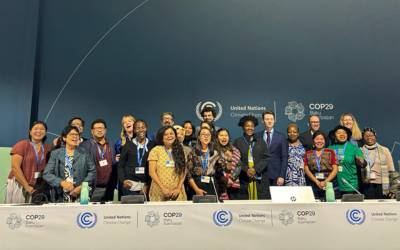
In today’s interconnected world, international forums play a pivotal role in shaping policies and strategies that impact communities and the environment worldwide. These gatherings, whether they focus on climate change, water resources, or biodiversity, are critical venues where decisions are made that affect the lives of billions of people and species. However, for these decisions to be truly inclusive and effective, they must be informed by the voices of those most affected by climate change and environmental degradation.
Civil Society Organizations (CSOs) play a crucial role in communicating global issues and linking local contexts to global debates and goals, such as the Sustainable Development Goals (SDGs). Full and meaningful participation of civil society, particularly women, Indigenous peoples, youth, and those most vulnerable to climate change, contributes to more sustainable social and environmental policies. Despite this need, the influence of CSOs in global politics remains limited. Moreover, civil society representatives often face significant barriers, exclusion, and pressure at international negotiations and conferences.
Recent events have highlighted the increasing threats to civic space at international gatherings. The People’s Water Forum (PWF) in Bali is a stark example, where CSOs and human rights representatives faced harassment, intimidation, and even physical barriers that prevented their full participation. This incident is not isolated. For example, at COP27 in Egypt in 2022, international and Egyptian civil society groups endured severe restrictions imposed by the authorities, hindering participation and leading to the arrests of journalists, activists, human rights defenders, and members of the LGBTQI+ community. Similarly, while the fossil fuel industry was largely represented at COP28 in Dubai in 2023, protests for human and environmental rights in the UAE were shut down.
Barriers to participation are not just about repression but also about access and agenda-setting. High costs, complex visa procedures, and language barriers limit the ability of CSOs, particularly those from the Global South, to attend these forums. Registration fees can be prohibitively expensive, and the lack of transparent sponsorship opportunities further restricts access. Language barriers also pose a significant challenge, as key documents and discussions are often not available in languages spoken by many grassroots organizations. Moreover, CSOs often struggle to influence the agenda-setting – both before and during international events, which are typically dominated by governments and the private sector. With limited access to the preparatory process, CSOs receive inadequate opportunities to participate and lead key discussions.
Looking ahead, it is crucial that countries like the Netherlands and other governments commit to securing and expanding civic space in upcoming international conferences, such as the Convention on Biological Diversity (CBD) COP16 (from 21 October to 1 November 2024 in Cali, Colombia), the UNFCCC COP29 (from 11 to 22 November 2024 in Baku, Azerbaijan), and the UNCCD COP16 (from 2 to 13 December 2024 in Saudi Arabia). By ensuring that CSOs have a meaningful role in agenda-setting and can participate without fear of repression or exclusion, we can work towards more equitable and effective global policies that truly reflect the needs and voices of all stakeholders.
That is why we – with contributions from (strategic) partners and publicly available documentation from civil society – have formulated a number of recommendations with the aim to secure and expand civic space in international forums.
Read the recommendations publication "A Path Towards Inclusive (Water) Fora: Proactive Measures for Succes".
For more information
Read more about this subject
-
 Environmentally Just Practice /
A Negotiated Approach for Inclusive Water Governance
A Negotiated Approach envisages the meaningful and long-term participation of communities in all aspects of managing the water and other natural resources on which their lives depend. It seeks to achieve healthy ecosystems and equitable sharing of benefits among all stakeholders within a river basin. This inclusive way of working is an essential precondition for the Transformative Practices that are promoted by Both ENDS and partners.
-
 Pathway /
Supporting a powerful civil society
Our goal is that civil society can work openly and safely, make their voices heard and influence decision-making on ecosystem challenges and matters of environmental justice and human rights. A strong civil society is indispensable to a healthy society. It checks the power of both state and corporate actors, holds decision-makers accountable, and defends the rights of those marginalised from positions of influence. A strong and independent civil society can advocate for fair and ecologically responsible policies as well as challenge structural inequalities in decision-making. It can also use accountability mechanisms to seek redress for the negative consequences of such inequitable decision-making, and instead promote, implement and upscale transformative practices.
-
 Dossier /
Dare to Trust: the power of unconditional funding
At Both ENDS we cherish our long-term relationships with partners in our global network. These relationships are based on equality and built on trust. The trust we have in each other has developed from years of strategic cooperation, including joint advocacy around common agendas, knowledge sharing, networking, and mobilising and sharing resources to advance environmental justice.
-
 Dossier /
Global Alliance for Green and Gender Action (GAGGA)
GAGGA rallies the collective power of the women's rights and environmental justice movements to realize a world where women can and do access their rights to water, food security, and a clean, healthy and safe environment.
-
 News / 29 september 2026
Summary - Both ENDS complaint under the EU-New Zealand trade agreement
On 29 September 2026, Both ENDS lodged the first complaint on climate grounds with the European Commission's Single Entry Point. It asks the Commission to examine whether Aotearoa New Zealand has broken two promises both sides made in the EU-New Zealand Free Trade Agreement: not to weaken or set aside environmental laws in order to encourage trade or investment, and to effectively implement the Paris Agreement.
-
Publication / 29 september 2026
-
 News / 29 september 2026
Q&A: New Zealand's climate rollback and the EU trade agreement
On 29 September 2026 / 30 September in Aotearoa New Zealand, Both ENDS lodged a complaint with the European Commission under the EU-New Zealand Free Trade Agreement. These are the questions we are asked most often, and our answers. The complaint summary, the case explainer and the key public sources are linked at the end of this page.
-
 News / 29 september 2026
What happens now? A timeline of the SEP Case
What happens now? On 29 September 2026 / 30 September in Aotearoa New Zealand, Both ENDS lodged a formal complaint with the European Commission. It is the first complaint to the EU's Single Entry Point on environmental and climate grounds. It asks the Commission to hold New Zealand to two promises it made in its trade agreement with the EU: not to weaken environmental protection to encourage trade or investment, and not to undermine the Paris Agreement on climate change.
-
 Press release / 29 september 2026
New Zealand faces its first climate complaint under EU trade rules
UTRECHT / WELLINGTON, 29 September 2026 /30 September in Aotearoa New Zealand
Both ENDS, a Dutch environmental justice organisation, has lodged a formal complaint with the European Commission arguing that New Zealand has broken the climate promises it made in its free trade agreement with the European Union. It is the first complaint on environmental and climate grounds under the Commission's Single Entry Point, the mechanism that lets civil society ask the EU to enforce the sustainability commitments in its trade agreements.
-
 News / 10 september 2026
Rutu Foundation receives UNESCO Literacy Prize for multilingual education
Both ENDS’ partner the Rutu Foundation for Intercultural Multilingual Education has been awarded the 2026 UNESCO King Sejong Literacy Prize for its language friendly school programme. This prestigious prize recognises the importance of multilingual education and the right of children to learn in an environment where their home languages are valued.
-
 Dossier /
Communities Regreen the Sahel
In various countries in the Sahel, vast tracts of land have been restored by the local population by nurturing what spontaneously springs from the soil and protecting the sprouts from cattle and hazards.
-
 News / 3 september 2026
Restoring Land, Restoring Hope: Both ENDS at UNCCD COP17 in Mongolia
From 17 to 28 August, governments gathered in Ulaanbaatar, Mongolia, for COP17 of the UN Convention to Combat Desertification (UNCCD). At stake was more than how the world responds to land degradation and drought. It was also a question of who gets to shape land restoration, whose knowledge counts, and where the money goes.
-
Letter / 14 juli 2026
Statement on CAO Cambodia Microfinance Case
The independent complaints mechanism of the International Finance Corporation (IFC) and the World Bank Group found that the IFC violated its own Environmental and Social Sustainability Framework by investing in six banks providing microfinance in Cambodia.
-
Publication / 3 juli 2026
-
 News / 2 juli 2026
Land restoration can help mitigate and resolve conflict - but only if everyone has a seat at the table
Can restoring degraded land also help reduce conflict? According to experts from Niger, Ghana, the Netherlands and other regions, the answer is yes - but only when restoration is rooted in inclusive land governance, local ownership and social cohesion.
-
 Dossier /
Finance for agroecology
The lion's share of public budgets for climate, agriculture and development still goes to conventional agroindustrial projects that contribute to the current climate, food and biodiversity crises. Both ENDS and our partners are calling for a transition to agroecological practices that are people- and environment-friendly.
-
Publication / 12 mei 2026
-
Publication / 10 april 2026
-
 News / 10 april 2026
Both ENDS: strengthened FMO complaints mechanism is a step forward, but major gaps remain
Both ENDS welcomes the strengthened Independent Complaints Mechanism (ICM) of development finance institutions FMO, DEG and Proparco as an important step forward in accountability. Working directly with communities affected by development projects, we see daily how essential it is that people can access justice when they are harmed in the name of development. For many communities, this mechanism is one of the few avenues through which harm can be formally recognised and addressed in relation to these development banks.
-
 News / 9 april 2026
Minister Sjoerdsma hosts roundtable conversations with civil society
This week, Minister Sjoerdsma organized roundtable conversations with civil society organizations – a valuable initiative that brings together Dutch civil society voices to address critical challenges faced by democratic societies.




