




The Need for Civic Space in Global Policymaking
and Kyra Pohlan
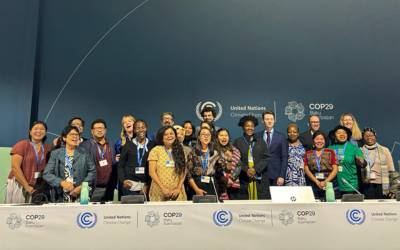
In today’s interconnected world, international forums play a pivotal role in shaping policies and strategies that impact communities and the environment worldwide. These gatherings, whether they focus on climate change, water resources, or biodiversity, are critical venues where decisions are made that affect the lives of billions of people and species. However, for these decisions to be truly inclusive and effective, they must be informed by the voices of those most affected by climate change and environmental degradation.
Civil Society Organizations (CSOs) play a crucial role in communicating global issues and linking local contexts to global debates and goals, such as the Sustainable Development Goals (SDGs). Full and meaningful participation of civil society, particularly women, Indigenous peoples, youth, and those most vulnerable to climate change, contributes to more sustainable social and environmental policies. Despite this need, the influence of CSOs in global politics remains limited. Moreover, civil society representatives often face significant barriers, exclusion, and pressure at international negotiations and conferences.
Recent events have highlighted the increasing threats to civic space at international gatherings. The People’s Water Forum (PWF) in Bali is a stark example, where CSOs and human rights representatives faced harassment, intimidation, and even physical barriers that prevented their full participation. This incident is not isolated. For example, at COP27 in Egypt in 2022, international and Egyptian civil society groups endured severe restrictions imposed by the authorities, hindering participation and leading to the arrests of journalists, activists, human rights defenders, and members of the LGBTQI+ community. Similarly, while the fossil fuel industry was largely represented at COP28 in Dubai in 2023, protests for human and environmental rights in the UAE were shut down.
Barriers to participation are not just about repression but also about access and agenda-setting. High costs, complex visa procedures, and language barriers limit the ability of CSOs, particularly those from the Global South, to attend these forums. Registration fees can be prohibitively expensive, and the lack of transparent sponsorship opportunities further restricts access. Language barriers also pose a significant challenge, as key documents and discussions are often not available in languages spoken by many grassroots organizations. Moreover, CSOs often struggle to influence the agenda-setting – both before and during international events, which are typically dominated by governments and the private sector. With limited access to the preparatory process, CSOs receive inadequate opportunities to participate and lead key discussions.
Looking ahead, it is crucial that countries like the Netherlands and other governments commit to securing and expanding civic space in upcoming international conferences, such as the Convention on Biological Diversity (CBD) COP16 (from 21 October to 1 November 2024 in Cali, Colombia), the UNFCCC COP29 (from 11 to 22 November 2024 in Baku, Azerbaijan), and the UNCCD COP16 (from 2 to 13 December 2024 in Saudi Arabia). By ensuring that CSOs have a meaningful role in agenda-setting and can participate without fear of repression or exclusion, we can work towards more equitable and effective global policies that truly reflect the needs and voices of all stakeholders.
That is why we – with contributions from (strategic) partners and publicly available documentation from civil society – have formulated a number of recommendations with the aim to secure and expand civic space in international forums.
Read the recommendations publication "A Path Towards Inclusive (Water) Fora: Proactive Measures for Succes".
For more information
Read more about this subject
-
 Environmentally Just Practice /
A Negotiated Approach for Inclusive Water Governance
A Negotiated Approach envisages the meaningful and long-term participation of communities in all aspects of managing the water and other natural resources on which their lives depend. It seeks to achieve healthy ecosystems and equitable sharing of benefits among all stakeholders within a river basin. This inclusive way of working is an essential precondition for the Transformative Practices that are promoted by Both ENDS and partners.
-
 Pathway /
Supporting a powerful civil society
Our goal is that civil society can work openly and safely, make their voices heard and influence decision-making on ecosystem challenges and matters of environmental justice and human rights. A strong civil society is indispensable to a healthy society. It checks the power of both state and corporate actors, holds decision-makers accountable, and defends the rights of those marginalised from positions of influence. A strong and independent civil society can advocate for fair and ecologically responsible policies as well as challenge structural inequalities in decision-making. It can also use accountability mechanisms to seek redress for the negative consequences of such inequitable decision-making, and instead promote, implement and upscale transformative practices.
-
 Dossier /
Global Alliance for Green and Gender Action (GAGGA)
GAGGA rallies the collective power of the women's rights and environmental justice movements to realize a world where women can and do access their rights to water, food security, and a clean, healthy and safe environment.
-
 News / 27 februari 2026
Both ENDS strengthens the resilience of female environmental defenders worldwide thanks to multi-year contribution from the Postcode Lottery
In recent years, Both ENDS has received an additional contribution of €875,000 from the Postcode Lottery for the Autonomy & Resilience Fund (2022–2025), implemented in collaboration with the Global Alliance for Green and Gender Action (GAGGA). This support was essential because female environmental rights defenders around the world are increasingly facing climate change, repression and shrinking civil space. With this contribution, Both ENDS supports female activists and their communities with flexible, trust-based funding, enabling them to develop their own solutions to urgent environmental and climate problems.
-
 News / 17 februari 2026
Civic space at the frontlines: "Build strong coalitions and counter repressive regimes"
Today, we look back on an inspiring event Civic space at the frontlines -
Environmental Defenders and the Role of International Trade and Investment Policy. The panel exist of Michel Forst, UN Special Rapporteur Environmental Defenders under the Aarhus Convention, Suzanne Kröger, Member of Parliament for GroenLinks–PvdA, Dr. Margit van Wessel, Associate Professor at Wageningen University, Anne de Jonghe, policy advisor at Both ENDS, and Jonila Castro, national spokesperson for Kalikasan People's Network for the Environment. With an audience of CSO experts, academics, accountability experts and students we discussed the effects of Dutch economic activity on Environmental Defenders, and what we all can do to support those on the front lines of the fight for the environment and human rights. -
Event / 26 januari 2026
Civic space at the frontlines
Environmental Defenders and the Role of International Trade and Investment Policy
Both ENDS invites you to an interactive dialogue with experts from the UN, policy, academia, and civil society on environmental defenders and international trade. Together, we will explore how citizens, policymakers, academics, and activists can defend civic space and support those on the frontlines of environmental and human rights struggles. With a focus on the Netherlands’ role in international trade and investment policy, and drawing on the experiences of activists from the Philippines, the event aims to foster solidarity and identify strategic priorities to better protect environmental defenders amid the global crackdown on civic space
-
Publication / 27 november 2025
-
 News / 27 november 2025
Communities and International Consortium Present Community-Led Plan for Nature-Based Adaptation to Sea-Level Rise in Coastal Bangladesh
Local communities in the southwestern coastal region of Bangladesh—together with an international consortium including Uttaran, CEGIS, and Both ENDS—have presented a community-led plan to confront climate change and accelerating sea-level rise through nature-based adaptation. The People’s Plan for Upscaling Ecosystem-Based Adaptation outlines a scalable strategy rooted in local ownership and generations of lived experience. At its centre is Community-Based Tidal River Management (CBTRM), a proven approach that reduces waterlogging, raises land elevation, and restores ecological balance by working with natural tidal and sediment dynamics.
-
 Dossier /
Wetlands without Borders
With our Wetlands without Borders program, we work towards environmentally sustainable and socially responsible governance of the wetlands system of the La Plata Basin in South America.
-
Letter / 14 november 2025
Letter: TPAC’s report “Final Judgement Detailed Research MTCS’’
A coalition of Malaysian and international NGOs has released a memorandum in response to the recent TPAC report on the Malaysian Timber Certification Scheme (MTCS). The organisations express serious concerns about the independence, quality, and credibility of the assessment carried out by the Timber Procurement Assessment Committee (TPAC).
-
 Dossier /
Communities Regreen the Sahel
In various countries in the Sahel, vast tracts of land have been restored by the local population by nurturing what spontaneously springs from the soil and protecting the sprouts from cattle and hazards.
-
 News / 5 november 2025
Overview of Both ENDS events at COP30 in Belem, Brazil
Both ENDS is present at COP30 to advocate for genuine access to climate finance for locally led, gender-just climate solutions, and for the mechanisms that make these possible, including those supporting farmer-led restoration. The organisation also engages to highlight the crucial connection between climate negotiations and the trade and investment frameworks that shape them.
Below is an overview of the Both ENDS team at COP30 and a detailed look at the activities and side-events in which Both ENDS will participate.
-
 News / 23 oktober 2025
TotalEnergies financiers beware: EACOP is eating up money, nature and livelihoods
A new analysis shows that the developers of the East African Crude Oil Pipeline, led by France’s TotalEnergies, are being forced to self-finance the project almost entirely. The analysis, part of a new Finance Risk Updatefrom a coalition of African and International civil society organisations, shows that the companies have abandoned plans to raise 60% of the project’s growing costs from bank loans, and are now on the hook for almost 90% of the costs themselves.
-
Publication / 9 oktober 2025
-
 Dossier /
International trade and investment with respect for people and planet
The network of international trade and investment treaties is large and complex. The Netherlands alone has signed more than 70 bilateral investment treaties (BITs) and is party to the trade and investment agreements concluded by the EU, like the EU-Mercosur and EU-Indonesia trade deals.
-
 Dossier /
Amplifying environmentally just practices
Because of the close relationship with their living environment, local communities often have the best ideas for the sustainable and equitable use and governance of land, water and forests. These environmentally just practices and processes successfully protect and restore ecosystems and address climate change. They are essential in the light of the multiple crises the world faces, but are in dire need of financial and policy support.
-
 News / 6 oktober 2025
From Entebbe to Accra: civil society is rewriting the rules of investment
By Fernando Hernández Espino and Bart-Jaap Verbeek
Almost a year after African civil society gathered in Uganda to adopt the Entebbe Declaration, the call to transform international investment governance continues to gain strength. From the 6th to the 9th of October, over 50 civil society organisations from across West Africa, including from Ghana, Senegal, Nigeria, Côte d’Ivoire, Cameroon, Gambia, Sierra Leone, as well as from Kenya and Latin America, are convening in Accra to deepen and operationalise the Declaration’s vision.
-
Publication / 2 oktober 2025
-
 News / 22 september 2025
EU-Indonesia Trade Deal Threatens Communities and Environment
On September 23th the European Union and Indonesia concluded their negotiations of the EU-Indonesia Comprehensive Economic Partnership Agreement (CEPA), a free trade agreement between the EU and Indonesia. Both ENDS condemns this agreement for favoring corporate interests over those of local communities and the environment.
-
 Dossier /
Towards a socially and environmentally just energy transition
To address the climate crisis we need to urgently transition away from fossil fuels towards clean, renewable energy. However, this transition is not only about changing energy sources. It requires an inclusive and fair process that tackles systemic inequalities and demanding consumption patterns, prioritizes environmental and social justice, and which does not repeat mistakes from the past.



