Is the Netherlands insuring a controversial gas extraction project in Mozambique?
At the end of last week, oil and gas company Total announced that, through its export credit insurer Atradius DSB, the Dutch government is participating in a funding package for a controversial gas extraction project in Mozambique. The project, in which various Dutch and foreign companies are involved, is having a deep impact on the local population and the natural environment in the area. Which Dutch companies the government will be insuring is not yet clear.
Fishers and farmers already affected
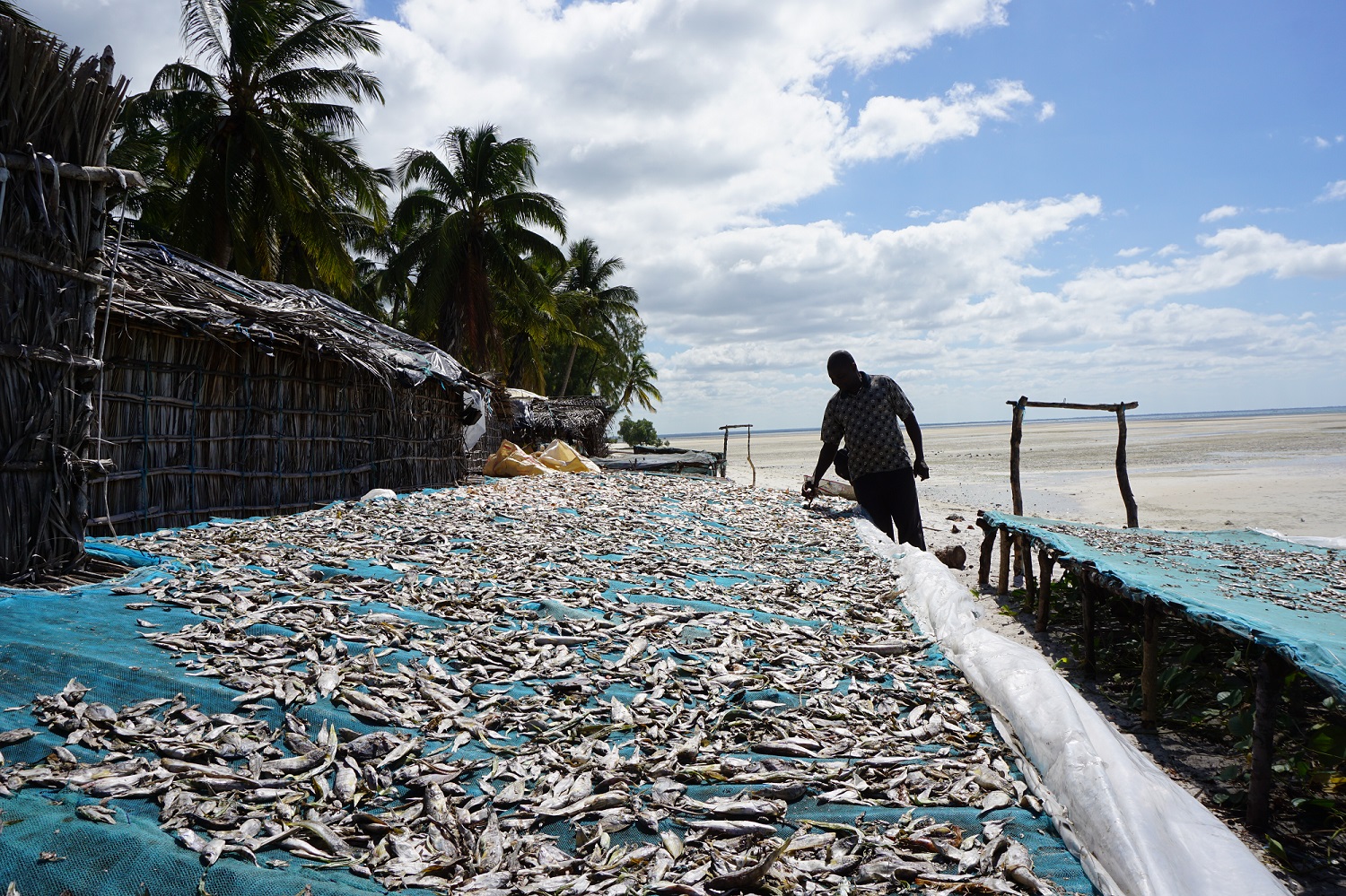
The approval of the funding package means that the government assumes that all the companies involved in the Total-led gas project are complying with international human rights and environmental agreements. Both ENDS, however, has serious doubts about this. "The preparations for the project are in full swing and the people who live in the area are already paying the price," says Anne de Jonghe of Both ENDS, who has had contact with the fishers' and farmers' organisations in the area. "Although the project provides work for some people and brings facilities to the area that were not there before, most of the local inhabitants are seriously concerned. Many have had to move to places where they have no access to land or fishing grounds, so that they can no longer make a living. Although agreements were made within the project to ensure that fishers can continue to fish, their fishing grounds at sea are now much less accessible."
Violence in the region
In the region where the investments are being made, there is also increasing violence by 'insurgents'. Dutch ministers Sigrid Kaag and Stef Blok recently informed the Dutch House of Representatives about this issue. In July, the gas developments were explicitly threatened in Al-Naba, the newspaper of the Islamic State (IS). IS propaganda focuses mainly on who benefits from the exploitation of natural resources in the area. The Mozambique government, the investors and the companies in the area do not speak openly about the increasing violence, and rely on (para)military support to protect the project.
Agreements not open to the public
To ensure that the project is implemented responsibly, Atradius DSB and Total have made agreements on how Total is going to comply with international guidelines and how Atradius DSB is going to monitor that compliance. "But these agreements are unfortunately not open to the public," says De Jonghe. "Transparency is crucial for the farmers and fishers in the area, so that all stakeholders know what is going to happen and can preferably have a say in what that is. It is, after all, their living environment and their future."
Multi-Stakeholder Platform
The Dutch government has set up a Multi-Stakeholder Platform in Mozambique so that the Mozambique and Dutch governments, donors, the private sector and civil society can exchange information and coordinate their plans. The local people have not yet had any real benefit from the Platform, as it is dominated by the private sector, there is a language barrier and the majority of the people at the table do not come from the area where the project is taking place. Moreover, partly because of the violence between different parties in the region, it can be dangerous for local inhabitants and organisations to speak out.
Local people's interests
Both ENDS has been calling on the Dutch government for many years to stop supporting the fossil fuel sector. "If the Netherlands does decide to provide public support," De Jonghe says, "it has a responsibility to ensure that it is does so properly. Atradius DSB should, at the very least, take strict measures to ensure that the companies involved comply with the rules and are transparent about their plans, the consequences for local people and how they will be compensated. In addition, the concerns and interests of all farming and fishing communities must be taken seriously in the Multi Stakeholder Platform."
For more information
Read more about this subject
-
 Dossier /
Export Credit Agencies: Who pays the price?
Both ENDS calls on the government only to provide export credit insurance to sustainable projects that cause no social and/or environmental damage in the countries where they take place.
-
 Dossier /
Gas in Mozambique
In 2011 one of the world’s largest gas reserves was found in the coastal province of Cabo Delgado, in the north of Mozambique. A total of 35 billion dollars has been invested to extract the gas. Dozens of multinationals and financiers are involved in these rapid developments. It is very difficult for the people living in Cabo Delgado to exert influence on the plans and activities, while they experience the negative consequences. With the arrival of these companies, they are losing their land.
-
 News / 27 October 2026
Both ENDS at COP31: Locally led climate finance and ending investment rules that block climate action
At COP31, Both ENDS advocates for climate finance that reaches women-led and community-based organisations at the forefront of climate action, while challenging the economic rules that obstruct the transition away from fossil fuels. Together with partners in the Global Alliance for Green and Gender Action (GAGGA) and the PAPeS programme, we push for locally led adaptation, gender-just climate action and greater accountability for governments and companies.
We asked our colleagues Daan Robben and Fernando Hernandez why they are going to COP31, what messages they want to bring to negotiators, and what a positive outcome would look like.
-
 News / 25 October 2026
Meet Sarah Adongo: “The soil remembers those who cry and defend it”
By Sarah Adongo, Lawyer, Witness Radio, Uganda
Sarah Adongo is one of the three winners of the 2026 Irene Dankelman Young Ecofeminist Award, presented on 21 October at the UN Biodiversity Conference (CBD COP17) in Yerevan, Armenia. A lawyer working with Witness Radio Uganda, Sarah works with women affected by gender-based violence and communities affected by land dispossession and large-scale investments. In this piece, she shares what the award means to her and why gender and environmental justice must go hand in hand.
-
 News / 25 October 2026
Meet Yemi Knight: “Your experience is expertise”
By Yemi Knight (they/them), Founder and Executive Director, AnchorBridge Environmental Inc., Barbados
Yemi Knight is one of the three winners of the 2026 Irene Dankelman Young Ecofeminist Award, presented on 21 October at the UN Biodiversity Conference (CBD COP17) in Yerevan, Armenia. Yemi founded AnchorBridge Environmental, a youth-led organisation that combines policy advocacy with climate education across the Caribbean. We asked them what the award means to them, what they are working on, and what they would tell other young ecofeminist leaders.
Yemi is also part of the network of the Joke Waller-Hunter Initiative, powered by Both ENDS. With a JWH grant, Yemi followed courses in Social, Environmental and Economic Impact Assessment and in Risk, Crisis and Disaster Management at the University of the West Indies, Cave Hill Campusc, as well as a Level 1A Spanish course at the Centre for Language Learning at the university’s St. Augustine Campus.
-
 Dossier /
International trade and investment with respect for people and planet
The network of international trade and investment treaties is large and complex. The Netherlands alone has signed more than 70 bilateral investment treaties (BITs) and is party to the trade and investment agreements concluded by the EU, like the EU-Mercosur and EU-Indonesia trade deals.
-
 Dossier /
Rights for People, Rules for Corporations – Stop ISDS!
Indigenous communities in Paraguay saw their attempts to regain their ancestral lands thwarted by German investors. In Indonesia, US-based mining companies succeeded to roll back new laws that were meant to boost the country’s economic development and protect its forests. This is the level of impact that investment treaties can have on social, environmental and economic development and rights. Why? Because of the ‘Investor-to-State Dispute Settlement’ clauses that are included in many such treaties.
-
 News / 15 October 2026
ISDS infringement complaint filed with the European Commission
The Netherlands and Portugal join four other EU countries facing such a complaint.
-
 Press release / 15 October 2026
Dutch and Portuguese organisations file EU complaint over investment treaties that let companies and sanctioned Russian oligarchs sue EU countries for compensation
The Netherlands and Portugal join four other EU countries facing such a complaint, as the Global Days of Action against Investor-State Dispute Settlement (ISDS) begin.
-
 Dossier /
Dare to Trust: the power of unconditional funding
At Both ENDS we cherish our long-term relationships with partners in our global network. These relationships are based on equality and built on trust. The trust we have in each other has developed from years of strategic cooperation, including joint advocacy around common agendas, knowledge sharing, networking, and mobilising and sharing resources to advance environmental justice.
-
 Dossier /
Global Alliance for Green and Gender Action (GAGGA)
GAGGA rallies the collective power of the women's rights and environmental justice movements to realize a world where women can and do access their rights to water, food security, and a clean, healthy and safe environment.
-
 News / 29 September 2026
Summary - Both ENDS complaint under the EU-New Zealand trade agreement
On 29 September 2026, Both ENDS lodged the first complaint on climate grounds with the European Commission's Single Entry Point. It asks the Commission to examine whether Aotearoa New Zealand has broken two promises both sides made in the EU-New Zealand Free Trade Agreement: not to weaken or set aside environmental laws in order to encourage trade or investment, and to effectively implement the Paris Agreement.
-
Publication / 29 September 2026
-
 News / 29 September 2026
Q&A: New Zealand's climate rollback and the EU trade agreement
On 29 September 2026 / 30 September in Aotearoa New Zealand, Both ENDS lodged a complaint with the European Commission under the EU-New Zealand Free Trade Agreement. These are the questions we are asked most often, and our answers. The complaint summary, the case explainer and the key public sources are linked at the end of this page.
-
 News / 7 September 2026
Unprecedented criminal conviction in the Mariana disaster case breaks mining industry's cycle of impunity
A Brazilian federal court has, for the first time, criminally convicted a mining company and three of its managers for their role in the 2015 collapse of the Fundão dam, one of the worst environmental disasters in Brazil's history. Our partner Instituto Cordilheira, which represented victims as assistant prosecutors in the case, calls it a historic breakthrough after years of impunity.
-
 News / 3 September 2026
Restoring Land, Restoring Hope: Both ENDS at UNCCD COP17 in Mongolia
From 17 to 28 August, governments gathered in Ulaanbaatar, Mongolia, for COP17 of the UN Convention to Combat Desertification (UNCCD). At stake was more than how the world responds to land degradation and drought. It was also a question of who gets to shape land restoration, whose knowledge counts, and where the money goes.
-
Letter / 14 July 2026
Statement on CAO Cambodia Microfinance Case
The independent complaints mechanism of the International Finance Corporation (IFC) and the World Bank Group found that the IFC violated its own Environmental and Social Sustainability Framework by investing in six banks providing microfinance in Cambodia.
-
Publication / 3 July 2026
-
 Dossier /
Finance for agroecology
The lion's share of public budgets for climate, agriculture and development still goes to conventional agroindustrial projects that contribute to the current climate, food and biodiversity crises. Both ENDS and our partners are calling for a transition to agroecological practices that are people- and environment-friendly.
-
Publication / 18 June 2026