




Press release: Indonesian giant sea wall project is pseudo-solution for Jakarta Bay
21 April 2017: Jakarta is sinking. Excessive groundwater extraction is causing the metropolis to sink by dozens of centimetres each year, making it more vulnerable to flooding. Dutch businesses have come up with a solution: an immense sea wall on the coast, which is also a stunning real estate project. But this intervention is just a pseudo-solution, say researchers from Both ENDS, Stichting Onderzoek Multinationale Ondernemingen (SOMO) and the Transnational Institute (TNI) today in a new report. Even worse, the project threatens the livelihoods of tens of thousands of people employed in local fisheries.
"A solution must be found – that's clear", says Katrin McGauran of SOMO, "But no measure taken will have any effect if the sinking of the city isn't stopped first. The sinking is caused by the fact that everyone, including businesses, pumps up their drinking water from underground. The huge infrastructural project proposed by the Dutch companies won't solve this problem".
Development cooperation?
Late 2015, the Dutch government granted a consortium of Dutch businesses 8 million euros to further develop the plan for the Indonesian government. Of this sum, 7.5 million euros originated from the Dutch Ministry of Development Cooperation. A sum of 3.9 million euros from the same source was previously granted to the plan.
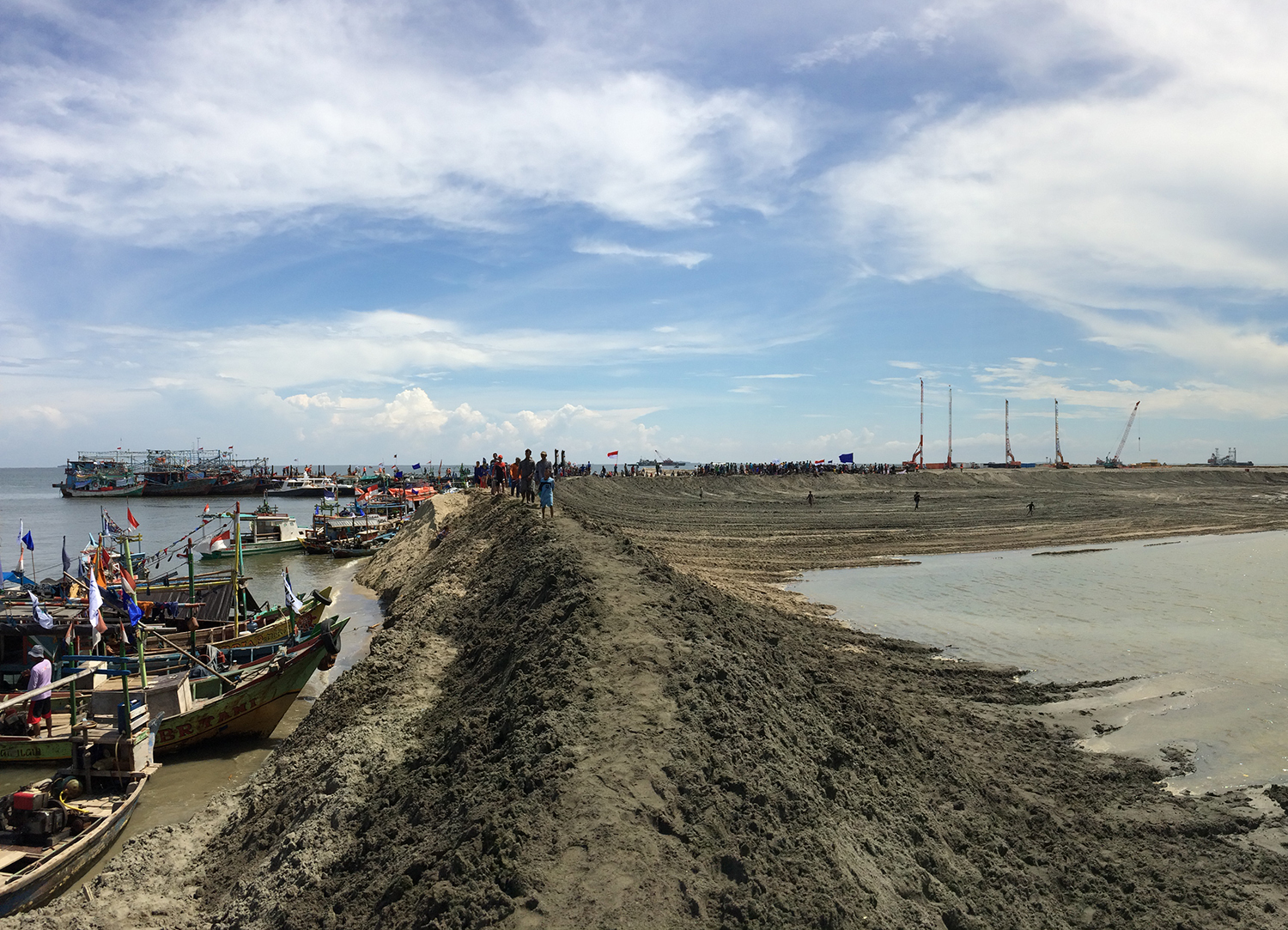
The National Capital Integrated Coastal Development project (NCICD) has proposed building a giant dike before the coast of Jakarta, combined with the creation of an artificial island, on which a new city district will be built. The project will be financed through real estate sales. The investment required could be as high as US$40 billion.
No voice for local people
Ten thousand people employed in the fisheries sector in Jakarta fear that the Indonesian mega-dike will cause them to lose their livelihoods. Fishers informed SOMO, Both ENDS and TNI that they have already lost income due to the present construction of artificial islands in the bay, in which Dutch companies are involved. Once the dike is built, the fishers will no longer have free access to the open sea.
According to Satoko Kishimoto of TNI, privatisation of the water supply in Jakarta, 18 years ago, worsened the problems: "By taking back management of the water supply, Jakarta would be able to solve this urgent problem much more quickly. The Dutch government could play an important part in this".
In 2016, the 'Save the Jakarta Bay Coalition', which has united fishers with others who are also affected since 2014, sent two letters to Dutch Prime Minister Mark Rutte to express concerns regarding the NCICD and to request that the Netherlands exert pressure on the Indonesian government. But until now, there has been no official response. The fishers and residents have not been sufficiently consulted in the project and their interests were never properly taken into account.
Polluted lagoon
The mega-dike threatens to turn Jakarta Bay into a large, polluted lagoon. Moreover, in order to realise the dike and the new city district, large quantities of sand are needed. This will further stimulate illegal sand mining, which is already a problem for Indonesia. Illegal sand mining causes serious damage to invaluable ecosystems such as coral reefs.
Double standards
"In supporting Dutch businesses abroad, it would be only logical if the Dutch government applied the same standards as in the Netherlands", says Giacomo Galli, who maintains contact for Both ENDS with the fishers' organisations. "The consequences of the project for people and their environment should be properly considered, local residents should have a say, and they should be compensated for damages suffered. These procedures are the norm in the Netherlands. The Dutch government could make a difference by focusing on these procedures in such a large-scale international project as well."
More information:
The full report: Social Justice at Bay: The Dutch role in Jakarta's coastal defence and land reclamation
Or contact Giacomo Galli: G.Galli@bothends / +31-205306624
Read more about this subject
-
 Dossier /
Large-scale infrastructure
Large-scale infrastructural projects have detrimental effects on local people and the environment, while their benefits are felt elsewhere. Both ENDS is working to ensure that local people have a greater say in decision-making and is investigating the way these projects are funded.
-
 Dossier /
Global Alliance for Green and Gender Action (GAGGA)
GAGGA rallies the collective power of the women's rights and environmental justice movements to realize a world where women can and do access their rights to water, food security, and a clean, healthy and safe environment.
-
 News / 22 January 2026
Shell files new arbitration against the Netherlands over Groningen gas field closure
Shell is suing the Netherlands in yet another attempt to evade its responsibility for decades of gas extraction in Groningen. For years, gas production has triggered earthquakes, damaged over a hundred thousand homes, and left residents living in prolonged insecurity, still waiting for repairs, reinforcement, and justice.
-
 Dossier /
Agua Zarca: indigenous fight against dam costs lives
Indigenous Hondurans are resisting the construction of the Agua Zarca hydrodam. Their fight has cost several lives, including that of Berta Cáceres. After considerable public pressure, Dutch development bank FMO withdrew from the project.
-
 Environmentally Just Practice /
A Negotiated Approach for Inclusive Water Governance
A Negotiated Approach envisages the meaningful and long-term participation of communities in all aspects of managing the water and other natural resources on which their lives depend. It seeks to achieve healthy ecosystems and equitable sharing of benefits among all stakeholders within a river basin. This inclusive way of working is an essential precondition for the Transformative Practices that are promoted by Both ENDS and partners.
-
 Dossier /
Rights for People, Rules for Corporations – Stop ISDS!
Indigenous communities in Paraguay saw their attempts to regain their ancestral lands thwarted by German investors. In Indonesia, US-based mining companies succeeded to roll back new laws that were meant to boost the country’s economic development and protect its forests. This is the level of impact that investment treaties can have on social, environmental and economic development and rights. Why? Because of the ‘Investor-to-State Dispute Settlement’ clauses that are included in many such treaties.
-
 Dossier /
Wetlands without Borders
With our Wetlands without Borders program, we work towards environmentally sustainable and socially responsible governance of the wetlands system of the La Plata Basin in South America.
-
 News / 5 November 2025
Another ISDS claim hits the Netherlands: Petrogas sues over solidarity contribution and royalty regulations
SOMO and Both ENDS strongly condemn the newly revealed investor-state dispute settlement (ISDS) case filed by Petrogas, an Omani oil and gas company operating two shallow-water gas fields in the Dutch North Sea, against the Netherlands under the Netherlands-Oman bilateral investment treaty (BIT).
-
Publication / 16 October 2025
-
Publication / 16 October 2025
-
 News / 6 October 2025
From Entebbe to Accra: civil society is rewriting the rules of investment
By Fernando Hernández Espino and Bart-Jaap Verbeek
Almost a year after African civil society gathered in Uganda to adopt the Entebbe Declaration, the call to transform international investment governance continues to gain strength. From the 6th to the 9th of October, over 50 civil society organisations from across West Africa, including from Ghana, Senegal, Nigeria, Côte d’Ivoire, Cameroon, Gambia, Sierra Leone, as well as from Kenya and Latin America, are convening in Accra to deepen and operationalise the Declaration’s vision.
-
 News / 22 September 2025
EU-Indonesia Trade Deal Threatens Communities and Environment
On September 23th the European Union and Indonesia concluded their negotiations of the EU-Indonesia Comprehensive Economic Partnership Agreement (CEPA), a free trade agreement between the EU and Indonesia. Both ENDS condemns this agreement for favoring corporate interests over those of local communities and the environment.
-
 Blog / 12 August 2025
Nickel mining for the energy transition: who is accountable for the damage?
Photo blog - In June, I travelled to Indonesia with our partner organization Puanifesto to research the impacts of nickel mining in East Sulawesi. On July 13th, the news broke that the European Union and Indonesia have reached a political agreement on a free trade agreement that was years in the making, called the Comprehensive Economic Partnership Agreement (CEPA). Nickel from Sulawesi is already being used in European cars. This makes it all the more important that we ensure that human and environmental rights are secured in mining and refining operations in Indonesia, before the road is opened to more extraction and exploitation for the European market. The conversations we have had with communities and workers on East Sulawesi show that more binding regulations are necessary to make this happen and ensure an energy transition that is socially and environmentally just.
-
 News / 17 July 2025
Both ENDS Calls on AIIB to Halt Forced Evictions in Mandalika
Together with Indonesian CSOs Both ENDS is calling on the Asian Infrastructure Investment Bank (AIIB) to intervene and direct its client, the Indonesia Tourism Development Corporation (ITDC), and its borrower, the Government of Indonesia, to immediately halt this week's ongoing forced evictions in Tanjung Aan Beach and surrounding areas in Mandalika, Lombok.
-
 Dossier /
Fair Green and Global Alliance (FGG)
Together with civil society organisations from all over the world, the Fair Green and Global (FGG) Alliance aims for socially just, inclusive and environmentally sustainable societies in the Netherlands and the Global South.
-
 News / 2 July 2025
 -
 Press release / 18 February 2025
Trade deal fueling resource grab? 120+ groups from Europe and Indonesia sound the alarm
Brussels, 18 February 2025 - Over 120 civil society organizations and trade unions from Indonesia and Europe today call on the Indonesian government and the European Union to stop the negotiations for the Indonesia-EU free trade agreement – the Comprehensive Economic Partnership Agreement (CEPA).
-
 News / 23 December 2024
Dare to Trust: Mama Sorghum Peace Movement Maintains Biodiversity
Yasores was supported by the Samdhana Institute in our Dare to Trust-project, a no-strings-attached way of funding. We only asked them to send a creative report in any shape or form they want about the activities. The Samdhana Institute send this story about the history and founding of Yasores by Mama Loretha, to report about their grant.
-
Letter / 9 December 2024
People and the Planet Entebbe Declaration: Reclaiming investment frameworks for people and the planet
The time for change is now. Civil society demands international investment
frameworks that are aligned with economic justice, social and environmental
sustainability, and the needs of communities worldwide. -
 News / 26 November 2024
The Time to Rethink Investment Rules: Amplifying Civil Society Voices
At the core of the Fair, Green, and Global (FGG) Alliance’s mission is the commitment to building a just and sustainable world. As members of this alliance, Both ENDS, SOMO, and the Transnational Institute (TNI) recognise the urgent need to reimagine global investment frameworks. These frameworks, entrenched in outdated treaties such as Bilateral Investment Treaties (BITs) and the Energy Charter Treaty (ECT), often prioritise corporate profits over human rights, environmental sustainability, and social justice.


