




Dutch government calls for investigation into Malaysian timber certification
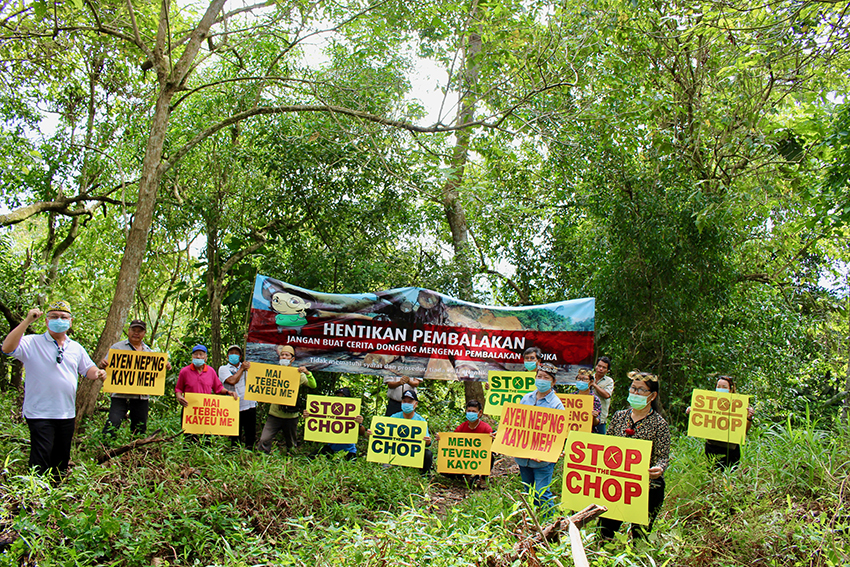
The Dutch government expects PEFC International to undertake an investigation into its own role as a forest certification system, using the Malaysian Timber Certification Scheme (MTCS). "It is about time the Dutch government takes a leading role in ensuring Malaysian timber entering The Netherlands is not associated with deforestation and human rights abuses," states Paul Wolvekamp of Both ENDS. "Considering that the Dutch government has the ambition to build 900.000 houses in the immediate future, involving massive volumes of timber, such as timber from Malaysia for window frames, builders, contractors, timber merchants and local governments rely on the Dutch government to have its, mandatory, timber procurement better organised, i.e. from reliable, accountable sources'.
A preliminary investigation by the Timber Procurement Assessment Committee (TPAC), an independent expert group advising the Dutch government, identified the lack of required transparency under PEFC/MTCS as a clear violation of the Dutch timber procurement policy. TPAC further found that MTCS might fall short of the Dutch procurement policy with regards to the complaints procedure, the implementation of Free, Prior and Informed Consent (FPIC), conversion of forests and the lack of stop-work-orders while complaints are pending, amongst other issues. Consequently, the Dutch Ministry of Infrastructure and Water Management decided at the end of last year for TPAC to request from PEFC "substantive convincing evidence within a reasonable time that these issues are unfounded or to make an acceptable improvement on them within a reasonable time". TPAC supports PEFC's proposal to do a joint field visit.
In the report - published in January - TPAC criticised the lack of cooperation from MTCC, which did not engage with TPAC beyond responding to one question in an email. TPAC also questioned "to what extent PEFC and MTCC have effective provisions and procedures for identifying and mitigating structural irregularities" in place. TPAC criticised that "PEFC - as the system operator - did not indicate that itself or any other entity would have an overarching and monitoring role in this" and stresses that buyers must be confident that PEFC-certified timber "meets all quality requirements."
In May 2022, an Indigenous delegation from Sarawak held a series of meetings with decision-makers in the Netherlands on the unresolved issues around accountability, flawed consultations and deforestation, amongst others. The case, however, began much earlier than that: in 2010, TPAC assessed MTCS and concluded that the standard did fall short of the Dutch procurement criteria for sustainably produced wood with regards to Indigenous rights, obtaining FPIC, conversion of natural forests and access to and quality of maps. MTCS was therefore not accepted by TPAC, even though it already fell under the endorsement of PEFC. MTCS remained under separate review of TPAC in the procurement of timber. However, government procurement under both systems has been allowed since June 2014. In 2016, TPAC conducted a field visit to verify whether the outstanding issues had been resolved, but was severely restricted in access to sites and stakeholders in Malaysia. In its subsequent report, TPAC concluded that the issues appeared to be solved on paper but could not assess the field situation. In January 2017, the Dutch government accepted MTCS as complying with the procurement policy. Since 2020, the Dutch government has placed the acceptance of MTCS under the umbrella of the endorsement of PEFC International. Regarding the raised concerns, however, PEFC must now provide evidence of MTCS's compliance to its own standard and the Dutch timber procurement policy.
Both ENDS, SAVE Rivers, KERUAN, Bruno Manser Fonds and The Borneo Project welcome the decision by the Dutch government to further investigate the raised complaints with a field visit. Celine Lim, Managing Director of Malaysian Indigenous grassroots organisation SAVE Rivers, states: "We expect MTCC and PEFC International to work closely with their Dutch counterparts as much as with civil society and affected local communities to resolve these problems. Until then, it is irresponsible to continue unlimited export of timber from controversial sources."
Later this week, Malaysian and international stakeholders are meeting in Sarawak's capital Kuching to discuss Sustainable Forest Management, such as MTCS and PEFC, at a conference.
For more information
Read more about this subject
-
 Dossier /
Fighting for improvements in the production of palm oil
The production of palm oil is causing social and environmental problems worldwide. Both ENDS is working to make the sector fairer and more sustainable and is promoting alternatives for palm oil.
-
Publication / 17 November 2025
-
 News / 28 February 2018
Human Rights defenders from all over the world visit EU to call for strong measures against deforestation
This week, from 12 until 16 February, fourteen indigenous leaders and human rights defenders from forest countries came to the Netherlands to call upon Dutch policy makers to take serious action against human rights abuses, land grabbing and further deforestation in relation to large scale agriculture, timber logging and mining. The Dutch harbours of Rotterdam and Amsterdam receive enormeous amounts of soy and palm oil, both for the Dutch market and for further transport into Europe and elswhere.
-
 Press release / 13 November 2025
Global Alliance Urges Dutch Government to Reconsider Endorsement of Controversial Timber Certification Scheme
A coalition of Malaysian and international NGOs has released a memorandum in response to the recent TPAC report on the Malaysian Timber Certification Scheme (MTCS). The organizations express serious concerns about the independence, quality, and credibility of the assessment carried out by the Timber Procurement Assessment Committee (TPAC).
-
Letter / 22 April 2022
Letter to State Secretary Heijnen about the MTCS certificate
Both ENDS, also on behalf of FERN, NCIV and Milieudefensie, sent a letter to Vivianne Heijnen, the State Secretary for Infrastructure and Water Management, about the MTCS certificate. In practice, this Malaysian timber certificate appears to tolerate the violation of indigenous land rights and intimidation of indigenous organisations. The Netherlands should therefore suspend the approval of MTCS in its purchasing policy, among other things.
-
 News / 14 June 2019
Both ENDS partner TUK presents symbolic tree to Dutch minister Schouten
Last Thursday June 13, Rahmawati Retno Winarni of TUK, an Indonesian partner organisation of Both ENDS, presented a symbolic tree and an appeal to the Dutch Minister of Agriculture Carola Schouten, also on behalf of 10 NGOs. The joint NGOs are pushing the EU, including the Dutch government, for strict EU legislation to prevent the destruction of forests and ecosystems and to protect human rights.
-
 News / 23 November 2018
RSPO takes further steps towards a less harmful palm oil sector
The production of palm oil is often accompanied by deforestation, environmental destruction and land grabbing. Local communities and activists who stand up against these problems are often threatened. Now the RSPO has taken significant steps in recent months to tackle these issues.
-
 News / 28 June 2018
Indigenous leaders present 'Supply Chain Solutions' and petition in Paris and Brussels
Last week, indigenous leaders from various countries were in Paris to urge action on deforestation and human rights abuses at the multi-stakeholder meeting of the Amsterdam Declarations Partnership. The group, invited by Forests Peoples Programme and Both ENDS, presented a publication 'Supply chain solutions for people and forests' containing a set of practical recommendations from local communities on how to make supply chains more sustainable and fair.
-
 Environmentally Just Practice /
Non-Timber Forest Products (NTFPs)
About one in every six people, particularly women, directly rely on forests for their lives and livelihoods, especially for food. This shows how important non-timber forest products (NTFPs) and forests are to ensure community resilience. Not only as a source of food, water and income, but also because of their cultural and spiritual meaning.
-
 News / 17 September 2021
Beyond trees: the importance of Non-Timber Forest Products for communities
About one in every six people, particularly women, directly rely on forests for their lives and livelihoods, especially for food. This shows how important non-timber forest products (NTFPs) and forests are to ensure community resilience. Not only as a source of food, water and income, but also because of their cultural and spiritual meaning.
-
Publication / 27 June 2018
-
 Environmentally Just Practice /
Farmer Managed Natural Regeneration
In various countries in the Sahel, vast tracts of degraded land have been restored by the local population by nurturing what spontaneously springs from the soil. They do this using a method called 'Farmer Managed Natural Regeneration (FMNR)'.
-
 News / 6 December 2024
South American Forest Fires Highlight Effects of Delaying EU Deforestation Law
On the 4th of December, the European Parliament voted in majority for a delay of implementation of the EU Deforestation Regulation (EUDR). Earlier, the European Commission and the European Council already endorsed this proposal for a delay with one year. Both ENDS and partners are worried about this decision, as there is no time to waste in our global fight against deforestation, biodiversity loss and climate change.
-
 News / 9 September 2025
Simplification Must Not Mean Weakening: Why the EUDR and other Environmental Legislation Must Stay Strong
Both ENDS warns that the current debate on “simplification” of EU environmental law must not become an excuse to weaken or postpone urgently needed safeguards. In earlier contributions to the drafting of the EU Deforestation Regulation (EUDR), Both ENDS relayed the voices of local and Indigenous forest-dependent peoples, who consistently urged the EU to take responsibility for the massive deforestation linked to European imports. They underlined how this deforestation destroys biodiversity, undermines climate stability, and erodes their rights, livelihoods and cultures.
-
 News / 3 May 2021
Opinion: ‘The Netherlands, use your influence to protect forests worldwide’
Recently, Dutch media covered the publication of a new report, issued by WWF, stating the big role the Netherlands still has in global deforestation, mainly due to our soy and palm oil imports. To counter this alarming message, Paul Wolvekamp and Tamara Mohr wrote an op-ed about the possibilities the Netherlands has to change the tide, which was published in Dutch on the website Joop.nl. Below, you find the English translation.
-
 News / 24 August 2023
Recognition of the transformative work of the ILED Network by GEF
A wave of international recognition is shedding light on the valuable role that indigenous communities play in looking after our planet's most vital ecosystems. Last night in Vancouver, two of our partners won a grant in the Inclusive GEF Assembly Challenge Program: the ILED Network and AIDER (Peru). Our colleague Eva Schmitz was present to receive the prize on behalf of the ILED Network.
-
Publication / 28 February 2018
-
 News / 2 August 2019
EU unveils 'Action Plan' on Deforestation
The EU is still one of the world’s largest importers of deforestation: EU demand for commodities like soy, palm oil, beef, coffee and cacao requires millions of hectares of tropical rainforest to be cleared. This deforestation has significant biodiversity and climate impacts, and is often linked to human rights violations and violence against local communities and indigenous peoples. Both ENDS and partners have been actively lobbying the EU Commission to adopt a robust action plan to address and prevent human rights violations and deforestation ‘embodied’ in EU imports of agricultural commodities.
-
 News / 3 February 2022
EU deforestation law can and must be stronger. Join #Together4Forests!
In the coming months, new EU regulation on deforestation-free products will be discussed in the Dutch and EU parliaments. The goal is that no more products related to deforestation in whatever way, will be imported into the EU . A very good and important initiative, but according to many civil society organisations, including Both ENDS, the bill that has now been drafted is far from sufficient.
-
 Blog / 18 January 2019
Unambitious and uninspiring: the European Commission’s proposal for stepping-up action on global deforestation
After five years of equivocation the European Commission has proposed a ‘roadmap’ for stepping-up EU action to address its contribution to global deforestation. Despite the escalating impact of EU trade in forest-risk commodities, regardless of repeated calls from the European Parliament for regulatory measures and contrary to the conclusions of the Commission’s own feasibility study in support of legislative intervention, the Commission has ruled-out out any new initiatives, let alone any legislative measures. The Commission’s solution to this complex problem: policy coherence.



