




Launch of ‘good gold’ in the Netherlands
The Netherlands follow the United Kingdom and became the second country where 'good gold' is being sold. On May 7th the official launch of 'Fairtrade-Fairmined gold' took place in Amsterdam. Highlight was the handover of the first golden bracelet with this certificate to Katja Römer-Schuurman by a Peruvian miner. The bracelet is symbolic for good gold and will be worn with pride by Römer-Schuurman. "The circle is now complete", says Lina Villa, director of the Alliance for Responsible Mining (ARM), who was involved in the project since the beginning.
Symbolism
Villa has been involved in the certification process, which led to this international standard for gold since the beginning. The launch of Fairtrade-Fairmined gold in the Netherlands, in cooperation with Solidaridad and Max Havelaar, means a lot to her. "It has a symbolic meaning. Dutch organizations such as Both ENDS believed in the project when it was still a small-scale, local initiative. We can now finally show that production and trade of good gold is in fact possible and has positive local impacts"
Inclusive process
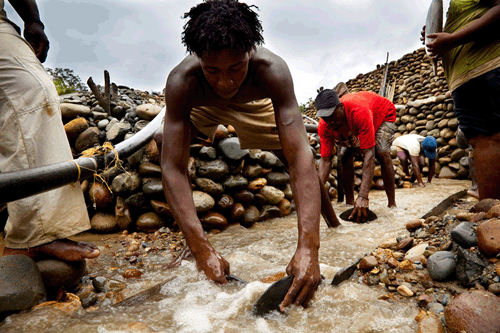
The production of gold often causes huge ecological and social problems, such as deforestation, water pollution and human rights violations. In order to counter these negative impacts and create possibilities for sustainable gold mining and -trade, network organization ARM started developing its own alternative certification system in 2004. Villa: "It had to be a truly inclusive process, involving everyone". Over 30,000 people have been involved in the development of these standards. "During our workshops miners from all over the world discovered that they faced the same challenges. The exchange of experiences, problems and solutions were extremely stimulating for these miners."
Big breakthrough
However, one of the biggest challenges turned out to be reaching the general public. "A lot of consumers do not know the origin of their gold and are unaware of the social and environmental problems", Villa explains. She calls the cooperation with the internationally renowned Fairtrade Labelling Organization (FLO) a big breakthrough. "Their expertise and reputation possibly have saved us 10 years of work."
Visibility
Yet ARM has not yet reached its targets, Villa emphasizes: "We are proud of what we have achieved, but we want to further expand our networks - also in other continents, such as Africa and Asia." ARM wants to guarantee the role and rights of marginalized and often criminalized small-scale miners by involving governments in the process. The organization is also committed to increasing the visibility of female miners.
Something Special
In the Netherlands, jewelry with the Fairtrade-Fairmined label is available at several designers and jewelers. Miners are paid a higher price for their sustainably extracted gold; the proceeds are invested in further increasing the sustainability of gold mining and the development of local communities. Villa believes that more and more people will decide to choose good gold. "Gold isn't something you really need, it is something special. As a consumer you have the power to change people's life. That is what makes it really special."
Photo: Guillaume Collanges
Read more about this subject
-
 News / 10 September 2026
Rutu Foundation receives UNESCO Literacy Prize for multilingual education
Both ENDS’ partner the Rutu Foundation for Intercultural Multilingual Education has been awarded the 2026 UNESCO King Sejong Literacy Prize for its language friendly school programme. This prestigious prize recognises the importance of multilingual education and the right of children to learn in an environment where their home languages are valued.
-
 News / 7 September 2026
Unprecedented criminal conviction in the Mariana disaster case breaks mining industry's cycle of impunity
A Brazilian federal court has, for the first time, criminally convicted a mining company and three of its managers for their role in the 2015 collapse of the Fundão dam, one of the worst environmental disasters in Brazil's history. Our partner Instituto Cordilheira, which represented victims as assistant prosecutors in the case, calls it a historic breakthrough after years of impunity.
-
 Dossier /
Communities Regreen the Sahel
In various countries in the Sahel, vast tracts of land have been restored by the local population by nurturing what spontaneously springs from the soil and protecting the sprouts from cattle and hazards.
-
 News / 3 September 2026
Restoring Land, Restoring Hope: Both ENDS at UNCCD COP17 in Mongolia
From 17 to 28 August, governments gathered in Ulaanbaatar, Mongolia, for COP17 of the UN Convention to Combat Desertification (UNCCD). At stake was more than how the world responds to land degradation and drought. It was also a question of who gets to shape land restoration, whose knowledge counts, and where the money goes.
-
Letter / 14 July 2026
Statement on CAO Cambodia Microfinance Case
The independent complaints mechanism of the International Finance Corporation (IFC) and the World Bank Group found that the IFC violated its own Environmental and Social Sustainability Framework by investing in six banks providing microfinance in Cambodia.
-
 News / 6 July 2026
Strengthening Women's Land Rights Across the Rio Conventions
From 29 June – 2 July 2026, Tamara Mohr, GAGGA coordinator at Both ENDS participated in the 4th convening of the Women's Land Rights Initiative (WLRI) in Nairobi, Kenya.Hosted by the Robert Bosch Stiftung, TMG Research and the Huairou Commission, the event brought together grassroots organisations, (inter)national NGOs, government institutions and donors from around the world.
-
Publication / 3 July 2026
-
 News / 2 July 2026
Land restoration can help mitigate and resolve conflict - but only if everyone has a seat at the table
Can restoring degraded land also help reduce conflict? According to experts from Niger, Ghana, the Netherlands and other regions, the answer is yes - but only when restoration is rooted in inclusive land governance, local ownership and social cohesion.
-
 Dossier /
Gas in Mozambique
In 2011 one of the world’s largest gas reserves was found in the coastal province of Cabo Delgado, in the north of Mozambique. A total of 35 billion dollars has been invested to extract the gas. Dozens of multinationals and financiers are involved in these rapid developments. It is very difficult for the people living in Cabo Delgado to exert influence on the plans and activities, while they experience the negative consequences. With the arrival of these companies, they are losing their land.
-
 Dossier /
Finance for agroecology
The lion's share of public budgets for climate, agriculture and development still goes to conventional agroindustrial projects that contribute to the current climate, food and biodiversity crises. Both ENDS and our partners are calling for a transition to agroecological practices that are people- and environment-friendly.
-
 Dossier /
Trade agreements
International trade agreements often have far-reaching consequences not only for the economy of a country, but also for people and the environment. It is primarily the most vulnerable groups who suffer most from these agreements.
-
Publication / 18 June 2026
-
Publication / 12 May 2026
-
 Press release / 12 May 2026
UN report warns of a growing sand crisis - The Dutch dredging sector plays a key role in global sand extraction
GENEVA/UTRECHT, 12 May 2026 – A new report by the United Nations Environment Programme (UNEP), Sand and Sustainability: An Essential Resource for Nature and Development, warns that global demand for sand is exceeding ecological limits. Large-scale extraction of sand from marine and coastal ecosystems is leading to biodiversity loss, damage to coastal communities and increasing risks in an era of climate change. Dutch dredging companies play a prominent role in this as global market leaders in large-scale sand extraction and land reclamation. “Our analyses show that the dredging sector operates globally within a system in which ecological damage and the consequences for coastal communities are systematically underestimated, whilst transparency and effective oversight are often lacking,” says the Dutch environmental and human rights organisation Both ENDS, which contributed to the report.
-
 News / 14 April 2026
New report: Phasing out ISDS in the Netherlands: a roadmap
Today, Both ENDS and SOMO are publishing the report Phasing out ISDS in the Netherlands: a roadmap. In the report, we highlight the Netherlands’ role in the ISDS system and offer practical guidance on phasing out ISDS.
-
 Dossier /
Rights for People, Rules for Corporations – Stop ISDS!
Indigenous communities in Paraguay saw their attempts to regain their ancestral lands thwarted by German investors. In Indonesia, US-based mining companies succeeded to roll back new laws that were meant to boost the country’s economic development and protect its forests. This is the level of impact that investment treaties can have on social, environmental and economic development and rights. Why? Because of the ‘Investor-to-State Dispute Settlement’ clauses that are included in many such treaties.
-
Publication / 14 April 2026
-
Publication / 10 April 2026
-
 News / 10 April 2026
Both ENDS: strengthened FMO complaints mechanism is a step forward, but major gaps remain
Both ENDS welcomes the strengthened Independent Complaints Mechanism (ICM) of development finance institutions FMO, DEG and Proparco as an important step forward in accountability. Working directly with communities affected by development projects, we see daily how essential it is that people can access justice when they are harmed in the name of development. For many communities, this mechanism is one of the few avenues through which harm can be formally recognised and addressed in relation to these development banks.
-
 News / 9 April 2026
Minister Sjoerdsma hosts roundtable conversations with civil society
This week, Minister Sjoerdsma organized roundtable conversations with civil society organizations – a valuable initiative that brings together Dutch civil society voices to address critical challenges faced by democratic societies.




