




Combating drought by protecting saplings
Koussanar, in eastern Senegal, is a small town that is expanding rapidly, surrounded by villages still rooted in rural and nomadic life. The region is hot and dry, which is exacerbated by climate change. The soil in the region is also dry and often exhausted due to a combination of factors such as unsustainable agricultural practices, (peanut) monoculture, intensive agriculture, forest fires and overgrazing. Today, however, the region's farmers and nomadic pastoralists take a different approach. They are working towards a better future by committing to the restoration of degraded land using Farmer Managed Natural Regeneration (FMNR).
The basic principle of FMNR is to nurture what spontaneously springs from the soil, and protect the sprouts are normally eaten by cattle or removed by farmers themselves. What are the benefits? Shade, food for cattle, hummus for the soil, an improved groundwater balance and ultimately better growth of other crops. As a result, farmers have more food security and gain extra income.
Care and protect
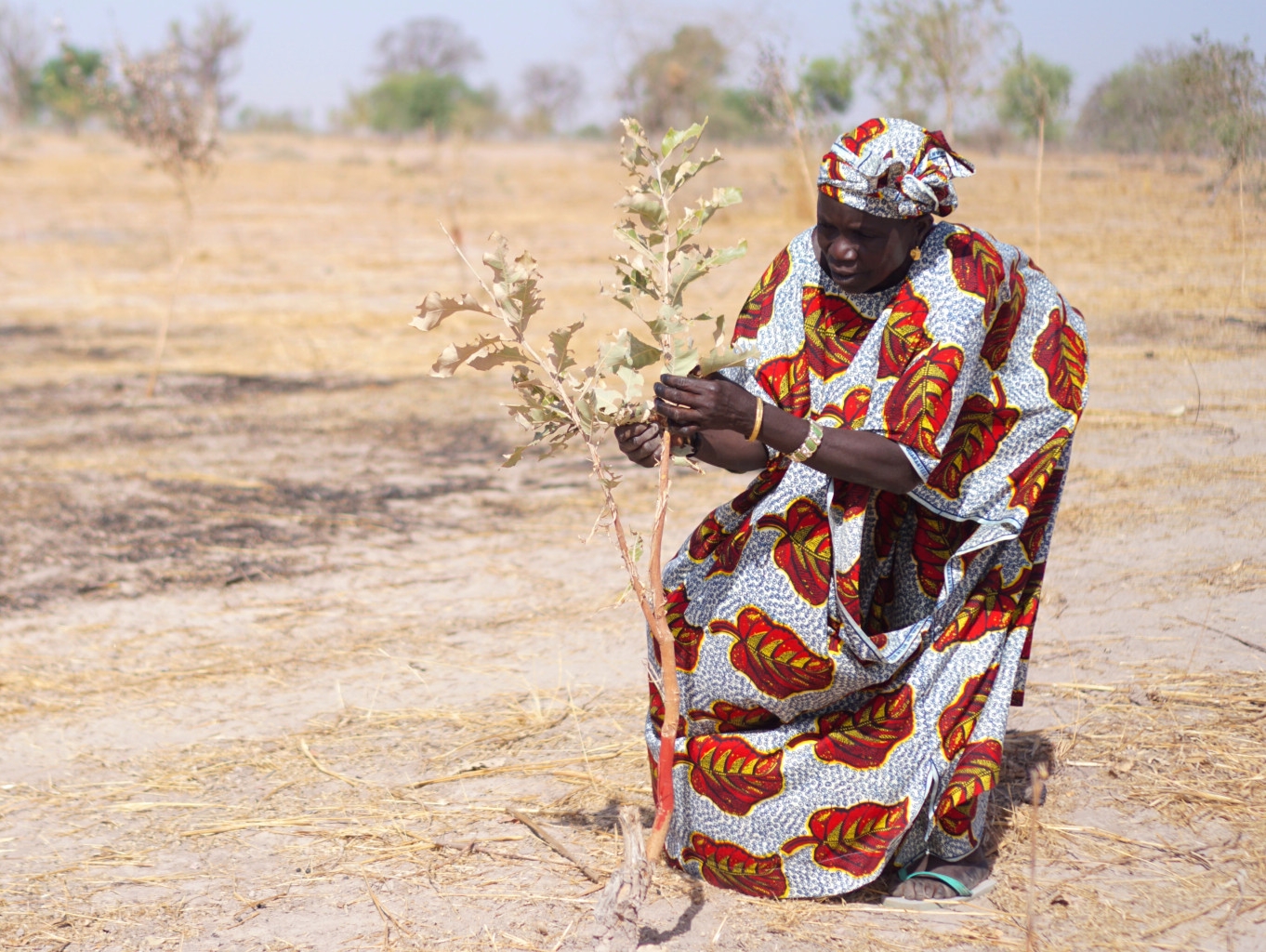
To achieve this, the young trees and shrubs must be given the opportunity to grow. They need to be properly pruned at the right time, and protected from livestock of nomadic groups that often move across the fields – or from villagers looking for firewood. The farmer in the photo, trained in FMNR by the Senegalese organisation ENDA Pronat, puts into practice the techniques she was taught to prune a young tree in order to stimulate its growth. We also see a red mark on the trunk: nomadic groups and the villagers then know that it is an FMNR tree that should be left alone.
Dialogue between different groups
ENDA Pronat supports local communities in the sustainable management of their natural resources. The organisation trains small-scale farming communities in agroecological skills and how to market their products on local markets. ENDA Pronat also ensures that different stakeholders - farmers, herdsmen, villagers and local authorities - talk to each other, understand each other, work together and reach agreements that benefit everyone. Of course within the framework of local agreements on the management of natural resources.
Communities Regreen the Sahel
ENDA Pronat is one of eight Senegalese organisations involved in the 'Communities Regreen the Sahel' programme. The woman in the photo is one of 11,484 farmers who have now been trained under the program in Senegal. Since its start in 2018, 27,656 hectares of degraded land in Senegal have been greened using this method. Both ENDS is the coordinator of the programme, which runs not only in Senegal but also in Niger and Burkina Faso.
This article has been published due to the International Day to Combat Desertification and Drought, installed by the UN Convention on Desertification and Drought (UNCCD) on June 17th. Here you find other articles from this series.
Read more about this subject
-
 Environmentally Just Practice /
Farmer Managed Natural Regeneration
In various countries in the Sahel, vast tracts of degraded land have been restored by the local population by nurturing what spontaneously springs from the soil. They do this using a method called 'Farmer Managed Natural Regeneration (FMNR)'.
-
 Dossier /
Communities Regreen the Sahel
In various countries in the Sahel, vast tracts of land have been restored by the local population by nurturing what spontaneously springs from the soil and protecting the sprouts from cattle and hazards.
-
 Dossier /
Amplifying environmentally just practices
Because of the close relationship with their living environment, local communities often have the best ideas for the sustainable and equitable use and governance of land, water and forests. These environmentally just practices and processes successfully protect and restore ecosystems and address climate change. They are essential in the light of the multiple crises the world faces, but are in dire need of financial and policy support.
-
 News / 27 februari 2026
Both ENDS strengthens the resilience of female environmental defenders worldwide thanks to multi-year contribution from the Postcode Lottery
In recent years, Both ENDS has received an additional contribution of €875,000 from the Postcode Lottery for the Autonomy & Resilience Fund (2022–2025), implemented in collaboration with the Global Alliance for Green and Gender Action (GAGGA). This support was essential because female environmental rights defenders around the world are increasingly facing climate change, repression and shrinking civil space. With this contribution, Both ENDS supports female activists and their communities with flexible, trust-based funding, enabling them to develop their own solutions to urgent environmental and climate problems.
-
 Dossier /
Seeking justice for the affected communities of Vale’s mining disasters in Mariana and Brumadinho
In 2015 and 2019, the Brazilian state of Minas Gerais experienced two severe mining tragedies in Mariana and Brumadinho, due to the same mining company: Vale. Since then, the affected communities have been seeking justice, via the criminal punishment of the responsible parties, and a fair compensation for the loss of their loved ones, their homes and their livelihoods. Both ENDS supports local CSOs by amplifying their quest for justice within an international audience and, more specifically, by raising awareness amongst Dutch investors in Vale about the high risks this company’s activities pose for people and the environment.
-
 Dossier /
Wetlands without Borders
With our Wetlands without Borders program, we work towards environmentally sustainable and socially responsible governance of the wetlands system of the La Plata Basin in South America.
-
 News / 5 november 2025
Interview: Both ENDS at COP30 for Climate Justice and Systemic Change
Both ENDS is present at COP30 to advocate for genuine access to climate finance for locally led, gender-just climate solutions and the mechanisms that facilitate this, including those for farmer-led restoration. Furthermore, the organisation participates to ensure the crucial connection between the climate negotiations and the trade and investment frameworks that shape them.
Learn more about the Both ENDS team at COP30 below, and find all the activities and side-events in which Both ENDS will participate.
-
 News / 5 november 2025
Overview of Both ENDS events at COP30 in Belem, Brazil
Both ENDS is present at COP30 to advocate for genuine access to climate finance for locally led, gender-just climate solutions, and for the mechanisms that make these possible, including those supporting farmer-led restoration. The organisation also engages to highlight the crucial connection between climate negotiations and the trade and investment frameworks that shape them.
Below is an overview of the Both ENDS team at COP30 and a detailed look at the activities and side-events in which Both ENDS will participate.
-
 News / 14 oktober 2025
Communities regreening the Sahel: strengthening resilience from the ground up
How can communities in the Sahel strengthen their food systems in the face of climate change and other shocks? Through the ARFSA Programme, Both ENDS and its partners SPONG (Burkina Faso), CRESA/INRAN (Niger) and IED Afrique (Senegal) are working together to show that locally led landscape restoration works. -
Publication / 9 oktober 2025
-
 Dossier /
International trade and investment with respect for people and planet
The network of international trade and investment treaties is large and complex. The Netherlands alone has signed more than 70 bilateral investment treaties (BITs) and is party to the trade and investment agreements concluded by the EU, like the EU-Mercosur and EU-Indonesia trade deals.
-
 News / 6 oktober 2025
From Entebbe to Accra: civil society is rewriting the rules of investment
By Fernando Hernández Espino and Bart-Jaap Verbeek
Almost a year after African civil society gathered in Uganda to adopt the Entebbe Declaration, the call to transform international investment governance continues to gain strength. From the 6th to the 9th of October, over 50 civil society organisations from across West Africa, including from Ghana, Senegal, Nigeria, Côte d’Ivoire, Cameroon, Gambia, Sierra Leone, as well as from Kenya and Latin America, are convening in Accra to deepen and operationalise the Declaration’s vision.
-
Publication / 2 oktober 2025
-
 Dossier /
Towards a socially and environmentally just energy transition
To address the climate crisis we need to urgently transition away from fossil fuels towards clean, renewable energy. However, this transition is not only about changing energy sources. It requires an inclusive and fair process that tackles systemic inequalities and demanding consumption patterns, prioritizes environmental and social justice, and which does not repeat mistakes from the past.
-
 News / 16 juli 2025
The challenges of climate change, gender inequality, and conflict
This FCDO-supported project, part of the GAGGA programme, brought together 6 women-led community-based organisations from around the world to explore how they navigate the combined challenges of climate change, gender inequality, and conflict. Through a Feminist Participatory Action Research approach, the organisations documented strategies ranging from land rights advocacy to climate-resilient agriculture, highlighting how extractive industries, militarisation, and patriarchal systems drive exclusion and insecurity. Their findings are now informing donors and policymakers on the need to support grassroots women’s leadership. In the following interview, the project lead shares more about the research, key insights, and its broader impact.
-
 News / 10 juli 2025
Shell's Silent Exit: Evading Accountability in the Niger Delta
Following Both ENDS & Kebekatche Women Development & Research Centre participation in Shell’s Annual General Meeting (AGM) and a formal follow-up in writing, the response received from Shell plc raises more questions than it answers.
-
 Blog / 2 juli 2025
Women at the frontlines of climate action: local power for global change
By Tamara MohrLast week, GAGGA, the Global Alliance for Green and Gender Action, with Both ENDS as one of the Alliance members, together with FCAM and Mama Cash, organised its Global Meeting in Indonesia. The goal of this meeting was to recognise, celebrate and look ahead at cross-movement and cross-regional connections, to strengthen the collective power of gender, climate and environmental justice movements.
-
Publication / 1 juli 2025
-
Publication / 1 juli 2025
-
 Environmentally Just Practice /
Analog Forestry
Analog forestry is a transformative approach to the ecological restoration of degraded lands. Natural forests are used as guides to create ecologically sustainable landscapes, which support the social and economical needs of local communities.




