




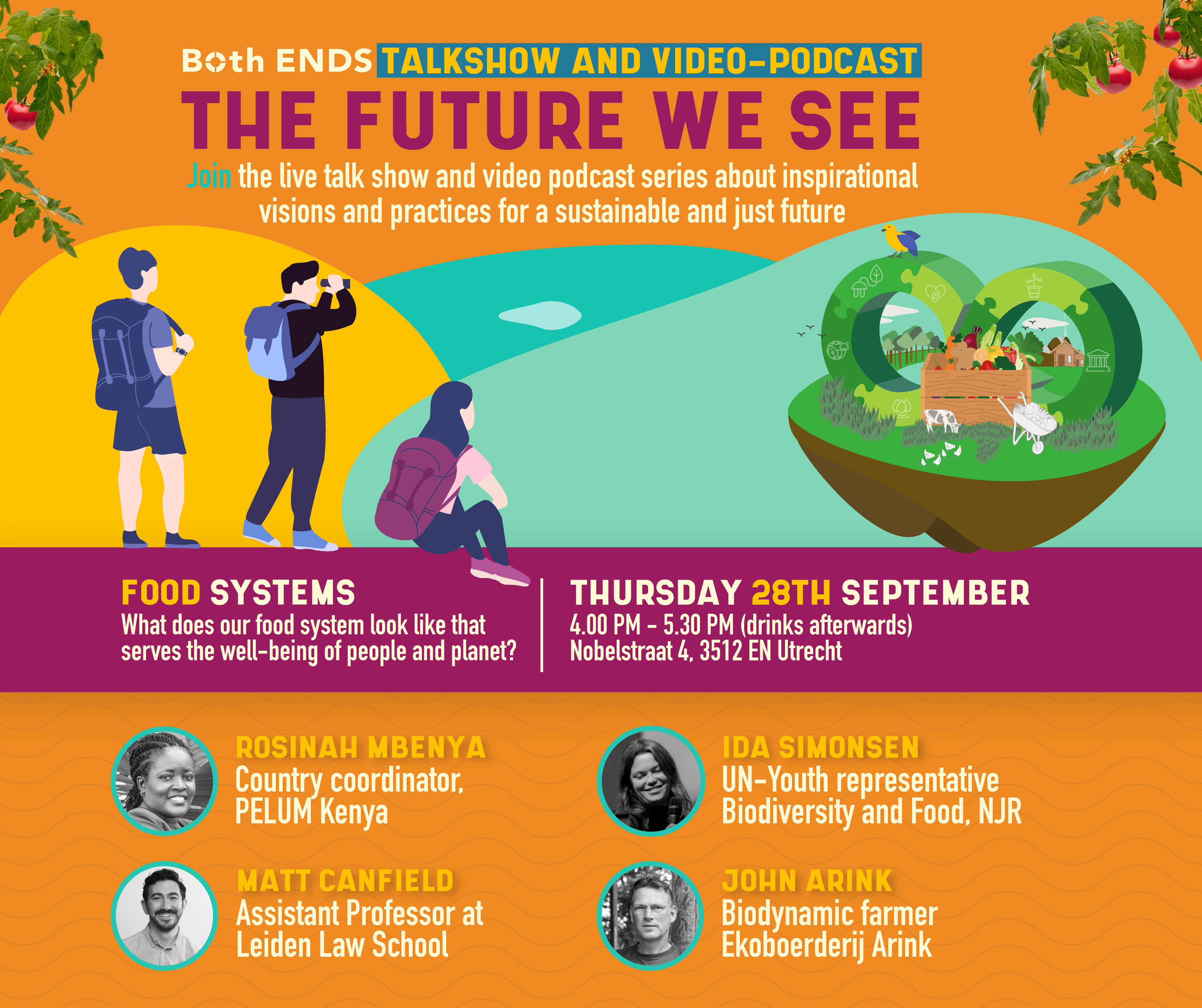
The Future We See - Food Systems
What does a food system look like that serves the well-being of people and the planet?
While agriculture and livestock food production in the world have become increasingly large-scale, industrial and ever more efficient for decades, the damage and inequality this food system causes is also becoming increasingly clear. Across the world, more and more people are therefore engaged in alternative, sustainable food production that ensures many generations to come to still have access to fertile, healthy land and clean water.
In this talkshow, we highlight some of these examples and hope to fuel the dialogue about this topic.
Speakers:
- Rosinah Mbenya - PELUM Kenya (via Zoom)
- Matt Canfield - University of Leiden
- Ida Simonsen - Dutch UN Youth Representative Biodiversity and Food
- John Arink - Ekoboerderij Arink (biodynamic farmer)
Moderator
Farid Tabarki - Studio Zeitgeist
Inspired? Join our 'The Future We See' - talkshow on September 28th! You can either attend live or online, quietly listen or actively participate in the discussion - or during the drinks afterwards. We hope to see you there!
Also take a look at our previous session
To get a glimpse of the atmosphere, see a short video of our last session (about economic systems): https://youtu.be/AUNGcROovnc
And to dive in a little deeper, watch this compilation: https://youtu.be/nzuwIREeiNo
-
 Dossier /
Communities Regreen the Sahel
In various countries in the Sahel, vast tracts of land have been restored by the local population by nurturing what spontaneously springs from the soil and protecting the sprouts from cattle and hazards.
-
 News / 18 March 2022
International Forests Day: the importance of forests for livelihoods and a healthy environment
Today is International Day of Forests. An ever more important day, as the amount of forest and forested area's on this globe is shrinking at a fast pace. One the main causes is our ever increasing demand for products such as soy and palm oil from area's that have been deforested for their cultivation. The current proposed EU-deforestation law to prevent this, is not strict enough and does not include the protection of other crucial natural areas such as grasslands, savannas and swamps, as well as the human rights of the millions of people living in these area's. During these past few weeks we therefore participated in the campaign #Together4Forests, calling on citizens to send a letter to their own responsible ministers. The campaign paid off: almost 54,000 letters were sent to European ministers across the European Union, demanding a strict forest law that guarantees the import of only deforestation-free products in Europe.
To celebrate this International Day of Forests, we would like to emphasise the great value of forests and other natural areas, directly or indirectly, for the livelihoods of at least 2 billion people. Below, we selected some examples that show how, throughout the world, local communities use many different ways to collect and produce food and other natural products in a sustainable way, while protecting and restoring the forests and forested area's they are so dependent upon.
-
 Dossier /
The merits of community-based restoration
Globally, the area that is suffering desertification and land degradation is ever expanding. Unsustainable and often large-scale agricultural practices, including the copious use of pesticides and fertilisers, are a major driver of land degradation, aprocess that is further exacerbated by climate change, causing more erratic rainfall patterns, longer periods of drought and unpredictable growing seasons. This is very problematic not only for the hundreds of millions of people who directly depend on land and water for their livelihoods, but also for life on earth as a whole. It is clear that this process must be stopped and reversed, better sooner than later. But how to go about it?
-
Publication / 30 June 2016
-
Publication / 11 July 2019
-
Publication / 7 November 2022
-
 Dossier /
Finance for agroecology
The lion's share of public budgets for climate, agriculture and development still goes to conventional agroindustrial projects that contribute to the current climate, food and biodiversity crises. Both ENDS and our partners are calling for a transition to agroecological practices that are people- and environment-friendly.
-
 News / 27 September 2021
Analog Forestry: sustainable food production with a feminist perspective
In times of ecosystem degradation, deforestation and climate change, rural communities often struggle to make a living in a healthy and autonomous way. One of the solutions to counter their problems is Analog Forestry, a sustainable practice promoted by many of Both ENDS's partners. We spoke to Carolina Sorzano Lopez*, Analog Forestry trainer from Colombia for the International Analog Forestry Network (IAFN), and Luz Marina Valle*, a local Analog Forestry promotora in her community of El Jocote in Northern Nicaragua, to explain to us the advantages of Analog Forestry.
-
 Environmentally Just Practice /
Analog Forestry
Analog forestry is a transformative approach to the ecological restoration of degraded lands. Natural forests are used as guides to create ecologically sustainable landscapes, which support the social and economical needs of local communities.
-
 Event / 28 May 2022, 13:00 - 14:15
Afrikadag: Future of food and farming in Africa: the role for small-scale agroecological food production
Join us this Saturday the 28th of May for an inpiring session about the role of agro-ecology in the trasformation to a future proof food and farming system on the African continent (and beyond).
-
 Press release / 21 April 2023
Manifesto: The Netherlands can reduce its international footprint with new Agricultural Agreement
The Dutch Agriculture Agreement, which is currently under development, is too much focused solely on the Netherlands. That is the opinion of a broad coalition of more than sixty NGOs, farmers' organisations, scientists and companies that have today sent an urgent letter to agriculture minister Piet Adema and foreign trade and development minister Liesje Schreinemacher. The government's agricultural policy should also aim to reduce the Netherlands' enormous agrarian footprint beyond our borders, by taking food security and the preservation of biodiversity as its starting points. The coalition has published a manifesto in which it sets out how reform of the Netherlands' foreign agricultural policy could be given shape.
-
 Blog / 16 February 2021
The Netherlands can contribute much to making agriculture sustainable – nationally and internationally
If the Netherlands wants to make its agriculture and livestock industry sustainable and to ensure that farmers get a fair price for their products, it will also have to look beyond its own borders. The Netherlands is the world's second largest exporter of agricultural products. We have a great impact because, through our trade relations, we uphold a system of intensive agriculture that destroys ecosystems and undermines local production. Partly due to our trade in agricultural products, the Dutch economy is has a large, and growing, footprint. That should and can be different: the Netherlands is in a good position to lead the required transition in agriculture. Fortunately, the party manifestos for the coming elections offer sufficient opportunities to set that in motion. A new coalition can thus take decisive new steps.
-
 Environmentally Just Practice /
Agroecology
Agroecology is a diverse set of agricultural practices, a field of science and a social movement. It aims to transform food systems towards greater ecological sustainability, social justice, and resilience. Both ENDS and CSO-partners around the world support farmers and pastoralists practising agroecology, both on the ground and in gathering political and financial support.
-
Publication / 2 November 2021
-
Publication / 1 July 2016
-
 Blog / 3 June 2025
A food forest as an inspiring oasis between monoculture fields
Recently, we visited food forest Ketelbroek with a group of colleagues. This project was initiated by food forest pioneer Wouter van Eck and our own Pieter Jansen. What a beautiful place! Located between monocrop fields of ryegrass, beetroot and potatoes, the food forest is a green oasis. Birdsong fills the air and there is a constant buzz and fluttering all around. Hares, badgers, foxes and wild boars are regular visitors. And let's not forget the beavers.
-
 News / 2 December 2024
Both ENDS at UNCCD COP16
Since 1994, Both ENDS has been advocating for inclusive governance in addressing desertification, land degradation, and drought, ensuring local communities have a strong voice in global discussions. As a member of Drynet, a network of over 20 civil society organisations, we champion the inclusion of women, youth, and Indigenous Peoples in land governance and highlight the importance of locally-led initiatives. Our work promotes gender equality, agroecology, and sustainable land management. This landing page serves as a comprehensive hub for all information and updates related to the UNCCD COP16 and Both ENDS' efforts to drive positive change. Here, you’ll find key resources, initiatives, and insights into how locally-led solutions can shape the future of land governance and environmental sustainability.
-
 Event / 11 December 2024, 13:00 - 14:30
Making strategic impact: Shifting resources and power to women-led initiatives for Land Degradation Neutrality (LDN)
How donors, foundations and other funders can better support women-led initiatives in achieving Land Degradation Neutrality (LDN), focusing on challenges, collaboration, and opportunities for improved matchmaking.
-
 News / 2 December 2024
Advocating for Local Solutions: Both ENDS at UNCCD COP16 to Champion Sustainable Land Management and Gender Equality
As the United Nations Convention to Combat Desertification (UNCCD) celebrates its 30th anniversary, the global community faces an urgent need to address the escalating challenges of land degradation, desertification and drought. At the forefront of these efforts, Both ENDS has long advocated for inclusive, locally-led solutions to these critical issues. In this interview, Nathalie van Haren and Yordanos Mulder, who will represent Both ENDS at the upcoming UNCCD COP16, share insights into the significance of the conference, the key issues on the agenda, and the crucial role of local communities in shaping effective land governance. They discuss Both ENDS' ongoing work to amplify the voices of marginalised groups and emphasise the importance of sustainable land management practices, particularly those driven by women, youth, and Indigenous Peoples.
-
 News / 15 June 2023
Combating drought by protecting saplings
Koussanar, in eastern Senegal, is a small town that is expanding rapidly, surrounded by villages still rooted in rural and nomadic life. The region is hot and dry, which is exacerbated by climate change. The soil in the region is also dry and often exhausted due to a combination of factors such as unsustainable agricultural practices, (peanut) monoculture, intensive agriculture, forest fires and overgrazing. Today, however, the region's farmers and nomadic pastoralists take a different approach. They are working towards a better future by committing to the restoration of degraded land using Farmer Managed Natural Regeneration (FMNR).




