




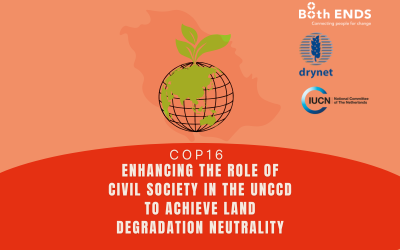
Enhancing the role of civil society in the UNCCD to achieve Land Degradation Neutrality (LDN)
Effective local action by land-using communities is at the heart of achieving LDN globally. However, their contributions are often not well recognized or adequately supported by governments and other agencies. Within the UNCCD framework, civil society organisations play a key role in engaging with policymakers in the context of recognizing and supporting these contributions by local communities. The side event will engage participants in a GEF-supported joint Drynet/ IUCN initiative to enhance the capacities of civil society to engage effectively in the achieving Land Degradation Neutrality (LDN) within the UNCCD framework.
The side-event will focus on how civil society can engage on Land Degradation Neutrality, building on the objectives of the Drynet/ IUCN GEF MSP “Strengthening Civil Society Role in Achieving Land Degradation Neutrality”. Speakers will provide participants with insight into the opportunities that the project offers to enhance the participation of civil society in the UNCCD and specifically in the context of achieving LDN. The side event will enable participants to contribute their perspectives and to explore how the achievements, realities and needs of land-using communities in advancing sustainable land management in the LDN context can be supported at the level of policy and better reflected in the decision making of the UNCCD through the effective engagement of Civil Society Organisations (CSOs).
Provisional list of speakers:
- Jean-Marc Sinnassamy, GEF
- Bora Masumbuko, IUCN
- Charles Oyeoussi Balogoun, UNCCD CSO Panel
- Marioldy Sanchez Santivanez, AIDER/ Drynet
- Marcos Montoiro, UNCCD Secretariat
-
 Dossier /
Communities Regreen the Sahel
In various countries in the Sahel, vast tracts of land have been restored by the local population by nurturing what spontaneously springs from the soil and protecting the sprouts from cattle and hazards.
-
 Environmentally Just Practice /
Farmer Managed Natural Regeneration
In various countries in the Sahel, vast tracts of degraded land have been restored by the local population by nurturing what spontaneously springs from the soil. They do this using a method called 'Farmer Managed Natural Regeneration (FMNR)'.
-
 Dossier /
Small Grants Big Impacts
Small grants funds offer an effective, alternative way to channel big money from large donors and funds to local groups and organisations that are striving for a sustainable and just society everywhere around the world.
-
 Dossier /
Dare to Trust: the power of unconditional funding
At Both ENDS we cherish our long-term relationships with partners in our global network. These relationships are based on equality and built on trust. The trust we have in each other has developed from years of strategic cooperation, including joint advocacy around common agendas, knowledge sharing, networking, and mobilising and sharing resources to advance environmental justice.
-
 Dossier /
Global Alliance for Green and Gender Action (GAGGA)
GAGGA rallies the collective power of the women's rights and environmental justice movements to realize a world where women can and do access their rights to water, food security, and a clean, healthy and safe environment.
-
 News / 5 oktober 2026
Rural Women's Assembly wins Right Livelihood Award
We are thrilled to share that our partner the Rural Women's Assembly (RWA) is one of this year's Right Livelihood Laureates! The award, often called the "Alternative Nobel Prize", honours RWA for bringing together more than 178,000 women farmers in eleven Southern African countries. Together, these women stand up for their land, their seeds and their right to make decisions about their own lives and bodies.
-
 News / 3 september 2026
Restoring Land, Restoring Hope: Both ENDS at UNCCD COP17 in Mongolia
From 17 to 28 August, governments gathered in Ulaanbaatar, Mongolia, for COP17 of the UN Convention to Combat Desertification (UNCCD). At stake was more than how the world responds to land degradation and drought. It was also a question of who gets to shape land restoration, whose knowledge counts, and where the money goes.
-
Letter / 14 juli 2026
Statement on CAO Cambodia Microfinance Case
The independent complaints mechanism of the International Finance Corporation (IFC) and the World Bank Group found that the IFC violated its own Environmental and Social Sustainability Framework by investing in six banks providing microfinance in Cambodia.
-
 News / 6 juli 2026
Strengthening Women's Land Rights Across the Rio Conventions
From 29 June – 2 July 2026, Tamara Mohr, GAGGA coordinator at Both ENDS participated in the 4th convening of the Women's Land Rights Initiative (WLRI) in Nairobi, Kenya.Hosted by the Robert Bosch Stiftung, TMG Research and the Huairou Commission, the event brought together grassroots organisations, (inter)national NGOs, government institutions and donors from around the world.
-
Publication / 3 juli 2026
-
 News / 2 juli 2026
Land restoration can help mitigate and resolve conflict - but only if everyone has a seat at the table
Can restoring degraded land also help reduce conflict? According to experts from Niger, Ghana, the Netherlands and other regions, the answer is yes - but only when restoration is rooted in inclusive land governance, local ownership and social cohesion.
-
 Dossier /
Finance for agroecology
The lion's share of public budgets for climate, agriculture and development still goes to conventional agroindustrial projects that contribute to the current climate, food and biodiversity crises. Both ENDS and our partners are calling for a transition to agroecological practices that are people- and environment-friendly.
-
Publication / 18 juni 2026
-
Publication / 12 mei 2026
-
 Dossier /
Rights for People, Rules for Corporations – Stop ISDS!
Indigenous communities in Paraguay saw their attempts to regain their ancestral lands thwarted by German investors. In Indonesia, US-based mining companies succeeded to roll back new laws that were meant to boost the country’s economic development and protect its forests. This is the level of impact that investment treaties can have on social, environmental and economic development and rights. Why? Because of the ‘Investor-to-State Dispute Settlement’ clauses that are included in many such treaties.
-
 News / 9 april 2026
Minister Sjoerdsma hosts roundtable conversations with civil society
This week, Minister Sjoerdsma organized roundtable conversations with civil society organizations – a valuable initiative that brings together Dutch civil society voices to address critical challenges faced by democratic societies.
-
 News / 24 maart 2026
Statement: Invest in local leadership for tropical forest management and local economies
IUCN-NL, Both ENDS, and 16 other Dutch and international civil society organizations (CSOs), networks, and expert groups are calling on the Dutch government to invest more strongly in locally led forest management and forest-based economies. This should be done within the framework of Dutch international cooperation and its associated policy instruments.
-
 News / 27 februari 2026
Both ENDS strengthens the resilience of female environmental defenders worldwide thanks to multi-year contribution from the Postcode Lottery
In recent years, Both ENDS has received an additional contribution of €875,000 from the Postcode Lottery for the Autonomy & Resilience Fund (2022–2025), implemented in collaboration with the Global Alliance for Green and Gender Action (GAGGA). This support was essential because female environmental rights defenders around the world are increasingly facing climate change, repression and shrinking civil space. With this contribution, Both ENDS supports female activists and their communities with flexible, trust-based funding, enabling them to develop their own solutions to urgent environmental and climate problems.
-
 Dossier /
Seeking justice for the affected communities of Vale’s mining disasters in Mariana and Brumadinho
In 2015 and 2019, the Brazilian state of Minas Gerais experienced two severe mining tragedies in Mariana and Brumadinho, due to the same mining company: Vale. Since then, the affected communities have been seeking justice, via the criminal punishment of the responsible parties, and a fair compensation for the loss of their loved ones, their homes and their livelihoods. Both ENDS supports local CSOs by amplifying their quest for justice within an international audience and, more specifically, by raising awareness amongst Dutch investors in Vale about the high risks this company’s activities pose for people and the environment.
-
 Environmentally Just Practice /
A Negotiated Approach for Inclusive Water Governance
A Negotiated Approach envisages the meaningful and long-term participation of communities in all aspects of managing the water and other natural resources on which their lives depend. It seeks to achieve healthy ecosystems and equitable sharing of benefits among all stakeholders within a river basin. This inclusive way of working is an essential precondition for the Transformative Practices that are promoted by Both ENDS and partners.



