




'Trade is War': Yash Tandon on the impact of global free trade and the geopolitcs behind TTIP
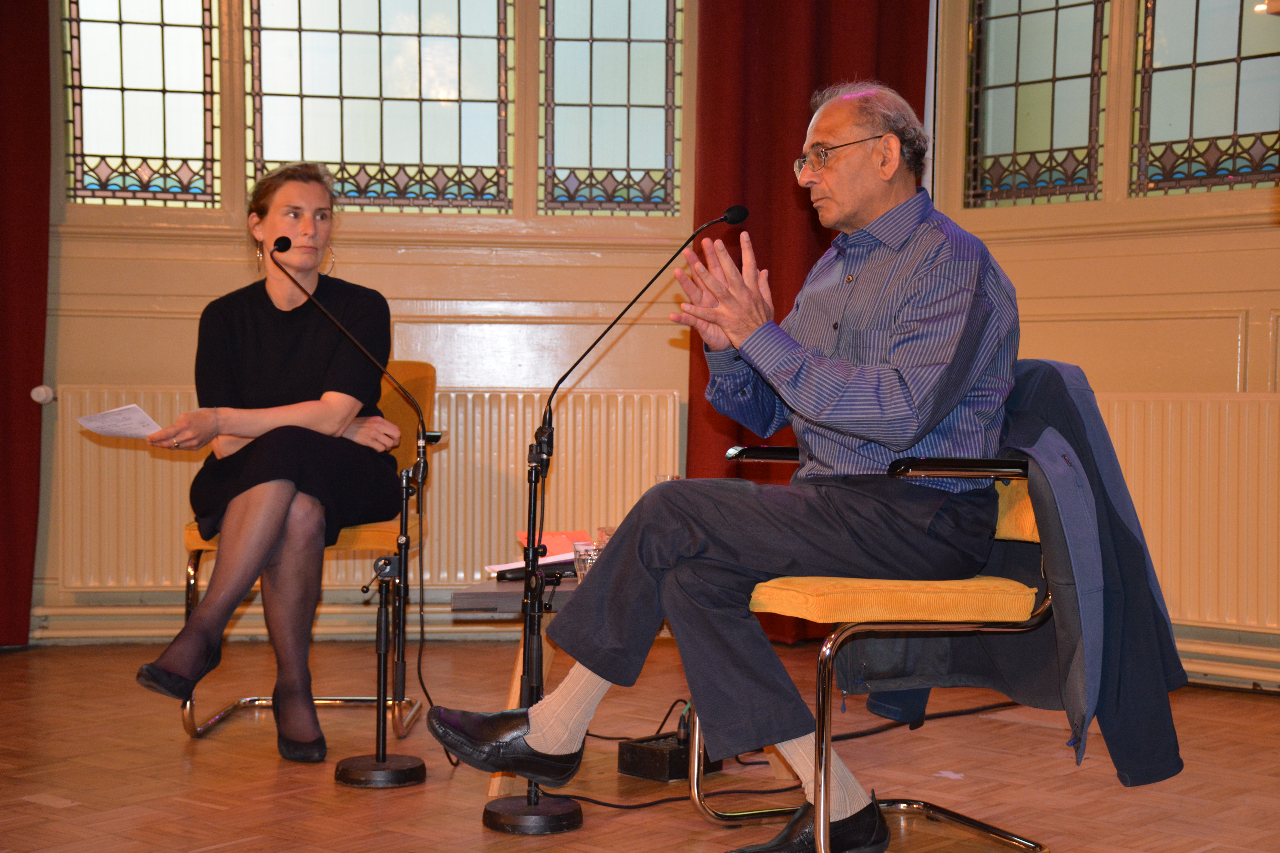
On June 3rd at De Balie in Amsterdam, ‘angry old man’ Yash Tandon presented his new book ‘Trade is War: The West’s War Against the World’ – a new perspective in the debate on the Transatlantic Trade and Investment Partnership (TTIP), the controversial trade agreement which the EU is currently negotiating with the US. In Europe, opponents of TTIP are mainly concerned about transparency, ever-increasing corporate power and the impact on the environment. But what does the treaty imply for North-South relations and what are the geopolitical dynamics behind it?
The debate on ‘Trade is War’ – organised by TNI, SOMO and Both ENDS – places TTIP in a broader perspective. Tandon passes a devastating judgement on free trade. “Since colonial times, global trade has been aimed at Western world domination.” Is there hope for change?
“Pleased with TTIP”
The recent fuss about TTIP has reinvigorated the public debate about the costs and benefits of globalisation and free trade in Europe. “Therefore I am very pleased with TTIP”, Yash Tandon joked after the introduction by moderator Natasja van den Berg. Tandon clarified that he hopes TTIP will generate attention to the Economic Partnership Agreements (EPAs), trade agreements the EU intends to sign with African countries. “What TTIP is to Europe, EPAs are to Africa. These trade and investment agreements serve the interests of multinationals and undermine the legal sovereignty of participating countries. Not only do EPAs hinder the development of many Africans, they lead to growing inequality, violence and migration.”
"TTIP is a military strategy"
Tandon said to be surprised by the superficiality of the public debate on TTIP in Europe. "There is an exclusive focus on economic and legal aspects, including the dispute resolution mechanism ISDS (Investor-State Dispute Settlement). There is absolutely no attention to the geopolitical dimensions of the treaty." According to Tandon TTIP seeks much more than the creation of a transatlantic economic power block. "It is pure power politics. TTIP is a military strategy aimed at containing China and Russia."
"Fair trade is a fairy tale"
Tandon, who called himself an ‘angry old man’, not only targeted the business lobby, the political establishment in Europe and the US, and the World Trade Organisation (WTO), which he accused of presenting backroom decisions as consensual agreements. He was also angry with former Minister of Development Cooperation of the Netherlands Jan Pronk, who called the result of 65 years of development cooperation ‘positive’. And with the progressive left in Europe, who he blames to be complacent and Eurocentric. According to Tandon, Europeans buy fair trade products to clear their conscience. But fair trade does not even exist, he argues. “Fair trade is a myth that Western consumers use to protect themselves from taking actual responsibility. Trade is war and how can war be fair?”
“Trade is not aid”
The current Dutch policy for development cooperation, aimed at combining aid and trade, was severely criticised by Tandon. In his view, reports on economic growth in Africa, which emphasise the growing GDP in many countries, give a distorted picture. “The firm belief in the West that trade is good for the world does not reflect harsh African realities. Global free trade has had devastating consequences for people in Africa. In Uganda not only domestic industry has been destroyed, but agriculture has also been hit hard. In supermarkets in Kampala one buys European chicken legs, which are being dumped as a result of EU subsidies. Ugandan tea farmers receive only 2% of the final proceeds of their harvest. And that is no different in the case of fair trade tea.”
"A thousand new ships"
Among the audience Tandon’s pessimistic message mainly raised questions about the future. Is there hope for change? If so, what should be done to turn the tide? And are there positive practical examples? Benign trade is indeed possible, Tandon said, but to achieve it requires radical change. "Global free trade is a sinking ship. We need to launch a thousand new ships: self-sufficient communities that trade on the basis of the actual value of goods and services. Through regional cooperation and with the combined strength of social movements around the world, we can bring about change."
Yash Tandon (Kampala, 1939) is a Ugandan scientist, author, political activist and policymaker. He is the founder and chairman of the Southern and Eastern African Trade, Information and Negotiations Institute (SEATINI) and the former director of the South Centre, an intergovernmental think tank of developing countries. He has published many books and articles on development, globalization and trade.
More Information? Have a look at our previous items on TTIP:
7 May 2015: Proposed reforms of ISDS in TTIP definitely insufficient
17 April 2015: Join the TTIP debate at the Volkshotel in Amsterdam
22 January 2015: Broad opposition to the controversial Investor-State Dispute Settlement (ISDS) mechanism
17 July 2014: Juncker against controversial dispute settlement mechanism ISDS as part of EU-US trade agreement TTIP
Read more about this subject
-
 Dossier /
Dare to Trust: the power of unconditional funding
At Both ENDS we cherish our long-term relationships with partners in our global network. These relationships are based on equality and built on trust. The trust we have in each other has developed from years of strategic cooperation, including joint advocacy around common agendas, knowledge sharing, networking, and mobilising and sharing resources to advance environmental justice.
-
 Dossier /
Global Alliance for Green and Gender Action (GAGGA)
GAGGA rallies the collective power of the women's rights and environmental justice movements to realize a world where women can and do access their rights to water, food security, and a clean, healthy and safe environment.
-
 News / 5 oktober 2026
Rural Women's Assembly wins Right Livelihood Award
We are thrilled to share that our partner the Rural Women's Assembly (RWA) is one of this year's Right Livelihood Laureates! The award, often called the "Alternative Nobel Prize", honours RWA for bringing together more than 178,000 women farmers in eleven Southern African countries. Together, these women stand up for their land, their seeds and their right to make decisions about their own lives and bodies.
-
 News / 29 september 2026
Summary - Both ENDS complaint under the EU-New Zealand trade agreement
On 29 September 2026, Both ENDS lodged the first complaint on climate grounds with the European Commission's Single Entry Point. It asks the Commission to examine whether Aotearoa New Zealand has broken two promises both sides made in the EU-New Zealand Free Trade Agreement: not to weaken or set aside environmental laws in order to encourage trade or investment, and to effectively implement the Paris Agreement.
-
Publication / 29 september 2026
-
Publication / 29 september 2026
-
 News / 29 september 2026
Q&A: New Zealand's climate rollback and the EU trade agreement
On 29 September 2026 / 30 September in Aotearoa New Zealand, Both ENDS lodged a complaint with the European Commission under the EU-New Zealand Free Trade Agreement. These are the questions we are asked most often, and our answers. The complaint summary, the case explainer and the key public sources are linked at the end of this page.
-
 News / 29 september 2026
What happens now? A timeline of the SEP Case
What happens now? On 29 September 2026 / 30 September in Aotearoa New Zealand, Both ENDS lodged a formal complaint with the European Commission. It is the first complaint to the EU's Single Entry Point on environmental and climate grounds. It asks the Commission to hold New Zealand to two promises it made in its trade agreement with the EU: not to weaken environmental protection to encourage trade or investment, and not to undermine the Paris Agreement on climate change.
-
 Press release / 29 september 2026
New Zealand faces its first climate complaint under EU trade rules
UTRECHT / WELLINGTON, 29 September 2026 /30 September in Aotearoa New Zealand
Both ENDS, a Dutch environmental justice organisation, has lodged a formal complaint with the European Commission arguing that New Zealand has broken the climate promises it made in its free trade agreement with the European Union. It is the first complaint on environmental and climate grounds under the Commission's Single Entry Point, the mechanism that lets civil society ask the EU to enforce the sustainability commitments in its trade agreements.
-
 Dossier /
Trade agreements
International trade agreements often have far-reaching consequences not only for the economy of a country, but also for people and the environment. It is primarily the most vulnerable groups who suffer most from these agreements.
-
 News / 10 september 2026
Rutu Foundation receives UNESCO Literacy Prize for multilingual education
Both ENDS’ partner the Rutu Foundation for Intercultural Multilingual Education has been awarded the 2026 UNESCO King Sejong Literacy Prize for its language friendly school programme. This prestigious prize recognises the importance of multilingual education and the right of children to learn in an environment where their home languages are valued.
-
 News / 7 september 2026
Unprecedented criminal conviction in the Mariana disaster case breaks mining industry's cycle of impunity
A Brazilian federal court has, for the first time, criminally convicted a mining company and three of its managers for their role in the 2015 collapse of the Fundão dam, one of the worst environmental disasters in Brazil's history. Our partner Instituto Cordilheira, which represented victims as assistant prosecutors in the case, calls it a historic breakthrough after years of impunity.
-
 Dossier /
Communities Regreen the Sahel
In various countries in the Sahel, vast tracts of land have been restored by the local population by nurturing what spontaneously springs from the soil and protecting the sprouts from cattle and hazards.
-
 News / 3 september 2026
Restoring Land, Restoring Hope: Both ENDS at UNCCD COP17 in Mongolia
From 17 to 28 August, governments gathered in Ulaanbaatar, Mongolia, for COP17 of the UN Convention to Combat Desertification (UNCCD). At stake was more than how the world responds to land degradation and drought. It was also a question of who gets to shape land restoration, whose knowledge counts, and where the money goes.
-
Letter / 14 juli 2026
Statement on CAO Cambodia Microfinance Case
The independent complaints mechanism of the International Finance Corporation (IFC) and the World Bank Group found that the IFC violated its own Environmental and Social Sustainability Framework by investing in six banks providing microfinance in Cambodia.
-
 News / 6 juli 2026
Strengthening Women's Land Rights Across the Rio Conventions
From 29 June – 2 July 2026, Tamara Mohr, GAGGA coordinator at Both ENDS participated in the 4th convening of the Women's Land Rights Initiative (WLRI) in Nairobi, Kenya.Hosted by the Robert Bosch Stiftung, TMG Research and the Huairou Commission, the event brought together grassroots organisations, (inter)national NGOs, government institutions and donors from around the world.
-
Publication / 3 juli 2026
-
 News / 2 juli 2026
Land restoration can help mitigate and resolve conflict - but only if everyone has a seat at the table
Can restoring degraded land also help reduce conflict? According to experts from Niger, Ghana, the Netherlands and other regions, the answer is yes - but only when restoration is rooted in inclusive land governance, local ownership and social cohesion.
-
 Dossier /
Gas in Mozambique
In 2011 one of the world’s largest gas reserves was found in the coastal province of Cabo Delgado, in the north of Mozambique. A total of 35 billion dollars has been invested to extract the gas. Dozens of multinationals and financiers are involved in these rapid developments. It is very difficult for the people living in Cabo Delgado to exert influence on the plans and activities, while they experience the negative consequences. With the arrival of these companies, they are losing their land.
-
 Dossier /
Finance for agroecology
The lion's share of public budgets for climate, agriculture and development still goes to conventional agroindustrial projects that contribute to the current climate, food and biodiversity crises. Both ENDS and our partners are calling for a transition to agroecological practices that are people- and environment-friendly.



