

Dutch and Portuguese organisations file EU complaint over investment treaties that let companies and sanctioned Russian oligarchs sue EU countries for compensation
The Netherlands and Portugal join four other EU countries facing such a complaint, as the Global Days of Action against Investor-State Dispute Settlement (ISDS) begin.
Brussels, 15 October 2026 - Dutch and Portuguese trade justice groups Handel Anders! and TROCA today asked the European Commission to start legal proceedings against both countries over their bilateral investment treaties (BITs) with non-EU countries. Handel Anders! and TROCA will hand in the complaint in person in Brussels, on behalf of a group of organisations that also includes Both ENDS and SOMO. They are arguing that these treaties breach EU law, and put at risk both governments’ ability to act in the public interest, including to protect people, the environment, the climate and to enforce sanctions. Similar complaints were filed in December 2025 against Germany, France, Austria and Sweden.
The complaint makes two arguments. Most Dutch and Portuguese BITs, especially those signed before 2009, fail to prevent interferences with EU law when foreign investors sue the state through ISDS. Their capital transfer clauses allow sanctioned businessmen to claim compensation for EU sanctions - a conflict the EU Court of Justice already identified in 2009. Since then, the Netherlands and Portugal have neither renegotiated nor terminated these treaties.
Between 2022 and 2025, Shell and ExxonMobil filed multiple arbitration cases against the Netherlands over the closure of the Groningen gas field, while contesting their financial liability for decades of earthquake damage. Since 2025, Omani energy company Petrogas has been using the Netherlands-Oman BIT to challenge the temporary solidarity contribution on windfall profits in the oil and gas sector, which the Netherlands introduced in 2022 to implement an EU regulation, as well as temporary increases in gas royalties. The levy was designed to ensure that energy companies paid their fair share towards public budgets and society during a period of exceptional profits and social hardship.
In July 2026 it emerged that Mikhail Fridman, a sanctioned Russian billionaire with investments in Holland & Barrett, is using the 1989 Netherlands-Russia BIT to sue the Netherlands over sanctions imposed after Russia’s invasion of Ukraine. Sanctioned investors are bringing similar claims elsewhere in Europe, including against Luxembourg.
The ISDS system poses a long-term financial burden on EU countries. It has already cost EU taxpayers over 10.5 billion euros, public money that should be going to healthcare and housing among other things.
Linda Fokkema, coordinator of Handel Anders! said:
“These treaties enable multinational corporations to sue governments with billion euro claims over policies meant to protect people, the environment and the climate. The Netherlands is experiencing this first-hand, with Shell and ExxonMobil pursuing claims over the closure of the Groningen gas field. Yet the Netherlands continues to maintain these treaties that expose countries all over the world to these risks. It is time that governments end this system and we hope our complaint at the European Commission finally sets us in that direction”.
Eduardo Proença, campaigner at TROCA said:
"The Portuguese Government has already recognised the extremely serious structural problems with ISDS, denouncing the Energy Charter Treaty in 2024. However, 34 BITs containing ISDS clauses remain in force. Today, Portugal is in a unique position to terminate these clauses. It has just won the first known ISDS case against the Portuguese State, but paid for that victory with nearly four years of legal proceedings and over 1.6 million euros in external legal fees. Even in victory, the impact is always one of exorbitant costs for the State and no benefit whatsoever."
Frances Verkamp, trade and investment campaigner at Friends of the Earth Europe said:
"Brussels has spent the last four years talking tough on democracy, sanctions against aggressors and strategic autonomy, but is still letting foreign investors challenge the very decisions and policies that are critical for our well-being and security. This wave of infringement complaints must be a wake-up call for the European Commission to finally end such illegitimate investor privileges."
The group calls on the Netherlands and Portugal to terminate their investment treaties or bring them in line with EU law, removing ISDS and the capital transfer clauses that undermine EU sanctions. Withdrawing from ISDS would mirror previous action by over 10 member-states and the EU itself, which recently exited the Energy Charter Treaty (ECT) over concerns about this mechanism. The European Commission must now decide whether and how to take the complaint forward.
The complaint is part of a growing global call to reform trade and investment agreements that give investors disproportionate rights. ISDS was already a central theme at the recent conference on Transitioning Away from Fossil Fuels (TAFF) in April in Colombia. From 15 October, anyone can support the call by signing the online petition.
ENDS
Notes to editors
-
The complaint argues that the Netherlands breaches its duty of sincere cooperation (Art. 4(3) TEU) and asks the Commission to act under Art. 258 TFEU. Only the Commission can open an infringement procedure and it is not obliged to do so; it will now assess the complaint.
-
2009 rulings: in Commission v Austria (C-205/06), Commission v Sweden (C-249/06) and Commission v Finland (C-118/07), the EU Court of Justice found that capital transfer clauses in investment treaties conflict with the Council’s power to impose sanctions.
-
European coalition: PowerShift (Germany), Veblen Institute (France), Attac Austria and Friends of the Earth Sweden filed complaints against their governments in December 2025, supported by Friends of the Earth Europe and the European Trade Justice Coalition: Announcement.
-
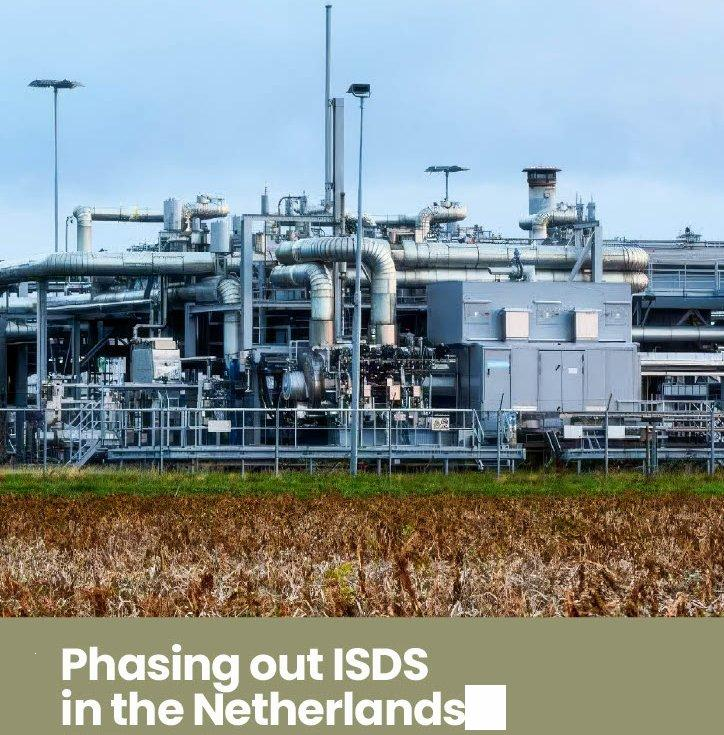
Background: Frozen Assets, Hot Claims (December 2025) maps ISDS claims by sanctioned investors.Phasing out ISDS in the Netherlands: a roadmap sets out how the Netherlands can exit. https://europeantradejustice.org/european-isds-scorecard-2026/ ranks the harmful effects of 30 countries’ investment treaties https://www.somo.nl/aftershock-in-groningen/ describes how Shell and ExxonMobil use arbitration to offload the costs of closing the Groningen gas field in the Netherlands.
-
The figure of EUR 10.5 billion is based on data are aggregated by PowerShift based on UNCTAD figures.
-
Petition launches on 15 October 2026 (English version): https://handelanders.nl/en/sign-the-petition-stop-isds Dutch version: https://handelanders.nl/teken-de-petitie-stop-isds The complaint and petition are part of the Global Days of Action against ISDS, 15-17 October 2026: https://stopisds.global/en/
-
A press release with more information about the context in Portugal will be sent in Portuguese to the national press.
About Handel Anders!
Handel Anders! is a Dutch coalition of civil society organisations, including environmental and human rights organisations, research organisations, trade unions and farmers’ groups, that calls for sustainable and just trade.
About TROCA
A non-partisan, civil society, volunteer-led group in Portugal dedicated to fostering fair international trade, which currently focuses its campaigning on the fight against the ISDS mechanism.
Spokespeople available for interviews:
- Linda Fokkema, coordinator, Handel Anders! Email: l.fokkema@tni.org
- Eduardo Proença, member of TROCA. Email: info@plataforma-troca.org
- Marius Troost, Senior policy expert on trade and investment, Both ENDS. Email: m.troost@bothends.org
- Bart-Jaap Verbeek, Senior Researcher, SOMO. Email: b.verbeek@somo.nl
- Frances Verkamp, Trade and Investment campaigner, Friends of the Earth Europe. Email: frances.verkamp@foeeurope.org
Read more about this subject
-
 Dossier /
International trade and investment with respect for people and planet
The network of international trade and investment treaties is large and complex. The Netherlands alone has signed more than 70 bilateral investment treaties (BITs) and is party to the trade and investment agreements concluded by the EU, like the EU-Mercosur and EU-Indonesia trade deals.
-
 Dossier /
Rights for People, Rules for Corporations – Stop ISDS!
Indigenous communities in Paraguay saw their attempts to regain their ancestral lands thwarted by German investors. In Indonesia, US-based mining companies succeeded to roll back new laws that were meant to boost the country’s economic development and protect its forests. This is the level of impact that investment treaties can have on social, environmental and economic development and rights. Why? Because of the ‘Investor-to-State Dispute Settlement’ clauses that are included in many such treaties.
-
 Dossier /
Trade agreements
International trade agreements often have far-reaching consequences not only for the economy of a country, but also for people and the environment. It is primarily the most vulnerable groups who suffer most from these agreements.
-
 News / 15 oktober 2026
ISDS infringement complaint filed with the European Commission
The Netherlands and Portugal join four other EU countries facing such a complaint.
-
 News / 29 september 2026
Summary - Both ENDS complaint under the EU-New Zealand trade agreement
On 29 September 2026, Both ENDS lodged the first complaint on climate grounds with the European Commission's Single Entry Point. It asks the Commission to examine whether Aotearoa New Zealand has broken two promises both sides made in the EU-New Zealand Free Trade Agreement: not to weaken or set aside environmental laws in order to encourage trade or investment, and to effectively implement the Paris Agreement.
-
Publication / 29 september 2026
-
 News / 29 september 2026
Q&A: New Zealand's climate rollback and the EU trade agreement
On 29 September 2026 / 30 September in Aotearoa New Zealand, Both ENDS lodged a complaint with the European Commission under the EU-New Zealand Free Trade Agreement. These are the questions we are asked most often, and our answers. The complaint summary, the case explainer and the key public sources are linked at the end of this page.
-
 Press release / 29 september 2026
New Zealand faces its first climate complaint under EU trade rules
UTRECHT / WELLINGTON, 29 September 2026 /30 September in Aotearoa New Zealand
Both ENDS, a Dutch environmental justice organisation, has lodged a formal complaint with the European Commission arguing that New Zealand has broken the climate promises it made in its free trade agreement with the European Union. It is the first complaint on environmental and climate grounds under the Commission's Single Entry Point, the mechanism that lets civil society ask the EU to enforce the sustainability commitments in its trade agreements.
-
Publication / 3 juli 2026
-
Publication / 18 juni 2026
-
Publication / 14 april 2026
-
 Blog / 25 november 2025
COP30 shows why dismantling ISDS is essential for real climate action
Standing in Belém during COP30, I felt the weight of the moment. We came to the Amazon hoping for decisive progress on phasing out fossil fuels, yet the final outcome fell far short of the ambition science and justice demand. The agreement brought welcome commitments on adaptation finance and global indicators, but it refused to confront the structural forces that make climate action so difficult.
-
 News / 5 november 2025
Another ISDS claim hits the Netherlands: Petrogas sues over solidarity contribution and royalty regulations
SOMO and Both ENDS strongly condemn the newly revealed investor-state dispute settlement (ISDS) case filed by Petrogas, an Omani oil and gas company operating two shallow-water gas fields in the Dutch North Sea, against the Netherlands under the Netherlands-Oman bilateral investment treaty (BIT).
-
Publication / 16 oktober 2025
-
Publication / 16 oktober 2025
-
 News / 6 oktober 2025
From Entebbe to Accra: civil society is rewriting the rules of investment
By Fernando Hernández Espino and Bart-Jaap Verbeek
Almost a year after African civil society gathered in Uganda to adopt the Entebbe Declaration, the call to transform international investment governance continues to gain strength. From the 6th to the 9th of October, over 50 civil society organisations from across West Africa, including from Ghana, Senegal, Nigeria, Côte d’Ivoire, Cameroon, Gambia, Sierra Leone, as well as from Kenya and Latin America, are convening in Accra to deepen and operationalise the Declaration’s vision.
-
 News / 23 september 2025
With the undemocratic splitting of the EU-Mercosur deal, Europe is missing the chance to lead on fair trade
Recently, many newspapers have written about Brussels’ rush to finalize the trade agreement between the EU and the South American Mercosur countries. According to the European Commission, national parliaments do not need to approve it because the trade part and the “political” part have been separated. This “splitting” means that the trade part can be approved as an EU-only decision by the European Council and the European Parliament, while national parliaments are sidelined and the political-cooperation part is postponed. Both ENDS and its partners are deeply concerned and are calling on the Dutch government to vote against this outdated agreement.
-
 News / 22 september 2025
EU-Indonesia Trade Deal Threatens Communities and Environment
On September 23th the European Union and Indonesia concluded their negotiations of the EU-Indonesia Comprehensive Economic Partnership Agreement (CEPA), a free trade agreement between the EU and Indonesia. Both ENDS condemns this agreement for favoring corporate interests over those of local communities and the environment.
-
 News / 11 september 2025
EU-Mercosur: Small GDP Gain, Big Question Marks for Farmers and Democracy
A recent report by Wageningen Economic Research (WER) on the economic consequences of the trade agreement between the EU and Mercosur confirms what civil society organizations, policymakers, and trade unions have been signaling for years: this agreement does not offer a balanced perspective for farmers and the environment. Instead, it increases power inequalities and shifts burdens onto (small-scale) farmers. Moreover, the deal risks reinforcing unsustainable practices that complicate the climate transition and addressing environmental challenges in both the EU and Mercosur countries.
-
 Blog / 12 augustus 2025
Nickel mining for the energy transition: who is accountable for the damage?
Photo blog - In June, I travelled to Indonesia with our partner organization Puanifesto to research the impacts of nickel mining in East Sulawesi. On July 13th, the news broke that the European Union and Indonesia have reached a political agreement on a free trade agreement that was years in the making, called the Comprehensive Economic Partnership Agreement (CEPA). Nickel from Sulawesi is already being used in European cars. This makes it all the more important that we ensure that human and environmental rights are secured in mining and refining operations in Indonesia, before the road is opened to more extraction and exploitation for the European market. The conversations we have had with communities and workers on East Sulawesi show that more binding regulations are necessary to make this happen and ensure an energy transition that is socially and environmentally just.