




Investor protection blocking climate action
How ISDS must be tackled at Santa Marta
From 24-29 April 2026, Colombia and the Netherlands are co-hosting the First Conference on Transitioning Away from Fossil Fuels in Santa Marta. The goal is urgent and widely shared: to accelerate a just and orderly phaseout of coal, oil and gas. But while governments are under growing pressure to act on climate change, a less visible legal obstacle could undermine progress: investor-state dispute settlement (ISDS).
The hidden legal barrier to climate action
ISDS is a legal mechanism that allows foreign investors to sue states before international arbitration tribunals when public policies affect their investments. It appears in thousands of bilateral investment treaties (BITs), trade agreements and investment contracts.
This mechanism emerged after the Second World War and was promoted as a tool to protect investors from political risk in newly independent states. In practice, it has reflected the economic interests of former colonial powers, and today, ISDS has become a tool for companies to bypass domestic courts and challenge climate and energy policies, regulatory reforms, and even efforts to enforce accountability for social and environmental harm.
In the context of climate policy, this matters greatly. Closing coal plants, cancelling oil and gas licenses, or strengthening environmental regulations have all triggered ISDS claims worth billions in alleged lost future profits.
Such cases reveal a deeper structural power imbalance: while companies gain legal tools to defend their interests, governments face financial risk and political pressure when regulating in the public interest. The mere threat of billion-dollar claims can dilute or delay ambitious climate policies, a phenomenon widely described as “regulatory chill”.
In a world that urgently needs to move away from fossil fuels, this imbalance between private legal power and public interest policy is becoming increasingly untenable.
The Netherlands as a hub for the ISDS system
The Netherlands plays a central role in this system. It was the first country to include ISDS in an investment treaty in 1968, with its former colony, Indonesia. Today, it maintains one of the world’s largest treaty networks, with 70 active BITs containing ISDS. Dutch treaties are highly investor-friendly and widely exploited through “treaty shopping”, where investors channel investment through so-called “mailbox” companies with minimal activity in the Netherlands to benefit from tax advantages and access to the country’s extensive treaty network.
As shown in the newly launched Dutch ISDS Datahub, Dutch treaties have been used in at least 140 known ISDS cases, nearly 10 per cent of all cases worldwide, making the Netherlands second only to the United States. These cases have exposed governments worldwide to US$ 113 billion in claimed compensation, with around US$ 20 billion already paid out to investors. The financial pressure of billions in potential liability weighs on public budgets, especially in the Global South, diverting resources from the very policies needed to achieve a just energy transition.
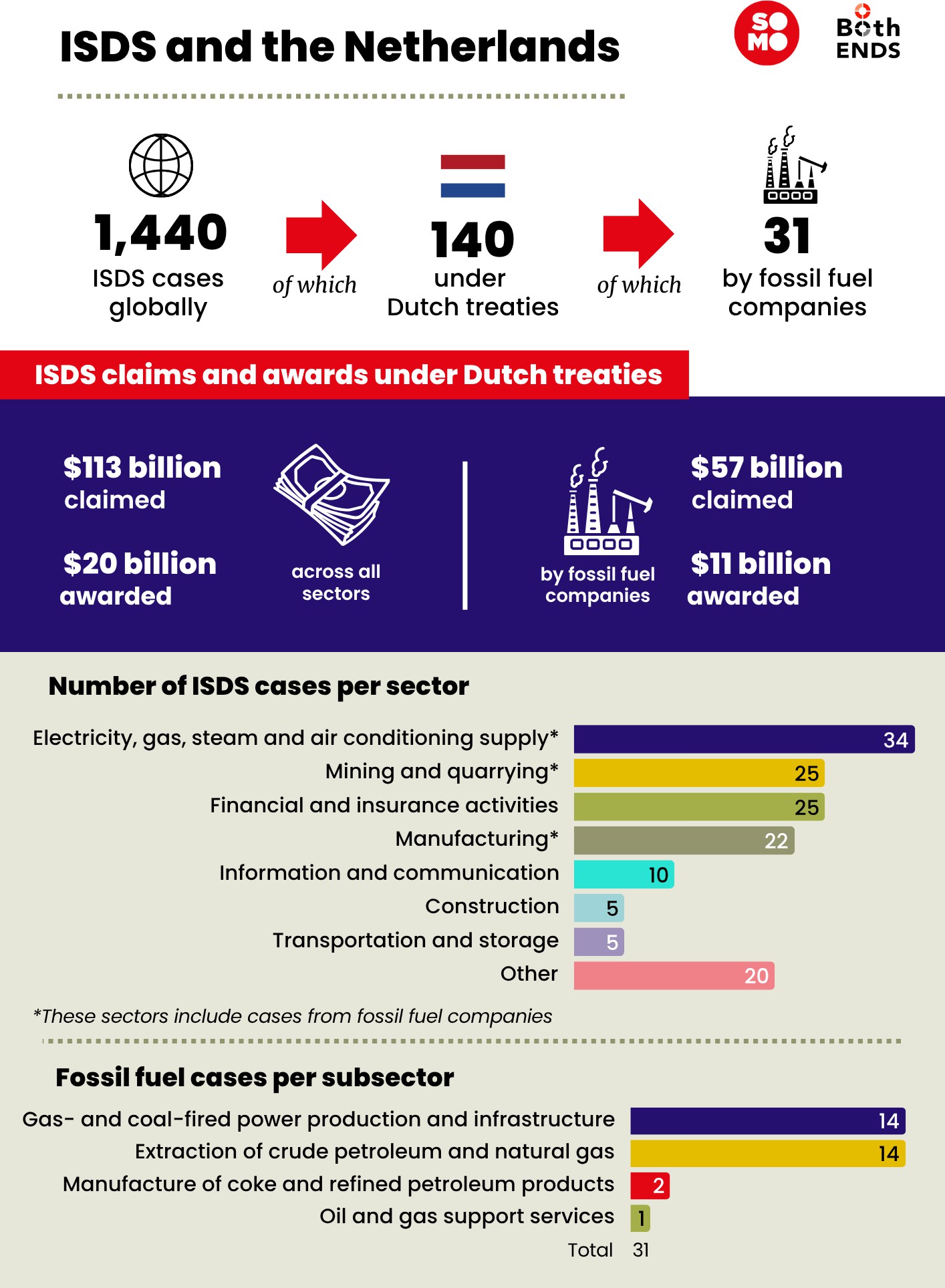
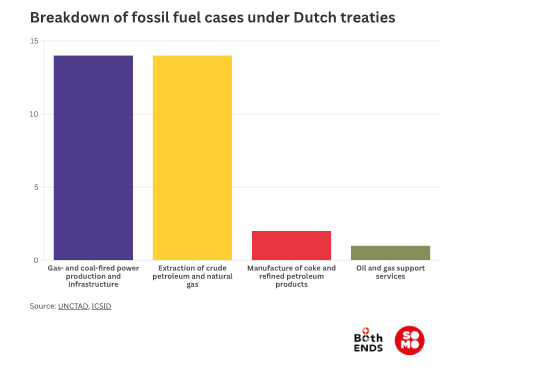
A significant share (22 per cent) of ISDS cases under Dutch treaties involve fossil fuel investments, with claims exceeding US$ 57 billion, of which US$ 11 billion has already been awarded. Major oil and gas companies such as Shell, ExxonMobil, TotalEnergies, ConocoPhillips, Eni, and Woodside Energy have relied on Dutch treaties to sue countries such as Nigeria, the Philippines, Senegal, Uganda, and Venezuela.
At the same time, the Netherlands has also become a target of ISDS claims itself. Between 2022 and 2025, Shell and ExxonMobil initiated multiple arbitrations over the closure of the Groningen gas field, claiming billions in lost revenues while disputing their liability for decades of extraction-related damage. In 2021, German utilities RWE and Uniper sued the Netherlands over its coal phase-out legislation, seeking a combined € 2.4 billion in compensation. Even though these cases were later dropped, the Netherlands was still forced to pay millions in legal costs.
In this sense, the Netherlands is now experiencing what countries in the Global South have faced for decades: the threat of costly arbitration, regulatory pressure, and legal challenges to measures taken in the public interest.
Momentum for change is building
There is no conclusive evidence that ISDS is necessary to attract foreign direct investment. At the same time, the financial and regulatory stakes are well documented. Across the world, governments are increasingly acknowledging that ISDS can conflict with climate action and environmental policy.
Colombia recently announced its intention to withdraw from ISDS, noting that the system too often favours private investors over the public interest and exposes the state to financial risks. This move was backed by a letter from 220 leading economists and academics, including prominent scholars like Joseph Stiglitz, Ha-Joon Chang, and Thomas Piketty, who argue that ISDS creates no measurable boost in investment but imposes enormous legal and financial risks on governments.
Other countries, such as Bolivia, Ecuador, India, Indonesia, and South Africa, have already taken steps to terminate their investment treaties. Even countries in the Global North, including traditionally strong supporters of ISDS, are shifting.
Australia no longer includes ISDS in new treaties and has sought to remove such provisions from existing ones. The United States and Canada have eliminated ISDS in their renegotiated North American trade agreement, while limiting its scope in relation to Mexico. A large number of European countries – including the Netherlands and the EU itself – have withdrawn from the Energy Charter Treaty after recognising incompatibility with climate objectives.
Yet despite this momentum, more than 2,600 treaties – most containing ISDS –remain in force globally.
Santa Marta: a chance for coordinated action
The Santa Marta Conference offers a unique opportunity to address these challenges directly. One of its thematic pillars focuses specifically on removing international legal barriers to a just transition, including ISDS.
For this discussion to be meaningful, this pillar must move beyond diagnosing the problem towards practical, coordinated solutions to reduce governments’ exposure to ISDS. As co-hosts, Colombia and the Netherlands have a particular responsibility to lead.
For the Netherlands in particular, this includes addressing its own treaty network and supporting international efforts to advance practical solutions.
Pathways for phasing out ISDS
To support these discussions, Both ENDS en SOMO have developed a roadmap outlining several pathways that states can pursue individually or collectively to reduce or eliminate ISDS risks in the context of a fossil fuel phase-out, using the Netherlands as an illustrative example.
- Avoid new ISDS commitments. Governments should refrain from negotiating or ratifying new treaties that contain ISDS provisions.
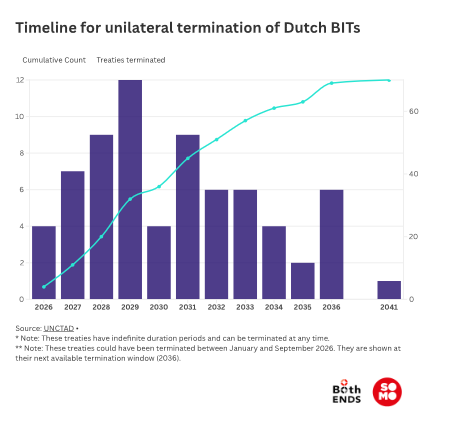
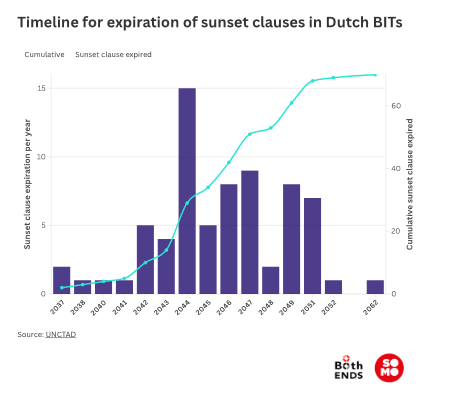
- Terminate or amend existing treaties. Investment treaties can be terminated by mutual agreement at any time, or unilaterally if governments respect notification timelines to avoid automatic renewal. Many treaties, however, include sunset clauses that extend investor protections for 10-20 years after termination.
- Pursue multilateral coordination. Addressing treaties one by one can take decades. In the Dutch case, for example, the final treaty that could be unilaterally terminated only expires in 2041, with investor protections potentially lasting until 2062 due to sunset clauses. Governments could therefore explore a multilateral instrument that allows participating countries to jointly terminate investment treaties and neutralise sunset clauses among themselves.
- Avoid ISDS in investment contracts. ISDS provisions in contracts with companies can create similar legal risks as treaty-based ISDS. Governments should likewise review existing contracts in key sectors and renegotiate where possible to remove ISDS provisions.
The legal options and precedents to curb or end ISDS already exist. The main barrier is not feasibility, but political will.
Why can’t action wait
The evidence is quite clear: ISDS does little to increase investment, but it does create significant legal and financial risks. Most importantly, it can constrain governments’ ability to regulate in the public interest at a time when decisive and prompt climate action is essential.
As policymakers gather in Santa Marta, the stakes are high. Will Colombia, the Netherlands and other participating states act decisively to reclaim the policy space needed for a just transition? Or will the energy transition remain constrained by legal barriers arising from ISDS?
We are also launching a Dutch ISDS Datahub to bring together the key information on Dutch bilateral investment treaties (BITs), their termination deadlines, and known ISDS cases linked to the Netherlands both abroad and at home.
Download the Roadmap to phasing out ISDS in the Netherlands
Read the full publication

Investor protection blocking climate action

For more information
Read more about this subject
-
 Dossier /
Rights for People, Rules for Corporations – Stop ISDS!
Indigenous communities in Paraguay saw their attempts to regain their ancestral lands thwarted by German investors. In Indonesia, US-based mining companies succeeded to roll back new laws that were meant to boost the country’s economic development and protect its forests. This is the level of impact that investment treaties can have on social, environmental and economic development and rights. Why? Because of the ‘Investor-to-State Dispute Settlement’ clauses that are included in many such treaties.
-
 Dossier /
Trade agreements
International trade agreements often have far-reaching consequences not only for the economy of a country, but also for people and the environment. It is primarily the most vulnerable groups who suffer most from these agreements.
-
 Dossier /
International trade and investment with respect for people and planet
The network of international trade and investment treaties is large and complex. The Netherlands alone has signed more than 70 bilateral investment treaties (BITs) and is party to the trade and investment agreements concluded by the EU, like the EU-Mercosur and EU-Indonesia trade deals.
-
 News / 15 October 2026
ISDS infringement complaint filed with the European Commission
The Netherlands and Portugal join four other EU countries facing such a complaint.
-
 Press release / 15 October 2026
Dutch and Portuguese organisations file EU complaint over investment treaties that let companies and sanctioned Russian oligarchs sue EU countries for compensation
The Netherlands and Portugal join four other EU countries facing such a complaint, as the Global Days of Action against Investor-State Dispute Settlement (ISDS) begin.
-
Publication / 29 September 2026
-
 News / 29 September 2026
Q&A: New Zealand's climate rollback and the EU trade agreement
On 29 September 2026 / 30 September in Aotearoa New Zealand, Both ENDS lodged a complaint with the European Commission under the EU-New Zealand Free Trade Agreement. These are the questions we are asked most often, and our answers. The complaint summary, the case explainer and the key public sources are linked at the end of this page.
-
 Press release / 29 September 2026
New Zealand faces its first climate complaint under EU trade rules
UTRECHT / WELLINGTON, 29 September 2026 /30 September in Aotearoa New Zealand
Both ENDS, a Dutch environmental justice organisation, has lodged a formal complaint with the European Commission arguing that New Zealand has broken the climate promises it made in its free trade agreement with the European Union. It is the first complaint on environmental and climate grounds under the Commission's Single Entry Point, the mechanism that lets civil society ask the EU to enforce the sustainability commitments in its trade agreements.
-
Publication / 3 July 2026
-
 News / 14 April 2026
New report: Phasing out ISDS in the Netherlands: a roadmap
Today, Both ENDS and SOMO are publishing the report Phasing out ISDS in the Netherlands: a roadmap. In the report, we highlight the Netherlands’ role in the ISDS system and offer practical guidance on phasing out ISDS.
-
 News / 26 March 2026
New project: Climate Accountability in EU Trade
Through its new project “Climate Accountability in EU Trade: Testing the SEP and DAGs for Climate-Linked FTA Enforcement” Both ENDS, with support from the European Climate Foundation, is exploring how the European complaints mechanism (SEP) and Domestic Advisory Groups (DAGs) can be more effectively used to advance climate accountability. The project runs for 13 months, until end of 2026.
-
 News / 22 January 2026
Shell files new arbitration against the Netherlands over Groningen gas field closure
Shell is suing the Netherlands in yet another attempt to evade its responsibility for decades of gas extraction in Groningen. For years, gas production has triggered earthquakes, damaged over a hundred thousand homes, and left residents living in prolonged insecurity, still waiting for repairs, reinforcement, and justice.
-
 Blog / 25 November 2025
COP30 shows why dismantling ISDS is essential for real climate action
Standing in Belém during COP30, I felt the weight of the moment. We came to the Amazon hoping for decisive progress on phasing out fossil fuels, yet the final outcome fell far short of the ambition science and justice demand. The agreement brought welcome commitments on adaptation finance and global indicators, but it refused to confront the structural forces that make climate action so difficult.
-
 News / 5 November 2025
Another ISDS claim hits the Netherlands: Petrogas sues over solidarity contribution and royalty regulations
SOMO and Both ENDS strongly condemn the newly revealed investor-state dispute settlement (ISDS) case filed by Petrogas, an Omani oil and gas company operating two shallow-water gas fields in the Dutch North Sea, against the Netherlands under the Netherlands-Oman bilateral investment treaty (BIT).
-
 News / 5 November 2025
Interview: Both ENDS at COP30 for Climate Justice and Systemic Change
Both ENDS is present at COP30 to advocate for genuine access to climate finance for locally led, gender-just climate solutions and the mechanisms that facilitate this, including those for farmer-led restoration. Furthermore, the organisation participates to ensure the crucial connection between the climate negotiations and the trade and investment frameworks that shape them.
Learn more about the Both ENDS team at COP30 below, and find all the activities and side-events in which Both ENDS will participate.
-
 News / 5 November 2025
Overview of Both ENDS events at COP30 in Belem, Brazil
Both ENDS is present at COP30 to advocate for genuine access to climate finance for locally led, gender-just climate solutions, and for the mechanisms that make these possible, including those supporting farmer-led restoration. The organisation also engages to highlight the crucial connection between climate negotiations and the trade and investment frameworks that shape them.
Below is an overview of the Both ENDS team at COP30 and a detailed look at the activities and side-events in which Both ENDS will participate.
-
Publication / 16 October 2025
-
Publication / 16 October 2025
-
 News / 6 October 2025
From Entebbe to Accra: civil society is rewriting the rules of investment
By Fernando Hernández Espino and Bart-Jaap Verbeek
Almost a year after African civil society gathered in Uganda to adopt the Entebbe Declaration, the call to transform international investment governance continues to gain strength. From the 6th to the 9th of October, over 50 civil society organisations from across West Africa, including from Ghana, Senegal, Nigeria, Côte d’Ivoire, Cameroon, Gambia, Sierra Leone, as well as from Kenya and Latin America, are convening in Accra to deepen and operationalise the Declaration’s vision.
-
 News / 23 September 2025
With the undemocratic splitting of the EU-Mercosur deal, Europe is missing the chance to lead on fair trade
Recently, many newspapers have written about Brussels’ rush to finalize the trade agreement between the EU and the South American Mercosur countries. According to the European Commission, national parliaments do not need to approve it because the trade part and the “political” part have been separated. This “splitting” means that the trade part can be approved as an EU-only decision by the European Council and the European Parliament, while national parliaments are sidelined and the political-cooperation part is postponed. Both ENDS and its partners are deeply concerned and are calling on the Dutch government to vote against this outdated agreement.


