Unprecedented criminal conviction in the Mariana disaster case breaks mining industry's cycle of impunity
A Brazilian federal court has, for the first time, criminally convicted a mining company and three of its managers for their role in the 2015 collapse of the Fundão dam, one of the worst environmental disasters in Brazil's history. Our partner Instituto Cordilheira, which represented victims as assistant prosecutors in the case, calls it a historic breakthrough after years of impunity.
On 3 September 2026, the second Panel of the Federal Regional Court (TRF-6) in Belo Horizonte unanimously convicted mining company Samarco Mineração S/A and three of its former managers - engineers Germano Silva Lopes, Daviély Rodrigues Silva and Wagner Milagres Alves - over the November 2015 collapse of the Fundão tailings dam in Mariana, Minas Gerais. The disaster killed 19 people (families count 20, as one of the victims was pregnant), destroyed the village of Bento Rodrigues, and sent a wave of toxic mining waste down the entire Rio Doce basin, with effects still felt today.
Both ENDS and Instituto Cordilheira
Both ENDS has supported Instituto Cordilheira since 2021, as the organisation's first funder. "If we're still here working today, it's because Both Ends trusted us and continue to trust us," said Carolina de Moura of Instituto Cordilheira. Since then, the organisation has become a key legal voice for communities affected by mining disasters in Brazil, also acting as assistant prosecutor in the ongoing criminal case over the 2019 Brumadinho dam collapse.
Alongside this direct support, Both ENDS has spent years amplifying the fight for justice for communities affected by Vale's disasters in Mariana and Brumadinho on the international stage. Both ENDS has also continued to press Dutch investors in Vale to reckon with the risks the company's conduct poses to people and the environment.
The verdict
Samarco - a joint venture between mining giants Vale and BHP Billiton - was barred from contracting with public authorities for 10 years and ordered to pay roughly R$7.2 million (about EUR 1.2 million) in fines. The two lead engineers were sentenced to eight years and nine months in prison; the third manager, found to have played a smaller role, received seven years, three months and 15 days. Ten other defendants, including Vale, BHP Billiton and engineering firm VogBR, remain acquitted - a decision the Federal Public Prosecutor's Office says it will now study closely, with an eye to appeal.
The ruling overturns a November 2024 first-instance decision that had acquitted all defendants. Instituto Cordilheira, acting alongside the Federal Public Prosecutor's Office as assistant prosecutor for the victims, had appealed that acquittal, a legal fight it has pursued since it was founded.
"We have broken the cycle of impunity," said lawyer Danilo Chammas of Human Rights Litigation Team at Instituto Cordilheira. "By recognising that Samarco and three of its managers knew the risk, ignored warnings and chose to look away, the judiciary has finally confirmed that this was not an accident. Even though the company's top directors were spared, we hope this ruling drives real change and pushes for an urgent review of the contracts this now-convicted company still holds with public authorities."
Voices from the communities
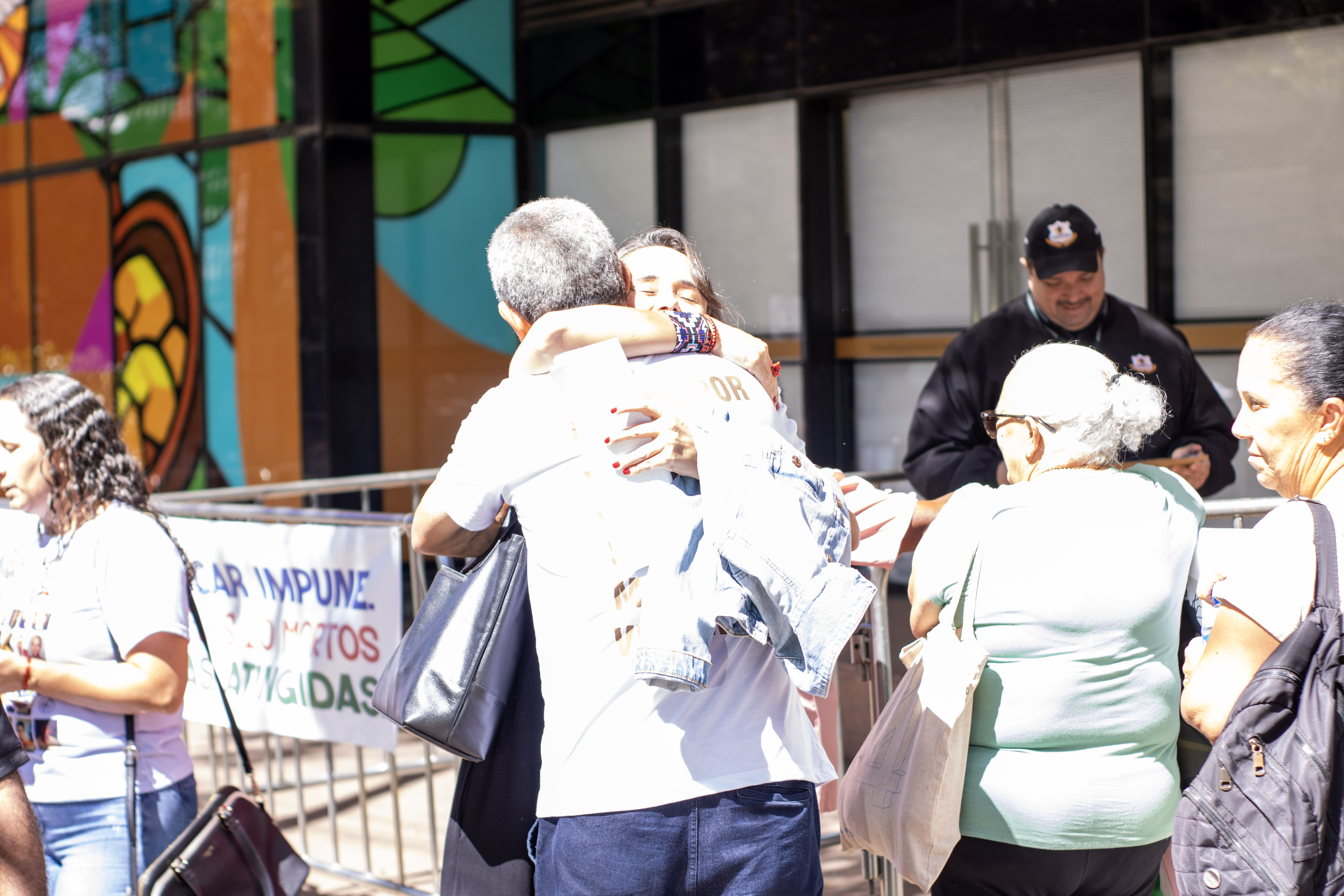
More than 100 people affected by the disaster travelled to Belo Horizonte to follow the hearing, and gathered outside the courthouse afterwards to mark what they described as a partial but hard-won victory - among them residents of Bento Rodrigues, families of victims, and members of the Quilombola community of Gesteira.
Mônica dos Santos, who lost her home in the disaster, was emotional outside the court: "Today is a day of joy, a day to look at our country's justice system and start believing in it again. We know this is only a first step, and that they will appeal but we're prepared. If we have to go to Brasília, or to another country, wherever this fight for justice takes us, we will go." She added: "If what happened here today had happened back in 2015, when the dam collapsed, I'm certain Brumadinho would never have broken and 272 lives could have been spared," referring to the 2019 Vale dam disaster in Brumadinho.
Read more about this subject
-
 Dossier /
Trade agreements
International trade agreements often have far-reaching consequences not only for the economy of a country, but also for people and the environment. It is primarily the most vulnerable groups who suffer most from these agreements.
-
 Dossier /
International trade and investment with respect for people and planet
The network of international trade and investment treaties is large and complex. The Netherlands alone has signed more than 70 bilateral investment treaties (BITs) and is party to the trade and investment agreements concluded by the EU, like the EU-Mercosur and EU-Indonesia trade deals.
-
 Dossier /
Rights for People, Rules for Corporations – Stop ISDS!
Indigenous communities in Paraguay saw their attempts to regain their ancestral lands thwarted by German investors. In Indonesia, US-based mining companies succeeded to roll back new laws that were meant to boost the country’s economic development and protect its forests. This is the level of impact that investment treaties can have on social, environmental and economic development and rights. Why? Because of the ‘Investor-to-State Dispute Settlement’ clauses that are included in many such treaties.
-
 News / 15 October 2026
ISDS infringement complaint filed with the European Commission
The Netherlands and Portugal join four other EU countries facing such a complaint.
-
 Press release / 15 October 2026
Dutch and Portuguese organisations file EU complaint over investment treaties that let companies and sanctioned Russian oligarchs sue EU countries for compensation
The Netherlands and Portugal join four other EU countries facing such a complaint, as the Global Days of Action against Investor-State Dispute Settlement (ISDS) begin.
-
 Dossier /
Dare to Trust: the power of unconditional funding
At Both ENDS we cherish our long-term relationships with partners in our global network. These relationships are based on equality and built on trust. The trust we have in each other has developed from years of strategic cooperation, including joint advocacy around common agendas, knowledge sharing, networking, and mobilising and sharing resources to advance environmental justice.
-
 Dossier /
Global Alliance for Green and Gender Action (GAGGA)
GAGGA rallies the collective power of the women's rights and environmental justice movements to realize a world where women can and do access their rights to water, food security, and a clean, healthy and safe environment.
-
 News / 5 October 2026
Rural Women's Assembly wins Right Livelihood Award
We are thrilled to share that our partner the Rural Women's Assembly (RWA) is one of this year's Right Livelihood Laureates! The award, often called the "Alternative Nobel Prize", honours RWA for bringing together more than 178,000 women farmers in eleven Southern African countries. Together, these women stand up for their land, their seeds and their right to make decisions about their own lives and bodies.
-
 News / 29 September 2026
Summary - Both ENDS complaint under the EU-New Zealand trade agreement
On 29 September 2026, Both ENDS lodged the first complaint on climate grounds with the European Commission's Single Entry Point. It asks the Commission to examine whether Aotearoa New Zealand has broken two promises both sides made in the EU-New Zealand Free Trade Agreement: not to weaken or set aside environmental laws in order to encourage trade or investment, and to effectively implement the Paris Agreement.
-
Publication / 29 September 2026
-
Publication / 29 September 2026
-
 News / 29 September 2026
Q&A: New Zealand's climate rollback and the EU trade agreement
On 29 September 2026 / 30 September in Aotearoa New Zealand, Both ENDS lodged a complaint with the European Commission under the EU-New Zealand Free Trade Agreement. These are the questions we are asked most often, and our answers. The complaint summary, the case explainer and the key public sources are linked at the end of this page.
-
 News / 29 September 2026
What happens now? A timeline of the SEP Case
What happens now? On 29 September 2026 / 30 September in Aotearoa New Zealand, Both ENDS lodged a formal complaint with the European Commission. It is the first complaint to the EU's Single Entry Point on environmental and climate grounds. It asks the Commission to hold New Zealand to two promises it made in its trade agreement with the EU: not to weaken environmental protection to encourage trade or investment, and not to undermine the Paris Agreement on climate change.
-
 Press release / 29 September 2026
New Zealand faces its first climate complaint under EU trade rules
UTRECHT / WELLINGTON, 29 September 2026 /30 September in Aotearoa New Zealand
Both ENDS, a Dutch environmental justice organisation, has lodged a formal complaint with the European Commission arguing that New Zealand has broken the climate promises it made in its free trade agreement with the European Union. It is the first complaint on environmental and climate grounds under the Commission's Single Entry Point, the mechanism that lets civil society ask the EU to enforce the sustainability commitments in its trade agreements.
-
 News / 10 September 2026
Rutu Foundation receives UNESCO Literacy Prize for multilingual education
Both ENDS’ partner the Rutu Foundation for Intercultural Multilingual Education has been awarded the 2026 UNESCO King Sejong Literacy Prize for its language friendly school programme. This prestigious prize recognises the importance of multilingual education and the right of children to learn in an environment where their home languages are valued.
-
 Dossier /
Communities Regreen the Sahel
In various countries in the Sahel, vast tracts of land have been restored by the local population by nurturing what spontaneously springs from the soil and protecting the sprouts from cattle and hazards.
-
 News / 3 September 2026
Restoring Land, Restoring Hope: Both ENDS at UNCCD COP17 in Mongolia
From 17 to 28 August, governments gathered in Ulaanbaatar, Mongolia, for COP17 of the UN Convention to Combat Desertification (UNCCD). At stake was more than how the world responds to land degradation and drought. It was also a question of who gets to shape land restoration, whose knowledge counts, and where the money goes.
-
Letter / 14 July 2026
Statement on CAO Cambodia Microfinance Case
The independent complaints mechanism of the International Finance Corporation (IFC) and the World Bank Group found that the IFC violated its own Environmental and Social Sustainability Framework by investing in six banks providing microfinance in Cambodia.
-
 News / 6 July 2026
Strengthening Women's Land Rights Across the Rio Conventions
From 29 June – 2 July 2026, Tamara Mohr, GAGGA coordinator at Both ENDS participated in the 4th convening of the Women's Land Rights Initiative (WLRI) in Nairobi, Kenya.Hosted by the Robert Bosch Stiftung, TMG Research and the Huairou Commission, the event brought together grassroots organisations, (inter)national NGOs, government institutions and donors from around the world.
-
Publication / 3 July 2026