




Indigenous leaders present 'Supply Chain Solutions' and petition in Paris and Brussels
Last week, indigenous leaders from various countries were in Paris to urge action on deforestation and human rights abuses at the multi-stakeholder meeting of the Amsterdam Declarations Partnership. The group, invited by Forests Peoples Programme and Both ENDS, presented a publication 'Supply chain solutions for people and forests' containing a set of practical recommendations from local communities on how to make supply chains more sustainable and fair.
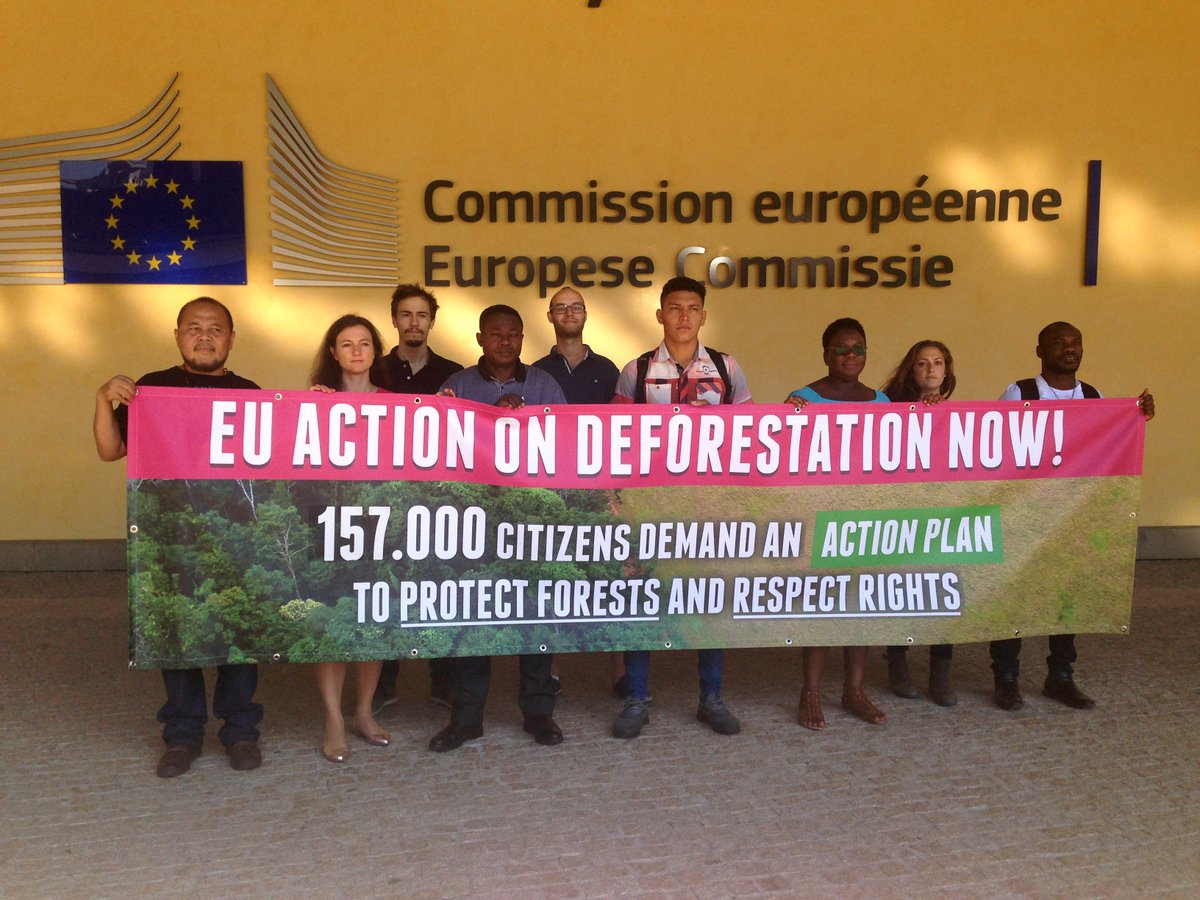
Together with our partner Forest Peoples Programme (FPP) we issued a press release (also see below) on June 28th. After the events in Paris, the delegates went to Brussels to present a petition signed by 157 000 people urging European Commission President Jean-Claude Juncker to uphold the European Union’s international commitment to halt deforestation by 2020 by supporting an EU Action Plan to protect forests and respect forest peoples’ rights.

PRESS RELEASE - 28 JUNE 2018
Indigenous leaders and human rights defenders from four tropical forest countries are travelling to Paris to urge action on deforestation and human rights abuses at the 27 June multistakeholdermeeting of the Amsterdam Declarations Partnership, 'Towards deforestation-free sustainable commodities: focus on key drivers'.
Six European Union member states and Norway have pledged to work with companies to eliminate deforestation from their agriculturalcommodity supply chains by 2020. As the deforestation-free trade target date gets ever closer, European countries continue to import palm oil and other agri-commodities causing negative impacts on forests and forest peoples. Indigenous and forest community representatives are in Paris urging immediate action.
Among the delegates coming to Paris is a human rights defender Ramón Bedoya from Colombia whose father was killed defending his community's ancestral lands in the Mi Terrabiodiversity zone.
Franky Samperante from Indonesia, where communities are suffering land conflicts, violence and intimidation at the hands of oil palm, pulp, paper and logging companies explains:"Logging and plantation companies in Indonesia continue to demolish, evict, and destroy our forests and agro-forests. Communities have lost and are still losing their livelihoods. They now have difficulties in finding decent sources of food. Their indigenous knowledge is threatened and they are suffering malnutrition and health problems. Action has to betaken to stop rights violations and forest clearance."
Who:
Jean-Marie Nkanda from Democratic Republic of the Congo, Wilhemina Beyan from Liberia, James Otto from Liberia, Franky Samperante from Indonesia and Ramón Bedoya from Colombia. See short biographies below.
Issues at stake:
Indigenous and forest communities around the world are losing their lives, land and livelihoods to world trade in agricultural products and other conflict commodities. Next week, indigenous peoples and community representatives will travel to Paris to set out the essential measures needed to reform global supply chains, ensuring respect for their lands, forests and human rights.
Their message comes during the French presidency of the Amsterdam Declarations, when the signatory countries will discuss progress made towards combatting deforestation. The Declarations, signed in 2015, commit the signatories to remove agricultural products driving deforestation from supply chains. The signatory countries are the United Kingdom, France, Denmark, Norway, Germany, the Netherlands, and Italy.
Growing demand for commodities such as beef, soybean, palm oil, timber, pulp and paper, rubber, biofuels and minerals drives accelerating deforestation in tropical forest countries, despite pledges to achieve zero deforestation by 2020. Forest clearance is often linked to human rights violations, land theft and harm to forest peoples' livelihoods alongside habitat destruction and damage to the global climate.
Europe is a major importer of deforestation commodities, often contained in products such as shampoo, cereals, pet food, and chocolate, with 27 EU member states importing 10% of global deforestation between 1990 and 2008 alone. Existing safeguards and frameworks have been insufficient to protect indigenous and forest communities which are taking back control of their territories and resisting encroachment of companies clearing and grabbing land for commodities.
Contact:
Les Amis de la Terre, France: Sylvain Angerand +33 7 51 69 78 81
Forest People Programme, UK: Tom Griffiths +44 7889 343380
Both ENDS, Netherlands: Michael Rice +31 6 3987 8462
To interview the delegates please contact the individuals listed above.
Biographies
Democratic Republic of Congo: Mr. Jean-Marie Nkanda
Jean-Marie Nkanda is a Forest Governance Program Officer whose work focuses on the development of participatory community forestry approaches to address the drivers of deforestation, as well as the development of community monitoring and control systems for the promotion and defence of community rights. He is currently acting coordinator of Réseau Ressources Naturelles, an advocacy organization that supports the rights and interests of local communities and indigenous peoples in the management of natural resources.
Liberia: Ms. Wilhemina B. O. Beyan
Wilhemina Boahemaa Owusu Beyan is a Programs Director at the Social Entrepreneurs for Sustainable Development (SESDev) in Liberia, with 13 years' experience working in the NGO sector. A strong focus of her work has been on natural resource management and governance, and in particular building capacities of forest fringed communities and other local communities to enable them protect and secure their rights in concessions (mining, logging and agribusiness). Currently she has been designing and initiating programs that support development models which promote social, economic and environmental justice particularly for those most marginalised from, at the same time directly impacted by, current development processes such as logging, monoculture plantations and mining extractions.
Liberia: Mr. James Otto
James coordinates the Community Rights and Corporate Governance Program at Sustainable Development Institute (SDI), which aims to create space for the participation of local communities in decision making processes on natural resources. He has worked for over ten years on natural resource management and governance in Liberia, and has partnered with communities across the country in forestry, land tenure and corporate issues. SDI is currently working to document the human rights violations and deforestation activities of oil palm expansion, as well as actively campaigning for the passage of a progressive land rights act.
Indonesia: Mr. Franky Samperante
Mr. Franky Samperante is an indigenous representative from Sulawesi, and is the founder director of the indigenous peoples' organisation Pusaka, which provides support to indigenous communities in Central Kalimantan, Indonesia. In 2014, Pusaka published an atlas detailing extensive palm oil land grabs on indigenous peoples' lands in Papua and West Papua.
Malaysia: Dr. Lanash Thanda
Organisation: SEPA (Sabah Environmental Protection Association) President (2013 – present). Lanash has been working on social and environmental issues for the last 17 years. She studied law in the UK and specialises in Environmental and Planning laws and Human Rights. She is currently serving her third term as the President of SEPA. SEPA is a locally based volunteer NGO, working closely with communities/groups/individuals that are affected by unsustainable development. SEPAs' main goal for Sabah is to attain Developmental Justice and to ensure that sustainable developement is achieved as per Malaysia's commitment to International Treaties.
Colombia: Mr. Ramón Bedoya
Information available on request (for security reasons)
Notes
The press conference has been organised by Friends of the Earth France, Forest Peoples Programme, Rainforest Foundation Norway and Fern, in partnership with Pusaka, Sustainable Development Institute and Réseau Ressources Naturelles.
For more information
Read more about this subject
-
 Dossier /
Fighting for improvements in the production of palm oil
The production of palm oil is causing social and environmental problems worldwide. Both ENDS is working to make the sector fairer and more sustainable and is promoting alternatives for palm oil.
-
 Environmentally Just Practice /
Inclusive Land Governance
Both ENDS works with partners around the world to ensure that land is governed fairly and inclusively and managed sustainably with priority for the rights and interests of local communities.
-
 Dossier /
Global Alliance for Green and Gender Action (GAGGA)
GAGGA rallies the collective power of the women's rights and environmental justice movements to realize a world where women can and do access their rights to water, food security, and a clean, healthy and safe environment.
-
 Dossier /
Seeking justice for the affected communities of Vale’s mining disasters in Mariana and Brumadinho
In 2015 and 2019, the Brazilian state of Minas Gerais experienced two severe mining tragedies in Mariana and Brumadinho, due to the same mining company: Vale. Since then, the affected communities have been seeking justice, via the criminal punishment of the responsible parties, and a fair compensation for the loss of their loved ones, their homes and their livelihoods. Both ENDS supports local CSOs by amplifying their quest for justice within an international audience and, more specifically, by raising awareness amongst Dutch investors in Vale about the high risks this company’s activities pose for people and the environment.
-
 News / 2 februari 2026
Seven years after Brumadinho: impunity allows Vale’s disasters to continue
Seven years ago, the dam owned by mining company Vale collapsed in Brumadinho, Brazil, killing 272 people and severely polluting the surrounding area. While the relatives of the victims commemorate them and fight for justice, the pollution continues.
-
 Dossier /
Rights for People, Rules for Corporations – Stop ISDS!
Indigenous communities in Paraguay saw their attempts to regain their ancestral lands thwarted by German investors. In Indonesia, US-based mining companies succeeded to roll back new laws that were meant to boost the country’s economic development and protect its forests. This is the level of impact that investment treaties can have on social, environmental and economic development and rights. Why? Because of the ‘Investor-to-State Dispute Settlement’ clauses that are included in many such treaties.
-
 Dossier /
Wetlands without Borders
With our Wetlands without Borders program, we work towards environmentally sustainable and socially responsible governance of the wetlands system of the La Plata Basin in South America.
-
Publication / 17 november 2025
-
 Environmentally Just Practice /
Non-Timber Forest Products (NTFPs)
About one in every six people, particularly women, directly rely on forests for their lives and livelihoods, especially for food. This shows how important non-timber forest products (NTFPs) and forests are to ensure community resilience. Not only as a source of food, water and income, but also because of their cultural and spiritual meaning.
-
 Press release / 13 november 2025
Global Alliance Urges Dutch Government to Reconsider Endorsement of Controversial Timber Certification Scheme
A coalition of Malaysian and international NGOs has released a memorandum in response to the recent TPAC report on the Malaysian Timber Certification Scheme (MTCS). The organizations express serious concerns about the independence, quality, and credibility of the assessment carried out by the Timber Procurement Assessment Committee (TPAC).
-
 Dossier /
Trade agreements
International trade agreements often have far-reaching consequences not only for the economy of a country, but also for people and the environment. It is primarily the most vulnerable groups who suffer most from these agreements.
-
 Dossier /
Communities Regreen the Sahel
In various countries in the Sahel, vast tracts of land have been restored by the local population by nurturing what spontaneously springs from the soil and protecting the sprouts from cattle and hazards.
-
Publication / 16 oktober 2025
-
Publication / 16 oktober 2025
-
Publication / 9 oktober 2025
-
 Dossier /
International trade and investment with respect for people and planet
The network of international trade and investment treaties is large and complex. The Netherlands alone has signed more than 70 bilateral investment treaties (BITs) and is party to the trade and investment agreements concluded by the EU, like the EU-Mercosur and EU-Indonesia trade deals.
-
 Dossier /
Amplifying environmentally just practices
Because of the close relationship with their living environment, local communities often have the best ideas for the sustainable and equitable use and governance of land, water and forests. These environmentally just practices and processes successfully protect and restore ecosystems and address climate change. They are essential in the light of the multiple crises the world faces, but are in dire need of financial and policy support.
-
 News / 23 september 2025
With the undemocratic splitting of the EU-Mercosur deal, Europe is missing the chance to lead on fair trade
Recently, many newspapers have written about Brussels’ rush to finalize the trade agreement between the EU and the South American Mercosur countries. According to the European Commission, national parliaments do not need to approve it because the trade part and the “political” part have been separated. This “splitting” means that the trade part can be approved as an EU-only decision by the European Council and the European Parliament, while national parliaments are sidelined and the political-cooperation part is postponed. Both ENDS and its partners are deeply concerned and are calling on the Dutch government to vote against this outdated agreement.
-
 News / 22 september 2025
EU-Indonesia Trade Deal Threatens Communities and Environment
On September 23th the European Union and Indonesia concluded their negotiations of the EU-Indonesia Comprehensive Economic Partnership Agreement (CEPA), a free trade agreement between the EU and Indonesia. Both ENDS condemns this agreement for favoring corporate interests over those of local communities and the environment.
-
 News / 11 september 2025
EU-Mercosur: Small GDP Gain, Big Question Marks for Farmers and Democracy
A recent report by Wageningen Economic Research (WER) on the economic consequences of the trade agreement between the EU and Mercosur confirms what civil society organizations, policymakers, and trade unions have been signaling for years: this agreement does not offer a balanced perspective for farmers and the environment. Instead, it increases power inequalities and shifts burdens onto (small-scale) farmers. Moreover, the deal risks reinforcing unsustainable practices that complicate the climate transition and addressing environmental challenges in both the EU and Mercosur countries.




