


EU unveils 'Action Plan' on Deforestation
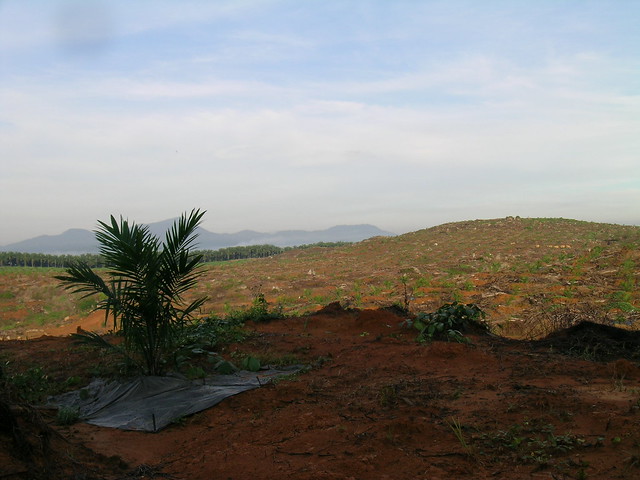
The EU is still one of the world’s largest importers of deforestation: EU demand for commodities like soy, palm oil, beef, coffee and cacao requires millions of hectares of tropical rainforest to be cleared. This deforestation has significant biodiversity and climate impacts, and is often linked to human rights violations and violence against local communities and indigenous peoples. Both ENDS and partners have been actively lobbying the EU Commission to adopt a robust action plan to address and prevent human rights violations and deforestation ‘embodied’ in EU imports of agricultural commodities.
The launch of the Commission’s long-awaited Communication on stepping-up EU action to tackle deforestation on 23 July 2019 sets an important foundation for further action and opens the door to binding regulation of EU supply chains to eradicate human rights violations and deforestation from EU imports.
Voluntary market mechanisms have failed
“The Communication is a step in the right direction”, says Michael Rice, Natural Resources Governance Officer at Both ENDS, “even though it does not adopt our calls for a rights-based approach to supply chain regulation or propose binding measures to ensure EU companies and investors are not contributing to human rights violations or deforestation.
We know that EU demand for products linked to deforestation continues to grow, forests continue to disappear at a frightening pace and violence against communities defending their lands and forests is escalating. Voluntary market mechanisms have failed to stop these trends. The Communication contains a clear recognition by the Commission that the situation is serious, getting worse, and that the EU has an unavoidable role to play in finding solutions that work. This is very welcome.”
Moral and legal obligation
Both ENDS and partners have been campaigning hard to emphasise the dire state of decline of the world’s forests and the responsibility of the industrial agriculture industry in deforestation, displacement of local and indigenous communities, violence against land and environmental defenders and attacks on community leaders. “As a major consumer of deforestation-risk commodities, the EU has a moral and legal obligation to ensure its businesses and investors are not driving deforestation or facilitating human rights violations", says Rice. "This is especially the case in this age of climate breakdown when we must be doing everything we possibly can to preserve the Earth's remaining forests and protect the communities that are fighting to defend them."
Assessment of new binding measures against deforestation
First Vice-President Timmermans announced at a press conference that the Commission is “launching preparatory work for possible regulatory measures, which can be easily picked up and built upon by the incoming Commission” and that the Commission “will start assessing new regulatory measures to prevent EU consumption linked to deforestation and forest degradation.” This announcement came just days after Ursula von der Leyen was elected to become the new President of the EU Commission, who will replacing Jean-Claude Junker on 31 October 2019 together with other changes in Commission staff.
EU must play its role to stop deforestation and human rights violations
Timmerman’s statements on the Commission’s work towards new regulatory measures are promising, and raise expectations that the incoming Commission will continue to build upon the foundation set by the Communication with proposals for binding legislative measures. “Both ENDS and our partners stand ready and willing to support the Commission in developing new legislative measures and to ensure that the perspectives, insights and knowledge of local partners and communities is included” says Rice.
More information:
Both ENDS and partners have developed a range of targeted proposals to address both demand and supply side drivers of deforestation and human rights violations and presented these to the Commission in 2018, as well as providing detailed submissions on draft communication during its development.
Read more about this subject
-
 Dossier /
International trade and investment with respect for people and planet
The network of international trade and investment treaties is large and complex. The Netherlands alone has signed more than 70 bilateral investment treaties (BITs) and is party to the trade and investment agreements concluded by the EU, like the EU-Mercosur and EU-Indonesia trade deals.
-
 Dossier /
Rights for People, Rules for Corporations – Stop ISDS!
Indigenous communities in Paraguay saw their attempts to regain their ancestral lands thwarted by German investors. In Indonesia, US-based mining companies succeeded to roll back new laws that were meant to boost the country’s economic development and protect its forests. This is the level of impact that investment treaties can have on social, environmental and economic development and rights. Why? Because of the ‘Investor-to-State Dispute Settlement’ clauses that are included in many such treaties.
-
 Press release / 15 October 2026
Dutch and Portuguese organisations file EU complaint over investment treaties that let companies and sanctioned Russian oligarchs sue EU countries for compensation
The Netherlands and Portugal join four other EU countries facing such a complaint, as the Global Days of Action against Investor-State Dispute Settlement (ISDS) begin.
-
 Dossier /
Dare to Trust: the power of unconditional funding
At Both ENDS we cherish our long-term relationships with partners in our global network. These relationships are based on equality and built on trust. The trust we have in each other has developed from years of strategic cooperation, including joint advocacy around common agendas, knowledge sharing, networking, and mobilising and sharing resources to advance environmental justice.
-
 Dossier /
Global Alliance for Green and Gender Action (GAGGA)
GAGGA rallies the collective power of the women's rights and environmental justice movements to realize a world where women can and do access their rights to water, food security, and a clean, healthy and safe environment.
-
 News / 29 September 2026
Summary - Both ENDS complaint under the EU-New Zealand trade agreement
On 29 September 2026, Both ENDS lodged the first complaint on climate grounds with the European Commission's Single Entry Point. It asks the Commission to examine whether Aotearoa New Zealand has broken two promises both sides made in the EU-New Zealand Free Trade Agreement: not to weaken or set aside environmental laws in order to encourage trade or investment, and to effectively implement the Paris Agreement.
-
Publication / 29 September 2026
-
Publication / 29 September 2026
-
 News / 29 September 2026
Q&A: New Zealand's climate rollback and the EU trade agreement
On 29 September 2026 / 30 September in Aotearoa New Zealand, Both ENDS lodged a complaint with the European Commission under the EU-New Zealand Free Trade Agreement. These are the questions we are asked most often, and our answers. The complaint summary, the case explainer and the key public sources are linked at the end of this page.
-
 News / 29 September 2026
What happens now? A timeline of the SEP Case
What happens now? On 29 September 2026 / 30 September in Aotearoa New Zealand, Both ENDS lodged a formal complaint with the European Commission. It is the first complaint to the EU's Single Entry Point on environmental and climate grounds. It asks the Commission to hold New Zealand to two promises it made in its trade agreement with the EU: not to weaken environmental protection to encourage trade or investment, and not to undermine the Paris Agreement on climate change.
-
 Press release / 29 September 2026
New Zealand faces its first climate complaint under EU trade rules
UTRECHT / WELLINGTON, 29 September 2026 /30 September in Aotearoa New Zealand
Both ENDS, a Dutch environmental justice organisation, has lodged a formal complaint with the European Commission arguing that New Zealand has broken the climate promises it made in its free trade agreement with the European Union. It is the first complaint on environmental and climate grounds under the Commission's Single Entry Point, the mechanism that lets civil society ask the EU to enforce the sustainability commitments in its trade agreements.
-
 News / 7 September 2026
Unprecedented criminal conviction in the Mariana disaster case breaks mining industry's cycle of impunity
A Brazilian federal court has, for the first time, criminally convicted a mining company and three of its managers for their role in the 2015 collapse of the Fundão dam, one of the worst environmental disasters in Brazil's history. Our partner Instituto Cordilheira, which represented victims as assistant prosecutors in the case, calls it a historic breakthrough after years of impunity.
-
 Dossier /
Communities Regreen the Sahel
In various countries in the Sahel, vast tracts of land have been restored by the local population by nurturing what spontaneously springs from the soil and protecting the sprouts from cattle and hazards.
-
 News / 3 September 2026
Restoring Land, Restoring Hope: Both ENDS at UNCCD COP17 in Mongolia
From 17 to 28 August, governments gathered in Ulaanbaatar, Mongolia, for COP17 of the UN Convention to Combat Desertification (UNCCD). At stake was more than how the world responds to land degradation and drought. It was also a question of who gets to shape land restoration, whose knowledge counts, and where the money goes.
-
Letter / 14 July 2026
Statement on CAO Cambodia Microfinance Case
The independent complaints mechanism of the International Finance Corporation (IFC) and the World Bank Group found that the IFC violated its own Environmental and Social Sustainability Framework by investing in six banks providing microfinance in Cambodia.
-
 News / 6 July 2026
Strengthening Women's Land Rights Across the Rio Conventions
From 29 June – 2 July 2026, Tamara Mohr, GAGGA coordinator at Both ENDS participated in the 4th convening of the Women's Land Rights Initiative (WLRI) in Nairobi, Kenya.Hosted by the Robert Bosch Stiftung, TMG Research and the Huairou Commission, the event brought together grassroots organisations, (inter)national NGOs, government institutions and donors from around the world.
-
Publication / 3 July 2026
-
 News / 2 July 2026
Land restoration can help mitigate and resolve conflict - but only if everyone has a seat at the table
Can restoring degraded land also help reduce conflict? According to experts from Niger, Ghana, the Netherlands and other regions, the answer is yes - but only when restoration is rooted in inclusive land governance, local ownership and social cohesion.
-
 Dossier /
Gas in Mozambique
In 2011 one of the world’s largest gas reserves was found in the coastal province of Cabo Delgado, in the north of Mozambique. A total of 35 billion dollars has been invested to extract the gas. Dozens of multinationals and financiers are involved in these rapid developments. It is very difficult for the people living in Cabo Delgado to exert influence on the plans and activities, while they experience the negative consequences. With the arrival of these companies, they are losing their land.
-
 Dossier /
Finance for agroecology
The lion's share of public budgets for climate, agriculture and development still goes to conventional agroindustrial projects that contribute to the current climate, food and biodiversity crises. Both ENDS and our partners are calling for a transition to agroecological practices that are people- and environment-friendly.



