




All Eyes on the Amazon: the future of protecting forests in Brazil
On Wednesday, November 14, Dutch Newspaper De Volkskrant published a joint op-ed by Both ENDS, Hivos, Greenpeace Netherlands and Witness about the deforestation in the Amazon region which is still going on rapidly, having disastrous consequences for the indigenous people who live in the area, for biodiversity and for the climate. The Netherlands is one of the largest buyers of Brazilian agricultural products such as soy and beef, and should ensure that deforestation, land grabbing and human rights violations do not occur in these production chains. Unfortunately, this is not at all the case yet.
“We are protecting nature,” explained André Karipuna, a young charismatic leader of an Indigenous community in the Brazilian Amazon when he recently visited Amsterdam, after his participation at a UN meeting in Geneva, where he reported about the dramatic situation his people face through deforestation. “But we’re afraid of not being alive tomorrow anymore.” The Karipuna, who are just 58 people, are facing serious threats through illegal deforestation, although their territory is demarcated and protected by Brazilian law.
In light of the changing political situation after the presidential elections, communities such as the Karipuna might be even more concerned about their future. After personally meeting André Karipuna, we share fears that the protection of Indigenous people and the Amazon rainforest is at stake.
The newly elected president, Jair Bolsonaro, stated during his election campaign that his government will stop demarcating new indigenous lands and revise the existing ones. He also declared that he will weaken the surveillance on environmental crimes, loosen up environmental licensing rules, and allow the use of weapons by rural landowners.
If these promises are transformed into public policies, Brazil could face a huge setback in environmental and social achievements. This is especially worrisome considering Brazil is already the deadliest country for environmental and human rights defenders, with alone in 2017 more than 57 environmentalists and Indigenous leaders killed, who tried to protect their homes and communities from mining, agribusiness and other destructive industries.
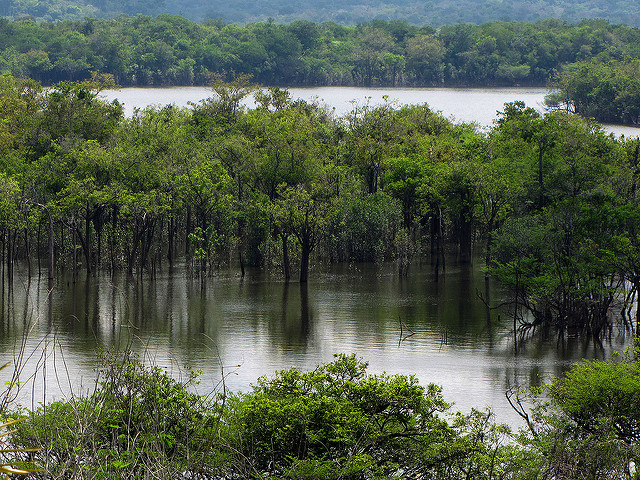
The Amazon rainforest is not only the habitat of the Karipuna and many other communities. It is a hotspot of biodiversity and has a crucial role for the world’s climate. We cannot afford putting the Amazon rainforest at risk. A recently published IPCC report clearly states that we need forests to limit global warming to 1.5ºC degrees and prevent the worst impacts of climate change.
The new Brazilian government holds the key to either protect the world or take us over a tipping point into the disastrous impacts of a climate breakdown. We call upon the world community to stand with the Indigenous Peoples, who are the guardians of the forest. Where they live, the protection of biodiversity and the forest is more guaranteed.
Fortunately, the Netherlands is not on the sidelines as it is one of the biggest trading partners of Brazil. This is the moment to take responsibility to eradicate deforestation, land grabs and human rights abuses from all supply chains. We call upon the Dutch government, banks and companies to make sure timber or agricultural products, such as soy and beef, reaching the Dutch market contribute under no circumstances to the destruction of the Amazon rainforest.
This is not only complying with the human rights commitments of the Dutch government, but is also in line with our international agreements to climate and deforestation (such as the Paris Agreement and the Amsterdam Declaration towards Eliminating Deforestation from Agricultural Commodity Chains with European Countries).
The Netherlands must make it mandatory for companies to trace their supply chains and ensure that they adhere to human rights laws. Besides addressing forest protection, the Netherlands must reconsider their direct involvement in the soy corridor, an infrastructure project that would transport soy and other commodities through several Indigenous lands.
Until now the Dutch government has always claimed the soy corridor would be a project meeting the highest sustainability standards. However, this has been questioned already in the past, and unless the new president strongly commits to environmental and Indigenous People protection, this mega-infrastructure project will most likely contribute to even more pressure on the fragile Amazon region.
Forest protection is key for Indigenous and local communities, and in return, Indigenous lands have proven to be the best measure against deforestation. Although they face a powerful logging industry, André Karipuna made one thing very clear: “If the Brazilian state does not protect our territory, the invaders can exterminate us to take possession of our territory, which is large and rich. We Karipuna are few, but we are going to resist.” As the organizations working together within the All Eyes on the Amazon program, we are standing with the Karipuna and other Indigenous and local communities, who are the guardians of the Amazon. We call on the Dutch government and companies to make sure that the Amazon is protected no matter who is the future president of Brazil.
Anna Schoemakers, Executive Director of Greenpeace Netherlands
Edwin Huizing, Executive Director Hivos Netherlands
Danielle Hirsch, Director Both ENDS
Kelly Matheson, Senior Attorney & Program Manager WITNESS
The op-ed as it was published on Wednesday the 14th of november in De Volkskrant (in Dutch)
Read more about this subject
-
 Dossier /
Large-scale infrastructure
Large-scale infrastructural projects have detrimental effects on local people and the environment, while their benefits are felt elsewhere. Both ENDS is working to ensure that local people have a greater say in decision-making and is investigating the way these projects are funded.
-
 Dossier /
Suape: port expansion threatens paradise
Two projects insured by Atradius DSB in the Brazilian port of Suape have caused serious social problems and environmental damage. Both ENDS is helping the local people to obtain justice.
-
 Dossier /
Soy: trade in deforestation
The rising demand for soy is having negative consequences for people and the environment in South America. Both ENDS reminds Dutch actors in the soy industry of their responsibilities and is working with partners on fair and sustainable alternatives.
-
 Dossier /
Global Alliance for Green and Gender Action (GAGGA)
GAGGA rallies the collective power of the women's rights and environmental justice movements to realize a world where women can and do access their rights to water, food security, and a clean, healthy and safe environment.
-
 News / 27 February 2026
Both ENDS strengthens the resilience of female environmental defenders worldwide thanks to multi-year contribution from the Postcode Lottery
In recent years, Both ENDS has received an additional contribution of €875,000 from the Postcode Lottery for the Autonomy & Resilience Fund (2022–2025), implemented in collaboration with the Global Alliance for Green and Gender Action (GAGGA). This support was essential because female environmental rights defenders around the world are increasingly facing climate change, repression and shrinking civil space. With this contribution, Both ENDS supports female activists and their communities with flexible, trust-based funding, enabling them to develop their own solutions to urgent environmental and climate problems.
-
 News / 17 February 2026
Civic space at the frontlines: "Build strong coalitions and counter repressive regimes"
Today, we look back on an inspiring event Civic space at the frontlines -
Environmental Defenders and the Role of International Trade and Investment Policy. The panel exist of Michel Forst, UN Special Rapporteur Environmental Defenders under the Aarhus Convention, Suzanne Kröger, Member of Parliament for GroenLinks–PvdA, Dr. Margit van Wessel, Associate Professor at Wageningen University, Anne de Jonghe, policy advisor at Both ENDS, and Jonila Castro, national spokesperson for Kalikasan People's Network for the Environment. With an audience of CSO experts, academics, accountability experts and students we discussed the effects of Dutch economic activity on Environmental Defenders, and what we all can do to support those on the front lines of the fight for the environment and human rights. -
 News / 2 February 2026
Response to the D66-VVD-CDA coalition agreement
Coalition: Repair the damage and dare to go further
At Both ENDS, we see a number of cautious steps in the right direction in this coalition agreement. There is a slight emphasis on green issues, renewed attention to women's rights, recognition of the importance of civil society, and discussion of trade agreements with a focus on mutual interests. However, without structural change in how we trade, invest, and cooperate, fine words remain empty shells.
-
 Dossier /
Seeking justice for the affected communities of Vale’s mining disasters in Mariana and Brumadinho
In 2015 and 2019, the Brazilian state of Minas Gerais experienced two severe mining tragedies in Mariana and Brumadinho, due to the same mining company: Vale. Since then, the affected communities have been seeking justice, via the criminal punishment of the responsible parties, and a fair compensation for the loss of their loved ones, their homes and their livelihoods. Both ENDS supports local CSOs by amplifying their quest for justice within an international audience and, more specifically, by raising awareness amongst Dutch investors in Vale about the high risks this company’s activities pose for people and the environment.
-
 News / 2 February 2026
Seven years after Brumadinho: impunity allows Vale’s disasters to continue
Seven years ago, the dam owned by mining company Vale collapsed in Brumadinho, Brazil, killing 272 people and severely polluting the surrounding area. While the relatives of the victims commemorate them and fight for justice, the pollution continues.
-
Event / 26 January 2026
Civic space at the frontlines
Environmental Defenders and the Role of International Trade and Investment Policy
Both ENDS invites you to an interactive dialogue with experts from the UN, policy, academia, and civil society on environmental defenders and international trade. Together, we will explore how citizens, policymakers, academics, and activists can defend civic space and support those on the frontlines of environmental and human rights struggles. With a focus on the Netherlands’ role in international trade and investment policy, and drawing on the experiences of activists from the Philippines, the event aims to foster solidarity and identify strategic priorities to better protect environmental defenders amid the global crackdown on civic space
-
 Dossier /
Agua Zarca: indigenous fight against dam costs lives
Indigenous Hondurans are resisting the construction of the Agua Zarca hydrodam. Their fight has cost several lives, including that of Berta Cáceres. After considerable public pressure, Dutch development bank FMO withdrew from the project.
-
 Dossier /
Gas in Mozambique
In 2011 one of the world’s largest gas reserves was found in the coastal province of Cabo Delgado, in the north of Mozambique. A total of 35 billion dollars has been invested to extract the gas. Dozens of multinationals and financiers are involved in these rapid developments. It is very difficult for the people living in Cabo Delgado to exert influence on the plans and activities, while they experience the negative consequences. With the arrival of these companies, they are losing their land.
-
 Dossier /
Export Credit Agencies: Who pays the price?
Both ENDS calls on the government only to provide export credit insurance to sustainable projects that cause no social and/or environmental damage in the countries where they take place.
-
 Dossier /
Indigenous communities threatened by Barro Blanco dam in Panama
The Barro Blanco dam project in Panama, which has Dutch financial support, is causing indigenous lands to disappear under water. Both ENDS is working to protect the rights of indigenous communities living near the dam.
-
 Blog / 1 December 2025
The Long Road to Justice for the Ngäbe of Kiad
In October 2025 I travelled to Kiad, the Indigenous Ngäbe community that led the struggle against the FMO-financed Barro Blanco dam, for one last time. I went there to say my goodbyes, both personally and on behalf of Both ENDS, and to catch a first glimpse on how a community program financed by FMO and DEG – the result of a dialogue process that took several years – is giving a new impulse to the dam-affected communities. But how did we get here?
-
 Environmentally Just Practice /
A Negotiated Approach for Inclusive Water Governance
A Negotiated Approach envisages the meaningful and long-term participation of communities in all aspects of managing the water and other natural resources on which their lives depend. It seeks to achieve healthy ecosystems and equitable sharing of benefits among all stakeholders within a river basin. This inclusive way of working is an essential precondition for the Transformative Practices that are promoted by Both ENDS and partners.
-
 News / 27 November 2025
Communities and International Consortium Present Community-Led Plan for Nature-Based Adaptation to Sea-Level Rise in Coastal Bangladesh
Local communities in the southwestern coastal region of Bangladesh—together with an international consortium including Uttaran, CEGIS, and Both ENDS—have presented a community-led plan to confront climate change and accelerating sea-level rise through nature-based adaptation. The People’s Plan for Upscaling Ecosystem-Based Adaptation outlines a scalable strategy rooted in local ownership and generations of lived experience. At its centre is Community-Based Tidal River Management (CBTRM), a proven approach that reduces waterlogging, raises land elevation, and restores ecological balance by working with natural tidal and sediment dynamics.
-
 Dossier /
Rights for People, Rules for Corporations – Stop ISDS!
Indigenous communities in Paraguay saw their attempts to regain their ancestral lands thwarted by German investors. In Indonesia, US-based mining companies succeeded to roll back new laws that were meant to boost the country’s economic development and protect its forests. This is the level of impact that investment treaties can have on social, environmental and economic development and rights. Why? Because of the ‘Investor-to-State Dispute Settlement’ clauses that are included in many such treaties.
-
 Blog / 25 November 2025
COP30 shows why dismantling ISDS is essential for real climate action
Standing in Belém during COP30, I felt the weight of the moment. We came to the Amazon hoping for decisive progress on phasing out fossil fuels, yet the final outcome fell far short of the ambition science and justice demand. The agreement brought welcome commitments on adaptation finance and global indicators, but it refused to confront the structural forces that make climate action so difficult.
-
 Dossier /
Wetlands without Borders
With our Wetlands without Borders program, we work towards environmentally sustainable and socially responsible governance of the wetlands system of the La Plata Basin in South America.