




The Good Life: Each region as self-sufficient as possible
The Good Life: Each region as self-sufficient as possible
Digital watches, with their extremely environmentally unfriendly batteries, will no longer be affordable because of the heavy tax levied on cadmium, mercury, and lead. This should be no problem because we can simply start wearing manual-winding or self-winding watches again. Like digital watches, many other consumer items of the global middle class such as a second car, air conditioning in every room, bigger and flatter TV screens - are unfeasible from an environmental perspective. That is why we have to drastically mitigate these consumer desires. The alternative to our current wasteful lifestyle is a sober but good life. That is Eduardo Gudynas's vision. To be sure, he looked up the term austero (austere) in the dictionary. Indeed: sober, plain. "In my ideal society, of course, luxury would still be an option, but a very, very, very expensive option. This is because the prices of things will be an honest reflection of their social and environmental costs." Thus, increased taxes and economic reforms will render mineral extraction much more expensive. "The royalties that the mining sector pays will increase substantially. One ton of iron will be much more expensive. And thus a great many consumer items as well."
To lead the good life is at the core of Gudynas's ideal vision of society. In Spanish: el buen vivir. But his interpretation of a good life is very different from the typical land of milk and honey. Buen vivir is the Spanish translation of some indigenous visions, such as the Kichwa sumak kawsay. This concept is diametrically opposed to the Western image of man and nature, in which the well-being and prosperity of the individual come first. Gudynas: "The underlying principle of buen vivir is that well-being can only occur in a community, which is social but also encompasses nature. After all, man is part of and not contrary to nature. Buen vivir thus goes beyond Western dualism where nature opposes society, and the individual opposes the community."
Gudynas warns that leading a good life should not be considered a "return to the past" of pre colonial times when the great indigenous cultures of South America reigned. "I do not advocate a return to the societies of hunters and gatherers in the forest. The point is that the protagonist should be the quality of life, and not increasing the gross domestic product." He laughs: "The concept of buen vivir includes good computers and other technology. To put it simply: in my dream, we don't stop building bridges and we don't reject Western physics and mathematics to build them. But the size and the materials used to build those bridges will be different. And they will bridge rivers and ravines in other places, i.e., where they can contribute to local and regional transportation needs, and not where they contribute to meet the needs of the global markets." So, technology is still very necessary, "but future consumer products will last much longer than they do today, for decades, even. There will also be more options to repair them. This will create jobs and generate much less waste."
A left-wing breeze has been blowing for quite some time now over the Latin American continent, which sometimes blows like a hurricane. But, alas, this has for the most part not caused any radical departure from conventional capitalist economic ideas. Ever since Latin America was 'discovered' by the Europeans, it has been a constant provider of important raw materials for Western economies. Despite all the leftist rhetoric, it has not changed much in recent times. While agricultural products and meat have long been the chief exports, in recent decades this has been complemented with petroleum, gas, coal, other minerals and agrifoods. Not only Europe and the United States, but also newcomers like China and other emerging economies, have become eager buyers of Latin American products. The new part of the equation is the important role that the state plays in mineral exploitation and the distribution of the revenues amongst a greater part of the general population. But the basic idea - that of Latin America as a cheap raw material provider - has remained unchanged and nothing is being done about the negative environmental impact or Latin America's dependence on foreign demand.
Gudynas offers a couple of examples to substantiate his harsh assessments: "Bolivia is increasingly exporting food crops, while a large part of its population lives in poverty and is starving. In Colombia, agriculture is dominated by the flower sector. The flowers are mainly exported to the United States. The country itself has to import an increasing proportion of its food. We really need to put an end to this in a radical way." More recently, open-pit mining has been booming because of the global scarcity of certain metals and minerals. The resulting environmental damage is significant, Gudynas points out: "Even Uruguay, an agricultural country, isn't able to escape the large-scale mining operations."
Gudynas believes that the mistake that all leftist South American governments make is that they believe that development is the same as economic growth. That is why Latin American countries continue to export enormous quantities of raw materials. Gudynas also considers it "naive to think that poverty can be reduced by exporting more raw materials. We need an autonomous development strategy that comes from within."
Mutual Trade
The strategy of buen vivir is a concept that has been incorporated into the new constitutions of both Ecuador and Bolivia, and is being widely discussed throughout South America. It literally means 'leading a good life', although "in fact, it's a term that cannot be translated properly." And we should definitely not consider this concept as a fully developed idea either.
Gudynas underscores that buen vivir has nothing to do with the Western debate about zero growth or negative growth. "Zero growth or negative growth might be a consequence of this approach, but not a pre-condition or assumption. The over-consumption by some groups, for example, the very rich, has to decrease. In that sense, there will indeed be less growth. But, on the other hand, some sectors do need to continue to show growth, for example, education and sanitation. The end result of this approach may be growth or no growth."
Buen vivir will also have important consequences for other economies, Gudynas predicts, because the unbridled exportation of raw materials to Europe and North America, or China and India, will eventually have to come to an end. "They will no longer receive our coal and gas. So, you better be prepared for winters without your fuel," he says with a laugh. "We will disconnect our continent from the global economy in order to determine our own economic strategy. The quantity of raw materials that we will eventually be exporting will only be about 10 percent of current levels. Only what is left over will be exported." An additional effect of this strategy would be that many social and ecological problems would automatically subside once the continent turns to a policy that involves using its natural resources for itself. This, of course, means that the total amount of raw materials that Latin America needs will be much lower than what it is currently exporting. Moreover, studies will be conducted to measure the social and environmental impacts prior to issuance of contracts for any large-scale projects or mining operations. Gudynas predicts that this will significantly reduce exploration and exploitation.
Instead of export-driven economies, Gudynas foresees Latin American economies that will be more regionally focused. "Trade between South American countries will increase. Instead of buying a table and chairs from China, we'd be much better doing this ourselves on a regional level!"
In Gudynas's vision, self-reliance will replace globalisation as the new perspective. The countries and continents will basically have to fend for themselves. And this will have far-reaching effects, "although it's not the same thing as isolation," Gudynas points out. "We can export our surplus food and other goods, provided production meets social and environmental standards. And I see no constraints at all regarding the provision of services." He suddenly takes on a reassuring tone: "And, of course, we'll always be exchanging books and music with the other continents."
Agriculture is the Basis
In Gudynas's dream, agriculture forms the basis of the economy, so that food sovereignty becomes reality for an entire continent. "When this process has been fully implemented, it will mean no more malnutrition. And since agriculture is good for employment, everyone will have a job and poverty will be reduced to 0 percent." Organic farming will be practiced on half of the farmland, with the actual distribution of production depending on the ecological capacities of each region. The starting point is that each region should become as self sufficient as possible. Which is, of course, not entirely possible, Gudynas admits. "Uruguay is better at producing organic meat than potatoes, which we can only grow here if we use a lot of pesticides. You have to increase production in the best areas with the best conditions. Which is quite a different concept from the notion of food sovereignty because this is not something that will be decided by individual countries in Latin America, but by the ecological capacity of its many regions."
And that brings him straight to the issue of governance, which, he insists, must also change. Latin American countries will maintain their sovereignty. But, whenever necessary, regions will turn to regional forms of governance "which will not be based on national boundaries but on the region's needs. The Lake Titicaca region, for example, is currently governed by both Peru and Bolivia. A regional government would perform this task much better, because it would consider the needs of the entire lake basin area."
Gudynas is convinced that large metropolises such as São Paulo and Buenos Aires have exceeded their human dimension. "They are losing inhabitants to medium-sized cities that are more spread across the continent. Today, almost all of Latin America largest cities are located along the coast. A strategy of reorganisation would ensure better distribution between urban areas and the countryside." He quickly adds that one should not enforce migrations out of the urban areas. On the contrary, the entire continent needs to become much more democratic. "We have to seek alternatives to presidential democracies, which concentrate executive powers in the office of the president. Instead, we need to seek a true balance between the various political powers. We need to increase citizen participation, particularly where larger projects are concerned. The balance of power will eventually shift from the urban areas to the provinces and rural regions."
There isn't much time to lose, according to Gudynas, because if something significant isn't done soon, the damage to mankind and nature by the current lifestyle may be irreversible "I hope that the petroleum will run out soon, or at least reach its production peak because then we still have enough time to repair the damage done by our current lifestyle. If it ends up being a long-term process, I will become increasingly pessimistic."
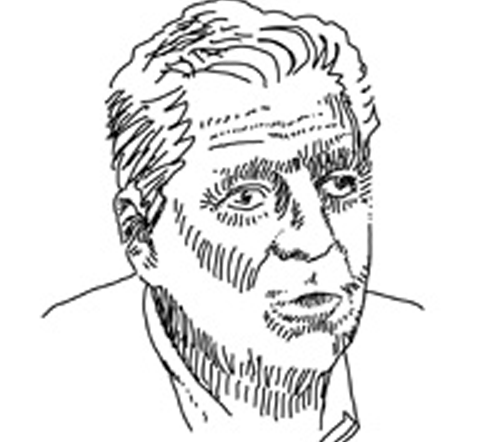
| An expert in sustainable development strategies Eduardo Gudynas was born in 1960 in Uruguay's capital of Montevideo. He graduated as a social ecologist and wrote his thesis on the environmental movement in Latin America. Today, he is the Director of the Centro Latino Americano de Ecología Social (CLAES) in Montevideo. His field of expertise is sustainable development strategies for Latin America, with an emphasis on protecting nature, the situation of agriculture, regional integration, and globalisation. Gudynas has participated in the publication of various editions of the Global Environmental Outlook of the UN Environmental Programme (UNEP). He has been a member of the UN climate panel IPCC since 2010. He has written a dozen or so books, which have been mainly distributed in Spanish-speaking countries. He is also the author of numerous scientific publications. Gudynas quite regularly shares his opinions in various Latin American media outlets. |
Read more about this subject
-
 Dossier /
Dare to Trust: the power of unconditional funding
At Both ENDS we cherish our long-term relationships with partners in our global network. These relationships are based on equality and built on trust. The trust we have in each other has developed from years of strategic cooperation, including joint advocacy around common agendas, knowledge sharing, networking, and mobilising and sharing resources to advance environmental justice.
-
 Dossier /
Global Alliance for Green and Gender Action (GAGGA)
GAGGA rallies the collective power of the women's rights and environmental justice movements to realize a world where women can and do access their rights to water, food security, and a clean, healthy and safe environment.
-
 News / 5 October 2026
Rural Women's Assembly wins Right Livelihood Award
We are thrilled to share that our partner the Rural Women's Assembly (RWA) is one of this year's Right Livelihood Laureates! The award, often called the "Alternative Nobel Prize", honours RWA for bringing together more than 178,000 women farmers in eleven Southern African countries. Together, these women stand up for their land, their seeds and their right to make decisions about their own lives and bodies.
-
 News / 29 September 2026
Summary - Both ENDS complaint under the EU-New Zealand trade agreement
On 29 September 2026, Both ENDS lodged the first complaint on climate grounds with the European Commission's Single Entry Point. It asks the Commission to examine whether Aotearoa New Zealand has broken two promises both sides made in the EU-New Zealand Free Trade Agreement: not to weaken or set aside environmental laws in order to encourage trade or investment, and to effectively implement the Paris Agreement.
-
Publication / 29 September 2026
-
Publication / 29 September 2026
-
 News / 29 September 2026
Q&A: New Zealand's climate rollback and the EU trade agreement
On 29 September 2026 / 30 September in Aotearoa New Zealand, Both ENDS lodged a complaint with the European Commission under the EU-New Zealand Free Trade Agreement. These are the questions we are asked most often, and our answers. The complaint summary, the case explainer and the key public sources are linked at the end of this page.
-
 News / 29 September 2026
What happens now? A timeline of the SEP Case
What happens now? On 29 September 2026 / 30 September in Aotearoa New Zealand, Both ENDS lodged a formal complaint with the European Commission. It is the first complaint to the EU's Single Entry Point on environmental and climate grounds. It asks the Commission to hold New Zealand to two promises it made in its trade agreement with the EU: not to weaken environmental protection to encourage trade or investment, and not to undermine the Paris Agreement on climate change.
-
 Press release / 29 September 2026
New Zealand faces its first climate complaint under EU trade rules
UTRECHT / WELLINGTON, 29 September 2026 /30 September in Aotearoa New Zealand
Both ENDS, a Dutch environmental justice organisation, has lodged a formal complaint with the European Commission arguing that New Zealand has broken the climate promises it made in its free trade agreement with the European Union. It is the first complaint on environmental and climate grounds under the Commission's Single Entry Point, the mechanism that lets civil society ask the EU to enforce the sustainability commitments in its trade agreements.
-
 Dossier /
Trade agreements
International trade agreements often have far-reaching consequences not only for the economy of a country, but also for people and the environment. It is primarily the most vulnerable groups who suffer most from these agreements.
-
 News / 10 September 2026
Rutu Foundation receives UNESCO Literacy Prize for multilingual education
Both ENDS’ partner the Rutu Foundation for Intercultural Multilingual Education has been awarded the 2026 UNESCO King Sejong Literacy Prize for its language friendly school programme. This prestigious prize recognises the importance of multilingual education and the right of children to learn in an environment where their home languages are valued.
-
 News / 7 September 2026
Unprecedented criminal conviction in the Mariana disaster case breaks mining industry's cycle of impunity
A Brazilian federal court has, for the first time, criminally convicted a mining company and three of its managers for their role in the 2015 collapse of the Fundão dam, one of the worst environmental disasters in Brazil's history. Our partner Instituto Cordilheira, which represented victims as assistant prosecutors in the case, calls it a historic breakthrough after years of impunity.
-
 Dossier /
Communities Regreen the Sahel
In various countries in the Sahel, vast tracts of land have been restored by the local population by nurturing what spontaneously springs from the soil and protecting the sprouts from cattle and hazards.
-
 News / 3 September 2026
Restoring Land, Restoring Hope: Both ENDS at UNCCD COP17 in Mongolia
From 17 to 28 August, governments gathered in Ulaanbaatar, Mongolia, for COP17 of the UN Convention to Combat Desertification (UNCCD). At stake was more than how the world responds to land degradation and drought. It was also a question of who gets to shape land restoration, whose knowledge counts, and where the money goes.
-
Letter / 14 July 2026
Statement on CAO Cambodia Microfinance Case
The independent complaints mechanism of the International Finance Corporation (IFC) and the World Bank Group found that the IFC violated its own Environmental and Social Sustainability Framework by investing in six banks providing microfinance in Cambodia.
-
 News / 6 July 2026
Strengthening Women's Land Rights Across the Rio Conventions
From 29 June – 2 July 2026, Tamara Mohr, GAGGA coordinator at Both ENDS participated in the 4th convening of the Women's Land Rights Initiative (WLRI) in Nairobi, Kenya.Hosted by the Robert Bosch Stiftung, TMG Research and the Huairou Commission, the event brought together grassroots organisations, (inter)national NGOs, government institutions and donors from around the world.
-
Publication / 3 July 2026
-
 News / 2 July 2026
Land restoration can help mitigate and resolve conflict - but only if everyone has a seat at the table
Can restoring degraded land also help reduce conflict? According to experts from Niger, Ghana, the Netherlands and other regions, the answer is yes - but only when restoration is rooted in inclusive land governance, local ownership and social cohesion.
-
 Dossier /
Gas in Mozambique
In 2011 one of the world’s largest gas reserves was found in the coastal province of Cabo Delgado, in the north of Mozambique. A total of 35 billion dollars has been invested to extract the gas. Dozens of multinationals and financiers are involved in these rapid developments. It is very difficult for the people living in Cabo Delgado to exert influence on the plans and activities, while they experience the negative consequences. With the arrival of these companies, they are losing their land.
-
 Dossier /
Finance for agroecology
The lion's share of public budgets for climate, agriculture and development still goes to conventional agroindustrial projects that contribute to the current climate, food and biodiversity crises. Both ENDS and our partners are calling for a transition to agroecological practices that are people- and environment-friendly.



