




Op-ed in Trouw: "Give more money to local sustainable food producers in developing countries"
The Dutch government and Dutch businesses spend a lot of money on food production in developing countries. But, according to Karin van Boxtel, policy officer at Both ENDS, far too little of that money finds its way to sustainable, nature-inclusive producers.
This is the English translation of Karin's op-ed in Dutch newspaper Trouw. The original can be found here.
With problems relating to food supply, drought and climate building up rapidly, World Food Day on 16 October seems more topical than ever. The international agrifood sector is awash with Dutch money, yet it offers no solution to these crises. And worst of all, everywhere there are local communities and organisations that possess a great deal of knowledge on how to tackle these problems but often lack the resources to do so.
Unfortunately, only a fraction of our money reaches these actors, while we have learned from the nitrogen crisis in the Netherlands that sustainable farmers like Caring Farmers – number one in this year's Sustainable Top 100 compiled by Dutch newspaper Trouw – must be included in the dialogue on how to set up the food system. And that applies not only to Dutch sustainable farmers: in the debate on food and agriculture in the Netherlands, hardly any attention is given to global pioneers in sustainable land use, or to their tried and tested ideas. And that is a missed opportunity.
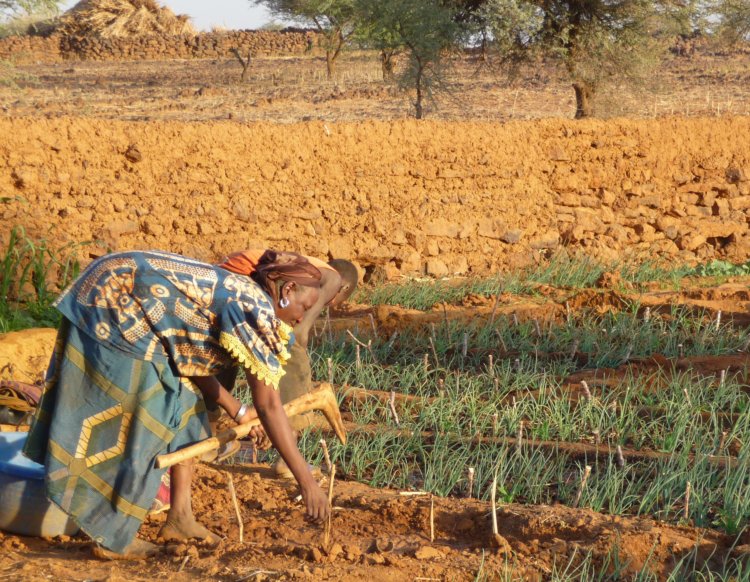
Farmers in Niger, for example, know how to triple their food production in arid areas by using centuries-old methods. By passing that knowledge on to others, millions of hectares of dryland have been made fit for cultivation. Good examples like this can be found all around the world.
The Netherlands can have an impact by supporting these 'food leaders'. We are the world's seventh largest investor in land beyond our borders. Rabobank, for example, has 65 billion euros in ongoing loans in the worldwide agrifood sector. And the Dutch Ministry of Foreign Affairs rightly wants to spend 400 million euros in the coming year on strengthening food security in developing countries. Money and opportunities aplenty, you might think.
Women and young people
To achieve real change, that money needs to go to the local farmers, women and young people who produce the food and who are leaders in sustainable food production. But that is not happening. Unfortunately Dutch public and private financiers are still putting their money in completely the wrong places.
Much of the Netherlands' funding for sustainable development and climate is currently being spent through large institutions like the World Bank, the Dutch development bank FMO and the UN's Green Climate Fund. In recent years, more than a third of Dutch agriculture-related development assistance has been spent through such institutions on large-scale projects. In the past decade, only 9% of that money has been spent on nature-inclusive, community-led sustainable food production. And finance by private banks generally doesn't find its way to the food leaders at all.
The Netherlands can change that. The climate conference in Egypt at the start of November and the budget debates in Dutch parliament this autumn are perfect opportunities to redirect the flow of money. It would be a step in the right direction if the Netherlands were to spend a large proportion of its development and climate funding on regional funds, which distribute money from large funds and donors in the form of small donations to local organisations and groups that offer sustainable solutions.
In this way, our government can set an example for private banks. They, too, should transform their financing to focus more on long-term investments and returns. And returns should be seen not only as financial but also in terms of the benefits for climate, environment and welfare.
By making such a change of course, the Netherlands can considerably support worldwide leaders in the food and agriculture transition. It is crucial that they become the main focus of how money is spent. That will make a significant contribution to achieving real solutions to the food and climate crisis.
For more information
Read more about this subject
-
 Dossier /
Finance for agroecology
The lion's share of public budgets for climate, agriculture and development still goes to conventional agroindustrial projects that contribute to the current climate, food and biodiversity crises. Both ENDS and our partners are calling for a transition to agroecological practices that are people- and environment-friendly.
-
 Dossier /
Inclusive ways to sustainable and healthy food for all
All around the world small-scale farmers are using sustainable and inclusive methods to produce food. Working together with nature and each other, they provide their families and communities with sufficient and healthy food. But their production methods are under pressure from large-scale agriculture and the globally dominant system of industrial food production. Together with our partners, Both ENDS is trying to turn the tide in favour of sustainable, local practices that are mostly known as 'agro-ecological' or 'nature-inclusive'. Why are we focusing on these methods? Agro-ecological practices are climate-proof and inclusive and increase the opportunities for communities around the world to produce their food sustainably.
-
 Dossier /
Amplifying environmentally just practices
Because of the close relationship with their living environment, local communities often have the best ideas for the sustainable and equitable use and governance of land, water and forests. These environmentally just practices and processes successfully protect and restore ecosystems and address climate change. They are essential in the light of the multiple crises the world faces, but are in dire need of financial and policy support.
-
 Dossier /
Global Alliance for Green and Gender Action (GAGGA)
GAGGA rallies the collective power of the women's rights and environmental justice movements to realize a world where women can and do access their rights to water, food security, and a clean, healthy and safe environment.
-
 News / 27 februari 2026
Both ENDS strengthens the resilience of female environmental defenders worldwide thanks to multi-year contribution from the Postcode Lottery
In recent years, Both ENDS has received an additional contribution of €875,000 from the Postcode Lottery for the Autonomy & Resilience Fund (2022–2025), implemented in collaboration with the Global Alliance for Green and Gender Action (GAGGA). This support was essential because female environmental rights defenders around the world are increasingly facing climate change, repression and shrinking civil space. With this contribution, Both ENDS supports female activists and their communities with flexible, trust-based funding, enabling them to develop their own solutions to urgent environmental and climate problems.
-
 Blog / 25 november 2025
COP30 shows why dismantling ISDS is essential for real climate action
Standing in Belém during COP30, I felt the weight of the moment. We came to the Amazon hoping for decisive progress on phasing out fossil fuels, yet the final outcome fell far short of the ambition science and justice demand. The agreement brought welcome commitments on adaptation finance and global indicators, but it refused to confront the structural forces that make climate action so difficult.
-
 Dossier /
Communities Regreen the Sahel
In various countries in the Sahel, vast tracts of land have been restored by the local population by nurturing what spontaneously springs from the soil and protecting the sprouts from cattle and hazards.
-
 News / 5 november 2025
Interview: Both ENDS at COP30 for Climate Justice and Systemic Change
Both ENDS is present at COP30 to advocate for genuine access to climate finance for locally led, gender-just climate solutions and the mechanisms that facilitate this, including those for farmer-led restoration. Furthermore, the organisation participates to ensure the crucial connection between the climate negotiations and the trade and investment frameworks that shape them.
Learn more about the Both ENDS team at COP30 below, and find all the activities and side-events in which Both ENDS will participate.
-
 News / 5 november 2025
Overview of Both ENDS events at COP30 in Belem, Brazil
Both ENDS is present at COP30 to advocate for genuine access to climate finance for locally led, gender-just climate solutions, and for the mechanisms that make these possible, including those supporting farmer-led restoration. The organisation also engages to highlight the crucial connection between climate negotiations and the trade and investment frameworks that shape them.
Below is an overview of the Both ENDS team at COP30 and a detailed look at the activities and side-events in which Both ENDS will participate.
-
Publication / 9 oktober 2025
-
 Dossier /
International trade and investment with respect for people and planet
The network of international trade and investment treaties is large and complex. The Netherlands alone has signed more than 70 bilateral investment treaties (BITs) and is party to the trade and investment agreements concluded by the EU, like the EU-Mercosur and EU-Indonesia trade deals.
-
 News / 6 oktober 2025
From Entebbe to Accra: civil society is rewriting the rules of investment
By Fernando Hernández Espino and Bart-Jaap Verbeek
Almost a year after African civil society gathered in Uganda to adopt the Entebbe Declaration, the call to transform international investment governance continues to gain strength. From the 6th to the 9th of October, over 50 civil society organisations from across West Africa, including from Ghana, Senegal, Nigeria, Côte d’Ivoire, Cameroon, Gambia, Sierra Leone, as well as from Kenya and Latin America, are convening in Accra to deepen and operationalise the Declaration’s vision.
-
Publication / 2 oktober 2025
-
 Dossier /
Fair Green and Global Alliance (FGG)
Together with civil society organisations from all over the world, the Fair Green and Global (FGG) Alliance aims for socially just, inclusive and environmentally sustainable societies in the Netherlands and the Global South.
-
Publication / 1 juli 2025
-
 Environmentally Just Practice /
Analog Forestry
Analog forestry is a transformative approach to the ecological restoration of degraded lands. Natural forests are used as guides to create ecologically sustainable landscapes, which support the social and economical needs of local communities.
-
 Blog / 3 juni 2025
A food forest as an inspiring oasis between monoculture fields
Recently, we visited food forest Ketelbroek with a group of colleagues. This project was initiated by food forest pioneer Wouter van Eck and our own Pieter Jansen. What a beautiful place! Located between monocrop fields of ryegrass, beetroot and potatoes, the food forest is a green oasis. Birdsong fills the air and there is a constant buzz and fluttering all around. Hares, badgers, foxes and wild boars are regular visitors. And let's not forget the beavers.
-
 Environmentally Just Practice /
Agroecology
Agroecology is a diverse set of agricultural practices, a field of science and a social movement. It aims to transform food systems towards greater ecological sustainability, social justice, and resilience. Both ENDS and CSO-partners around the world support farmers and pastoralists practising agroecology, both on the ground and in gathering political and financial support.
-
 News / 9 mei 2025
Women’s leadership in agroecology flourishes in Eastern and Southern Africa
On 12 and 13 February 2025, women from Kenya, Uganda, and Zimbabwe gathered in Nairobi for the Africa Women Leaders in Agroecology (AWOLA) Regional Networking Forum. The event marked a significant moment in the leadership programme of PELUM Kenya, which empowers young women in their role as leaders in the agroecological transition. This project was made possible thanks to support from Both ENDS as part of the Fair, Green and Global (FGG) Alliance.
-
 Blog / 23 april 2025
The power of trust
Trust builds trust. That is what I have learned from how Both ENDS works - within our team, with partners in joint strategies and advocacy, and in our relationships with partners as a funder. Trust is the foundation. It is what allows compassion to grow, what gives rise to hope, and what fuels real solidarity. This is especially powerful in contrast to the prevailing global trend of political and international leaders who prioritize hard measures and self-interest, ignoring relations of trust. It is even more reason for us to share what we have experienced when we put trust first.



