




I did not want to go, but when I got there…
I did not want to go, but when I got there…
Eye opener
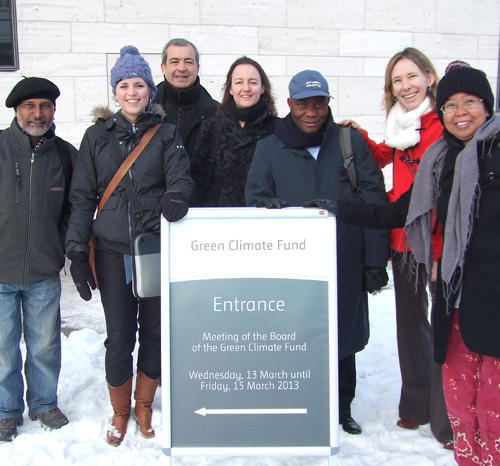
I was reluctant to come to this GCF Board Meeting but I am glad I did. Both ENDS helped us in processing our visa and arranged for our transportation and accommodation. I was also happy to learn and meet that the Philippine representative to the GCF is Governor Joey Salceda from our region. Right now he is an alternate board member and soon to sit as board member in the next board meeting. Before I came here, I asked myself, why I am here? What is my message for Board Members? What does the GCF has to do with community of fishers that I have been are working with for the past ten years? And how the marine protected areas that the community we have been trying to protect benefit from GCF?
Our project
The discussion on the GCF’s business model framework yesterday reminds me of our own, local financial sustainability mechanism we called- Piso Para sa Sanktuwaryo (a coin for marine sanctuary). Like GCF, we are still studying what kind of business model framework is appropriate to our Piso Para sa Sanktuwaryo and how it will be operationalized. Like the GCF Business Model Framework includes a chapter on Country Ownership, we are guided also by the principle of community ownership. Establishment of marine sanctuaries is our way of addressing overfishing and improving the resiliency of our marine ecosystems to the changing climate. In our Piso para sa Sanktuwaryo it were the community members who are the ones investing on it. This is one of our agreed indicators on community buy-in and ownership of the sanctuary- a measure of community commitment and pride. This is not only about money but also about giving private sector/citizens a chance to participate in community enforcement and a chance to invest for the future of their children.
My message to GCF
During the Board Meeting it became clear to me what my message is for the Board Members of the GCF: I think with this project, we have a great example of a project which could be financed by the GCF: supporting micro, small and medium private sector, within Public-Private Partnerships, working together with NGOs on climate change adaptation and sustainable development.
The story in my pictures
Aside from listening to the discussion of the board meeting next door, I was entertained by my Single Lens Reflex Camera. I took pictures of CSO’s meeting and discussing before the session, which tell story in another way than words. I also took pictures of board members during their unguarded moments, of CSOs faces who have been lobbying and tired but still with a smile on their face. Photos can be accessed in my Facebook page.
Catherine Demesa, Network of Sustainable Livelihoods Catalysts, Philippines
Read more about this subject
-
 Dossier /
Dare to Trust: the power of unconditional funding
At Both ENDS we cherish our long-term relationships with partners in our global network. These relationships are based on equality and built on trust. The trust we have in each other has developed from years of strategic cooperation, including joint advocacy around common agendas, knowledge sharing, networking, and mobilising and sharing resources to advance environmental justice.
-
 Dossier /
Global Alliance for Green and Gender Action (GAGGA)
GAGGA rallies the collective power of the women's rights and environmental justice movements to realize a world where women can and do access their rights to water, food security, and a clean, healthy and safe environment.
-
 News / 5 October 2026
Rural Women's Assembly wins Right Livelihood Award
We are thrilled to share that our partner the Rural Women's Assembly (RWA) is one of this year's Right Livelihood Laureates! The award, often called the "Alternative Nobel Prize", honours RWA for bringing together more than 178,000 women farmers in eleven Southern African countries. Together, these women stand up for their land, their seeds and their right to make decisions about their own lives and bodies.
-
 News / 29 September 2026
Summary - Both ENDS complaint under the EU-New Zealand trade agreement
On 29 September 2026, Both ENDS lodged the first complaint on climate grounds with the European Commission's Single Entry Point. It asks the Commission to examine whether Aotearoa New Zealand has broken two promises both sides made in the EU-New Zealand Free Trade Agreement: not to weaken or set aside environmental laws in order to encourage trade or investment, and to effectively implement the Paris Agreement.
-
Publication / 29 September 2026
-
Publication / 29 September 2026
-
 News / 29 September 2026
Q&A: New Zealand's climate rollback and the EU trade agreement
On 29 September 2026 / 30 September in Aotearoa New Zealand, Both ENDS lodged a complaint with the European Commission under the EU-New Zealand Free Trade Agreement. These are the questions we are asked most often, and our answers. The complaint summary, the case explainer and the key public sources are linked at the end of this page.
-
 News / 29 September 2026
What happens now? A timeline of the SEP Case
What happens now? On 29 September 2026 / 30 September in Aotearoa New Zealand, Both ENDS lodged a formal complaint with the European Commission. It is the first complaint to the EU's Single Entry Point on environmental and climate grounds. It asks the Commission to hold New Zealand to two promises it made in its trade agreement with the EU: not to weaken environmental protection to encourage trade or investment, and not to undermine the Paris Agreement on climate change.
-
 Press release / 29 September 2026
New Zealand faces its first climate complaint under EU trade rules
UTRECHT / WELLINGTON, 29 September 2026 /30 September in Aotearoa New Zealand
Both ENDS, a Dutch environmental justice organisation, has lodged a formal complaint with the European Commission arguing that New Zealand has broken the climate promises it made in its free trade agreement with the European Union. It is the first complaint on environmental and climate grounds under the Commission's Single Entry Point, the mechanism that lets civil society ask the EU to enforce the sustainability commitments in its trade agreements.
-
 Dossier /
Trade agreements
International trade agreements often have far-reaching consequences not only for the economy of a country, but also for people and the environment. It is primarily the most vulnerable groups who suffer most from these agreements.
-
 News / 10 September 2026
Rutu Foundation receives UNESCO Literacy Prize for multilingual education
Both ENDS’ partner the Rutu Foundation for Intercultural Multilingual Education has been awarded the 2026 UNESCO King Sejong Literacy Prize for its language friendly school programme. This prestigious prize recognises the importance of multilingual education and the right of children to learn in an environment where their home languages are valued.
-
 News / 7 September 2026
Unprecedented criminal conviction in the Mariana disaster case breaks mining industry's cycle of impunity
A Brazilian federal court has, for the first time, criminally convicted a mining company and three of its managers for their role in the 2015 collapse of the Fundão dam, one of the worst environmental disasters in Brazil's history. Our partner Instituto Cordilheira, which represented victims as assistant prosecutors in the case, calls it a historic breakthrough after years of impunity.
-
 Dossier /
Communities Regreen the Sahel
In various countries in the Sahel, vast tracts of land have been restored by the local population by nurturing what spontaneously springs from the soil and protecting the sprouts from cattle and hazards.
-
 News / 3 September 2026
Restoring Land, Restoring Hope: Both ENDS at UNCCD COP17 in Mongolia
From 17 to 28 August, governments gathered in Ulaanbaatar, Mongolia, for COP17 of the UN Convention to Combat Desertification (UNCCD). At stake was more than how the world responds to land degradation and drought. It was also a question of who gets to shape land restoration, whose knowledge counts, and where the money goes.
-
Letter / 14 July 2026
Statement on CAO Cambodia Microfinance Case
The independent complaints mechanism of the International Finance Corporation (IFC) and the World Bank Group found that the IFC violated its own Environmental and Social Sustainability Framework by investing in six banks providing microfinance in Cambodia.
-
 News / 6 July 2026
Strengthening Women's Land Rights Across the Rio Conventions
From 29 June – 2 July 2026, Tamara Mohr, GAGGA coordinator at Both ENDS participated in the 4th convening of the Women's Land Rights Initiative (WLRI) in Nairobi, Kenya.Hosted by the Robert Bosch Stiftung, TMG Research and the Huairou Commission, the event brought together grassroots organisations, (inter)national NGOs, government institutions and donors from around the world.
-
Publication / 3 July 2026
-
 News / 2 July 2026
Land restoration can help mitigate and resolve conflict - but only if everyone has a seat at the table
Can restoring degraded land also help reduce conflict? According to experts from Niger, Ghana, the Netherlands and other regions, the answer is yes - but only when restoration is rooted in inclusive land governance, local ownership and social cohesion.
-
 Dossier /
Gas in Mozambique
In 2011 one of the world’s largest gas reserves was found in the coastal province of Cabo Delgado, in the north of Mozambique. A total of 35 billion dollars has been invested to extract the gas. Dozens of multinationals and financiers are involved in these rapid developments. It is very difficult for the people living in Cabo Delgado to exert influence on the plans and activities, while they experience the negative consequences. With the arrival of these companies, they are losing their land.
-
 Dossier /
Finance for agroecology
The lion's share of public budgets for climate, agriculture and development still goes to conventional agroindustrial projects that contribute to the current climate, food and biodiversity crises. Both ENDS and our partners are calling for a transition to agroecological practices that are people- and environment-friendly.



