


Divest from EACOP before it’s too late
and Abigail Kyomuhendo*
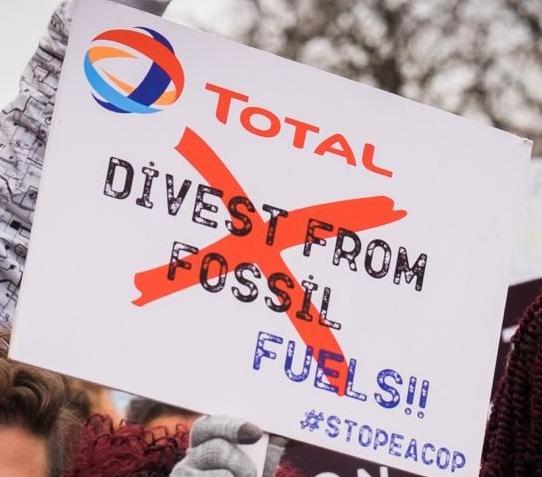
This week the annual shareholder meeting (AGM) of TotalEnergies took place. Whilst the shareholders celebrated their profits, Ugandan people were being evicted from their lands, thousands of kilometers away, for Total's East African Crude Oil Pipeline (EACOP).
EACOP will transport crude oil from the Albertine region in northwest Uganda to Tanga, a port in Tanzania from where it will be exported around the world. The oil drilling and the pipeline threatens biodiversity, water supply and fishing resources for millions of people and displace thousands of households. It now already leads to human rights violations, especially targeted at activists speaking out against EACOP**.
EACOP has the dubious honour to become a replicate of the Niger Delta trauma. And that in an era when we all know we shouldn't be building any more pipelines and drill for new oil and gas sources. To keep the 1.5 degrees of the Paris Agreement within reach, we should keep fossil fuels in the ground.
Ugandan CSO's call for investments in clean energy instead
Says one citizen activist: "We want people in Europe and around the world to know about the East Africa Crude Oil Pipeline. We want financial institutions and other big companies supporting Total to withdraw their support. We want to see this project stopped, as well as any other new oil projects in Africa and around the world."
Our Ugandan partners want to see an end to the funding of any new fossil-fuel projects, including EACOP, and an increased investment in clean and sustainable energy, particularly off grid solar energy. Because EACOP oil is for export, the project will not help the more than 90% of rural Ugandan people without electricity access. As such, Both ENDS supports their calls on government for putting in place policy frameworks, consumer protection laws, and investment that promotes expansion of off-grid solar energy.
Alarm bells are ringing: divest from TotalEnergies
Lately, good news has been coming in: earlier this year Dutch asset manager ACTIAM has set the standard: after a year long engagement failed to deliver adequate assurances from TotalEnergies on EACOP, they took the decision to exclude the oil and gas company from their investments. BankTrack on behalf of the coalition of #StopEACOP announced that this week seven more banks and insurers have confirmed they will not join the project loan to finance the EACOP. This takes the number of banks that want nothing to do with the EACOP project loan to 20 and the number of insurers to eight.
We think many other Dutch pension funds and asset managers need to influence TotalEnergies to stop EACOP or when they resist being influenced, do as ACTIAM has, and get out. The 11 mainly Dutch asset managers who tried to get a climate resolution on the agenda at this week's shareholder meeting but whose resolution was rejected to be tabled by TotalEnergies management should turn an even more critical eye towards TotalEnergies.
Both ENDS has sent information about EACOP to more than 15 Dutch pension funds and asked for meetings between these funds and our Ugandan partners so they can hear for themselves the perspective from the ground about how the oil and gas companies TotalEnergies and its Chinese counterpart CNOOC are operating. The first of these meetings occurred in April 2022 with Achmea, who manages the assets of 15 pension funds.
EACOP should be setting off alarm bells for investors committed to the Paris agreement. EACOP shows that TotalEnergies is not transitioning to becoming a renewable energy leader as some investors have hoped.
Call on investors: save Uganda from the disaster called EACOP
Banks, insurers, pension funds and export credit agencies need to cut off the money supply to develop EACOP.
At this moment, we can still save Uganda and its citizens from this disaster called EACOP. So let's join forces and help protect the lives, lands, and water supplies for thousands of Ugandans, as well as score one for the climate crisis.
*This is a pseudonym
**The environmental and human rights consequences of EACOP
EACOP will transport crude oil from the Albertine region in northwest Uganda to Tanga, a port in Tanzania from where it will be exported around the world. Nearly a third of EACOP will be constructed in the Lake Victoria basin, affecting Ramsar wetlands teeming with culturally-significant biodiversity. The lake also meets the water needs of up to 40 million people in East Africa.
The pipeline will cross 2,000sq. km of protected areas in Uganda and Tanzania, a third of which are habitats for chimpanzees and elephants. The oil to be transported by the pipeline will be extracted from Murchison Falls National Park, one of Uganda's largest, oldest and most visited parks, as well as Lake Albert, which contributes 43% of Uganda's fish resources.
Over 13,000 households are being re-located, more than 100,000 people affected. Human rights violations in the region are increasing, targeted mostly at activists protesting the pipeline and speaking out for the environment and the rights of the local communities. Women activists who speak out fare worse as when they are arrested, they face domestic and other pressures that take a psychological toll on them.
Read more about this subject
-
 Dossier /
Uganda’s Energy Future
Despite the existence of many hydropower dams, foreign investments and large government spending on energy, and new plans for hydropower, oil and gas projects, the vast majority of rural Uganda still remains without electricity. Together with our local partners we are striving towards a sustainable energy strategy for Uganda that starts from the needs and wishes of local communities.
-
 Dossier /
Making pension funds more sustainable
Pension funds have a lot of influence because of their enormous assets. Both ENDS therefore wants pension funds such as the Dutch ABP to withdraw their investments from the fossil industry and to invest sustainably instead.
-
 Dossier /
Global Alliance for Green and Gender Action (GAGGA)
GAGGA rallies the collective power of the women's rights and environmental justice movements to realize a world where women can and do access their rights to water, food security, and a clean, healthy and safe environment.
-
 News / 6 November 2026
Both ENDS and partners head to COP31 in Antalya, Türkiye
On Monday 9 November, world leaders, negotiators and civil society meet in Antalya, Türkiye for COP31, the UN climate conference that runs until 20 November. Both ENDS and our partners will be there, pushing for two things: climate finance that actually reaches women-led and community-based organisations, and an end to economic rules that block the move away from fossil fuels.
-
Letter / 3 November 2026
Objection to the proposed FMO financing of Eni Natural Energies Congo SAU
Together with JA! Justica Ambiental and ReCommon Italy, Both ENDS wrote a letter to FMO’s investment team urging them to reject a financing of up to USD 150 million in the IFC-led facility for Eni Natural Energies S.p.A. and its subsidiaries in Angola, the Republic of the Congo and Mozambique.
-
 News / 2 November 2026
Our call to FMO: Put people and climate before Eni’s profits
The Dutch development bank FMO is considering a loan to help Eni natural Energies Congo1 to grow its biofuel business in Africa. Together with our partners, we have asked FMO not to go ahead, for three reasons: Eni is a highly profitable oil and gas company that does not need public development, its biofuel projects in Africa have harmed farmers and put pressure on food supplies, and it uses lawsuits to intimidate its critics.
-
 News / 27 October 2026
Both ENDS at COP31: Locally led climate finance and ending investment rules that block climate action
At COP31, Both ENDS advocates for climate finance that reaches women-led and community-based organisations at the forefront of climate action, while challenging the economic rules that obstruct the transition away from fossil fuels. Together with partners in the Global Alliance for Green and Gender Action (GAGGA) and the PAPeS programme, we push for locally led adaptation, gender-just climate action and greater accountability for governments and companies.
We asked our colleagues Daan Robben and Fernando Hernandez why they are going to COP31, what messages they want to bring to negotiators, and what a positive outcome would look like.
-
 Dossier /
International trade and investment with respect for people and planet
The network of international trade and investment treaties is large and complex. The Netherlands alone has signed more than 70 bilateral investment treaties (BITs) and is party to the trade and investment agreements concluded by the EU, like the EU-Mercosur and EU-Indonesia trade deals.
-
 News / 15 October 2026
ISDS infringement complaint filed with the European Commission
The Netherlands and Portugal join four other EU countries facing such a complaint.
-
 Press release / 15 October 2026
Dutch and Portuguese organisations file EU complaint over investment treaties that let companies and sanctioned Russian oligarchs sue EU countries for compensation
The Netherlands and Portugal join four other EU countries facing such a complaint, as the Global Days of Action against Investor-State Dispute Settlement (ISDS) begin.
-
 News / 29 September 2026
Summary - Both ENDS complaint under the EU-New Zealand trade agreement
On 29 September 2026, Both ENDS lodged the first complaint on climate grounds with the European Commission's Single Entry Point. It asks the Commission to examine whether Aotearoa New Zealand has broken two promises both sides made in the EU-New Zealand Free Trade Agreement: not to weaken or set aside environmental laws in order to encourage trade or investment, and to effectively implement the Paris Agreement.
-
Publication / 29 September 2026
-
 News / 29 September 2026
Q&A: New Zealand's climate rollback and the EU trade agreement
On 29 September 2026 / 30 September in Aotearoa New Zealand, Both ENDS lodged a complaint with the European Commission under the EU-New Zealand Free Trade Agreement. These are the questions we are asked most often, and our answers. The complaint summary, the case explainer and the key public sources are linked at the end of this page.
-
Publication / 3 July 2026
-
 Dossier /
Gas in Mozambique
In 2011 one of the world’s largest gas reserves was found in the coastal province of Cabo Delgado, in the north of Mozambique. A total of 35 billion dollars has been invested to extract the gas. Dozens of multinationals and financiers are involved in these rapid developments. It is very difficult for the people living in Cabo Delgado to exert influence on the plans and activities, while they experience the negative consequences. With the arrival of these companies, they are losing their land.
-
Publication / 18 June 2026
-
 News / 14 April 2026
New report: Phasing out ISDS in the Netherlands: a roadmap
Today, Both ENDS and SOMO are publishing the report Phasing out ISDS in the Netherlands: a roadmap. In the report, we highlight the Netherlands’ role in the ISDS system and offer practical guidance on phasing out ISDS.
-
Publication / 14 April 2026
-
 News / 26 March 2026
New project: Climate Accountability in EU Trade
Through its new project “Climate Accountability in EU Trade: Testing the SEP and DAGs for Climate-Linked FTA Enforcement” Both ENDS, with support from the European Climate Foundation, is exploring how the European complaints mechanism (SEP) and Domestic Advisory Groups (DAGs) can be more effectively used to advance climate accountability. The project runs for 13 months, until end of 2026.
-
 Dossier /
Seeking justice for the affected communities of Vale’s mining disasters in Mariana and Brumadinho
In 2015 and 2019, the Brazilian state of Minas Gerais experienced two severe mining tragedies in Mariana and Brumadinho, due to the same mining company: Vale. Since then, the affected communities have been seeking justice, via the criminal punishment of the responsible parties, and a fair compensation for the loss of their loved ones, their homes and their livelihoods. Both ENDS supports local CSOs by amplifying their quest for justice within an international audience and, more specifically, by raising awareness amongst Dutch investors in Vale about the high risks this company’s activities pose for people and the environment.