




Food forest Ketelbroek: where food production and biodiversity come together
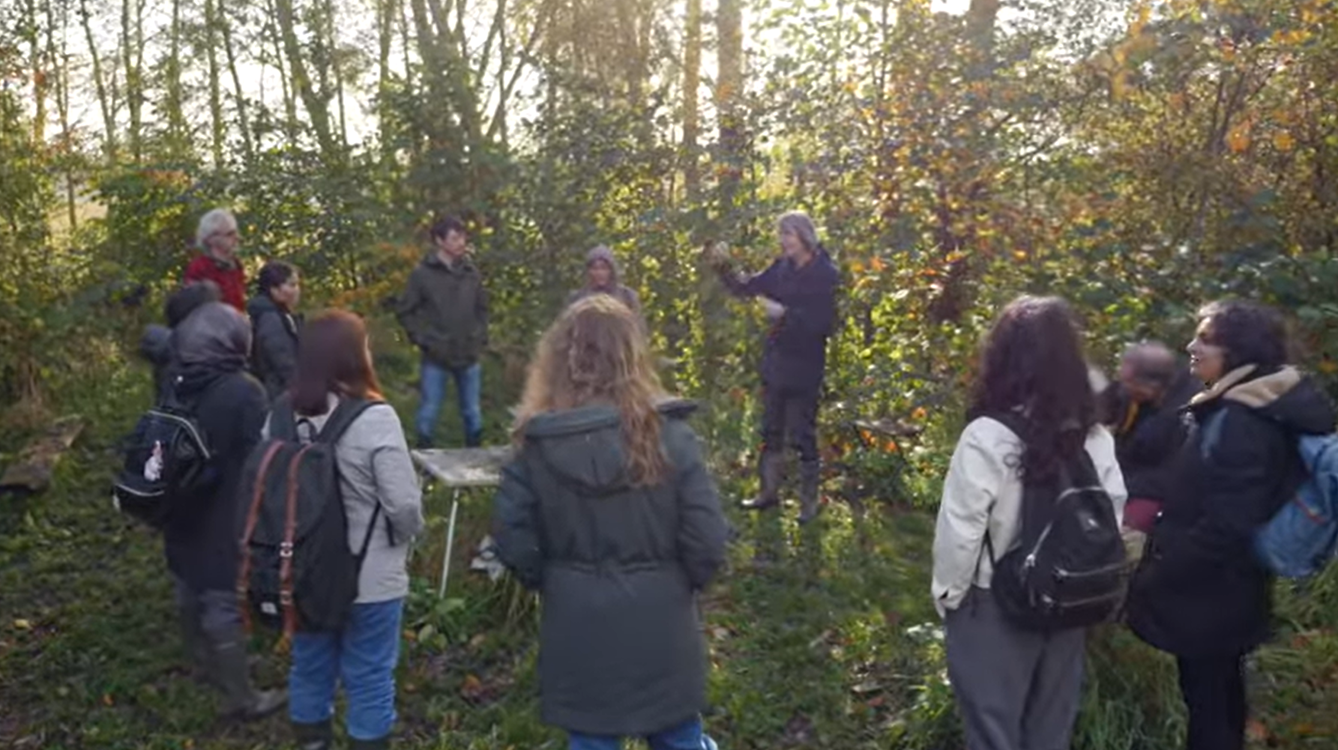
When Both ENDS-colleagues visit partners, they often go on a "field trip" to see how our joint work affects people and communities. This year, we did the same in the Netherlands. Food forestry pioneer Wouter van Eck demonstrates a group of Both ENDS partners how regenerative agriculture can offer solutions to the climate and biodiversity crises.
Lessons from Ketelbroek
Wouter van Eck, co-founder of Ketelbroek, was inspired by African communities. He explained how the food forest is designed to mimic a natural ecosystem. "Monoculturele and toxins aren't necessary. Agriculture doesn't have to exist at the expense of nature. We can also work for agricultural systems that produce good food and restore nature at the same time."
The exchange left participants energised, united by a shared mission to promote food sovereignty and climate justice. Sadhana Sanjay (IT for Change, India): "We draw from practices that communities have succesfully preserved for many years now. We build to that to improve both food security, income security as well as biodiversity."
Read more about this subject
-
 Environmentally Just Practice /
Analog Forestry
Analog forestry is a transformative approach to the ecological restoration of degraded lands. Natural forests are used as guides to create ecologically sustainable landscapes, which support the social and economical needs of local communities.
-
 Dossier /
Inclusive ways to sustainable and healthy food for all
All around the world small-scale farmers are using sustainable and inclusive methods to produce food. Working together with nature and each other, they provide their families and communities with sufficient and healthy food. But their production methods are under pressure from large-scale agriculture and the globally dominant system of industrial food production. Together with our partners, Both ENDS is trying to turn the tide in favour of sustainable, local practices that are mostly known as 'agro-ecological' or 'nature-inclusive'. Why are we focusing on these methods? Agro-ecological practices are climate-proof and inclusive and increase the opportunities for communities around the world to produce their food sustainably.
-
 Dossier /
Amplifying environmentally just practices
Because of the close relationship with their living environment, local communities often have the best ideas for the sustainable and equitable use and governance of land, water and forests. These environmentally just practices and processes successfully protect and restore ecosystems and address climate change. They are essential in the light of the multiple crises the world faces, but are in dire need of financial and policy support.
-
 Dossier /
Wetlands without Borders
With our Wetlands without Borders program, we work towards environmentally sustainable and socially responsible governance of the wetlands system of the La Plata Basin in South America.
-
 Dossier /
Communities Regreen the Sahel
In various countries in the Sahel, vast tracts of land have been restored by the local population by nurturing what spontaneously springs from the soil and protecting the sprouts from cattle and hazards.
-
 News / 5 November 2025
Interview: Both ENDS at COP30 for Climate Justice and Systemic Change
Both ENDS is present at COP30 to advocate for genuine access to climate finance for locally led, gender-just climate solutions and the mechanisms that facilitate this, including those for farmer-led restoration. Furthermore, the organisation participates to ensure the crucial connection between the climate negotiations and the trade and investment frameworks that shape them.
Learn more about the Both ENDS team at COP30 below, and find all the activities and side-events in which Both ENDS will participate.
-
Publication / 9 October 2025
-
 Dossier /
International trade and investment with respect for people and planet
The network of international trade and investment treaties is large and complex. The Netherlands alone has signed more than 70 bilateral investment treaties (BITs) and is party to the trade and investment agreements concluded by the EU, like the EU-Mercosur and EU-Indonesia trade deals.
-
 News / 6 October 2025
From Entebbe to Accra: civil society is rewriting the rules of investment
By Fernando Hernández Espino and Bart-Jaap Verbeek
Almost a year after African civil society gathered in Uganda to adopt the Entebbe Declaration, the call to transform international investment governance continues to gain strength. From the 6th to the 9th of October, over 50 civil society organisations from across West Africa, including from Ghana, Senegal, Nigeria, Côte d’Ivoire, Cameroon, Gambia, Sierra Leone, as well as from Kenya and Latin America, are convening in Accra to deepen and operationalise the Declaration’s vision.
-
 Dossier /
Fair Green and Global Alliance (FGG)
Together with civil society organisations from all over the world, the Fair Green and Global (FGG) Alliance aims for socially just, inclusive and environmentally sustainable societies in the Netherlands and the Global South.
-
 News / 2 July 2025
 -
 Blog / 2 July 2025
Women at the frontlines of climate action: local power for global change
By Tamara MohrLast week, GAGGA, the Global Alliance for Green and Gender Action, with Both ENDS as one of the Alliance members, together with FCAM and Mama Cash, organised its Global Meeting in Indonesia. The goal of this meeting was to recognise, celebrate and look ahead at cross-movement and cross-regional connections, to strengthen the collective power of gender, climate and environmental justice movements.
-
Publication / 1 July 2025
-
 Blog / 3 June 2025
A food forest as an inspiring oasis between monoculture fields
Recently, we visited food forest Ketelbroek with a group of colleagues. This project was initiated by food forest pioneer Wouter van Eck and our own Pieter Jansen. What a beautiful place! Located between monocrop fields of ryegrass, beetroot and potatoes, the food forest is a green oasis. Birdsong fills the air and there is a constant buzz and fluttering all around. Hares, badgers, foxes and wild boars are regular visitors. And let's not forget the beavers.
-
 Environmentally Just Practice /
Agroecology
Agroecology is a diverse set of agricultural practices, a field of science and a social movement. It aims to transform food systems towards greater ecological sustainability, social justice, and resilience. Both ENDS and CSO-partners around the world support farmers and pastoralists practising agroecology, both on the ground and in gathering political and financial support.
-
 News / 9 May 2025
Women’s leadership in agroecology flourishes in Eastern and Southern Africa
On 12 and 13 February 2025, women from Kenya, Uganda, and Zimbabwe gathered in Nairobi for the Africa Women Leaders in Agroecology (AWOLA) Regional Networking Forum. The event marked a significant moment in the leadership programme of PELUM Kenya, which empowers young women in their role as leaders in the agroecological transition. This project was made possible thanks to support from Both ENDS as part of the Fair, Green and Global (FGG) Alliance.
-
Publication / 1 April 2025
-
 Blog / 27 March 2025
Fair trade and equal partnerships: only then can Kenya stand on its own
Several media outlets, including de Volkskrant, focused last week on the shift from “aid” to “trade,” partly in response to the state visit of the Dutch royal couple to Kenya. The idea is that it would be beneficial for Kenya to stand on its own two feet. A beautiful ideal—one I whole heartedly believe in. But this ideal can only become a reality if equality is at the heart of trade and international cooperation.
-
 News / 21 March 2025
Dutch Royal couple visits Thogoto Forest: a green oasis on the outskirts of Nairobi
This week, King Willem-Alexander and Queen Máxima visited Thogoto Forest as part of their state visit to Kenya. They were able to see the impact of the work of our partner MCDI in the area: a restored forest, clean water and farmers who can earn a living by selling their agro-ecological products.
-
 News / 13 January 2025
New partnership with Netherlands Enterprise Agency for resilient food systems in Sahel
The situation in Africa's Sahel is the world's fastest-growing humanitarian crisis. Over 3 million people are fleeing violence. They are ravaged by hunger, disease and increasing drought caused by climate change. Both ENDS and its partners are successfully working on accelerating the resilience of local food systems and communities in the Sahel, based on ‘Farmer Managed Natural Regeneration’ (FMNR). The project, funded by DOB Ecology, will end in mid-2026, but has already been followed up thanks to a new collaboration with the Netherlands Enterprise Agency (RVO).



