




Is the Netherlands’ reputation as a world leader in the field of water knowledge deserved?
The Netherlands is a major player in the global water sector, but our investments can quite often lead to human rights violations and environmental problems in the countries where they are made. What can a new Dutch government do to reduce the Netherlands’ footprint beyond our borders? Ellen Mangnus spoke to various experts about this issue: today, part 3.
This time, an interview with Simon Richter and Murtah Shannon. Richter is Professor of Germanic Languages and Literature at the University of Pennsylvania, but is better known in the Netherlands as Professor Poldergeist, a cartoon figure who shows in short film clips why countries and cities lying below sea level should be concerned about their future. Shannon is senior policy advisor on sustainable and inclusive water management at Both ENDS.
Is the Netherlands’ reputation as a world leader in the field of water knowledge deserved?
Murtah: This is primarily a narrative that the Netherlands itself projects to raise the international profile of Dutch companies that do ‘something’ with water. It is part of an export strategy backed up by considerable diplomatic, institutional and financial resources.
Richter: “The Netherlands want people around the world to think of the Netherlands if they encounter water-related problems: ‘The Dutch know everything about water, we need the Netherlands, let’s ask them for help.’ They often refer to the historical fight against the water, which they have won by working together. As if the Dutch all agree about everything, which is far from the truth.
With his cartoon figure Professor Poldergeist, Richter tries to get the Dutch to take a good look at themselves.
Shannon: Dutch companies have a lot of technical know-how that can be useful elsewhere, but that doesn’t necessarily translate into sustainable water governance. Sustainability is mainly a question of to what end technical expertise is being used, and who gets to decide. These matters tends to receives less attention, resulting in projects that benefit local elites at the expense of water users like farmers and fisherfolk. In the most extreme cases, Dutch companies have become involved in serious human rights violations and biodiversity loss, as is currently happening in the Bay of Manila for the construction of a new airport - with the unwitting support of Dutch tax-payers. That’s why Both ENDS is fighting, together with its partners, for an inclusive water sector. ’
What does that mean and how can we do things better?
Richter: “It is important that European Dutch citizens become more aware that the Netherlands is also vulnerable. The islands of Bonaire, Aruba, Curaçao and Saba are threatenedbyclimate change. And in the long run, the European Netherlands will also be under serious threat. At present, the Netherlands sees climate adaptation as a business case, a problem mainly affecting other countries.
A lot depends on how quickly the sea level rises – for the Netherlands as a whole, including the Caribbean parts of the kingdom, but also for other countries where the Netherlands wants to be a leader in climate adaptation. If this awareness really takes hold, you would expect the Netherlands to be a champion of rapid decarbonization.”
At COP 28 in Dubai, Richter organized a panel on the dangers and opportunities posed by sand for climate adaptation, the subject of the most recent Poldergeist video. The panel members came from Manila, Khulna and Aruba, all places where Dutch dredging operations are seen as disruptive and destructive for ecosystems and the coastal population. "While the Netherlands is exploring ways to harvest sand from the North Sea without causing too much ecological harm. Shouldn’t it apply the same standards to its activities abroad?"
Shannon: “First of all, the Netherlands should be a lot more selective in terms of who it supports. Companies that contribute to human rights violations or the destruction of ecosystems should not be eligible for export credit insurance, participation in trade missions or other benefits made possible with public money. Secondly, support in the water sector should focus much more on facilitating equal cooperation and knowledge development with partner countries, with special attention to the expertise and institutions of local water users. Cooperation is still too often seen as unilateral transfer of Dutch knowledge to other countries, as if the Netherlands has nothing more to learn. That is simply not true.”
What message do you have for the new government?
Shannon: “The Netherlands should much more actively take on the role of innovator in the field of sustainable and inclusive water management. There is an enormous demand for that worldwide.”
For more information
Read more about this subject
-
Publication / 21 March 2023
-
 Environmentally Just Practice /
A Negotiated Approach for Inclusive Water Governance
A Negotiated Approach envisages the meaningful and long-term participation of communities in all aspects of managing the water and other natural resources on which their lives depend. It seeks to achieve healthy ecosystems and equitable sharing of benefits among all stakeholders within a river basin. This inclusive way of working is an essential precondition for the Transformative Practices that are promoted by Both ENDS and partners.
-
 News / 21 March 2023
Agua es vida: Both ENDS and water governance
Water is literally life, the lifeblood of ecosystems, of nature, of humans. However, in many places the distribution and use of water is unjust and unsustainable. Water management is generally focused on short-term economic interests, on maximizing the profit of a well-connected few at the expense of people and nature. This dominant view of water and water management has its origins in the European industrial revolution, which became the global norm through colonialism and globalization. But according to Melvin van der Veen and Murtah Shannon, water experts at Both ENDS, this view will have to give way to equitable, sustainable and inclusive water management. Both ENDS cooperates with and supports communities and organisations worldwide who are working to this end.
-
 News / 23 June 2025
Who benefits from better protection of our oceans?
The ocean emerged strengthened from the UN Ocean Conference in Nice. More countries are supporting a ban on deep-sea mining, more marine protected areas are being established, and more pledges are being made to fight pollution. The question now is whether countries will follow through on their commitments. Because the ocean movement faces a camp of powerful interests.
This article was originally posted in Dutch on MO*Magazine.
-
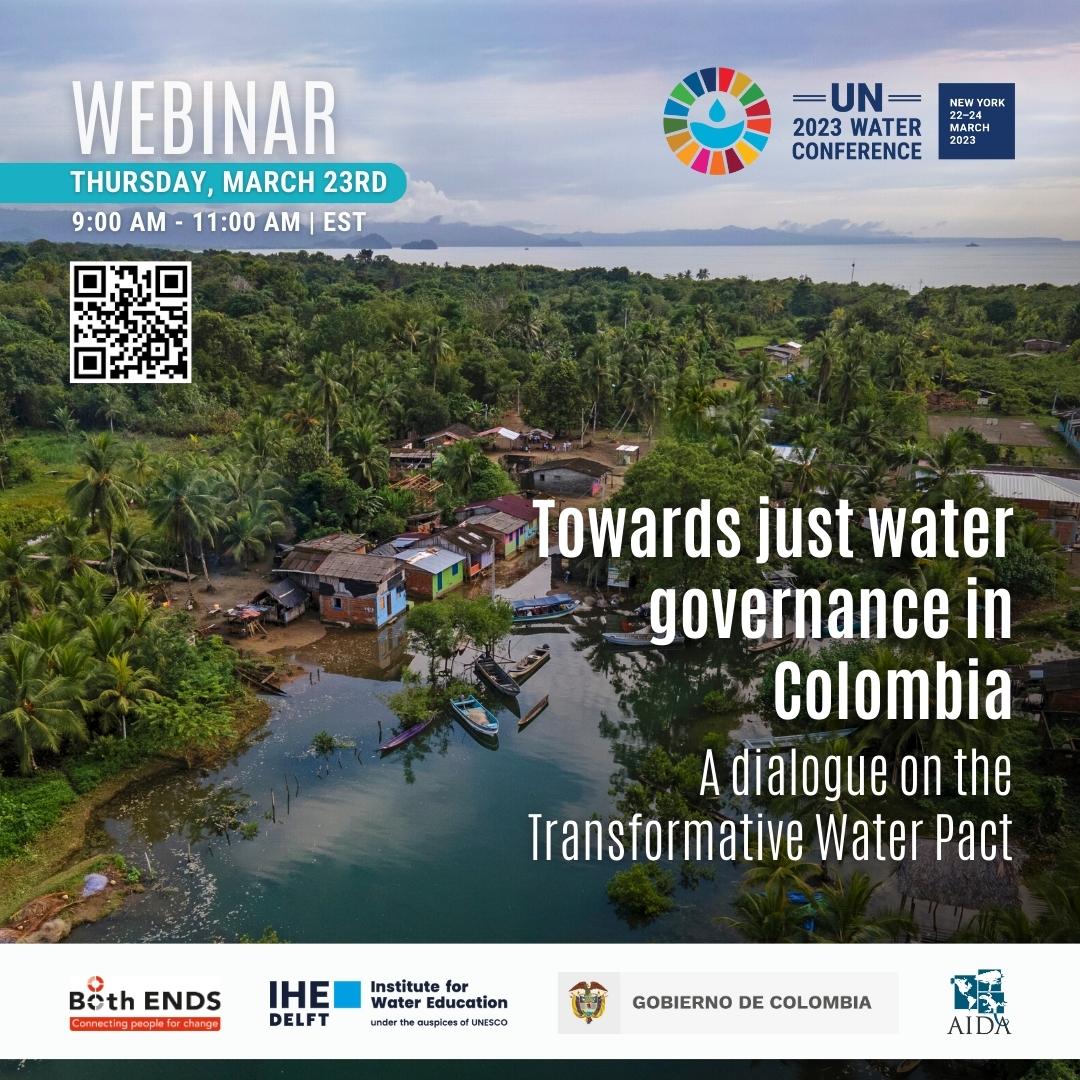
 Event / 23 March 2023, 09:00 - 11:00
Towards just water governance in Colombia; a dialogue on the Transformative Water Pact
Online side event at the UN Water conference in New York
This event will present The Transformative Water Pact (TWP), an innovative framework for water governance that has been developed by environmental justice experts from around the world. The TWP will serve as a starting point for dialogue between representatives of the government of Colombia, academia, regional and international NGOs in relation to Colombia's current ambitions in multi-scalar water governance.
-
 Press release / 20 March 2023
A Transformative Water Pact : A radical response to the global water governance crisis
Academics and civil society representatives from around the world came together to articulate an alternative vision and framework for water governance, in the run-up to the UN Water Conference 2023 in New York. The Transformative Water Pact was developed in response to the continued exploitation of nature, neglect of human rights and the extreme power-imbalances that characterize contemporary water governance throughout the world. It details an alternative vision of water governance based on the tenets of environmental justice, equality and care.
-
 News / 22 March 2022
World Water Day: just climate solutions already exist
These past weeks we have been joining the #WeWomenAreWater campaign to put the spotlights on just climate solutions of and for women, girls, trans, intersex and non-binary people around the world. The campaign started on International Women's Day (March 8th) and ends today, on World Water Day. Just climate solutions already exist but these initiatives are grossly underfunded, and the people implementing them are also those most impacted by climate change and climate-related water scarcity. Therefore, we would like to highlight, especially today on World Water Day, some of these solutions below. And we also have a special message from the colleagues at Both ENDS working on inclusive water governance.
-
Publication / 12 May 2026
-
 Press release / 12 May 2026
UN report warns of a growing sand crisis - The Dutch dredging sector plays a key role in global sand extraction
GENEVA/UTRECHT, 12 May 2026 – A new report by the United Nations Environment Programme (UNEP), Sand and Sustainability: An Essential Resource for Nature and Development, warns that global demand for sand is exceeding ecological limits. Large-scale extraction of sand from marine and coastal ecosystems is leading to biodiversity loss, damage to coastal communities and increasing risks in an era of climate change. Dutch dredging companies play a prominent role in this as global market leaders in large-scale sand extraction and land reclamation. “Our analyses show that the dredging sector operates globally within a system in which ecological damage and the consequences for coastal communities are systematically underestimated, whilst transparency and effective oversight are often lacking,” says the Dutch environmental and human rights organisation Both ENDS, which contributed to the report.
-
 News / 10 July 2025
Both ENDS and Global Witness condemn harassment of anti-reclamation activists in Manila Bay
Global Witness and Both ENDS strongly condemn the reported of harassment and surveillance by the Armed Forces of the Philippines of environmental activists and fishing communities in Navotas, Philippines. Pamalakaya-Pilipinas, a National Federation of Small Fisherfolk Organisation in the Philippines, has received credible reports that the Armed Forces of the Philippines (AFP) are engaged in “red-tagging” their members.
-
 News / 6 June 2025
Both ENDS at the UN Ocean Conference: voicing our environmental justice concerns about the “Blue Economy”
Next week, the United Nations Ocean Conference will take place in Nice, France. This conference is focused on the conservation and sustainable use of coasts, seas and marine resources. Both ENDS colleague Murtah Shannon will be attending. We’ve asked him to explain a bit more about his plans.
-
 Blog / 28 January 2025
Sinking promises in Manila
Yesterday, Global Witness published a new report, "Sunk Costs" - in which I had a modest role to play - that comes up with new facts about the disastrous New Manila International Airport project in the Philippines, for which the Dutch dredging multinational Boskalis received Dutch export credit insurance (ekv) of €1.5 billion.
-
 News / 16 August 2024
Statement on the denial of legal protection by the Philippines Court of Appeals towards environmental defenders Jonila Castro and Jhed Tamano
Both ENDS expresses its profound concern over the recent decision by the Philippines Court of Appeals to deny legal protection to Jonila Castro and Jhed Tamano against unlawful harassment and reprisals from state forces. Castro and Jhed are two young environmental human rights defenders who were violently abducted by Filipino armed forces in September 2023, for almost 17 days, in a case that made international headlines. The two women had been working as community organizers in Northern Manila Bay, where large-scale land reclamation's have wreaked havoc on communities and ecosystems.
-
 News / 29 March 2024
Both ENDS visit Tweede Kamer to talk about destructiveness of dredging worldwide
This week several Both ENDS colleagues visit Tweede Kamer der Staten-Generaal to meet Christine Teunissen and Luc Stultiens with partners from Mozambique, Indonesia and the Filippines to talk about the destructiveness of dredging worldwide and especially in projects with the aid of the Dutch government.
Read their plea
-
Publication / 25 March 2024
-
 Press release / 25 March 2024
Dredging destruction; worldwide research into Dutch dredgers
Dredging Destruction: Report reveals how Dutch dredging companies are systematically destroying human lives and the environment around the world with the help of taxpayers’ money
The Netherlands is providing billions of euros in support for dredging projects by Boskalis and Van Oord around the world. All of these projects are destroying human lives and the environment. The Dutch government’s policy to protect people and planet is failing systemically. And after twelve years of studies and talking, there are no real improvements. It is time for a thorough clean-up of government support for the dredging sector.
-
 News / 13 August 2021
Food sovereignty in the polders of Southwest Bangladesh
The situation in the southwest delta of Bangladesh is critical. Because of sea level rise, floods are increasing and the area is about to become uninhabitable, despite Dutch-style dikes and polders built in the previous century. Partner organisation Uttaran works with local communities on climate-friendly solutions that restore the living environment and give the inhabitants a say about their future and food production.
-
 News / 21 March 2025
Dutch Royal couple visits Thogoto Forest: a green oasis on the outskirts of Nairobi
This week, King Willem-Alexander and Queen Máxima visited Thogoto Forest as part of their state visit to Kenya. They were able to see the impact of the work of our partner MCDI in the area: a restored forest, clean water and farmers who can earn a living by selling their agro-ecological products.
-
 News / 22 March 2012
What did Both ENDS do at the World Water Forum?
Halls filled with booths, stands, professionally set up corners, wifi-spots. Big rooms where lectures, interactive sessions and workshops are held. People from all corners of the world and from different kinds of sectors (companies, government, and social organisations) are gathering here for five days. They have one thing in common: they are talking about water. The sixth World Water Forum in Marseille is about 'solutions'. For water issues, that is. Almost a billion people worldwide have to cope without clean drinking water.
-
 News / 23 March 2020
Women in Latin America claim their right to water
In many places in Latin America, access to clean water is under great pressure from overuse and pollution, often caused by large-scale agriculture or mining. This has significant impact, especially on women. In March, with International Women's Day on March 8 and World Water Day on March 22, they make themselves heard and claim their right to water.



