




Dutch Pension funds do not vote in line with climate ambitions
Authors note rectification 13 April 2023
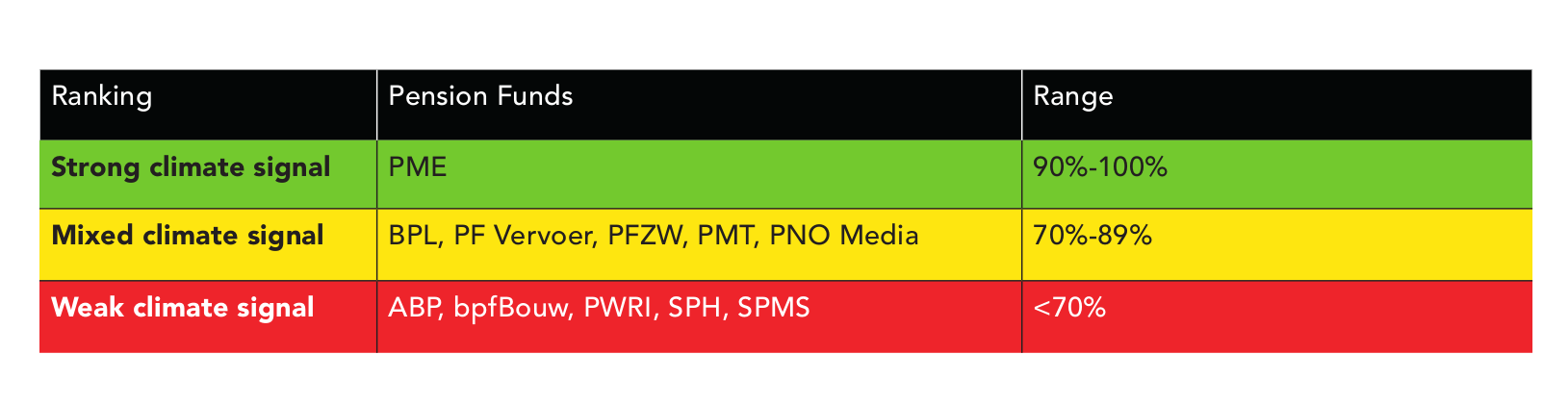
Most Dutch pension funds and their asset managers do not vote consistently in favour of climate resolutions at the oil and gas companies and banks in which they invest. That is the conclusion of a report published today by Both ENDS and Groen Pensioen. Eleven of the twelve* Dutch pension funds studied have made public statements and pledges about adapting their policies in line with the Paris Climate Agreement. But their voting behaviour does not sufficiently correspond with these pledges. Only pension fund PME votes for 100% in line with its own climate promises.
None of the companies involved in fossil fuels has drawn up a credible business plan compatible with the 1.5 degree goal agreed in Paris. Participants in pension plans have been calling on their pension funds for many years to withdraw from the fossil sector, but too little comes of that in practice. Some pension funds continue to invest in the sector with the stated intention to use their influence as shareholders to push fossil companies in the right direction. This study shows, however, that pension funds exert their influence insufficiently and that their engagement has hardly led a change of course among fossil companies.
Banks out of the fossil sector too
The researchers focused on voting behaviour on climate resolutions at oil and gas companies and banks. The latter play a key role as, without financing, fossil projects cannot be implemented. "Eleven of the twelve pension funds and their asset managers that we studied did not use their votes to send sufficiently strong messages," says Cindy Coltman of Both ENDS. "To have a realistic chance of keeping global warming below 1.5°C, it is essential that pension funds stop investing in oil and gas companies and exert pressure on banks to stop financing the fossil sector. And that is not happening enough."
Clear expectations
Pension funds normally vote in 75% to 98% of cases in favour of general resolutions, for example on the appointment of board members or management plans. The report shows that, in the case of climate resolutions, that percentage is much lower. Most pension funds vote in favour of the climate in only 58% to 89% of cases. "We would expect pension funds that claim to take the climate seriously to vote in favour of all resolutions that will have a positive effect on the climate," says Marjolein van Dillen of Groen Pensioen. "They have to overcome their fear of being 'too controlling or too difficult' for the companies in which they invest, and indicate clearly what they expect of the companies in terms of climate policy."
Using their influence
The researchers think that pension funds should lay out a clearer vision on fossil and sustainable investments. And they should be much more assertive in using the influence they have to redirect financing towards the renewable sector and climate solutions.
"We have seen that pension funds can show genuine leadership," says Coltman. "ABP and PME have almost entirely phased out their investments in fossil companies. That means that the pension funds we studied can utilise their engagement much more effectively or, if they really want to effect change, can withdraw from the fossil sector completely. We also believe that they should be much more transparent towards their pension savers about their plans and engagement in that respect. 'Business as usual' is no longer an option in a world that is wrestling with enormous climate problems".
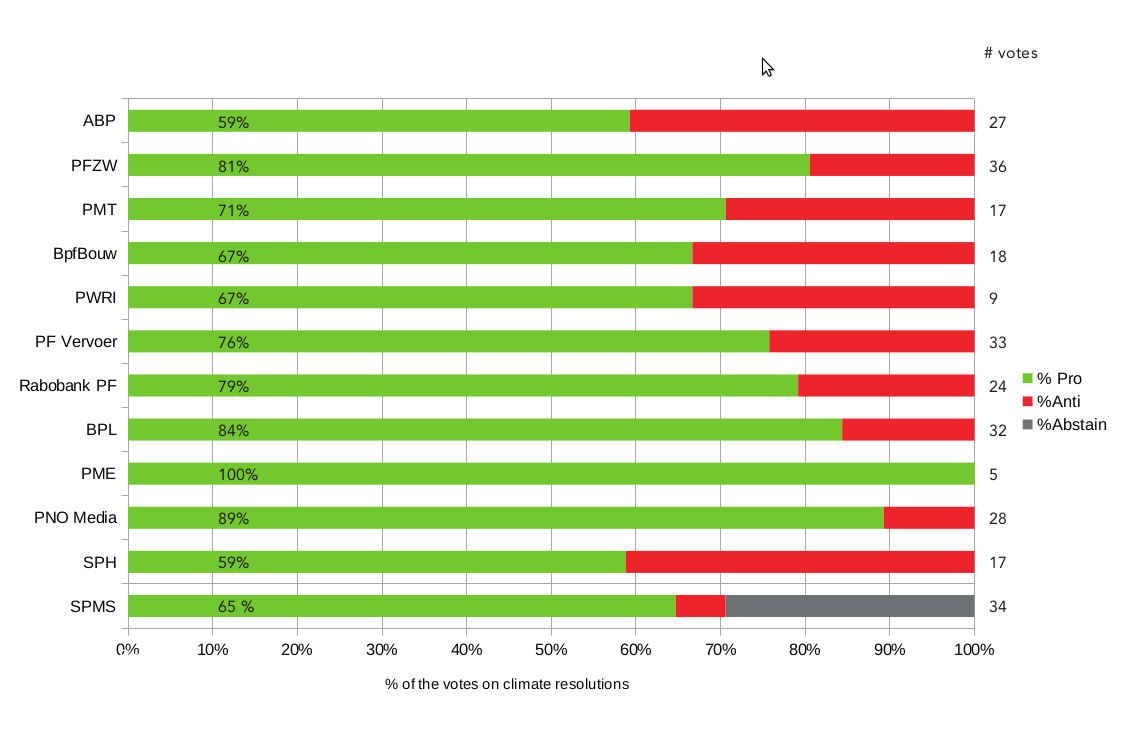
* The pension funds studied were ABP, PFZW, PMT, BpfBouw, PWRI, PF Vervoer, Rabobank PF, BPL, PME, PNO Media, SPH and SPMS
Read more about this subject
-
 Dossier /
Towards a socially and environmentally just energy transition
To address the climate crisis we need to urgently transition away from fossil fuels towards clean, renewable energy. However, this transition is not only about changing energy sources. It requires an inclusive and fair process that tackles systemic inequalities and demanding consumption patterns, prioritizes environmental and social justice, and which does not repeat mistakes from the past.
-
 Dossier /
Making pension funds more sustainable
Pension funds have a lot of influence because of their enormous assets. Both ENDS therefore wants pension funds such as the Dutch ABP to withdraw their investments from the fossil industry and to invest sustainably instead.
-
 News / 3 september 2026
Restoring Land, Restoring Hope: Both ENDS at UNCCD COP17 in Mongolia
From 17 to 28 August, governments gathered in Ulaanbaatar, Mongolia, for COP17 of the UN Convention to Combat Desertification (UNCCD). At stake was more than how the world responds to land degradation and drought. It was also a question of who gets to shape land restoration, whose knowledge counts, and where the money goes.
-
 News / 6 juli 2026
Strengthening Women's Land Rights Across the Rio Conventions
From 29 June – 2 July 2026, Tamara Mohr, GAGGA coordinator at Both ENDS participated in the 4th convening of the Women's Land Rights Initiative (WLRI) in Nairobi, Kenya.Hosted by the Robert Bosch Stiftung, TMG Research and the Huairou Commission, the event brought together grassroots organisations, (inter)national NGOs, government institutions and donors from around the world.
-
Publication / 3 juli 2026
-
 Dossier /
Gas in Mozambique
In 2011 one of the world’s largest gas reserves was found in the coastal province of Cabo Delgado, in the north of Mozambique. A total of 35 billion dollars has been invested to extract the gas. Dozens of multinationals and financiers are involved in these rapid developments. It is very difficult for the people living in Cabo Delgado to exert influence on the plans and activities, while they experience the negative consequences. With the arrival of these companies, they are losing their land.
-
 Dossier /
Finance for agroecology
The lion's share of public budgets for climate, agriculture and development still goes to conventional agroindustrial projects that contribute to the current climate, food and biodiversity crises. Both ENDS and our partners are calling for a transition to agroecological practices that are people- and environment-friendly.
-
Publication / 18 juni 2026
-
Publication / 12 mei 2026
-
 Press release / 12 mei 2026
UN report warns of a growing sand crisis - The Dutch dredging sector plays a key role in global sand extraction
GENEVA/UTRECHT, 12 May 2026 – A new report by the United Nations Environment Programme (UNEP), Sand and Sustainability: An Essential Resource for Nature and Development, warns that global demand for sand is exceeding ecological limits. Large-scale extraction of sand from marine and coastal ecosystems is leading to biodiversity loss, damage to coastal communities and increasing risks in an era of climate change. Dutch dredging companies play a prominent role in this as global market leaders in large-scale sand extraction and land reclamation. “Our analyses show that the dredging sector operates globally within a system in which ecological damage and the consequences for coastal communities are systematically underestimated, whilst transparency and effective oversight are often lacking,” says the Dutch environmental and human rights organisation Both ENDS, which contributed to the report.
-
 News / 14 april 2026
New report: Phasing out ISDS in the Netherlands: a roadmap
Today, Both ENDS and SOMO are publishing the report Phasing out ISDS in the Netherlands: a roadmap. In the report, we highlight the Netherlands’ role in the ISDS system and offer practical guidance on phasing out ISDS.
-
Publication / 14 april 2026
-
 News / 9 april 2026
Minister Sjoerdsma hosts roundtable conversations with civil society
This week, Minister Sjoerdsma organized roundtable conversations with civil society organizations – a valuable initiative that brings together Dutch civil society voices to address critical challenges faced by democratic societies.
-
 News / 26 maart 2026
New project: Climate Accountability in EU Trade
Through its new project “Climate Accountability in EU Trade: Testing the SEP and DAGs for Climate-Linked FTA Enforcement” Both ENDS, with support from the European Climate Foundation, is exploring how the European complaints mechanism (SEP) and Domestic Advisory Groups (DAGs) can be more effectively used to advance climate accountability. The project runs for 13 months, until end of 2026.
-
 News / 19 maart 2026
Winners of the ILED ‘Women Are Educators Award’ announced
Our partner organisation ILED (Indigenous-led Education Network) announced the seven winners of the ILED ‘Women Are Educators Award’ this month. These are women who play extraordinary roles in passing on knowledge, whether in formal or informal educational settings.
-
 News / 27 februari 2026
Both ENDS strengthens the resilience of female environmental defenders worldwide thanks to multi-year contribution from the Postcode Lottery
In recent years, Both ENDS has received an additional contribution of €875,000 from the Postcode Lottery for the Autonomy & Resilience Fund (2022–2025), implemented in collaboration with the Global Alliance for Green and Gender Action (GAGGA). This support was essential because female environmental rights defenders around the world are increasingly facing climate change, repression and shrinking civil space. With this contribution, Both ENDS supports female activists and their communities with flexible, trust-based funding, enabling them to develop their own solutions to urgent environmental and climate problems.
-
 News / 2 februari 2026
Response to the D66-VVD-CDA coalition agreement
Coalition: Repair the damage and dare to go further
At Both ENDS, we see a number of cautious steps in the right direction in this coalition agreement. There is a slight emphasis on green issues, renewed attention to women's rights, recognition of the importance of civil society, and discussion of trade agreements with a focus on mutual interests. However, without structural change in how we trade, invest, and cooperate, fine words remain empty shells.
-
 Dossier /
Seeking justice for the affected communities of Vale’s mining disasters in Mariana and Brumadinho
In 2015 and 2019, the Brazilian state of Minas Gerais experienced two severe mining tragedies in Mariana and Brumadinho, due to the same mining company: Vale. Since then, the affected communities have been seeking justice, via the criminal punishment of the responsible parties, and a fair compensation for the loss of their loved ones, their homes and their livelihoods. Both ENDS supports local CSOs by amplifying their quest for justice within an international audience and, more specifically, by raising awareness amongst Dutch investors in Vale about the high risks this company’s activities pose for people and the environment.
-
 News / 2 februari 2026
Seven years after Brumadinho: impunity allows Vale’s disasters to continue
Seven years ago, the dam owned by mining company Vale collapsed in Brumadinho, Brazil, killing 272 people and severely polluting the surrounding area. While the relatives of the victims commemorate them and fight for justice, the pollution continues.
-
 News / 22 januari 2026
Shell files new arbitration against the Netherlands over Groningen gas field closure
Shell is suing the Netherlands in yet another attempt to evade its responsibility for decades of gas extraction in Groningen. For years, gas production has triggered earthquakes, damaged over a hundred thousand homes, and left residents living in prolonged insecurity, still waiting for repairs, reinforcement, and justice.




