




Record submissions to public consultation urge EU to act on deforestation
Brussels, Belgium - 14 December
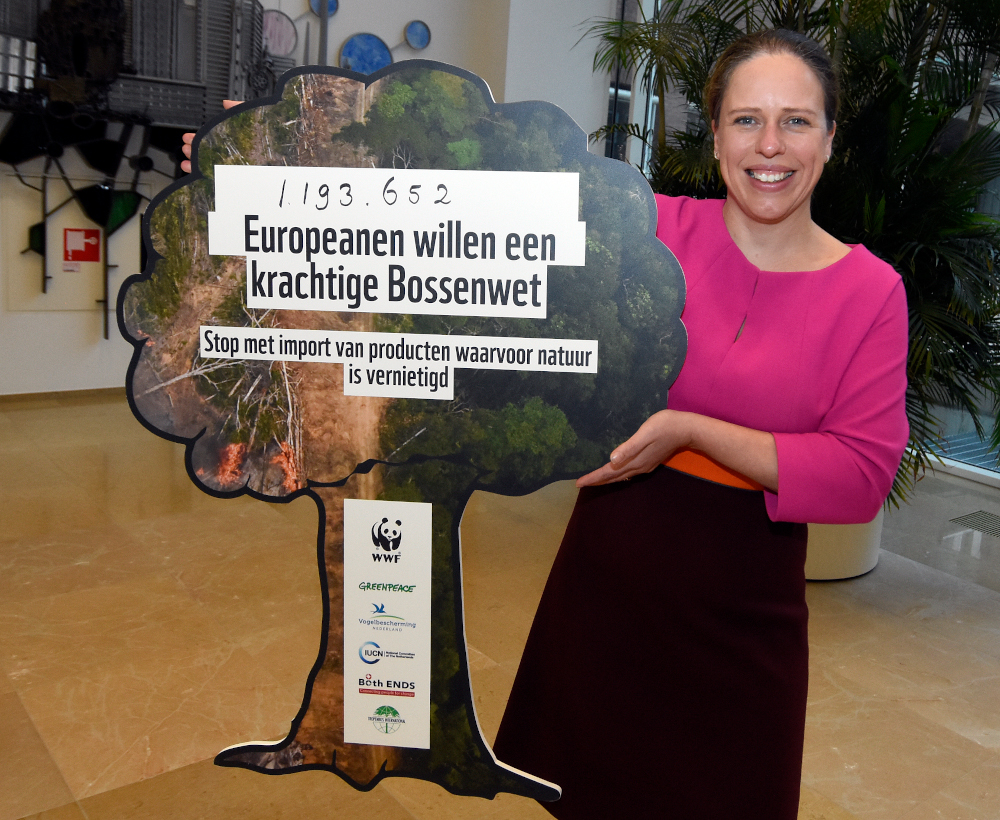
A landmark 1,193,652 submissions to the EU's public consultation on deforestation were handed over to the European Commission this afternoon, all of which demanded a strong EU law to protect the world's forests and the rights of people who depend on them. The one million+ submissions have made this the largest public consultation on environmental issues in the history of the EU, and the second largest ever.
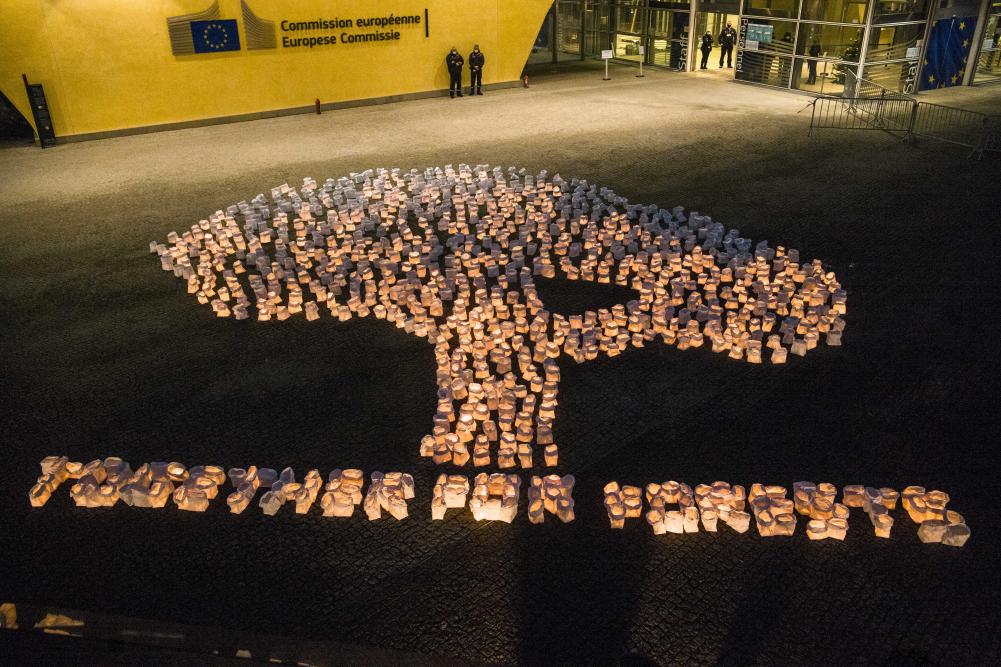
The signatures were received by Frans Timmermans, Executive Vice-President for the European Green Deal, and Virginijus Sinkevičius, EU Commissioner for Environment, Oceans and Fisheries in an online event. The ground outside the European Commission's Berlaymont building was decorated with 1,193 lanterns, each representing 1,000 people who signed the petition.
Ester Asin, Director of WWF's European Policy Office, said: "For too long, the burden has been put on citizens to work out whether their shopping has contributed to deforestation. This call from over one million people can't be ignored. The EU has the power to help stop the destruction of the world's forests and other nature, like grasslands. It can do this by passing a new law which would get products linked to the destruction of nature off the EU market - and citizens' plates!"
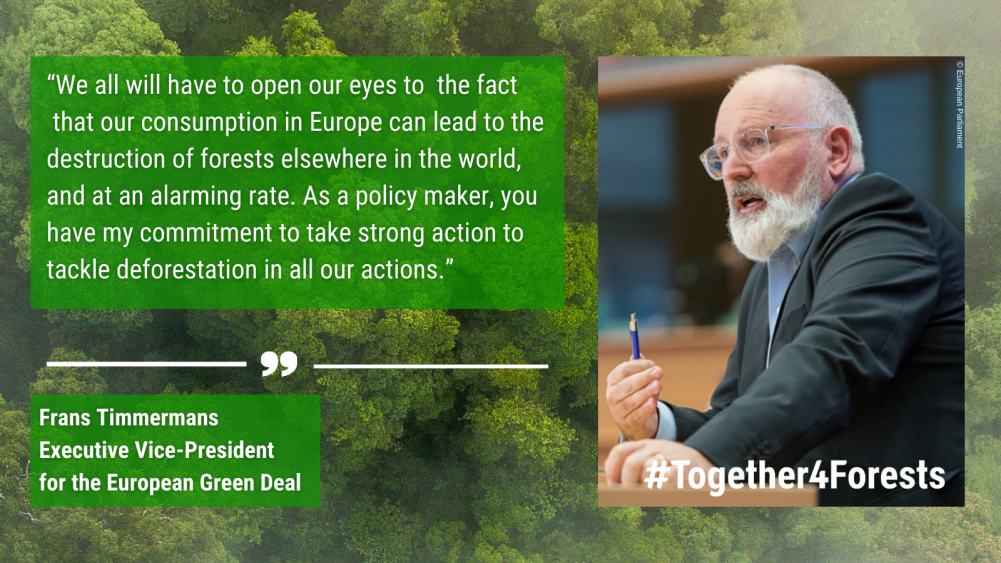
Executive Vice-President Frans Timmermans, Executive Vice-President for the European Green Deal, said: "We all will have to open our eyes to the fact that our consumption in Europe can lead to the destruction of forests elsewhere in the world, and at an alarming rate. We each need to make responsible and informed choices as individual consumers. And as a policy maker, you have my commitment to take strong action to tackle deforestation in all our actions."
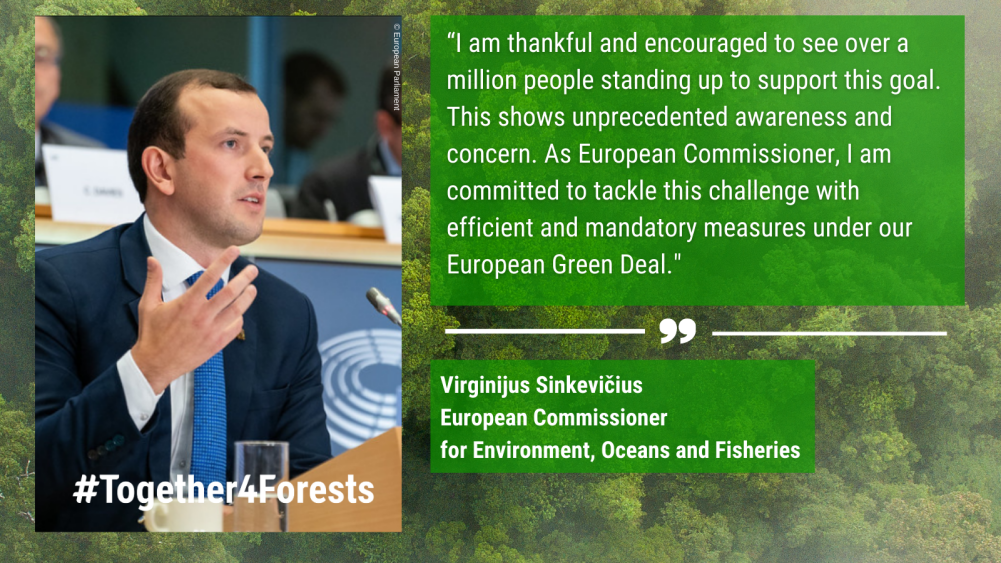
Commissioner Virginijus Sinkevičius, EU Commissioner for Environment, Oceans and Fisheries, said: "Fighting deforestation is an emergency, and we are determined to act. I am thankful and encouraged to see over a million people standing up to support this goal. This shows unprecedented awareness and concern. As European Commissioner, I am committed to tackle this challenge with efficient and mandatory measures under our European Green Deal."
The over one million respondents called for a new ambitious EU law to keep products linked to deforestation and nature destruction off the European market, and ensure that the production of such commodities (e.g. beef, soy for animal feed, cocoa, coffee and palm oil) has not led to human rights violations, including the rights of indigenous peoples and local communities. Such a law should also apply to the finance sector.
#Together4Forests, a campaign led by WWF, Greenpeace, ClientEarth, Conservation International and the Environmental Investigation Agency, and backed by more than 160 environmental groups including Both ENDS, encouraged people to make submissions to the public consultation demanding the EU tackle the forest footprint of its consumption.
The EU's demand for products like beef, soy for animal feed, leather, coffee, cocoa, rubber and palm oil, is pushing the world's forests and nature to the brink. A powerful example is EU soy imports which, together with China, accounts for more than half of all soybeans exported by Brazil. EU soy imports are, however, more often sourced from "deforestation frontiers", like the Amazon rainforest and the Cerrado grassland [1], and a recent study estimated that as much as one fifth of EU soy imports from Brazil may have come from illegally deforested land [2].
-----------------------------------
References:
[1] TRASE yearbook (2020): The state of forest risk supply chains, p.5
[2] Raoni Rajão, et al: 'The rotten apples of Brazil's agribusiness'. Published in Science on 17 July 2020
Contact:
Sophie Bauer, WWF Senior Communications Officer, Deforestation
sbauer@wwf.eu
+32 471 05 25 11
Anke Schulmeister - Oldenhove, WWF Senior Forest Policy Officer
aschulmeister@wwf.eu
+32 485 84 31 44
Read more about this subject
-
 Blog / 18 January 2019
Unambitious and uninspiring: the European Commission’s proposal for stepping-up action on global deforestation
After five years of equivocation the European Commission has proposed a ‘roadmap’ for stepping-up EU action to address its contribution to global deforestation. Despite the escalating impact of EU trade in forest-risk commodities, regardless of repeated calls from the European Parliament for regulatory measures and contrary to the conclusions of the Commission’s own feasibility study in support of legislative intervention, the Commission has ruled-out out any new initiatives, let alone any legislative measures. The Commission’s solution to this complex problem: policy coherence.
-
 News / 28 June 2018
Indigenous leaders present 'Supply Chain Solutions' and petition in Paris and Brussels
Last week, indigenous leaders from various countries were in Paris to urge action on deforestation and human rights abuses at the multi-stakeholder meeting of the Amsterdam Declarations Partnership. The group, invited by Forests Peoples Programme and Both ENDS, presented a publication 'Supply chain solutions for people and forests' containing a set of practical recommendations from local communities on how to make supply chains more sustainable and fair.
-
 News / 3 February 2022
EU deforestation law can and must be stronger. Join #Together4Forests!
In the coming months, new EU regulation on deforestation-free products will be discussed in the Dutch and EU parliaments. The goal is that no more products related to deforestation in whatever way, will be imported into the EU . A very good and important initiative, but according to many civil society organisations, including Both ENDS, the bill that has now been drafted is far from sufficient.
-
 News / 28 February 2018
Human Rights defenders from all over the world visit EU to call for strong measures against deforestation
This week, from 12 until 16 February, fourteen indigenous leaders and human rights defenders from forest countries came to the Netherlands to call upon Dutch policy makers to take serious action against human rights abuses, land grabbing and further deforestation in relation to large scale agriculture, timber logging and mining. The Dutch harbours of Rotterdam and Amsterdam receive enormeous amounts of soy and palm oil, both for the Dutch market and for further transport into Europe and elswhere.
-
 News / 2 August 2019
EU unveils 'Action Plan' on Deforestation
The EU is still one of the world’s largest importers of deforestation: EU demand for commodities like soy, palm oil, beef, coffee and cacao requires millions of hectares of tropical rainforest to be cleared. This deforestation has significant biodiversity and climate impacts, and is often linked to human rights violations and violence against local communities and indigenous peoples. Both ENDS and partners have been actively lobbying the EU Commission to adopt a robust action plan to address and prevent human rights violations and deforestation ‘embodied’ in EU imports of agricultural commodities.
-
 News / 14 June 2019
Both ENDS partner TUK presents symbolic tree to Dutch minister Schouten
Last Thursday June 13, Rahmawati Retno Winarni of TUK, an Indonesian partner organisation of Both ENDS, presented a symbolic tree and an appeal to the Dutch Minister of Agriculture Carola Schouten, also on behalf of 10 NGOs. The joint NGOs are pushing the EU, including the Dutch government, for strict EU legislation to prevent the destruction of forests and ecosystems and to protect human rights.
-
 Press release / 11 September 2020
Press release: Golden opportunity to stop deforestation caused by EU consumption
100+ NGOs launch #Together4Forests urging EU action
Fires raging in the Amazon are started deliberately to make way for large-scale industrial agriculture – and EU market demand for commodities produced on former-forest land is adding fuel to the fires. Globally, the EU is responsible for over 10% of forest destruction through its consumption of commodities like meat, dairy, soy for animal feed, palm oil, coffee and cacao.
-
 News / 11 September 2020
Have your say on the EU’s deforestation policy
The world's forests are under threat. Remaining forests – havens of precious biodiversity and the lungs of the planet – are being cleared to make way for beef, soy, sugar and palm oil production, mining and other industrial activities, fuelled by increasing demand from Europe and other countries. But the good news is: you can help stop the destruction!
-
 News / 15 May 2018
Driving on palm oil: a dead end
Both ENDS and Forest Peoples Program have formally requested the European Parliament, Commission and Council and the EU Commissioner for Trade, Cecilia Malmström, to consult indigenous and local communities impacted by EU trade in palm oil and other agricultural commodities in formal EU policy deliberations on these topics. Why did we decide to do so and what's it all about? Our colleague Michael Rice sheds some light on the matter.
-
 Dossier /
Fighting for improvements in the production of palm oil
The production of palm oil is causing social and environmental problems worldwide. Both ENDS is working to make the sector fairer and more sustainable and is promoting alternatives for palm oil.
-
 News / 16 October 2020
Restoring forests, “free supermarkets” for Cameroon’s inhabitants
To Eric Wirsiy, director of CENDEP, the importance of forests is clear: not only do they function as a "free supermarket", providing foods and other things to local communities, but they are crucial to make landscapes resilient to climate change and other impacts.
-
 Blog / 15 April 2024
The year of truth: EU Member States urged to combat deforestation
The EU is the world's largest "importer of deforestation," due to the huge volumes of unsustainably produced soy, timber, palm oil, and other raw materials that EU member states import. After many years of delay, the European Parliament and the European Council passed a law in December 2023 to address this problem: The EU Deforestation Regulation (EUDR). Both ENDS is part of a broad coalition of organizations that have been pushing for this European legislation. However, there is now a serious delay, and perhaps even postponement, of the law's implementation. Objections have been raised by a number of member states, who are sensitive to lobbying by certain business sectors and producer countries.
-
 News / 29 June 2020
Global civil society pushes for mandatory environmental and human rights rules in the EU
On 23 July 2020 a global network of NGOs working to strengthen corporate accountability for environmental destruction and human rights abuses, including Both ENDS, published an open letter to European Commission DG Justice Commissioner Reynders. The letter is a response to his recent commitment to propose legislation in 2021 on both corporate due diligence and directors’ duties as part of an initiative on sustainable corporate governance.
-
 News / 3 May 2021
Opinion: ‘The Netherlands, use your influence to protect forests worldwide’
Recently, Dutch media covered the publication of a new report, issued by WWF, stating the big role the Netherlands still has in global deforestation, mainly due to our soy and palm oil imports. To counter this alarming message, Paul Wolvekamp and Tamara Mohr wrote an op-ed about the possibilities the Netherlands has to change the tide, which was published in Dutch on the website Joop.nl. Below, you find the English translation.
-
 News / 5 September 2016
Letter to the government about biofuels
By 2020, the EU wants a larger percentage of fuel used for transportation to consist of renewable sources, such as biofuel. Many European countries have therefore made the blending of biofuels in diesel and gasoline mandatory. A large proportion of this biofuel is now palm oil.
-
 News / 6 December 2024
South American Forest Fires Highlight Effects of Delaying EU Deforestation Law
On the 4th of December, the European Parliament voted in majority for a delay of implementation of the EU Deforestation Regulation (EUDR). Earlier, the European Commission and the European Council already endorsed this proposal for a delay with one year. Both ENDS and partners are worried about this decision, as there is no time to waste in our global fight against deforestation, biodiversity loss and climate change.
-
 News / 23 October 2014
Local organisations on the daily practice of soy and palm oil
Many of our food products contain palm oil and soy in one form or another. To meet the growing demand, they are being cultivated on an increasingly large scale. This has unfortunately been the cause of many problems. Deforestation, environmental pollution and ‘land-grabbing’ are rampant in South-East Asia and South America. Of course, these paractices should stop. But what are the most sustainable, ethical, and – above all – feasible ways to achieve this? And how do you get all parties to cooperate? To explore the answers to these questions, the Ecosystem Alliance (Both ENDS, IUCN NL and Wetlands International) is organising a conference on October 30.
-
 News / 11 November 2014
Dutch Cabinet slowly taking steps towards sustainable palm oil and soy
On Wednesday November 5th, Dutch State Secretary for Infrastructure and Environment, Mansveld, and Minister for Agriculture, Dijksma, issued a letter to the Dutch House of Representatives. This letter was their reaction to the ‘Advice Sustainability Food Sector’, which was drafted at the request of the Cabinet by the Commission Sustainability Issues Biomass – or Commission Corbey in short. Paul Wolvekamp of Both ENDS is member of this commission and gave his opinion on the letter.
-
 News / 15 October 2020
Land rights for Indigenous Peoples to protect their forests
Institut Dayakologi works to preserve Indigenous Peoples' livelihoods and cultures in West Kalimantan. One of their central goals is to gain ancestral land rights for Indigenous communities. This is not only essential for the security of these communities, but also for the forests and ecosystems on which they depend for their livelihood, identity, culture and customs.
-
Publication / 27 June 2018

