




Threatened lakes in the Albertine Oil Rift in Uganda
Was the discovery of oil in Uganda in 2005 a blessing or a curse for its poor population? Meanwhile, it's become clear that oil exploitation is a great threat to people and the environment through corruption and misuse of natural resources. Frank Muramuzi of the Ugandan organisation NAPE visited Both ENDS on January 28th to talk about the threatened lakes in the Albertine oil rift. A number of western oil companies have a permit for mining in and around Lake Albert, resulting in large scale erosion. Chances are that Uganda will suffer from the lack of regulation and legislation around this topic, and like many African countries, will go down in the battle for oil. As members of the Ecosystem Alliance, NAPE, Both ENDS, IUCN NL and Friends of the Earth are actively involved in protecting this area.
Risks for people and the environment
The Albertine rift has the world's largest biodiversity because it's situated on the border of eastern and western species. The area around Lake Albert provides for livelihoods of four million people. The oil mining threatens fishery of the local population and erosion causes the area to be less resistant against the consequences of climate change. Human rights are violated on a large scale and the population is often forced to make way for oil companies.
Minor transparency
Uganda has very clear laws to protect its natural areas. However, the government has made a lot of concessions to oil companies for using the natural resources. Nor the government, nor the oil companies provide any information about their plans and about the profits they gain from it. So the problem lies primarily with the management of the area. According to Frank Muramuzi this can be solved with the so-called 'Negotiated Approach' that is already being applied by Both ENDS and her partners in other areas. This approach is all about providing the local people with a voice at the negotiation table, so they can express their ideas on proper management of the area. Unfortunately the government has forbidden NGO's to inform the local communities, doing so can even lead to sanctions.
Salt mining in Lake Katwe
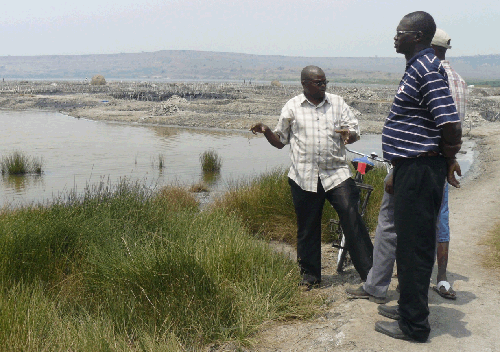
Lake Katwe, a little south of Lake Albert, is threatened by salt mining: in a couple of years time the surface of the lake has decreased from 7 to 3,5 km. The surrounding communities are dependant on salt mining but they haven't been using the lake sustainably which has caused the banks to erode and be surrounded by cattle keepers and salt layers. It's not NAPE's purpose to deprive the local people of their income but to teach them better ways of using the area.
Intervention
NAPE has drafted a plan of action to cut back the damaging consequences for people and the environment in the region of the Albertine Lake and promote sustainable use of the area. The organization does so by providing documentaries and publications, trying to involve the government and the oil companies with the well-being of the local people, and supporting court cases against human rights violators. NAPE also supports local communities with campaigns for a better environment, for example on planting trees on the river banks. Finally, NAPE organises gatherings and trainings for the local people, they founded the 'Sustainability School' to teach local communities how to profit from their environment. Both ENDS supports these initiatives and will keep on supporting NAPE as much as possible.
Read more about this subject
-
 Dossier /
Global Alliance for Green and Gender Action (GAGGA)
GAGGA rallies the collective power of the women's rights and environmental justice movements to realize a world where women can and do access their rights to water, food security, and a clean, healthy and safe environment.
-
 News / 27 februari 2026
Both ENDS strengthens the resilience of female environmental defenders worldwide thanks to multi-year contribution from the Postcode Lottery
In recent years, Both ENDS has received an additional contribution of €875,000 from the Postcode Lottery for the Autonomy & Resilience Fund (2022–2025), implemented in collaboration with the Global Alliance for Green and Gender Action (GAGGA). This support was essential because female environmental rights defenders around the world are increasingly facing climate change, repression and shrinking civil space. With this contribution, Both ENDS supports female activists and their communities with flexible, trust-based funding, enabling them to develop their own solutions to urgent environmental and climate problems.
-
 News / 17 februari 2026
Civic space at the frontlines: "Build strong coalitions and counter repressive regimes"
Today, we look back on an inspiring event Civic space at the frontlines -
Environmental Defenders and the Role of International Trade and Investment Policy. The panel exist of Michel Forst, UN Special Rapporteur Environmental Defenders under the Aarhus Convention, Suzanne Kröger, Member of Parliament for GroenLinks–PvdA, Dr. Margit van Wessel, Associate Professor at Wageningen University, Anne de Jonghe, policy advisor at Both ENDS, and Jonila Castro, national spokesperson for Kalikasan People's Network for the Environment. With an audience of CSO experts, academics, accountability experts and students we discussed the effects of Dutch economic activity on Environmental Defenders, and what we all can do to support those on the front lines of the fight for the environment and human rights. -
 News / 2 februari 2026
Response to the D66-VVD-CDA coalition agreement
Coalition: Repair the damage and dare to go further
At Both ENDS, we see a number of cautious steps in the right direction in this coalition agreement. There is a slight emphasis on green issues, renewed attention to women's rights, recognition of the importance of civil society, and discussion of trade agreements with a focus on mutual interests. However, without structural change in how we trade, invest, and cooperate, fine words remain empty shells.
-
 Dossier /
Seeking justice for the affected communities of Vale’s mining disasters in Mariana and Brumadinho
In 2015 and 2019, the Brazilian state of Minas Gerais experienced two severe mining tragedies in Mariana and Brumadinho, due to the same mining company: Vale. Since then, the affected communities have been seeking justice, via the criminal punishment of the responsible parties, and a fair compensation for the loss of their loved ones, their homes and their livelihoods. Both ENDS supports local CSOs by amplifying their quest for justice within an international audience and, more specifically, by raising awareness amongst Dutch investors in Vale about the high risks this company’s activities pose for people and the environment.
-
 News / 2 februari 2026
Seven years after Brumadinho: impunity allows Vale’s disasters to continue
Seven years ago, the dam owned by mining company Vale collapsed in Brumadinho, Brazil, killing 272 people and severely polluting the surrounding area. While the relatives of the victims commemorate them and fight for justice, the pollution continues.
-
Event / 26 januari 2026
Civic space at the frontlines
Environmental Defenders and the Role of International Trade and Investment Policy
Both ENDS invites you to an interactive dialogue with experts from the UN, policy, academia, and civil society on environmental defenders and international trade. Together, we will explore how citizens, policymakers, academics, and activists can defend civic space and support those on the frontlines of environmental and human rights struggles. With a focus on the Netherlands’ role in international trade and investment policy, and drawing on the experiences of activists from the Philippines, the event aims to foster solidarity and identify strategic priorities to better protect environmental defenders amid the global crackdown on civic space
-
 News / 22 januari 2026
Shell files new arbitration against the Netherlands over Groningen gas field closure
Shell is suing the Netherlands in yet another attempt to evade its responsibility for decades of gas extraction in Groningen. For years, gas production has triggered earthquakes, damaged over a hundred thousand homes, and left residents living in prolonged insecurity, still waiting for repairs, reinforcement, and justice.
-
 Dossier /
Agua Zarca: indigenous fight against dam costs lives
Indigenous Hondurans are resisting the construction of the Agua Zarca hydrodam. Their fight has cost several lives, including that of Berta Cáceres. After considerable public pressure, Dutch development bank FMO withdrew from the project.
-
 Press release / 13 januari 2026
Investigation: FMO failed to exercise adequate control over project linked to the murder of Berta Cáceres
TEGUCIGALPA/UTRECHT, January 12, 2026 – The murder of indigenous environmental activist Berta Cáceres, which took place almost 10 years ago in Honduras, appears to be the result of an organized criminal operation, in which funds from the Dutch Development Bank FMO were misappropriated to finance illegal activities. This is the conclusion of the investigation report published today by the independent commission set up by the Inter-American Commission on Human Rights, the Honduran state, and the relatives of Berta Cáceres.
For years, FMO was a major financier of the Agua Zarca project. Berta Cáceres, an indigenous leader, fought against this controversial dam and was murdered for that reason in March 2016.
-
 Dossier /
Gas in Mozambique
In 2011 one of the world’s largest gas reserves was found in the coastal province of Cabo Delgado, in the north of Mozambique. A total of 35 billion dollars has been invested to extract the gas. Dozens of multinationals and financiers are involved in these rapid developments. It is very difficult for the people living in Cabo Delgado to exert influence on the plans and activities, while they experience the negative consequences. With the arrival of these companies, they are losing their land.
-
 Blog / 11 december 2025
Reflections on working on Dutch finance for Mozambique LNG
Last Tuesday, I received a short text message with big news: the minister had just announced that the financing policy for the Mozambique LNG project was stopped. It was a decision that I – along with so many others – have fought for for years. Only now, more than a week later, it is slowly sinking in that we have really won. The years of perseverance, frustration, discussions and investigations have finally led to this result. It still feels a bit surreal.
-
 Dossier /
Export Credit Agencies: Who pays the price?
Both ENDS calls on the government only to provide export credit insurance to sustainable projects that cause no social and/or environmental damage in the countries where they take place.
-
 Press release / 2 december 2025
End of Dutch involvement in controversial gas project in Mozambique in sight after TotalEnergies withdraws from Dutch insurance
THE HAGUE/CABO DELGADO, December 1, 2025 - Today, Minister of Finance Eelco Heinen announced that TotalEnergies is withdrawing from a $640 million Dutch export credit insurance policy for a controversial gas project in Mozambique. Although the Dutch government has been avoiding this decision for years, this move has finally ended part of the Dutch involvement in this disastrous project.
-
 Dossier /
Indigenous communities threatened by Barro Blanco dam in Panama
The Barro Blanco dam project in Panama, which has Dutch financial support, is causing indigenous lands to disappear under water. Both ENDS is working to protect the rights of indigenous communities living near the dam.
-
 Blog / 1 december 2025
The Long Road to Justice for the Ngäbe of Kiad
In October 2025 I travelled to Kiad, the Indigenous Ngäbe community that led the struggle against the FMO-financed Barro Blanco dam, for one last time. I went there to say my goodbyes, both personally and on behalf of Both ENDS, and to catch a first glimpse on how a community program financed by FMO and DEG – the result of a dialogue process that took several years – is giving a new impulse to the dam-affected communities. But how did we get here?
-
Publication / 27 november 2025
-
 Environmentally Just Practice /
A Negotiated Approach for Inclusive Water Governance
A Negotiated Approach envisages the meaningful and long-term participation of communities in all aspects of managing the water and other natural resources on which their lives depend. It seeks to achieve healthy ecosystems and equitable sharing of benefits among all stakeholders within a river basin. This inclusive way of working is an essential precondition for the Transformative Practices that are promoted by Both ENDS and partners.
-
 News / 27 november 2025
Communities and International Consortium Present Community-Led Plan for Nature-Based Adaptation to Sea-Level Rise in Coastal Bangladesh
Local communities in the southwestern coastal region of Bangladesh—together with an international consortium including Uttaran, CEGIS, and Both ENDS—have presented a community-led plan to confront climate change and accelerating sea-level rise through nature-based adaptation. The People’s Plan for Upscaling Ecosystem-Based Adaptation outlines a scalable strategy rooted in local ownership and generations of lived experience. At its centre is Community-Based Tidal River Management (CBTRM), a proven approach that reduces waterlogging, raises land elevation, and restores ecological balance by working with natural tidal and sediment dynamics.
-
 Dossier /
Rights for People, Rules for Corporations – Stop ISDS!
Indigenous communities in Paraguay saw their attempts to regain their ancestral lands thwarted by German investors. In Indonesia, US-based mining companies succeeded to roll back new laws that were meant to boost the country’s economic development and protect its forests. This is the level of impact that investment treaties can have on social, environmental and economic development and rights. Why? Because of the ‘Investor-to-State Dispute Settlement’ clauses that are included in many such treaties.

