




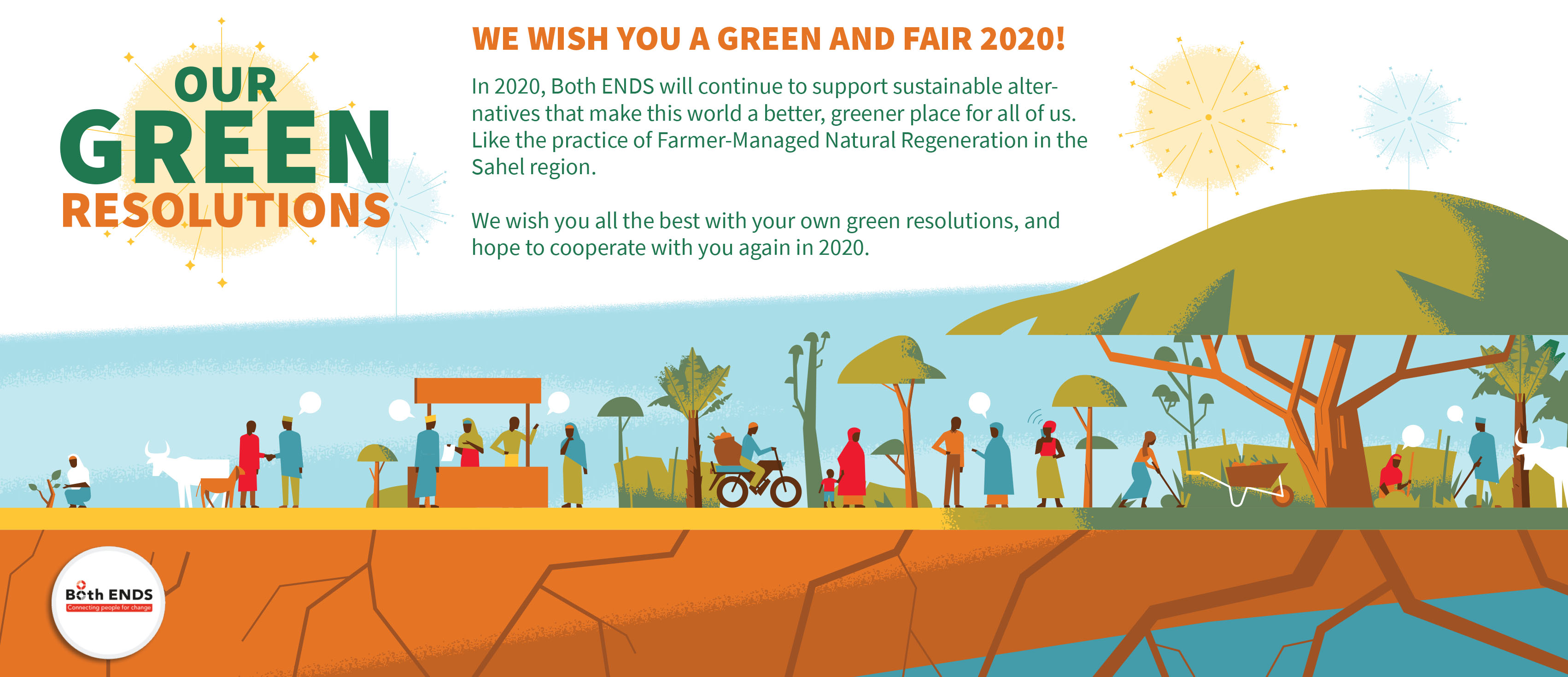
We wish you all a beautiful, fruitful and prosperous 2020!
We have already defined our own Green New Years resolutions!

Read more about this subject
-
 News / 13 January 2025
New partnership with Netherlands Enterprise Agency for resilient food systems in Sahel
The situation in Africa's Sahel is the world's fastest-growing humanitarian crisis. Over 3 million people are fleeing violence. They are ravaged by hunger, disease and increasing drought caused by climate change. Both ENDS and its partners are successfully working on accelerating the resilience of local food systems and communities in the Sahel, based on ‘Farmer Managed Natural Regeneration’ (FMNR). The project, funded by DOB Ecology, will end in mid-2026, but has already been followed up thanks to a new collaboration with the Netherlands Enterprise Agency (RVO).
-
 News / 14 October 2025
Communities regreening the Sahel: strengthening resilience from the ground up
How can communities in the Sahel strengthen their food systems in the face of climate change and other shocks? Through the ARFSA Programme, Both ENDS and its partners SPONG (Burkina Faso), CRESA/INRAN (Niger) and IED Afrique (Senegal) are working together to show that locally led landscape restoration works. -
 External link / 19 June 2020
The social practice of regreening the Sahel (Annual Report 2019)
In the first two years of the programme "Communities Regreen the Sahel", more than 10,000 farmers have been trained in Farmer-Managed Natural Regeneration and the practice has expanded to more than 44,000 ha. Moreover, the number of agreements by farmers and nomadic pastoralists has increased significantly, which is important to avoid conflict over land use.
-
 External link / 29 May 2019
Communities regreen the Sahel (Annual Report 2018)
Even as climate change intensifies these challenging conditions, the Sahel need not become a desert. Unsustainable agricultural practices and overgrazing are among the main factors causing land degradation in the Sahel, which is threatening the lives and livelihoods of millions of people. Fortunately, organisations like CRESA in Niger have shown that with the right approach, desertification of the Sahel can be reversed.
-
 Dossier /
Communities Regreen the Sahel
In various countries in the Sahel, vast tracts of land have been restored by the local population by nurturing what spontaneously springs from the soil and protecting the sprouts from cattle and hazards.
-
Publication / 28 January 2019
-
 Event / 13 April 2019, 14:15 - 15:30
'Positive Vibes from the Sahel' on Africa Day in KIT Amsterdam
On Saturday April 13th, the annual Africa day will take place in the Royal Tropical Institute in Amsterdam.
Both ENDS and Voice 4 Thought will organise a joint workhop (in English), titled:
'Positive vibes from the Sahel: from regreening to slam poetry'
Facilitator: Andrew Makkinga
The Sahel region from Chad to Senegal is often seen in the Netherlands as an immensely dry, infertile area where extremists and smugglers serve and where hunger thrives. But there is so much more to tell about the Sahel region.
Over the last decades, a large number of positive social initiatives have been taken up both in the cities and in rural areas. Initiatives that create and stimulate self-esteem, culture, education, climate resilience and prosperity.
Young people are often the driving force behind these movements, which is not surprising considering that almost 70 percent of the population in a country like Niger is under the age of 25.
In this workshop Both ENDS and Voice4Thought want to tell the other story of the Sahel by highlighting some of these positive initiatives, and by showing how they are interlinked and part of a larger, bottom up movement in this area.
Hope to see you there!
-
 Event / 6 September 2019, 13:00 - 15:00
UNCCD COP14: Communities regreen the Sahel
At the UNCCD COP14 in India, which is taking place from 2-13 September 2019, Both ENDS is co-organising a number of side events.
-
Publication / 23 December 2019
-
Publication / 30 June 2016
-
Publication / 29 January 2019
-
 News / 24 February 2012
The social aspects of turning the Sahel green
In Niger, farmers have turned no less than 5 million ha. of the Southern Sahelian provinces Maradi and Zinder green. They protected and assisted spontaneous regeneration of trees in and around their agricultural fields. Between January 12th and 20th, Both ENDS colleague Marie José van der Werff ten Bosch accompanied Chris Reij (CIS, VU University Amsterdam) to the south of Niger, to find out how farmers were able to regreen at such a large scale, and how their experiences can benefit other villages in the Sahel. Both ENDS, VU-CIS and the Centre Régional d'Enseignement Spécialisé en Agriculture (CRESA) have a joint project to spread the approach to the region of Dogondoutchi.
-
 Environmentally Just Practice /
Farmer Managed Natural Regeneration
In various countries in the Sahel, vast tracts of degraded land have been restored by the local population by nurturing what spontaneously springs from the soil. They do this using a method called 'Farmer Managed Natural Regeneration (FMNR)'.
-
 News / 14 June 2023
Both ENDS’s partners combat land degradation and drought
For decades, the local partner organisations of Both ENDS have been developing and promoting ways to fight land degradation, desertification and drought in their surroundings. And this accounts not only for regions like the Sahel, but also for forests and wetlands. To celebrate the UNCCD's Desertification and Drought Day 2023, we'd like to show a few examples of how our partners restore ecosystems to serve the well-being of people and the environment.
-
 External link / 31 May 2018
Supporting farmer managed natural regeneration to gain ground (Annual Report 2017)
Many people in the desertifying Sahel region have to choose: claim their land back from the desert, or leave their farms behind. In 2017, Both ENDS started a new project here, introducing a method for regreening the landscape: Farmer Managed Natural Regeneration (FMNR). It has proven itself in Niger, where we worked on FMNR for 15 years. By 2017, 15.000 ha of dryland had been regreened.
-
Publication / 8 April 2019
-
 Event / 14 April 2018, 11:30
Small grants, big impacts: workshop on Africa Day
On the 14th of April, Both ENDS wil host a workshop called 'Small Grants, Big Impacts' on the annual Africa day in Amsterdam. The workshop aims to demonstrate that so called 'small grants funds' effectively deliver (devopment and climate) money where it matters, to people that need it the most. Large development banks, funds, donors and governments could use small grants funds as alternative financing mechanisms to make sure their money benefits people and their environment now and it the far future.
-
 News / 15 June 2023
Combating drought by protecting saplings
Koussanar, in eastern Senegal, is a small town that is expanding rapidly, surrounded by villages still rooted in rural and nomadic life. The region is hot and dry, which is exacerbated by climate change. The soil in the region is also dry and often exhausted due to a combination of factors such as unsustainable agricultural practices, (peanut) monoculture, intensive agriculture, forest fires and overgrazing. Today, however, the region's farmers and nomadic pastoralists take a different approach. They are working towards a better future by committing to the restoration of degraded land using Farmer Managed Natural Regeneration (FMNR).
-
 News / 16 August 2019
Opinion: "Sustainable land use needs radical policy change"
Today, an op-ed by Nathalie van Haren and Stefan Schüller was published in the Dutch national newspaper De Volkskrant about the IPCC's latest report "Climate Change and Land". Below you find the English translation.
-
 News / 23 November 2018
Yacouba Sawadogo receives Right Livelihood Award!
Today, the Right Livelihood Awards 2018 will be presented in Stockholm. One of the four people who will receive the prize this year is Yacouba Sawadogo, 'the man who stopped the desert'. Yacouba, a farmer from Yatenga, Burkina Faso, is one of the founders of so-called 'Farmer Managed Natural Regeneration' with which degenerated and dry areas are becoming green and fertile again. According to Both ENDS, Yacouba's award is very well-deserved!




