




Interview: Both ENDS at COP30 for Climate Justice and Systemic Change
Both ENDS is present at COP30 to advocate for genuine access to climate finance for locally led, gender-just climate solutions and the mechanisms that facilitate this, including those for farmer-led restoration. Furthermore, the organisation participates to ensure the crucial connection between the climate negotiations and the trade and investment frameworks that shape them.
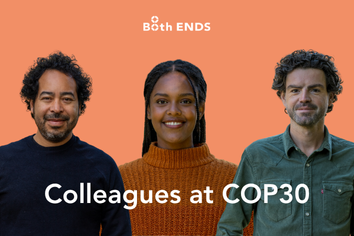
Learn more about the Both ENDS team at COP30 below, and find all the activities and side-events in which Both ENDS will participate.
Why are you going to COP30?
Fernando Hernandez: I’m going to COP30 as Both ENDS’ trade and investment policy lead, to connect climate negotiations with the urgent need to transform the economic frameworks that shape them. Over the past year, I helped convene the Entebbe and Accra processes, where civil society movements from Africa, Latin America and beyond called for investment rules that work for people and the planet. At COP30, in the heart of the Amazon, I want to ensure that those perspectives are heard — that we move from words to action, from abstract climate pledges to locally led, gender-just and rights-based solutions.
Daan Robben: I’m going to COP30 as part of GAGGA’s global call to advance gender-just climate action. Together with GAGGA, Both ENDS will organise five key side-events, hold in-person exchanges with key policymakers, and facilitate a delegation of GAGGA partners from all continents. I’ll also push for more attention to agroecology and locally led adaptation throughout the negotiations, while ensuring that Both ENDS partners have space to voice their demands. I’m also very keen to join the People’s COP and the large mobilisation of civil society around the official proceedings.
Yordanos Mulder: I’m going to COP30 as part of the Communities Regreen the Sahel Alliance. Through this programme, local organisations and farmers are restoring their lands, improving food security, and strengthening resilience in the face of climate change. Their work shows that locally led restoration delivers real and lasting impact when communities are in the lead. At COP30, together with our partners, I’ll advocate for an enabling environment for these types of initiatives to grow, and connect with others to strengthen a broader regional movement capable of meeting the scale of the climate challenges ahead.
What would be your main message to the negotiators?
Fernando Hernandez: My main message to negotiators is that we cannot achieve climate justice within economic structures designed for extraction and inequality. Investor-State Dispute Settlement (ISDS) and similar investment regimes still allow corporations to challenge environmental and climate regulations, draining public budgets and discouraging transition policies. Unless we address these structural barriers, every discussion on climate finance or just transition will remain superficial.
We need a new generation of investment and trade frameworks that dismantle corporate impunity, restore democratic control over public policy, and channel resources to women’s, Indigenous, and community-led initiatives. Only by transforming the underlying rules of the economy can climate ambition truly serve justice.
Daan Robben: Together with GAGGA, Both ENDS brings four key messages to COP30: to elevate the leadership and impact of grassroots feminist and environmental justice movements driving climate justice on the ground; to expose and challenge false climate solutions that violate human rights; to redirect resources toward gender-just, community-led action; and to amplify the voices of our frontline partners, recognising that no solution is just without their leadership.
I also believe that in the Adaptation and Climate Finance negotiations, much more attention should be given to agroecology. Negotiations do not occur on paper or in a vacuum; they are about people, planet, and justice. I want to hold negotiators accountable to make decisions that actually support those most in need — with solutions where these same people are in the lead.
Yordanos Mulder: As part of the Communities Regreen the Sahel Alliance, my key message is that it’s time to truly unlock the enabling environment needed to support and scale locally led climate solutions — such as community-led restoration. This means ensuring that climate finance mechanisms are genuinely accessible to local organisations, and that policies actively support their work — through concrete implementation of adaptation goals and a strong commitment to agroecology for climate-resilient food systems.
How would a positive outcome of COP30 look like to you?
Fernando Hernandez, Daan Robben and Yordanos Mulder: A positive outcome of COP30 would show that governments are ready to act on structural transformation. It would include a clear political signal to phase out ISDS and other mechanisms that privilege investors over communities, and a roadmap to align investment and trade frameworks with the Paris Agreement.
It would also mean renewed commitments to fund locally led and gender-just climate solutions directly, recognising them as central to adaptation, restoration, and resilience. In short, success in Belém would mean moving beyond pledges toward an economic system that values care, cooperation, and ecological balance over extraction and profit.
Contact the Both ENDS team in Belem:
Daan Robben: 10-21 November, d.robben@bothends.org
Fernando Hernandez Espino: 12-21 November, f.hernandez@bothends.org
Yordanos Mulder: 15-21 November, y.mulder@bothends.org
For more information
Read more about this subject
-
 Dossier /
Communities Regreen the Sahel
In various countries in the Sahel, vast tracts of land have been restored by the local population by nurturing what spontaneously springs from the soil and protecting the sprouts from cattle and hazards.
-
 Dossier /
Global Alliance for Green and Gender Action (GAGGA)
GAGGA rallies the collective power of the women's rights and environmental justice movements to realize a world where women can and do access their rights to water, food security, and a clean, healthy and safe environment.
-
 News / 27 februari 2026
Both ENDS strengthens the resilience of female environmental defenders worldwide thanks to multi-year contribution from the Postcode Lottery
In recent years, Both ENDS has received an additional contribution of €875,000 from the Postcode Lottery for the Autonomy & Resilience Fund (2022–2025), implemented in collaboration with the Global Alliance for Green and Gender Action (GAGGA). This support was essential because female environmental rights defenders around the world are increasingly facing climate change, repression and shrinking civil space. With this contribution, Both ENDS supports female activists and their communities with flexible, trust-based funding, enabling them to develop their own solutions to urgent environmental and climate problems.
-
 News / 2 februari 2026
Response to the D66-VVD-CDA coalition agreement
Coalition: Repair the damage and dare to go further
At Both ENDS, we see a number of cautious steps in the right direction in this coalition agreement. There is a slight emphasis on green issues, renewed attention to women's rights, recognition of the importance of civil society, and discussion of trade agreements with a focus on mutual interests. However, without structural change in how we trade, invest, and cooperate, fine words remain empty shells.
-
 Dossier /
Seeking justice for the affected communities of Vale’s mining disasters in Mariana and Brumadinho
In 2015 and 2019, the Brazilian state of Minas Gerais experienced two severe mining tragedies in Mariana and Brumadinho, due to the same mining company: Vale. Since then, the affected communities have been seeking justice, via the criminal punishment of the responsible parties, and a fair compensation for the loss of their loved ones, their homes and their livelihoods. Both ENDS supports local CSOs by amplifying their quest for justice within an international audience and, more specifically, by raising awareness amongst Dutch investors in Vale about the high risks this company’s activities pose for people and the environment.
-
 News / 2 februari 2026
Seven years after Brumadinho: impunity allows Vale’s disasters to continue
Seven years ago, the dam owned by mining company Vale collapsed in Brumadinho, Brazil, killing 272 people and severely polluting the surrounding area. While the relatives of the victims commemorate them and fight for justice, the pollution continues.
-
 News / 22 januari 2026
Shell files new arbitration against the Netherlands over Groningen gas field closure
Shell is suing the Netherlands in yet another attempt to evade its responsibility for decades of gas extraction in Groningen. For years, gas production has triggered earthquakes, damaged over a hundred thousand homes, and left residents living in prolonged insecurity, still waiting for repairs, reinforcement, and justice.
-
 Dossier /
Gas in Mozambique
In 2011 one of the world’s largest gas reserves was found in the coastal province of Cabo Delgado, in the north of Mozambique. A total of 35 billion dollars has been invested to extract the gas. Dozens of multinationals and financiers are involved in these rapid developments. It is very difficult for the people living in Cabo Delgado to exert influence on the plans and activities, while they experience the negative consequences. With the arrival of these companies, they are losing their land.
-
 News / 27 november 2025
Communities and International Consortium Present Community-Led Plan for Nature-Based Adaptation to Sea-Level Rise in Coastal Bangladesh
Local communities in the southwestern coastal region of Bangladesh—together with an international consortium including Uttaran, CEGIS, and Both ENDS—have presented a community-led plan to confront climate change and accelerating sea-level rise through nature-based adaptation. The People’s Plan for Upscaling Ecosystem-Based Adaptation outlines a scalable strategy rooted in local ownership and generations of lived experience. At its centre is Community-Based Tidal River Management (CBTRM), a proven approach that reduces waterlogging, raises land elevation, and restores ecological balance by working with natural tidal and sediment dynamics.
-
 Dossier /
Rights for People, Rules for Corporations – Stop ISDS!
Indigenous communities in Paraguay saw their attempts to regain their ancestral lands thwarted by German investors. In Indonesia, US-based mining companies succeeded to roll back new laws that were meant to boost the country’s economic development and protect its forests. This is the level of impact that investment treaties can have on social, environmental and economic development and rights. Why? Because of the ‘Investor-to-State Dispute Settlement’ clauses that are included in many such treaties.
-
 Blog / 25 november 2025
COP30 shows why dismantling ISDS is essential for real climate action
Standing in Belém during COP30, I felt the weight of the moment. We came to the Amazon hoping for decisive progress on phasing out fossil fuels, yet the final outcome fell far short of the ambition science and justice demand. The agreement brought welcome commitments on adaptation finance and global indicators, but it refused to confront the structural forces that make climate action so difficult.
-
 Dossier /
Wetlands without Borders
With our Wetlands without Borders program, we work towards environmentally sustainable and socially responsible governance of the wetlands system of the La Plata Basin in South America.
-
 Environmentally Just Practice /
Non-Timber Forest Products (NTFPs)
About one in every six people, particularly women, directly rely on forests for their lives and livelihoods, especially for food. This shows how important non-timber forest products (NTFPs) and forests are to ensure community resilience. Not only as a source of food, water and income, but also because of their cultural and spiritual meaning.
-
 Dossier /
Trade agreements
International trade agreements often have far-reaching consequences not only for the economy of a country, but also for people and the environment. It is primarily the most vulnerable groups who suffer most from these agreements.
-
 News / 5 november 2025
Overview of Both ENDS events at COP30 in Belem, Brazil
Both ENDS is present at COP30 to advocate for genuine access to climate finance for locally led, gender-just climate solutions, and for the mechanisms that make these possible, including those supporting farmer-led restoration. The organisation also engages to highlight the crucial connection between climate negotiations and the trade and investment frameworks that shape them.
Below is an overview of the Both ENDS team at COP30 and a detailed look at the activities and side-events in which Both ENDS will participate.
-
 News / 14 oktober 2025
Communities regreening the Sahel: strengthening resilience from the ground up
How can communities in the Sahel strengthen their food systems in the face of climate change and other shocks? Through the ARFSA Programme, Both ENDS and its partners SPONG (Burkina Faso), CRESA/INRAN (Niger) and IED Afrique (Senegal) are working together to show that locally led landscape restoration works. -
Publication / 9 oktober 2025
-
 Dossier /
International trade and investment with respect for people and planet
The network of international trade and investment treaties is large and complex. The Netherlands alone has signed more than 70 bilateral investment treaties (BITs) and is party to the trade and investment agreements concluded by the EU, like the EU-Mercosur and EU-Indonesia trade deals.
-
 Dossier /
Amplifying environmentally just practices
Because of the close relationship with their living environment, local communities often have the best ideas for the sustainable and equitable use and governance of land, water and forests. These environmentally just practices and processes successfully protect and restore ecosystems and address climate change. They are essential in the light of the multiple crises the world faces, but are in dire need of financial and policy support.
-
 News / 6 oktober 2025
From Entebbe to Accra: civil society is rewriting the rules of investment
By Fernando Hernández Espino and Bart-Jaap Verbeek
Almost a year after African civil society gathered in Uganda to adopt the Entebbe Declaration, the call to transform international investment governance continues to gain strength. From the 6th to the 9th of October, over 50 civil society organisations from across West Africa, including from Ghana, Senegal, Nigeria, Côte d’Ivoire, Cameroon, Gambia, Sierra Leone, as well as from Kenya and Latin America, are convening in Accra to deepen and operationalise the Declaration’s vision.

