




Initial public offering of the world’s biggest palm oil corporation threatens livelihood of 113,000 farming families
The planned initial public offering (IPO) of Malayan state-owned enterprise Felda Global Ventures Holdings (FGVH) will take place this month (28th June). It will be underwritten by Deutsche Bank, JP Morgan and Morgan Stanley; with an expected valuation of around 2.5 billion Euro this will be the second biggest IPO ever, trailing Facebook. A significant detail is that FGVH is controlled by the governing part UMNO, led by Prime Minister Mohd Najib Abdul Razak. The upcoming privatisation might be prompted by a need to generate capital for the upcoming elections.
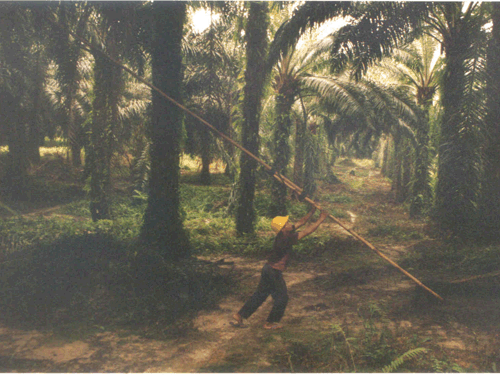
FGVH also encompasses the world's biggest cooperative of small-scale palm oil producers, comprising over 113,000 farming families. Historically FGVH is always presented as an extraordinary success where it comes to the position of these state-organised farmers. The IPO, however, may have serious consequences for their position, land rights and other privileges, since their land is to be privatised. This situation is even more remarkable considering that these small holders, as of old, represent a significant part of the rural electorate. Investors acquiring FGVH shares are taking a large risk in the social and political sphere that is accompanied by financial risks. These risks are underexposed in the IPO prospectus.
Financial institutions that are directly or indirectly stakeholders in FGVH and it's shareholders, and that simultaneously have an ambition to make the world a better place, now face an opportunity to ensure the basis of existence of 113,000 farming families remains secure. If their supervision prevents the violation of farmers rights they will prove that such cooperation has a future. Money can achieve good things.
Read the ProFundo press release for more information, and take a look at their report for more in-depth information on the issue.
Both ENDS is a member of the Roundtable on Sustainable Palm Oil and has contributed to the design of the RSPO Dispute Settlement Facility
Read more about this subject
-
 News / 2 February 2026
Seven years after Brumadinho: impunity allows Vale’s disasters to continue
Seven years ago, the dam owned by mining company Vale collapsed in Brumadinho, Brazil, killing 272 people and severely polluting the surrounding area. While the relatives of the victims commemorate them and fight for justice, the pollution continues.
-
 Event / 26 January 2026
Civic space at the frontlines
Environmental Defenders and the Role of International Trade and Investment Policy
Both ENDS invites you to an interactive dialogue with experts from the UN, policy, academia, and civil society on environmental defenders and international trade. Together, we will explore how citizens, policymakers, academics, and activists can defend civic space and support those on the frontlines of environmental and human rights struggles. With a focus on the Netherlands’ role in international trade and investment policy, and drawing on the experiences of activists from the Philippines, the event aims to foster solidarity and identify strategic priorities to better protect environmental defenders amid the global crackdown on civic space
-
 News / 22 January 2026
Shell files new arbitration against the Netherlands over Groningen gas field closure
Shell is suing the Netherlands in yet another attempt to evade its responsibility for decades of gas extraction in Groningen. For years, gas production has triggered earthquakes, damaged over a hundred thousand homes, and left residents living in prolonged insecurity, still waiting for repairs, reinforcement, and justice.
-
 Dossier /
Agua Zarca: indigenous fight against dam costs lives
Indigenous Hondurans are resisting the construction of the Agua Zarca hydrodam. Their fight has cost several lives, including that of Berta Cáceres. After considerable public pressure, Dutch development bank FMO withdrew from the project.
-
 Press release / 13 January 2026
Investigation: FMO failed to exercise adequate control over project linked to the murder of Berta Cáceres
TEGUCIGALPA/UTRECHT, January 12, 2026 – The murder of indigenous environmental activist Berta Cáceres, which took place almost 10 years ago in Honduras, appears to be the result of an organized criminal operation, in which funds from the Dutch Development Bank FMO were misappropriated to finance illegal activities. This is the conclusion of the investigation report published today by the independent commission set up by the Inter-American Commission on Human Rights, the Honduran state, and the relatives of Berta Cáceres.
For years, FMO was a major financier of the Agua Zarca project. Berta Cáceres, an indigenous leader, fought against this controversial dam and was murdered for that reason in March 2016.
-
 Dossier /
Gas in Mozambique
In 2011 one of the world’s largest gas reserves was found in the coastal province of Cabo Delgado, in the north of Mozambique. A total of 35 billion dollars has been invested to extract the gas. Dozens of multinationals and financiers are involved in these rapid developments. It is very difficult for the people living in Cabo Delgado to exert influence on the plans and activities, while they experience the negative consequences. With the arrival of these companies, they are losing their land.
-
 Blog / 11 December 2025
Reflections on working on Dutch finance for Mozambique LNG
Last Tuesday, I received a short text message with big news: the minister had just announced that the financing policy for the Mozambique LNG project was stopped. It was a decision that I – along with so many others – have fought for for years. Only now, more than a week later, it is slowly sinking in that we have really won. The years of perseverance, frustration, discussions and investigations have finally led to this result. It still feels a bit surreal.
-
 Dossier /
Export Credit Agencies: Who pays the price?
Both ENDS calls on the government only to provide export credit insurance to sustainable projects that cause no social and/or environmental damage in the countries where they take place.
-
 Press release / 2 December 2025
End of Dutch involvement in controversial gas project in Mozambique in sight after TotalEnergies withdraws from Dutch insurance
THE HAGUE/CABO DELGADO, December 1, 2025 - Today, Minister of Finance Eelco Heinen announced that TotalEnergies is withdrawing from a $640 million Dutch export credit insurance policy for a controversial gas project in Mozambique. Although the Dutch government has been avoiding this decision for years, this move has finally ended part of the Dutch involvement in this disastrous project.
-
 Dossier /
Indigenous communities threatened by Barro Blanco dam in Panama
The Barro Blanco dam project in Panama, which has Dutch financial support, is causing indigenous lands to disappear under water. Both ENDS is working to protect the rights of indigenous communities living near the dam.
-
 Blog / 1 December 2025
The Long Road to Justice for the Ngäbe of Kiad
In October 2025 I travelled to Kiad, the Indigenous Ngäbe community that led the struggle against the FMO-financed Barro Blanco dam, for one last time. I went there to say my goodbyes, both personally and on behalf of Both ENDS, and to catch a first glimpse on how a community program financed by FMO and DEG – the result of a dialogue process that took several years – is giving a new impulse to the dam-affected communities. But how did we get here?
-
Publication / 27 November 2025
-
 Environmentally Just Practice /
A Negotiated Approach for Inclusive Water Governance
A Negotiated Approach envisages the meaningful and long-term participation of communities in all aspects of managing the water and other natural resources on which their lives depend. It seeks to achieve healthy ecosystems and equitable sharing of benefits among all stakeholders within a river basin. This inclusive way of working is an essential precondition for the Transformative Practices that are promoted by Both ENDS and partners.
-
 News / 27 November 2025
Communities and International Consortium Present Community-Led Plan for Nature-Based Adaptation to Sea-Level Rise in Coastal Bangladesh
Local communities in the southwestern coastal region of Bangladesh—together with an international consortium including Uttaran, CEGIS, and Both ENDS—have presented a community-led plan to confront climate change and accelerating sea-level rise through nature-based adaptation. The People’s Plan for Upscaling Ecosystem-Based Adaptation outlines a scalable strategy rooted in local ownership and generations of lived experience. At its centre is Community-Based Tidal River Management (CBTRM), a proven approach that reduces waterlogging, raises land elevation, and restores ecological balance by working with natural tidal and sediment dynamics.
-
 Dossier /
Rights for People, Rules for Corporations – Stop ISDS!
Indigenous communities in Paraguay saw their attempts to regain their ancestral lands thwarted by German investors. In Indonesia, US-based mining companies succeeded to roll back new laws that were meant to boost the country’s economic development and protect its forests. This is the level of impact that investment treaties can have on social, environmental and economic development and rights. Why? Because of the ‘Investor-to-State Dispute Settlement’ clauses that are included in many such treaties.
-
 Blog / 25 November 2025
COP30 shows why dismantling ISDS is essential for real climate action
Standing in Belém during COP30, I felt the weight of the moment. We came to the Amazon hoping for decisive progress on phasing out fossil fuels, yet the final outcome fell far short of the ambition science and justice demand. The agreement brought welcome commitments on adaptation finance and global indicators, but it refused to confront the structural forces that make climate action so difficult.
-
 Dossier /
Wetlands without Borders
With our Wetlands without Borders program, we work towards environmentally sustainable and socially responsible governance of the wetlands system of the La Plata Basin in South America.
-
Publication / 17 November 2025
-
 Environmentally Just Practice /
Non-Timber Forest Products (NTFPs)
About one in every six people, particularly women, directly rely on forests for their lives and livelihoods, especially for food. This shows how important non-timber forest products (NTFPs) and forests are to ensure community resilience. Not only as a source of food, water and income, but also because of their cultural and spiritual meaning.
-
Letter / 14 November 2025
Letter: TPAC’s report “Final Judgement Detailed Research MTCS’’
A coalition of Malaysian and international NGOs has released a memorandum in response to the recent TPAC report on the Malaysian Timber Certification Scheme (MTCS). The organisations express serious concerns about the independence, quality, and credibility of the assessment carried out by the Timber Procurement Assessment Committee (TPAC).


