




Dare to Trust: a journey of culture, renewal, and empowerment of Sengwer women
Historically, the Sengwer community has lived in harmony with their environment, relying on forest resources for sustenance and integrating conservation into their daily lives. However, recent government policies aimed at forest protection have limited their access to these ancestral lands. Although these regulations intend to protect the environment, they often disregard the traditional conservation practices of indigenous communities like the Sengwer, who have been natural stewards of these lands for generations. Faced with these restrictions, the Segerger Women’s Conservation Group intensified their conservation efforts, viewing it as both a cultural duty and a means to safeguard their heritage.
Initially part of a mixed-gender group focused on conservation projects such as cultivating and selling native tree seedlings, the women felt marginalized as men often dominated decision-making without consulting them. This experience led the women to form their own group, allowing them to reclaim their voices and directly influence conservation work impacting their community.
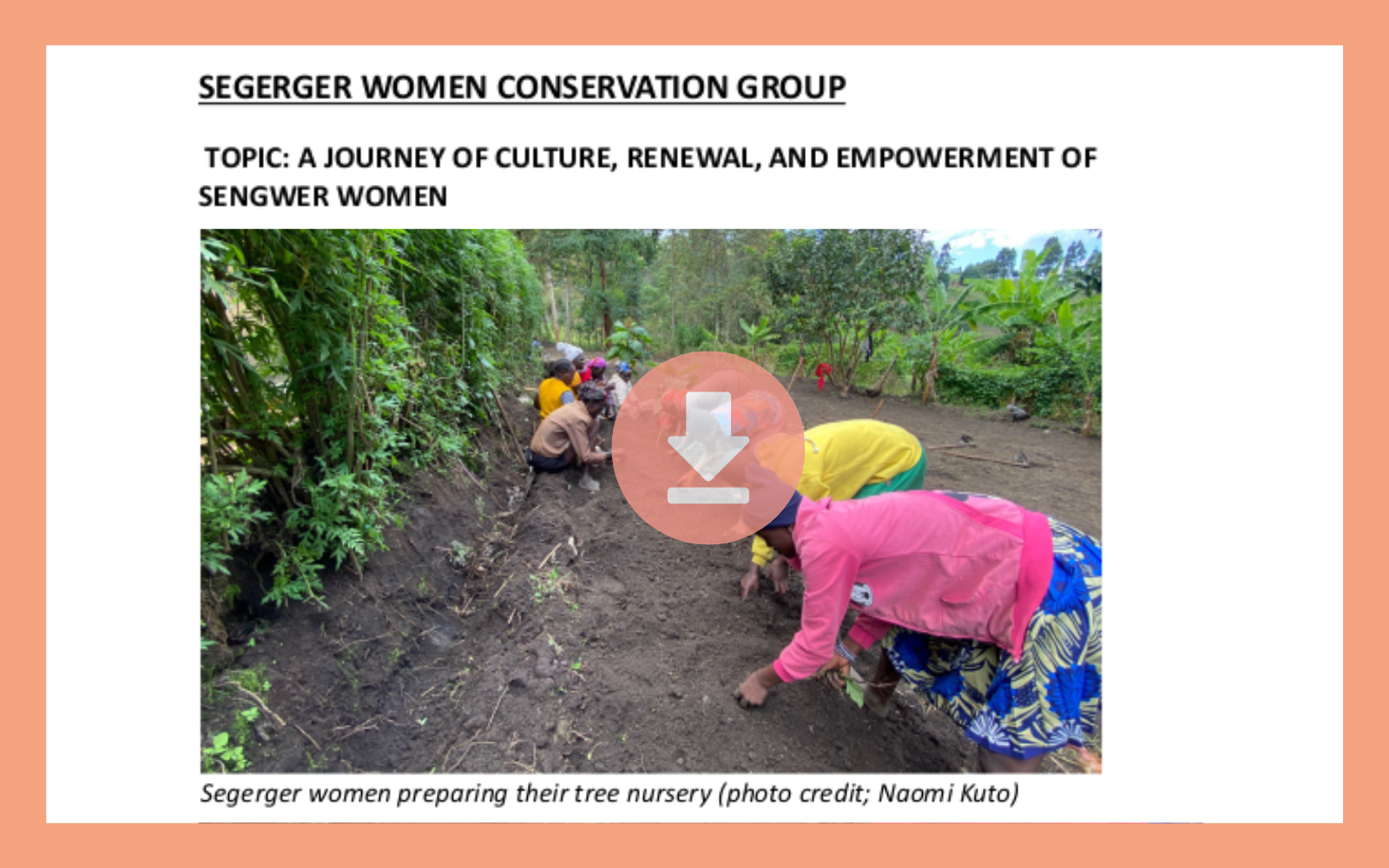
With support from Dare to Trust, the women began re-establishing their projects independently. Today, their conservation efforts have grown significantly, with nurseries for indigenous tree species flourishing under their care. They have started planting these trees on family lands, and they plan to expand with more native trees and fruit-bearing plants to increase biodiversity and indigenous food security. Their progress is evident, as the women actively shape an environmental future that aligns with their cultural heritage and sustains their land.
Creative report: newspaper article and video
The support to the women's group was made possible within our Dare to Trust-project, a no-strings-attached way of funding. The Sengwer of Embobut Community-Based Organisation, our partner who gave the grant to the women's group, has written a report, whilst some of their young members filmed interviews with some of the women of the group:
For more information

Read more about this subject
-
 Dossier /
Dare to Trust: the power of unconditional funding
At Both ENDS we cherish our long-term relationships with partners in our global network. These relationships are based on equality and built on trust. The trust we have in each other has developed from years of strategic cooperation, including joint advocacy around common agendas, knowledge sharing, networking, and mobilising and sharing resources to advance environmental justice.
-
 Dossier /
Global Alliance for Green and Gender Action (GAGGA)
GAGGA rallies the collective power of the women's rights and environmental justice movements to realize a world where women can and do access their rights to water, food security, and a clean, healthy and safe environment.
-
 News / 27 februari 2026
Both ENDS strengthens the resilience of female environmental defenders worldwide thanks to multi-year contribution from the Postcode Lottery
In recent years, Both ENDS has received an additional contribution of €875,000 from the Postcode Lottery for the Autonomy & Resilience Fund (2022–2025), implemented in collaboration with the Global Alliance for Green and Gender Action (GAGGA). This support was essential because female environmental rights defenders around the world are increasingly facing climate change, repression and shrinking civil space. With this contribution, Both ENDS supports female activists and their communities with flexible, trust-based funding, enabling them to develop their own solutions to urgent environmental and climate problems.
-
 Environmentally Just Practice /
A Negotiated Approach for Inclusive Water Governance
A Negotiated Approach envisages the meaningful and long-term participation of communities in all aspects of managing the water and other natural resources on which their lives depend. It seeks to achieve healthy ecosystems and equitable sharing of benefits among all stakeholders within a river basin. This inclusive way of working is an essential precondition for the Transformative Practices that are promoted by Both ENDS and partners.
-
 Environmentally Just Practice /
Non-Timber Forest Products (NTFPs)
About one in every six people, particularly women, directly rely on forests for their lives and livelihoods, especially for food. This shows how important non-timber forest products (NTFPs) and forests are to ensure community resilience. Not only as a source of food, water and income, but also because of their cultural and spiritual meaning.
-
 Dossier /
Communities Regreen the Sahel
In various countries in the Sahel, vast tracts of land have been restored by the local population by nurturing what spontaneously springs from the soil and protecting the sprouts from cattle and hazards.
-
Publication / 1 juli 2025
-
 Environmentally Just Practice /
Analog Forestry
Analog forestry is a transformative approach to the ecological restoration of degraded lands. Natural forests are used as guides to create ecologically sustainable landscapes, which support the social and economical needs of local communities.
-
 Environmentally Just Practice /
Agroecology
Agroecology is a diverse set of agricultural practices, a field of science and a social movement. It aims to transform food systems towards greater ecological sustainability, social justice, and resilience. Both ENDS and CSO-partners around the world support farmers and pastoralists practising agroecology, both on the ground and in gathering political and financial support.
-
 News / 9 mei 2025
Women’s leadership in agroecology flourishes in Eastern and Southern Africa
On 12 and 13 February 2025, women from Kenya, Uganda, and Zimbabwe gathered in Nairobi for the Africa Women Leaders in Agroecology (AWOLA) Regional Networking Forum. The event marked a significant moment in the leadership programme of PELUM Kenya, which empowers young women in their role as leaders in the agroecological transition. This project was made possible thanks to support from Both ENDS as part of the Fair, Green and Global (FGG) Alliance.
-
 External link / 29 april 2025
 -
 Blog / 23 april 2025
The power of trust
Trust builds trust. That is what I have learned from how Both ENDS works - within our team, with partners in joint strategies and advocacy, and in our relationships with partners as a funder. Trust is the foundation. It is what allows compassion to grow, what gives rise to hope, and what fuels real solidarity. This is especially powerful in contrast to the prevailing global trend of political and international leaders who prioritize hard measures and self-interest, ignoring relations of trust. It is even more reason for us to share what we have experienced when we put trust first.
-
 Dossier /
Inclusive ways to sustainable and healthy food for all
All around the world small-scale farmers are using sustainable and inclusive methods to produce food. Working together with nature and each other, they provide their families and communities with sufficient and healthy food. But their production methods are under pressure from large-scale agriculture and the globally dominant system of industrial food production. Together with our partners, Both ENDS is trying to turn the tide in favour of sustainable, local practices that are mostly known as 'agro-ecological' or 'nature-inclusive'. Why are we focusing on these methods? Agro-ecological practices are climate-proof and inclusive and increase the opportunities for communities around the world to produce their food sustainably.
-
Publication / 1 april 2025
-
 External link / 28 maart 2025
Eerlijke handel en gelijkwaardige relaties: pas dán kan Kenia echt op eigen benen staan
This op-ed is available in Dutch.
-
 Blog / 27 maart 2025
Fair trade and equal partnerships: only then can Kenya stand on its own
Several media outlets, including de Volkskrant, focused last week on the shift from “aid” to “trade,” partly in response to the state visit of the Dutch royal couple to Kenya. The idea is that it would be beneficial for Kenya to stand on its own two feet. A beautiful ideal—one I whole heartedly believe in. But this ideal can only become a reality if equality is at the heart of trade and international cooperation.
-
 News / 21 maart 2025
Dutch Royal couple visits Thogoto Forest: a green oasis on the outskirts of Nairobi
This week, King Willem-Alexander and Queen Máxima visited Thogoto Forest as part of their state visit to Kenya. They were able to see the impact of the work of our partner MCDI in the area: a restored forest, clean water and farmers who can earn a living by selling their agro-ecological products.
-
 News / 24 december 2024
LILAK's Dare to Trust projects: Dreams transformed into actions
LILAK has worked alongside indigenous women communities for over a decade, focusing on building capacity and advocating for rights to land, the environment, and bodily autonomy. Despite gaining recognition and trust from allies, the journey was challenging. Starting with limited resources, LILAK faced resistance, particularly from patriarchal leaders and the state, which often labeled them as adversaries. Nevertheless, they adapted and continued their work, grounded in solidarity and sisterhood.
-
 News / 24 december 2024
Fórum Suape empowers women's groups with Dare to Trust-grants
Fórum Suape decided to help several women’s groups in their network. First, they wanted to understand the desires and needs of each group, with the aim of fostering collective thinking and understanding their collective interests and goals. Five groups were selected, one group had difficulty in organizing themselves. They did not move forward and did not receive the money. The other four had wonderful results.
-
 News / 24 december 2024
Dare to Trust: Sowing dreams irrigated with droplets of trust (Colectivo CASA)
Collectivo CASA in Bolivia, with support from Both ENDS and Dare to Trust, found great satisfaction in assisting women defenders with personal and economic needs. This support allowed the women to express their needs and develop a shared vision for their improvement. Although managing funds sustainably posed challenges, the women defenders demonstrated their skills by quickly creating a “Plan for Good Living,” (“Buen Vivir” in Spanish) addressing health, economy, empowerment, and food production.


