




2022 is the year for FMO to make good on its promises and provide financial support only to sustainable development
2021 was a turbulent year for Dutch development bank FMO, to say the least. The bank has been under fire for many years for investments linked to human rights violations and suspected corruption. But in the past year, the Dutch press and media have reported on one new development after the other in ongoing cases involving FMO. Below we give a short summary of these cases and call on FMO to make the promised improvements in 2022.
FICOHSA
Civil society organisations, including Both ENDS, sent a letter calling on FMO not to approve a proposed loan to the FICOHSA bank, due to suspected corruption and human rights violations. While FMO did indeed not approve the loan and even broke all ties with FICOHSA, it gave no information at all on the case to the CSOs that had sent the letter, including organisations from Honduras who were gravely concerned about FICOHSA's role in corruption and harmful investments. In this way, FMO failed to make a significant contribution to efforts to combat impunity in the Central American country. Transparency on the part of FMO on its knowledge of FICOHSA and its reasons for breaking ties with the bank would give some insight into the precise activities of the political and economic elite in Honduras. Dutch politicians raised questions in parliament asking the government, which has a 51% interest in FMO, to clarify the situation. The government, however, followed the line adopted by FMO and did not find it necessary to provide an explanation or transparency.
Agua Zarca
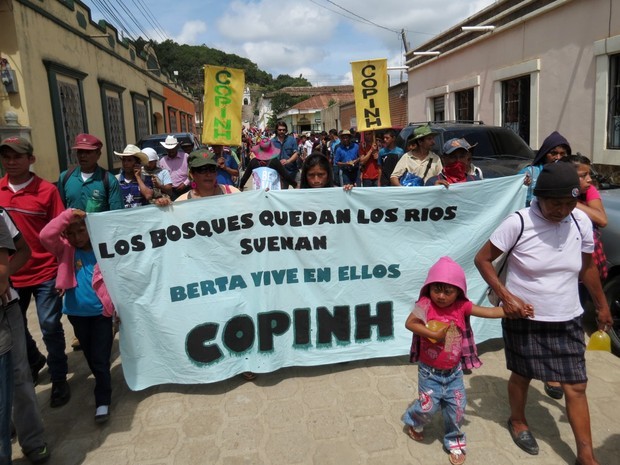
In May of this year David Castillo, ex-CEO of the Honduran company DESA, was found guilty of the murder of Berta Cáceres, who was assassinated in her own home in 2016. FMO provided DESA with financial support for the controversial Agua Zarca project and, even several years after withdrawing from the project, the bank continued to insist that it had no reason to believe that DESA was an unreliable client. In the meantime, Berta's family is still awaiting the court ruling on Castillo's sentence.
In the summer, research revealed that the FMO loan could even have been directly used to pay for Berta's murder. FMO clearly failed to fulfil its basic duty as a bank, to check thoroughly what the money was used for. An article in Dutch newspaper Het Financieele Dagblad shows that FMO had to suspend its activities for six weeks because it did not meet the requirements of the Dutch central bank DNB regarding money laundering and terrorism. After recent publications in the paper, Honduran CSO COPINH published a statement saying "The banks and the international financial structure that finance projects and companies that violate the rights of communities are responsible and must be sanctioned, as well as their officials".
Barro Blanco
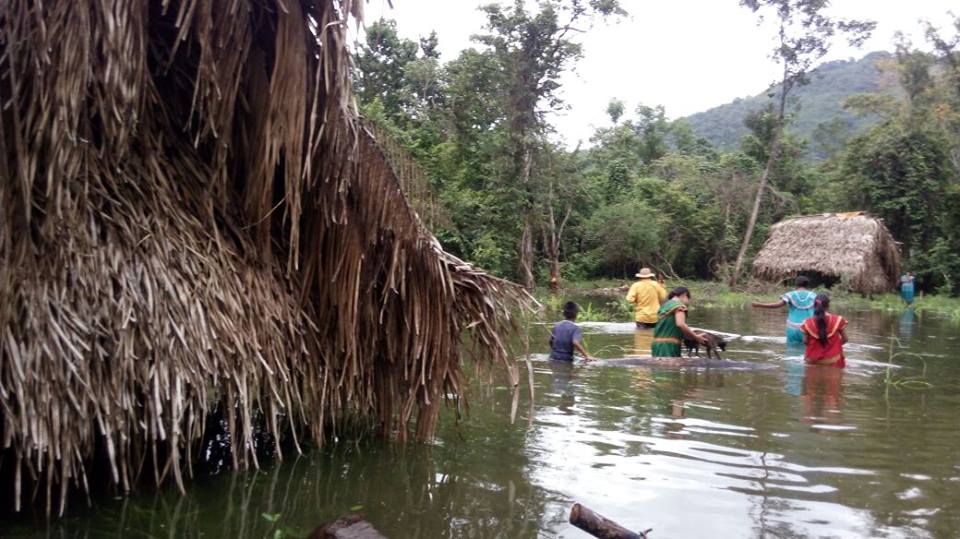
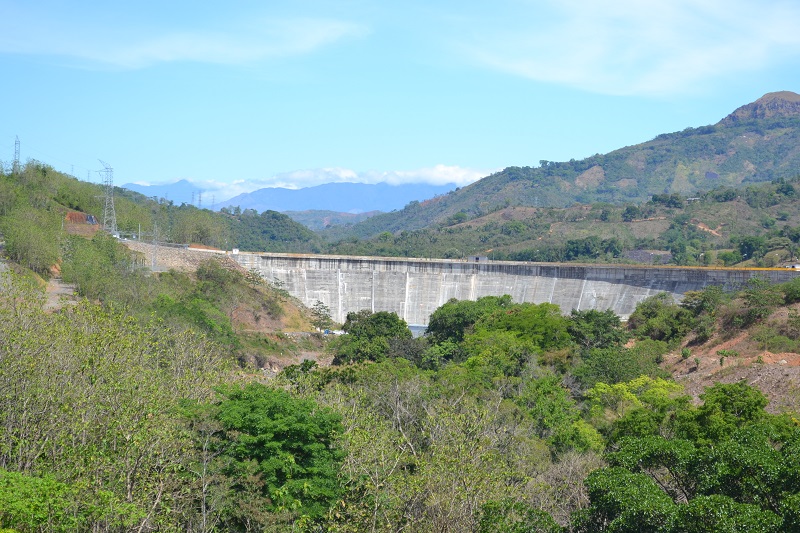
FMO was also faced with an unexpected development in the Barro Blanco dam project this year. Building contractor GENISA suddenly sold the FMO loan of 25 million dollars for the construction of the dam to another investor. This placed GENISA beyond the reach of FMO and its complaints mechanism. The indigenous community, which suffers much harm from the dam project, has been fighting for many years for justice and for recognition of the human rights violations that have been committed. The members of the community continue to hold FMO partly responsible for these abuses. FMO claims that it wishes to reach a satisfactory conclusion to the problem, together with the community, but will have to show in 2022 exactly what means in concrete terms.
A recent opinion article referred to FMO – partly in light of these cases – as a 'dislocation' rather than a 'development' bank. FMO has pledged to learn from its mistakes but has so far shown little evidence of that in practice. We call on FMO to live up to its mandate in 2020 and show the world that it really is a development bank. It can only do that by admitting that it has made mistakes in assessing projects and institutions that it has financed in the past and that it will do much better in the future. FMO needs to provide transparency on all of these problematic cases and not hide behind its clients, lack of capacity or the mantra of collateral damage in light of the supposed development achieved through its support. The mantra should be 'Rather no project than a harmful project'. Only then can FMO guarantee that abuses like those in Honduras and Panama cannot happen again.
You can find more information about the reffered to articles here (Dutch), scroll down to see them.
For more information
Read more about this subject
-
 Dossier /
Agua Zarca: indigenous fight against dam costs lives
Indigenous Hondurans are resisting the construction of the Agua Zarca hydrodam. Their fight has cost several lives, including that of Berta Cáceres. After considerable public pressure, Dutch development bank FMO withdrew from the project.
-
 Dossier /
Indigenous communities threatened by Barro Blanco dam in Panama
The Barro Blanco dam project in Panama, which has Dutch financial support, is causing indigenous lands to disappear under water. Both ENDS is working to protect the rights of indigenous communities living near the dam.
-
 News / 17 February 2026
Civic space at the frontlines: "Build strong coalitions and counter repressive regimes"
Today, we look back on an inspiring event Civic space at the frontlines -
Environmental Defenders and the Role of International Trade and Investment Policy. The panel exist of Michel Forst, UN Special Rapporteur Environmental Defenders under the Aarhus Convention, Suzanne Kröger, Member of Parliament for GroenLinks–PvdA, Dr. Margit van Wessel, Associate Professor at Wageningen University, Anne de Jonghe, policy advisor at Both ENDS, and Jonila Castro, national spokesperson for Kalikasan People's Network for the Environment. With an audience of CSO experts, academics, accountability experts and students we discussed the effects of Dutch economic activity on Environmental Defenders, and what we all can do to support those on the front lines of the fight for the environment and human rights. -
 Press release / 13 January 2026
Investigation: FMO failed to exercise adequate control over project linked to the murder of Berta Cáceres
TEGUCIGALPA/UTRECHT, January 12, 2026 – The murder of indigenous environmental activist Berta Cáceres, which took place almost 10 years ago in Honduras, appears to be the result of an organized criminal operation, in which funds from the Dutch Development Bank FMO were misappropriated to finance illegal activities. This is the conclusion of the investigation report published today by the independent commission set up by the Inter-American Commission on Human Rights, the Honduran state, and the relatives of Berta Cáceres.
For years, FMO was a major financier of the Agua Zarca project. Berta Cáceres, an indigenous leader, fought against this controversial dam and was murdered for that reason in March 2016.
-
 Dossier /
Gas in Mozambique
In 2011 one of the world’s largest gas reserves was found in the coastal province of Cabo Delgado, in the north of Mozambique. A total of 35 billion dollars has been invested to extract the gas. Dozens of multinationals and financiers are involved in these rapid developments. It is very difficult for the people living in Cabo Delgado to exert influence on the plans and activities, while they experience the negative consequences. With the arrival of these companies, they are losing their land.
-
 Blog / 11 December 2025
Reflections on working on Dutch finance for Mozambique LNG
Last Tuesday, I received a short text message with big news: the minister had just announced that the financing policy for the Mozambique LNG project was stopped. It was a decision that I – along with so many others – have fought for for years. Only now, more than a week later, it is slowly sinking in that we have really won. The years of perseverance, frustration, discussions and investigations have finally led to this result. It still feels a bit surreal.
-
 Press release / 2 December 2025
End of Dutch involvement in controversial gas project in Mozambique in sight after TotalEnergies withdraws from Dutch insurance
THE HAGUE/CABO DELGADO, December 1, 2025 - Today, Minister of Finance Eelco Heinen announced that TotalEnergies is withdrawing from a $640 million Dutch export credit insurance policy for a controversial gas project in Mozambique. Although the Dutch government has been avoiding this decision for years, this move has finally ended part of the Dutch involvement in this disastrous project.
-
 Blog / 1 December 2025
The Long Road to Justice for the Ngäbe of Kiad
In October 2025 I travelled to Kiad, the Indigenous Ngäbe community that led the struggle against the FMO-financed Barro Blanco dam, for one last time. I went there to say my goodbyes, both personally and on behalf of Both ENDS, and to catch a first glimpse on how a community program financed by FMO and DEG – the result of a dialogue process that took several years – is giving a new impulse to the dam-affected communities. But how did we get here?
-
 News / 27 November 2025
Communities and International Consortium Present Community-Led Plan for Nature-Based Adaptation to Sea-Level Rise in Coastal Bangladesh
Local communities in the southwestern coastal region of Bangladesh—together with an international consortium including Uttaran, CEGIS, and Both ENDS—have presented a community-led plan to confront climate change and accelerating sea-level rise through nature-based adaptation. The People’s Plan for Upscaling Ecosystem-Based Adaptation outlines a scalable strategy rooted in local ownership and generations of lived experience. At its centre is Community-Based Tidal River Management (CBTRM), a proven approach that reduces waterlogging, raises land elevation, and restores ecological balance by working with natural tidal and sediment dynamics.
-
 News / 27 October 2025
New Step in FMO’s Complaint Policy – Civil Society Organizations Call for Further Strengthening
The updated complaint mechanism of the development banks FMO, DEG, and Proparco marks an important step forward. Organizations that participated in the consultation acknowledge the efforts to improve the mechanism. At the same time, they emphasize that much still needs to be done to make the policy truly effective, transparent, and independent.
-
Publication / 9 October 2025
-
Publication / 2 October 2025
-
 Dossier /
Towards a socially and environmentally just energy transition
To address the climate crisis we need to urgently transition away from fossil fuels towards clean, renewable energy. However, this transition is not only about changing energy sources. It requires an inclusive and fair process that tackles systemic inequalities and demanding consumption patterns, prioritizes environmental and social justice, and which does not repeat mistakes from the past.
-
 Dossier /
Fair Green and Global Alliance (FGG)
Together with civil society organisations from all over the world, the Fair Green and Global (FGG) Alliance aims for socially just, inclusive and environmentally sustainable societies in the Netherlands and the Global South.
-
 Blog / 2 July 2025
Women at the frontlines of climate action: local power for global change
By Tamara MohrLast week, GAGGA, the Global Alliance for Green and Gender Action, with Both ENDS as one of the Alliance members, together with FCAM and Mama Cash, organised its Global Meeting in Indonesia. The goal of this meeting was to recognise, celebrate and look ahead at cross-movement and cross-regional connections, to strengthen the collective power of gender, climate and environmental justice movements.
-
Publication / 1 July 2025
-
Publication / 1 July 2025
-
 News / 24 June 2025
Indigenous communities in Panama obtain recognition and partial mitigation measures by Development Banks FMO and DEG in relation to the Barro Blanco dam
Both ENDS and SOMO welcome the signing of the agreement of understanding between four Indigenous Ngäbe communities in Panama and the European development banks FMO and DEG on June 17th 2025. The arrangement includes a community development program that, together with a public statement issued by the banks, aims to recognize and mitigate some of the negative impacts caused by the Barro Blanco hydropower dam. We wish to congratulate the community-based organisation Movimiento 10 de Abril (M10) for its perseverance to seek justice for the affected communities, and we acknowledge the commitment of FMO and DEG to pursue a solution to their long-standing dispute with the communities arising from their partial financing of the hydropower project since 2011.
-
 Dossier /
Advocating for responsible policies of development banks
Development banks should comply with strict environmental and human rights rules to ensure that their projects benefit and do not harm the poorest groups. Both ENDS monitors the banks to make sure they do.
-
 Blog / 11 April 2025
FMO is very pleased with its own success – now the local population still needs to be
The FMO development bank is proud of its results and the opportunities it seizes where commercial banks fail to act. But do the bank's actions really help, ask Anne de Jonghe and Nick Middeldorp.




