




Petition to protect the Saamaka people and the Amazon Forest
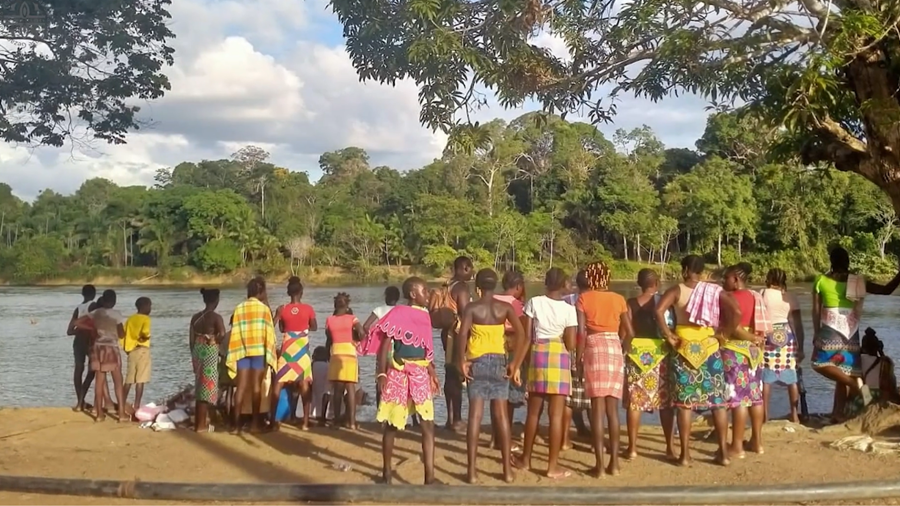
The Saamaka People, the Afro-descendant tribe of Suriname, have preserved close to 1.4 million hectares of the Amazon rainforest. They have for decades urged the government to recognise their ancestral territorial land rights.
In 2007, the Inter-American Court of Human Rights ruled in the Samaaka People. It also ruled that the government of Suriname is to stop logging and mining concessions on Samaaka territory and to legally recognize their collective ownership rights over the land.
Both ENDS has supported the cause of the Samaaka People, and worked with the leadership of the Association of Saramaka Authorities (VSG) which was created (1996) to represent the position of traditional Saamaka leaders and their People from 77 villages.
New threat
While the Surinamese government is dragging its feet to implement the ruling of the Inter-American Court, a new threat is looming: the construction of a road through Saamaka territory which will open up the forest to logging, mining and poaching. Both ENDS supports the Samaaka People in their request to the Suriname Government to fully comply with the ruling of the Inter-American Court of Human Rights, and notably:
- Stop road work and all logging activities along the Palmeras road
- Conduct a proper Free Prior Informed Consent with the wide Saamaka communities
- Implement a Social Environmental Impact Assessment of the Palmeras road (and logging concession) by an independent body
- Legally recognize Samaaka land ownership rights so that we have the autonomy to manage our forest sustainably and have the legal means to protect our livelihoods and culture from increasing threats
- It is high time the international community recognizes that Suriname is one of the last remaining largely intact forest frontiers in the world. The Saamaka People offer an invaluable contribution to help preserve global biodiversity and climate stability.
Sign petition!
We invite both organisations and individuals to sign on to the petition initiated by the Saamaka People.
More information
Read more about this subject
-
 Blog / 15 april 2024
The year of truth: EU Member States urged to combat deforestation
The EU is the world's largest "importer of deforestation," due to the huge volumes of unsustainably produced soy, timber, palm oil, and other raw materials that EU member states import. After many years of delay, the European Parliament and the European Council passed a law in December 2023 to address this problem: The EU Deforestation Regulation (EUDR). Both ENDS is part of a broad coalition of organizations that have been pushing for this European legislation. However, there is now a serious delay, and perhaps even postponement, of the law's implementation. Objections have been raised by a number of member states, who are sensitive to lobbying by certain business sectors and producer countries.
-
 Blog / 18 december 2017
Bali: The disappearance of a fishermen’s village
We pushed the canoe through the turf and climbing on board he suggested I take the helm while he would hoist the sail. Being aboard this fast sailing lightweight canoe, carried by the swell of the blue sea, brought back images so vividly described in Hemingway's book The old man and the sea. After leaving the coast, going further onto the sea we eventually changed track and went north. I learned from the fisherman that the daily catch of fish was very meagre. Fishermen had to leave home early morning, around 4 AM, and had to venture out far off the coast to find fish. When I spotted my hotel near the beach we set course for the coast. When we had reached the shore again, I paid the fisherman and we parted amicably, in good spirit.
-
 News / 15 november 2018
All Eyes on the Amazon: the future of protecting forests in Brazil
On Wednesday, November 14, Dutch Newspaper De Volkskrant published a joint op-ed by Both ENDS, Hivos, Greenpeace Netherlands and Witness about the deforestation in the Amazon region which is still going on rapidly, having disastrous consequences for the indigenous people who live in the area, for biodiversity and for the climate. The Netherlands is one of the largest buyers of Brazilian agricultural products such as soy and beef, and should ensure that deforestation, land grabbing and human rights violations do not occur in these production chains. Unfortunately, this is not at all the case yet.
-
Publication / 7 november 2018
-
Publication / 8 mei 2019
-
Publication / 26 augustus 2020
-
 Blog / 25 november 2025
COP30 shows why dismantling ISDS is essential for real climate action
Standing in Belém during COP30, I felt the weight of the moment. We came to the Amazon hoping for decisive progress on phasing out fossil fuels, yet the final outcome fell far short of the ambition science and justice demand. The agreement brought welcome commitments on adaptation finance and global indicators, but it refused to confront the structural forces that make climate action so difficult.
-
 News / 6 december 2024
South American Forest Fires Highlight Effects of Delaying EU Deforestation Law
On the 4th of December, the European Parliament voted in majority for a delay of implementation of the EU Deforestation Regulation (EUDR). Earlier, the European Commission and the European Council already endorsed this proposal for a delay with one year. Both ENDS and partners are worried about this decision, as there is no time to waste in our global fight against deforestation, biodiversity loss and climate change.
-
 Event / 16 november 2020, 18:30 - 19:30
Business as Usual: Dutch neo-colonialism in Brazil
The Netherlands is a major business partner to Brazil and has not been deterred by the record of human rights' abuses by Bolsonaro's government, nor by the coup d'Etat against the president Dilma Rousseff in 2016. How do the Dutch economic ties with the Brazilian political and corporate elites affect the Brazilian population, in particular indigenous peoples, nature and the global climate?
-
 News / 11 september 2020
Have your say on the EU’s deforestation policy
The world's forests are under threat. Remaining forests – havens of precious biodiversity and the lungs of the planet – are being cleared to make way for beef, soy, sugar and palm oil production, mining and other industrial activities, fuelled by increasing demand from Europe and other countries. But the good news is: you can help stop the destruction!
-
 Press release / 26 augustus 2020
Dutch pension funds invest in deforestation in the Brazilian Amazon
Dutch pension money is invested heavily in companies that contribute to deforestation in the Amazon region and the Cerrado savanna in Brazil, such as soy, animal feed and beef companies. This is concluded in a report published today by Profundo, commisioned by the Fair Finance Guide, Hivos and Both ENDS. All ten pension funds that were examined invest in these types of companies, with the ABP pension fund and Pensioenfonds Zorg en Welzijn on top with investments worth EUR 580 million and EUR 383 million respectively.
-
 News / 2 augustus 2019
EU unveils 'Action Plan' on Deforestation
The EU is still one of the world’s largest importers of deforestation: EU demand for commodities like soy, palm oil, beef, coffee and cacao requires millions of hectares of tropical rainforest to be cleared. This deforestation has significant biodiversity and climate impacts, and is often linked to human rights violations and violence against local communities and indigenous peoples. Both ENDS and partners have been actively lobbying the EU Commission to adopt a robust action plan to address and prevent human rights violations and deforestation ‘embodied’ in EU imports of agricultural commodities.
-
 News / 14 juni 2019
Both ENDS partner TUK presents symbolic tree to Dutch minister Schouten
Last Thursday June 13, Rahmawati Retno Winarni of TUK, an Indonesian partner organisation of Both ENDS, presented a symbolic tree and an appeal to the Dutch Minister of Agriculture Carola Schouten, also on behalf of 10 NGOs. The joint NGOs are pushing the EU, including the Dutch government, for strict EU legislation to prevent the destruction of forests and ecosystems and to protect human rights.
-
 Press release / 7 mei 2019
Press release: European stakeholders call for immediate action in face of climate emergency
Brussels, 7 May 2019 - In an unprecedented Climate Action Call published today, a broad coalition is urging European leaders to take decisive action to respond to the climate emergency. Hundreds of European cities, regions, businesses, youth and faith groups and civil society organisations working on climate, human rights, litigation, mobilization, sports and health call upon leaders to profoundly alter the way we run our societies and economies to limit temperature rise to 1.5°C.
-
 News / 3 juli 2024
Illegal logging is devastating Suriname's forest: The Saamaka and their fight against deforestation
The Saamaka people of Suriname have long resisted the government's violation of their land rights. Despite a 2007 ruling by the Inter-American Court of Human Rights (IACHR) against such violations, the government continues to grant logging and mining concessions on Saamaka territory without free prior and informed consent (FPIC). New report shows this has led to deforestation, land dispossession, and disruption of their livelihoods. A recent example includes a 42.7 km road built through their lands for logging access.
-
 News / 28 november 2017
Ten years after ground-breaking ruling the Saramaka are still fighting for their rights
On 28 November 2007, the Saramaka people won a ground-breaking court case against Suriname at the Inter-American Court of Human Rights (IACHR). The Court ruling included the provision that Suriname could no longer grant concessions on tribal territory without the permission of the inhabitants. Ten years later, little has come of implementing this ruling in practice.
-
 News / 7 oktober 2014
FARN’s hard work results in round table meeting
Whenever deforestation is mentioned, most people will automatically think of the Amazon rainforest. In Argentina, however, the disappearance of its forests has also become a pressing problem. In the province of Salta, for example, the deforestation level is the highest. Between 1998 and 2006, the amount of lost hectares of forests has doubled there. The culprit to this problem is the country’s agricultural activities.
-
 Press release / 14 december 2020
Record submissions to public consultation urge EU to act on deforestation
Brussels, Belgium - 14 December
A landmark 1,193,652 submissions to the EU's public consultation on deforestation were handed over to the European Commission this afternoon, all of which demanded a strong EU law to protect the world's forests and the rights of people who depend on them. The one million+ submissions have made this the largest public consultation on environmental issues in the history of the EU, and the second largest ever.
-
Publication / 19 juni 2020




