Showcasing transformative approaches for women’s land rights
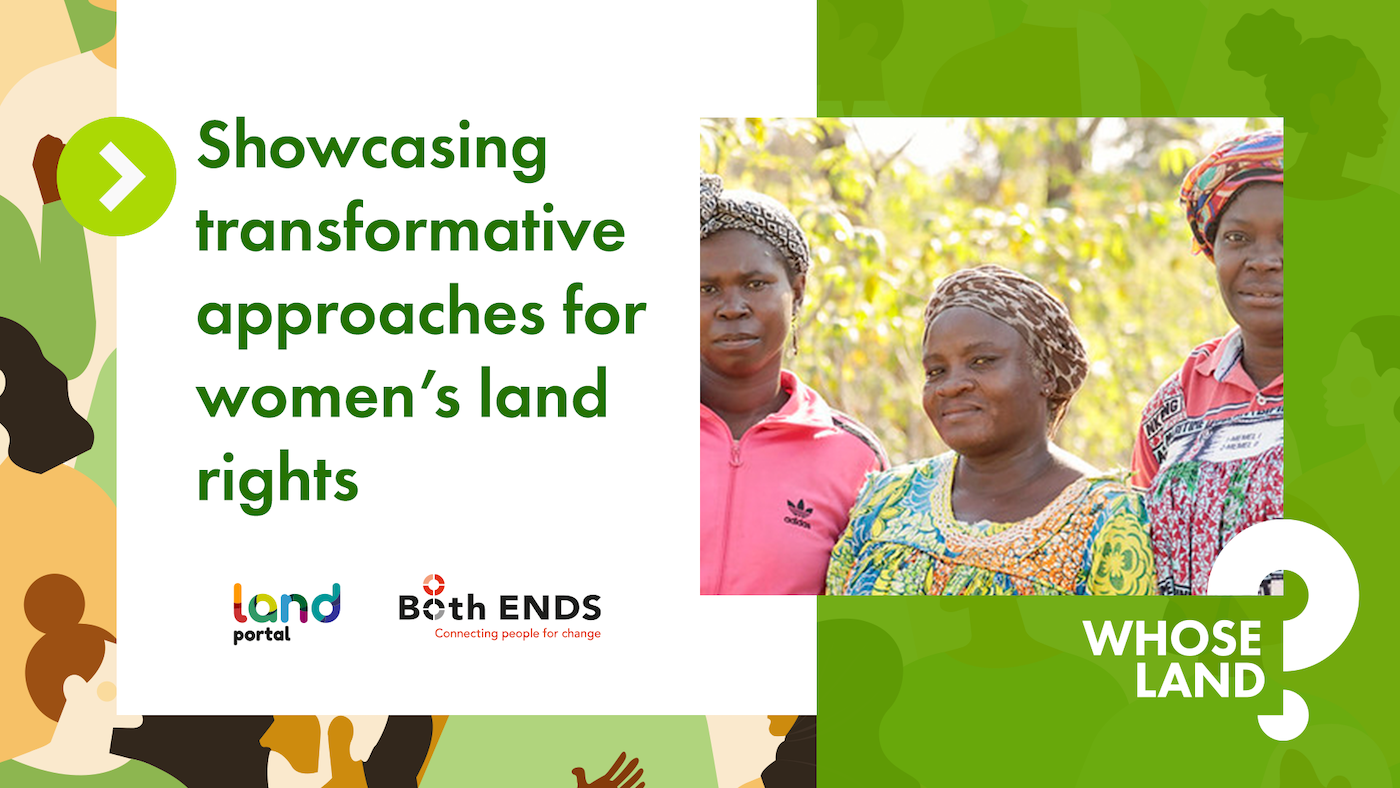
Both ENDS and the Land Portal Foundation invite you to the third webinar in the Whose Land? Inclusive Pathways to Land Governance series. This third Whose Land? webinar will showcase gender transformative approaches on women's land rights. Gender transformative approaches are defined by women acting as agents of change, transforming structural barriers and redefining gender norms. These approaches facilitate the participation of women in land governance decision-making processes, but require closing the land data gender gap.
Register here
For more information
-
 Event / 28 February 2019, 14:00 - 15:30
Webinar: Realizing women’s land rights in Africa
This webinar will feature experiences from several grassroots initiatives and highlight how they fight for women's improved access to and control over land and other natural resources and to scale up women's land rights.
-
Publication / 1 September 2017
-
Publication / 1 September 2017
-
 News / 28 September 2017
Both ENDS at UNCCD COP13: don’t forget about the people
This September, Both ENDS participated at the 13th Conference of the Parties of the UNCCD in Ordos, Inner Mongolia in China. We were part of the Drynet delegation, a network of CSOs, to bring local realities to the international UNCCD discussions.
-
 Event / 2 March 2023, 14:00 - 15:30
Inclusive finance for land governance: A conversation with donors
Both ENDS and the Land Portal Foundation invite you to the fourth webinar in the Whose Land? Inclusive Pathways to Land Governance series. This fourth Whose Land? webinar will focus on the question: How can donors fund land governance initiatives through an inclusive process?
More information about this event is available on Landportal.org
-
Publication / 24 April 2023
-
 Environmentally Just Practice /
Non-Timber Forest Products (NTFPs)
About one in every six people, particularly women, directly rely on forests for their lives and livelihoods, especially for food. This shows how important non-timber forest products (NTFPs) and forests are to ensure community resilience. Not only as a source of food, water and income, but also because of their cultural and spiritual meaning.
-
 News / 17 September 2021
Beyond trees: the importance of Non-Timber Forest Products for communities
About one in every six people, particularly women, directly rely on forests for their lives and livelihoods, especially for food. This shows how important non-timber forest products (NTFPs) and forests are to ensure community resilience. Not only as a source of food, water and income, but also because of their cultural and spiritual meaning.
-
Publication / 1 April 2025
-
 News / 15 October 2020
Land rights for Indigenous Peoples to protect their forests
Institut Dayakologi works to preserve Indigenous Peoples' livelihoods and cultures in West Kalimantan. One of their central goals is to gain ancestral land rights for Indigenous communities. This is not only essential for the security of these communities, but also for the forests and ecosystems on which they depend for their livelihood, identity, culture and customs.
-
 Blog / 16 October 2018
The case of Kasepuhan Karang: Secure land rights lead to food security
Photoblog - In 2016, the state forest around the community of Kasepuhan Karang, in Java, Indonesia, was transformed into customary lands. With these newly acquired land tenure rights, the community has started initiatives to use their land in a sustainable and inclusive way. What this means for the community in terms of livelihoods and food security, became clear during a field visit at the start of the Global Land Forum 2018.
-
 External link / 24 June 2023
Women’s land rights in Mozambique (Annual Report 2022)
In Mozambique, few women can rest assured that their right to use and enjoy land is guaranteed. Forum Mulher, a network of Mozambican women's rights organisations, raised public awareness and mobilised rural women to effectively make their voices heard during the government's formal review of the legislative framework for land governance. As a result, the revised National Land Policy of Mozambique now emphasises the importance of prioritising and valuing rural peasant women in land policy and law.
-
 Blog / 8 March 2019
Women lead struggle for land rights for the Avá Guaraní
By Tamara MohrTogether with five women from the Platform Suace Pyvyvõhára, I travel to Mingã Pora in the east of Paraguay. Around 45 families from the indigenous Tekohá Suace community settled here in 2016. In Guaraní, Tekohá means 'the place where we are what we are'. They reside in tents - self-made out of waste materials - on a small strip of land with a soy field on one side and a nature reserve owned by the Itaipu company on the other.
-
 News / 9 April 2026
Minister Sjoerdsma hosts roundtable conversations with civil society
This week, Minister Sjoerdsma organized roundtable conversations with civil society organizations – a valuable initiative that brings together Dutch civil society voices to address critical challenges faced by democratic societies.
-
 News / 5 November 2025
Interview: Both ENDS at COP30 for Climate Justice and Systemic Change
Both ENDS is present at COP30 to advocate for genuine access to climate finance for locally led, gender-just climate solutions and the mechanisms that facilitate this, including those for farmer-led restoration. Furthermore, the organisation participates to ensure the crucial connection between the climate negotiations and the trade and investment frameworks that shape them.
Learn more about the Both ENDS team at COP30 below, and find all the activities and side-events in which Both ENDS will participate.
-
 News / 5 November 2025
Overview of Both ENDS events at COP30 in Belem, Brazil
Both ENDS is present at COP30 to advocate for genuine access to climate finance for locally led, gender-just climate solutions, and for the mechanisms that make these possible, including those supporting farmer-led restoration. The organisation also engages to highlight the crucial connection between climate negotiations and the trade and investment frameworks that shape them.
Below is an overview of the Both ENDS team at COP30 and a detailed look at the activities and side-events in which Both ENDS will participate.
-
 Blog / 23 April 2025
The power of trust
Trust builds trust. That is what I have learned from how Both ENDS works - within our team, with partners in joint strategies and advocacy, and in our relationships with partners as a funder. Trust is the foundation. It is what allows compassion to grow, what gives rise to hope, and what fuels real solidarity. This is especially powerful in contrast to the prevailing global trend of political and international leaders who prioritize hard measures and self-interest, ignoring relations of trust. It is even more reason for us to share what we have experienced when we put trust first.
-
 External link / 28 March 2025
Eerlijke handel en gelijkwaardige relaties: pas dán kan Kenia echt op eigen benen staan
This op-ed is available in Dutch.
-
 Blog / 27 March 2025
Fair trade and equal partnerships: only then can Kenya stand on its own
Several media outlets, including de Volkskrant, focused last week on the shift from “aid” to “trade,” partly in response to the state visit of the Dutch royal couple to Kenya. The idea is that it would be beneficial for Kenya to stand on its own two feet. A beautiful ideal—one I whole heartedly believe in. But this ideal can only become a reality if equality is at the heart of trade and international cooperation.
-
 News / 21 February 2025
Cabinet turns its back on international cooperation and solidarity with callous policy letter
Foreign Trade and Development Minister Klever's published policy letter is coldhearted and callous. It places the Netherlands in international isolation and abandons the most vulnerable people worldwide, including many women, farmers, indigenous peoples and youth.