




If you walk the footsteps of a stranger...
Guest blog
Saturday morning, call time at the office is five o'clock. The group of ten people arriving is still half asleep. Like almost every weekend Kalikasan PNE, the organisation where I'm conducting my internship, organizes a field trip. Today, we will we visit one of the fisher communities in Bulakan, where the new airport of Manila is planned.
The field trips are meant to generate knowledge on the realities in which the people in Manila Bay live, who are or will be (potentially) affected by land reclamation projects as part of the government's 'Build, Build, Build' campaign. Simultaneously, the trips are designed to inform communities about the little that is known about land reclamation projects, as well as about human rights and environmental legislation according to international and national law. "This way, we empower communities to organize and mobilize against development aggression", our team leader concludes her introduction.
There seems to be no clear information or specifics of any land reclamation project including the one for the airport in Bulakan. Will the people have to move? How? When? Where to? And why, really? And if not, how will the airport affect them? These questions are left unanswered by the local governments, the national government and the companies said to execute the projects. The grassroots organizations working with the communities also don't know but recognize the similarities to previous land reclamation projects in the Bay. With the experience of mass relocation to make way for malls and casinos, and with promises of jobs for these communities unfulfilled, they set to work preparing people for the worst.
Village on poles
So, this Saturday morning we jump in a jeepney (old US jeeps, now colourfully painted over). An hour and a half later we are dropped off at a dock and clamber into a bright yellow boat, which will bring us to the village.
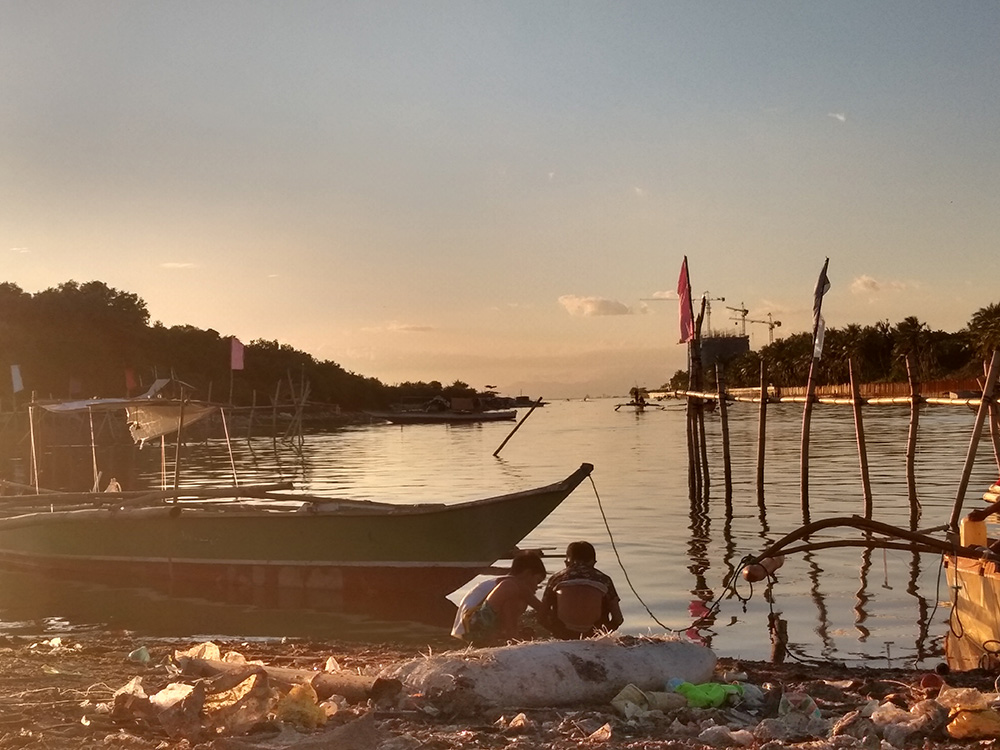
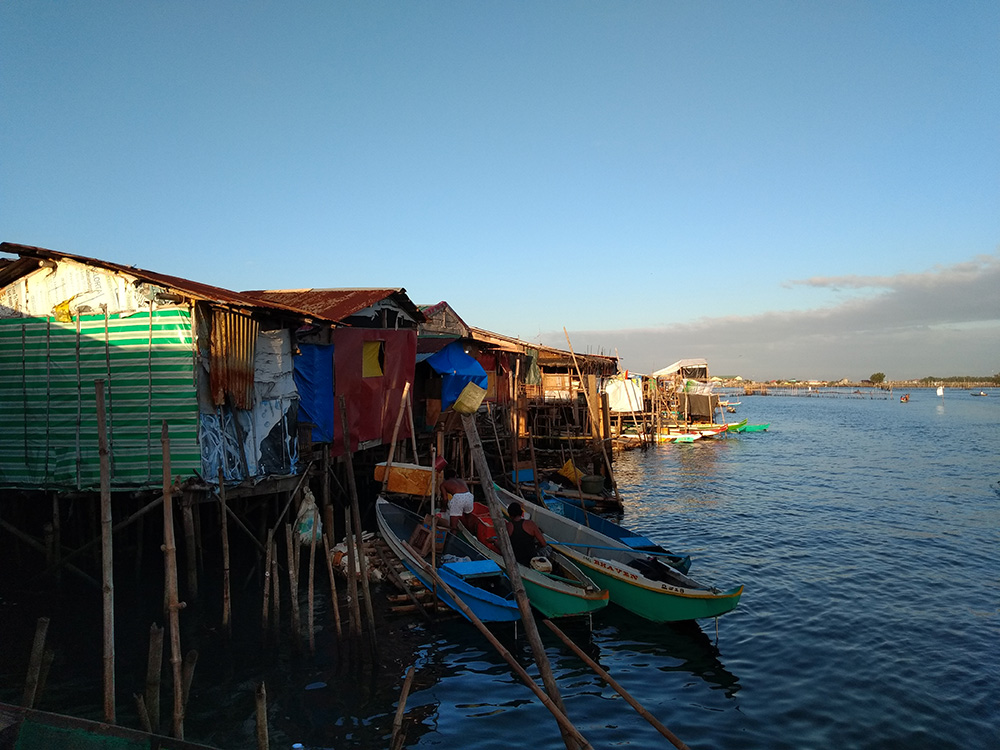
The village rests on bamboo stilts. The last typhoon has swallowed the island. It is now solely the foundation on which the bamboo stilts rest. The poles hold up around 80 houses, a small shop and a chapel which is where we gather with 16 people and at least as many children. The attendees are invited to share their concerns on the project and the impacts they imagine it will have on their livelihoods. "We will be as fish on dry land, gulping for air. Literally." One woman says. Discussions are alternated by presentations of the volunteers on environmental topics, human rights and opportunities for action. "Land Reclamation means seagrass and mangroves will disappear" they explain. The public nods. Communities have reported the illegal cutting of around 700 mangrove trees recently. Is the airport project already starting? Maybe. Probably.
Manila Bay, the mangrove bay
Manila is said to be named after a species of mangrove that grew all around the bay, the Nila(d). A tree with flowers of bright white and yellow that swayed in the breeze, waving at visitors coming in and going out of the bay. Manila, 'where the nila(d) is'. Now, the bay boasts a meagre population of the saltwater liking trees and the future seems bleak for this form of natural coastal defense.
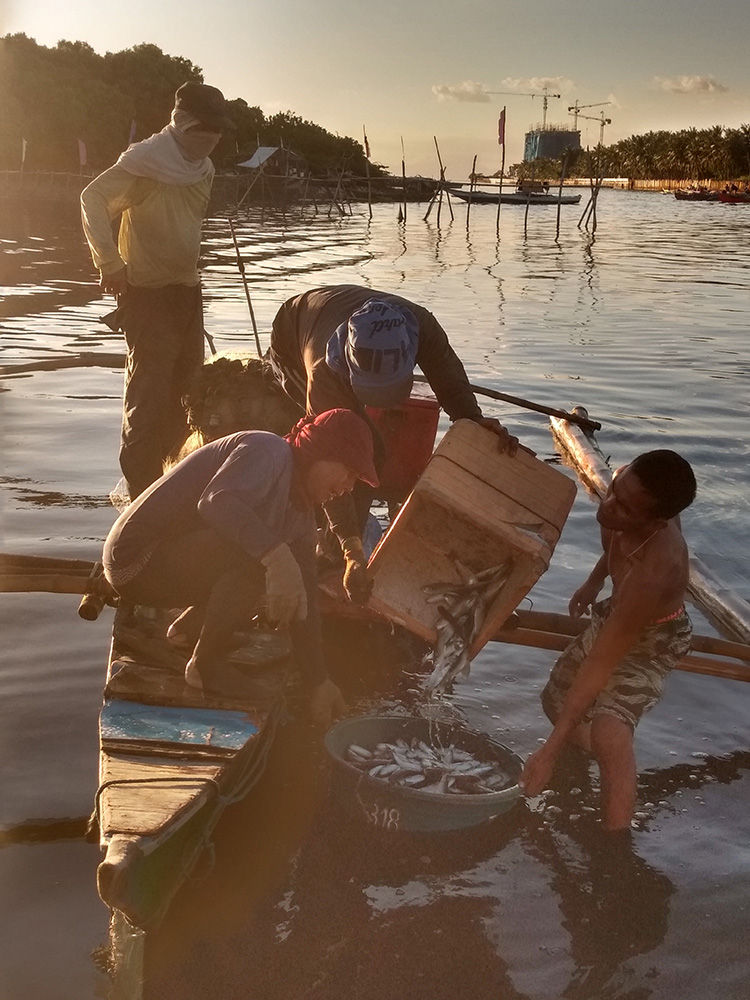
After a lunch of rice and fried bangus fish, there are break-out sessions in which women and men are separated. The atmosphere is open and relaxed. Difficult topics are discussed such as rape, a risk women will face with the influx of construction workers to the area. The risk of 'loss of livelihood', is elaborately discussed. Fisherfolk communities are among the poorest of the Philippines. The catch of fishermen mostly consists of crabs which are caught by hand. The women tend to the children. Some sell candies and bread. All in all, the income of a fisherfolk family is around 10 euros per day with which they must feed five or more. Many are afraid that relocation will mean removal from fishing areas. From the age of ten years old, these people have helped their fathers catching crabs. To lose their profession is to lose their identity.
Walking the footsteps of a stranger
As I try to fall asleep at night, in the house of one of the families participating in the workshop, I listen to the seawater sloshing against the foundation of the home which makes us rock a little. If development projects claim to help these people, promising a sustainable future, addressing inequality – we should have learned by now that it is arrogant to think one knows how to improve someone else's life without ever consulting them. Us outsiders, 'we' see how fishing is providing none of these families a living wage. 'We' see women who have no way of sustaining themselves. 'We' see communities that are vulnerable to natural hazards.
But only by going there you can learn that this is a limited perspective full of judgements. Speaking to the people living in Bulakan on bamboo stilts and on the last islands secluded by mangroves, I have learned to see again what is forgotten so often: 'If you walk the footsteps of a stranger, you'll learn things you never knew, you never knew' (yes, this is a Disney lyric). I have learned how grassroots organizations, with next to no resources, are going out to ask what we expect our governments to ask: 'What is your life like? How do you think it could be improved? How can I support you with that, if at all?' Us outsiders might learn that these islands - where daily life is tough and where typhoons hit hard - are worth fighting for.
This blog post was written by Pippi van Ommen, an intern of a Kalikasan PNE (People's Network for the Environment), a grassroots organisation in the Philipines.
Read more about this subject
-
 News / 22 March 2021
The importance of a gender perspective in Dutch water policies
An increasing number of stakeholders in the Dutch water sector are acknowledging the importance of an inclusive approach to climate adaptation. However, where our knowledge institutes and companies are involved in delta plans and master plans, as in Bangladesh and the Philippines, this approach is proving difficult to apply in practice. Taking local realities, vulnerabilities and inequalities – such as those between men and women – as a starting point is essential for good plans that give everyone the opportunity to adapt to climate change.
-
Publication / 4 October 2019
-
Publication / 25 March 2024
-
 News / 20 September 2019
Call for solidarity with Philippine environmental rights defenders
We are shocked and alarmed by the news of a planned raid into the headquarters of an environmental organisation in the Philippines. Although the raid has not materialised until now, we are deeply concerned for their wellbeing.
-
 News / 5 July 2019
Philippines: The People’s Plan for Manila Bay
Manila Bay is crucial site for biodiversity and home to over 23 million people, but their wellbeing is at risk due to reclamation projects, which are part of a large-scale top-down masterplan for the bay. It is estimated that more than 11 million people are threatened with displacement due to land reclamations and related disaster risks. As an alternative, Kalikasan is developing a People's Plan.
-
 Blog / 28 January 2025
Sinking promises in Manila
Yesterday, Global Witness published a new report, "Sunk Costs" - in which I had a modest role to play - that comes up with new facts about the disastrous New Manila International Airport project in the Philippines, for which the Dutch dredging multinational Boskalis received Dutch export credit insurance (ekv) of €1.5 billion.
-
 News / 17 February 2026
Civic space at the frontlines: "Build strong coalitions and counter repressive regimes"
Today, we look back on an inspiring event Civic space at the frontlines -
Environmental Defenders and the Role of International Trade and Investment Policy. The panel exist of Michel Forst, UN Special Rapporteur Environmental Defenders under the Aarhus Convention, Suzanne Kröger, Member of Parliament for GroenLinks–PvdA, Dr. Margit van Wessel, Associate Professor at Wageningen University, Anne de Jonghe, policy advisor at Both ENDS, and Jonila Castro, national spokesperson for Kalikasan People's Network for the Environment. With an audience of CSO experts, academics, accountability experts and students we discussed the effects of Dutch economic activity on Environmental Defenders, and what we all can do to support those on the front lines of the fight for the environment and human rights. -
 Environmentally Just Practice /
A Negotiated Approach for Inclusive Water Governance
A Negotiated Approach envisages the meaningful and long-term participation of communities in all aspects of managing the water and other natural resources on which their lives depend. It seeks to achieve healthy ecosystems and equitable sharing of benefits among all stakeholders within a river basin. This inclusive way of working is an essential precondition for the Transformative Practices that are promoted by Both ENDS and partners.
-
 News / 23 June 2025
Who benefits from better protection of our oceans?
The ocean emerged strengthened from the UN Ocean Conference in Nice. More countries are supporting a ban on deep-sea mining, more marine protected areas are being established, and more pledges are being made to fight pollution. The question now is whether countries will follow through on their commitments. Because the ocean movement faces a camp of powerful interests.
This article was originally posted in Dutch on MO*Magazine.
-
 Video / 3 July 2024
Jonila Castro of AKAP KA & Kalikasan People's Network for the Environment
Jonila Castro works for AKAP KA Manila Bay and/or Kalikasan People's Network for the Environment (Kalikasan PNE). The livelihood of the majority of the Filipino people depends on the environment, on the seas and the lands and mountains.
-
 News / 26 July 2021
CSOs call upon Dutch government not to support destructive land reclamation in Manila Bay
Both ENDS, together with nine other parties has expressed their concern on the development of a new airport off the coast in Manila Bay, Philippines, where the Dutch company Royal Boskalis Westminster has been contracted for the land development. In a joint letter of concern, different organisations and stakeholders describe the alarming situation around this contested airport that will be built on newly reclaimed land.
-
 Event / 26 January 2026
Civic space at the frontlines
Environmental Defenders and the Role of International Trade and Investment Policy
Both ENDS invites you to an interactive dialogue with experts from the UN, policy, academia, and civil society on environmental defenders and international trade. Together, we will explore how citizens, policymakers, academics, and activists can defend civic space and support those on the frontlines of environmental and human rights struggles. With a focus on the Netherlands’ role in international trade and investment policy, and drawing on the experiences of activists from the Philippines, the event aims to foster solidarity and identify strategic priorities to better protect environmental defenders amid the global crackdown on civic space
-
 News / 6 June 2025
Both ENDS at the UN Ocean Conference: voicing our environmental justice concerns about the “Blue Economy”
Next week, the United Nations Ocean Conference will take place in Nice, France. This conference is focused on the conservation and sustainable use of coasts, seas and marine resources. Both ENDS colleague Murtah Shannon will be attending. We’ve asked him to explain a bit more about his plans.
-
Publication / 18 June 2018
-
 Event / 6 December 2023, 12:00 - 13:30
Agroecology as a Climate Change Measure: Exploring financial opportunities for Agroecological Practices in Africa
Climate conference (UNFCCC) side event
This event will showcase the vital need to advance agroecology as a people, nature and livelihood-centred approach towards climate adaptation and mitigation. It will make the case for agroecology and climate action based on researched and carefully selected case studies on agroecology in Africa and how it is and can continue contributing to adaptation and mitigation of the impacts of climate change.
-
 Press release / 25 May 2022
Award of export support for controversial project in Manilla undermines the Netherlands’ environmental and CSR ambitions
Dutch export credit agency Atradius DSB announced yesterday that it is to provide export credit insurance worth 1,5 billion euros to Dutch dredging company Boskalis for a controversial land reclamation project in the Philippines. According to Dutch and international organisations, including Both ENDS, CARE Netherlands, IUCN NL, Kalikasan PNE and Oceana Philippines, the award of export credit insurance for this project runs contrary to the Netherlands' ambitions in the areas of environment and corporate social responsibility (CSR).
-
 Dossier /
Large-scale infrastructure
Large-scale infrastructural projects have detrimental effects on local people and the environment, while their benefits are felt elsewhere. Both ENDS is working to ensure that local people have a greater say in decision-making and is investigating the way these projects are funded.
-
 News / 22 November 2016
Is coastal defense project in Jakarta promoting Dutch business interests or protecting the city?
A Dutch economic trade mission is visiting Indonesia from the 21st to the 24th of November. Prime Minister Mark Rutte, who heads the mission, is accompanied by Minister Ploumen (Foreign Trade and Development), Minister Schultz van Haegen and State Secretary Dijksma (Infrastructure and Environment).
-
 Dossier /
Small Grants Big Impacts
Small grants funds offer an effective, alternative way to channel big money from large donors and funds to local groups and organisations that are striving for a sustainable and just society everywhere around the world.
-
 Blog / 2 February 2019
“Poldering” to face climate change
Last week Mark Rutte met with Ban Ki Moon, Bill Gates and World Bank Director Kristalina Georgieva in Davos. They are the chairpersons of the Global Commission on Adaptation, which was also founded by the Netherlands. This is an important organisation because, as Rutte wrote on Twitter, "climate change is the biggest challenge of this century," and as an international community we should "pay attention to the problems of the countries that are being threatened by climate change."



