




This is what a fair and sustainable Africa strategy looks like
Minister Liesje Schreinemacher for Foreign Trade and Development Cooperation recently made her first working visit, to Kenya and Uganda. With this visit, the minister made a flying start in honouring the pledge in the new government's coalition agreement to formulate a 'targeted Dutch Africa strategy'. Such a strategy is desperately needed as, too often, our foreign trade is conducted at the expense of people and the environment, including in countries in Africa. The new strategy presents a perfect opportunity to ensure that the 'trade and aid' agendas are closely aligned.
Africa is high on the political agenda, and with good reason. Dutch companies are active on the continent in agriculture, horticulture, water management, infrastructure and the energy sector. The Netherlands has invested in relations with Africa countries for many years and its new Africa strategy offers the chance to contribute to sustainability. But the strategy must not forget the most important ingredient: fair trade relations that promote equal opportunities and which are in line with our ambitions in the field of human rights, the environment and climate. That means that a number of difficult choices will have to be made. As yet, our government still devotes insufficient attention to the negative effects of its extensive support to all that economic activity on people, their living environment and the climate.
The Netherlands has signed trade and investment agreements with many countries on the African continent that aim to bring economic progress, employment and prosperity to both parties. In practice, however, they often achieve the opposite. Local farmers and producers in African countries are pushed out of the market by our cheap and non-sustainable products. We sell them cheap chicken that is unmarketable in the Netherlands and semi-skimmed milk powder that is made into 'skimmed' powder by adding palm oil – most probably from oil plantations in Indonesia, Malaysia or even Liberia on land that was once rainforest. Consequently, farmers in Africa cannot get a fair and realistic price for their products. In addition, trade and investment agreements are often drafted in such a way that African countries have little other choice than to export their natural resources at high speed and at unfavourable terms, rather than deciding for themselves how to process them into end products. It is time for trade and investment agreements that, instead of suffocating local food production and manufacturing industries, protect them and allows them sufficient space to develop.
These unequal trade and investment relations are also kept in place by subsidies and other forms of export support. This government's support for large-scale agriculture and infrastructure projects and for fossil industries causes pollution of water resources, forces farmers from the most fertile land, undermines local food production and obstructs access to energy and food security. Our subsidies and export support can be better used for sustainable activities that promote access to sustainable energy, the recovery of ecosystems and the development of green infrastructure and local industries on the African continent.
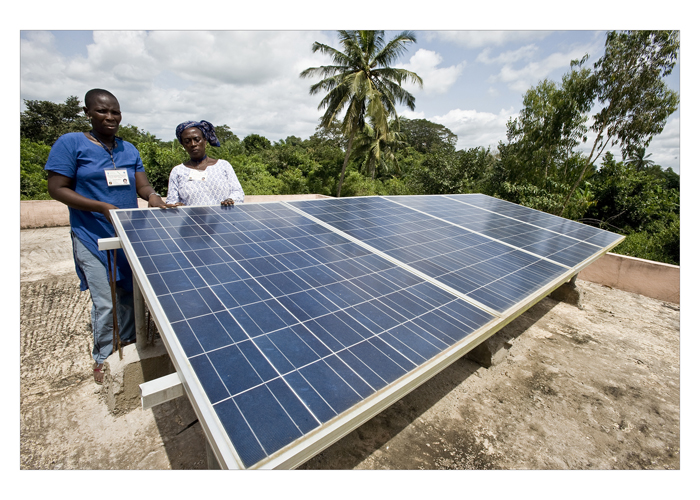
Now that the Netherlands has committed itself in Glasgow to putting a stop to its extensive support for our fossil companies, there is an opportunity to make that move towards sustainability. The reality is that, even in a large oil-producing country like Nigeria, 43% of people have no access to electricity. The solution lies in renewable energy; research has shown that solar and wind energy produced in small-scale, independent electricity networks, is the most effective, affordable and sustainable solution for remote areas that have no access to the national electricity network. In addition, renewable energy generates more employment than fossil energy. That is what Dutch companies should invest in, with the support of our government.
There are opportunities aplenty to produce a truly sustainable and fair Africa strategy. A strategy that no longer supports Dutch trade and investment in fossil industries and in harmful agriculture, but focuses on trade relations that make the food and energy sectors in Africa more sustainable and accessible to people in Africa itself. A strategy in which knowledge exchange is encouraged on both sides and in which local populations decide for themselves and genuinely benefit from trade and investment relations with the Netherlands. A hopeful task for Minister Schreinemacher!
Read more about this subject
-
 Dossier /
Trade agreements
International trade agreements often have far-reaching consequences not only for the economy of a country, but also for people and the environment. It is primarily the most vulnerable groups who suffer most from these agreements.
-
 Dossier /
Global Alliance for Green and Gender Action (GAGGA)
GAGGA rallies the collective power of the women's rights and environmental justice movements to realize a world where women can and do access their rights to water, food security, and a clean, healthy and safe environment.
-
 News / 29 September 2026
Summary - Both ENDS complaint under the EU-New Zealand trade agreement
On 29 September 2026, Both ENDS lodged the first complaint on climate grounds with the European Commission's Single Entry Point. It asks the Commission to examine whether Aotearoa New Zealand has broken two promises both sides made in the EU-New Zealand Free Trade Agreement: not to weaken or set aside environmental laws in order to encourage trade or investment, and to effectively implement the Paris Agreement.
-
Publication / 29 September 2026
-
 News / 29 September 2026
Q&A: New Zealand's climate rollback and the EU trade agreement
On 29 September 2026 / 30 September in Aotearoa New Zealand, Both ENDS lodged a complaint with the European Commission under the EU-New Zealand Free Trade Agreement. These are the questions we are asked most often, and our answers. The complaint summary, the case explainer and the key public sources are linked at the end of this page.
-
 Press release / 29 September 2026
New Zealand faces its first climate complaint under EU trade rules
UTRECHT / WELLINGTON, 29 September 2026 /30 September in Aotearoa New Zealand
Both ENDS, a Dutch environmental justice organisation, has lodged a formal complaint with the European Commission arguing that New Zealand has broken the climate promises it made in its free trade agreement with the European Union. It is the first complaint on environmental and climate grounds under the Commission's Single Entry Point, the mechanism that lets civil society ask the EU to enforce the sustainability commitments in its trade agreements.
-
 Dossier /
Communities Regreen the Sahel
In various countries in the Sahel, vast tracts of land have been restored by the local population by nurturing what spontaneously springs from the soil and protecting the sprouts from cattle and hazards.
-
 Dossier /
Gas in Mozambique
In 2011 one of the world’s largest gas reserves was found in the coastal province of Cabo Delgado, in the north of Mozambique. A total of 35 billion dollars has been invested to extract the gas. Dozens of multinationals and financiers are involved in these rapid developments. It is very difficult for the people living in Cabo Delgado to exert influence on the plans and activities, while they experience the negative consequences. With the arrival of these companies, they are losing their land.
-
Publication / 18 June 2026
-
Publication / 12 May 2026
-
Publication / 14 April 2026
-
 Dossier /
Seeking justice for the affected communities of Vale’s mining disasters in Mariana and Brumadinho
In 2015 and 2019, the Brazilian state of Minas Gerais experienced two severe mining tragedies in Mariana and Brumadinho, due to the same mining company: Vale. Since then, the affected communities have been seeking justice, via the criminal punishment of the responsible parties, and a fair compensation for the loss of their loved ones, their homes and their livelihoods. Both ENDS supports local CSOs by amplifying their quest for justice within an international audience and, more specifically, by raising awareness amongst Dutch investors in Vale about the high risks this company’s activities pose for people and the environment.
-
 News / 2 February 2026
Seven years after Brumadinho: impunity allows Vale’s disasters to continue
Seven years ago, the dam owned by mining company Vale collapsed in Brumadinho, Brazil, killing 272 people and severely polluting the surrounding area. While the relatives of the victims commemorate them and fight for justice, the pollution continues.
-
 Environmentally Just Practice /
A Negotiated Approach for Inclusive Water Governance
A Negotiated Approach envisages the meaningful and long-term participation of communities in all aspects of managing the water and other natural resources on which their lives depend. It seeks to achieve healthy ecosystems and equitable sharing of benefits among all stakeholders within a river basin. This inclusive way of working is an essential precondition for the Transformative Practices that are promoted by Both ENDS and partners.
-
 News / 5 November 2025
Another ISDS claim hits the Netherlands: Petrogas sues over solidarity contribution and royalty regulations
SOMO and Both ENDS strongly condemn the newly revealed investor-state dispute settlement (ISDS) case filed by Petrogas, an Omani oil and gas company operating two shallow-water gas fields in the Dutch North Sea, against the Netherlands under the Netherlands-Oman bilateral investment treaty (BIT).
-
 News / 23 October 2025
TotalEnergies financiers beware: EACOP is eating up money, nature and livelihoods
A new analysis shows that the developers of the East African Crude Oil Pipeline, led by France’s TotalEnergies, are being forced to self-finance the project almost entirely. The analysis, part of a new Finance Risk Updatefrom a coalition of African and International civil society organisations, shows that the companies have abandoned plans to raise 60% of the project’s growing costs from bank loans, and are now on the hook for almost 90% of the costs themselves.
-
Publication / 16 October 2025
-
Publication / 16 October 2025
-
 Dossier /
International trade and investment with respect for people and planet
The network of international trade and investment treaties is large and complex. The Netherlands alone has signed more than 70 bilateral investment treaties (BITs) and is party to the trade and investment agreements concluded by the EU, like the EU-Mercosur and EU-Indonesia trade deals.
-
 News / 6 October 2025
From Entebbe to Accra: civil society is rewriting the rules of investment
By Fernando Hernández Espino and Bart-Jaap Verbeek
Almost a year after African civil society gathered in Uganda to adopt the Entebbe Declaration, the call to transform international investment governance continues to gain strength. From the 6th to the 9th of October, over 50 civil society organisations from across West Africa, including from Ghana, Senegal, Nigeria, Côte d’Ivoire, Cameroon, Gambia, Sierra Leone, as well as from Kenya and Latin America, are convening in Accra to deepen and operationalise the Declaration’s vision.




