




Indigenous leader tells about aching nine year palm oil conflict
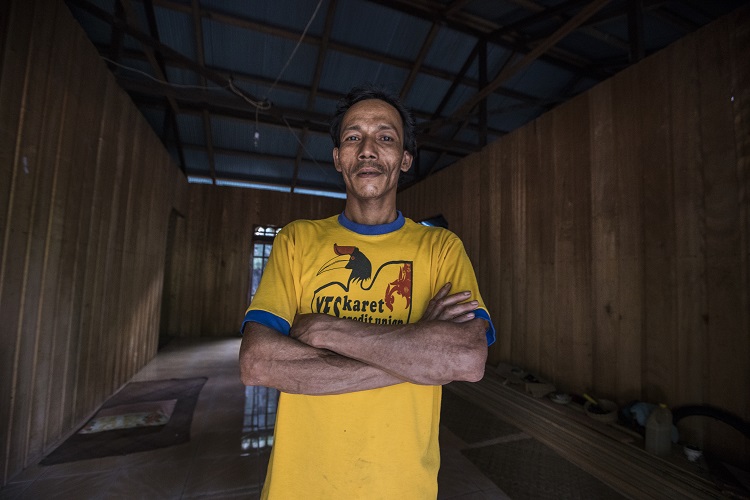
Pak Japin is a quiet, slim, and softly-spoken man from the village of Silat Hulu, West Kalimantan, Indonesia. I met him at a recent documentary screening in Bali on the fringe of the Round Table for Sustainable Palm Oil (RSPO) annual conference, where he spoke about his community's nine year-long conflict with palm oil company Golden Agri Resources Ltd (GAR).
Documentary shines light on the darkest palm oil conflicts
The documentary "Menata Asa Di Jalan Terjal Kebun Kelapa Sawit" (Lit the Candle in the Darkest Palm Oil Conflict) produced by INFIS beautifully depicts the stories of two distant communities as they struggle to resolve long-standing grievances with encroaching palm oil companies: Pak Japin's community of Silat Hulu and the community of Sima Village in West Papua. The stories of these two communities follow similar paths and reflect the hundreds of unresolved conflicts across Indonesia between communities and palm oil companies.
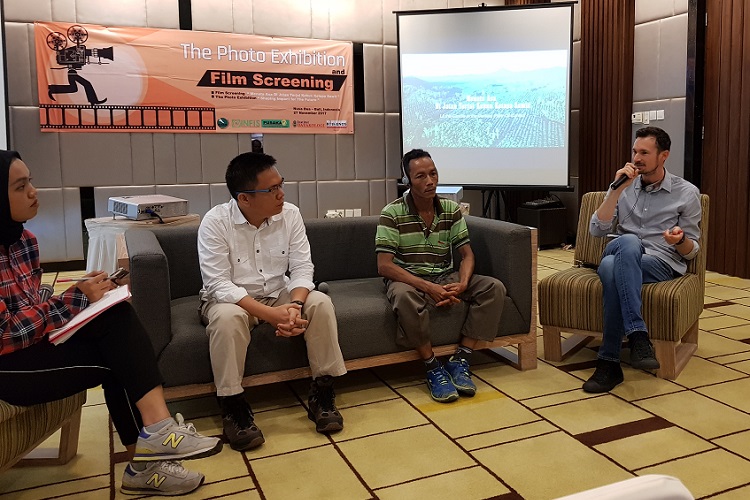
Pak Japin was chosen by his community to represent their story to the outside world. After the film screening, organised by Both ENDS' partner organization Institute for Policy Research and Advocacy (ELSAM), Pak Japin was asked about the impacts on his community. As he told his story it became clear why the people of Silat Hulu chose this man to be their voice in Bali. He sat erect with a tense energy that vibrated from his index finger and he spoke with such passion and intensity that he had no need for the microphone that he clutched tightly in his left. The anger and conviction in his voice left no-one in doubt that the conflict in Silat Hulu continues unresolved, and that the hurt suffered by his community is far from over.
He told the audience about the escalating impacts on his community, and his voice trembled with the frustration of nine years of being ignored, with the indignation of being challenged to prove his community's claim to the lands they had occupied for generations, and with the fury of watching the company that had taken those lands profiting from the oil palms it had planted there. He spoke about forest clearing and dispossession that happened in 2008 as though it happened yesterday. He spoke about his community's many pleas for help to politicians, regulators and GAR falling on deaf ears for years.
The English translator struggled to keep pace with his words and I was spellbound by the passion and energy that this short man exuded. I can't recall everything he said, but his message was clear: 'We were here first, and we will never give up'.
Community stories emblematic of bigger picture of environmental and human rights violations
The stories of Silat Hulu and Sima Village are unique, yet they are also emblematic of many communities' experiences with palm oil in Indonesia. An experience typified by a lack of notice, lack of information, lack of consultation, lack of consent, land-grabbing, illegal forest clearing, unfulfilled promises of wealth and prosperity, depleted and polluted watersheds, contaminated rice paddies, polluted rivers, and division and conflict between families and within communities.
Pak Japin and the Silat Hulu community claim that the plantation has stolen 1,406 hectares of their communal land: a drop in the ocean for a company the size of Golden Agri Resources, but of crucial importance to the community. The Silat Hulu community, with the support of Institut Dayakologi, ELSAM and others, has been attempting to negotiate a private resolution with GAR for several years and finally seemed to make headway two years ago when a 'mutual verification process' for the disputed area was proposed. Agreement on how that process will be implemented now seems within reach.
However, there is deep concern about how a small community like Silat Hulu can obtain a fair and lasting outcome through private negotiation with a company of relatively infinite resources and expertise. The remarks of a GAR representative after the film screening - challenging the film's message, belittling the impacts Pak Japin described, and blaming the community for failing to prove their title to the disputed lands - was a worrying sign that the company staff involved in addressing the community's grievances do not fully understand them. The sad irony that a GAR representative came and speak against an indigenous leader in an intimidating manner at the screening of a film documenting testimonies of company intimidation seemed lost on the company man.
Few options available to resolve grievances and deliver redress for communities
For an outsider to the dispute, this power dynamic is concerning. Yet Pak Japin and the civil society groups that support him remain optimistic about achieving a negotiated solution. The Silat Hulu community has already sought justice in the courts, a slow and costly process without any clear results, so the decision to negotiate a settlement is understandable.
GAR is a member of the RSPO, so the Silat Hulu community could also raise its dispute under the RSPO's grievance mechanism. It is obvious why GAR would want to avoid a formal, public complaint, but GAR's avoidance of scrutiny to the RSPO standard will undermine the credibility of the RSPO system. For the Silat Hulu community, the RSPO's grievance mechanism may be too slow and may not offer a guaranteed solution. There may be few incentives for the community to start a new process if a negotiated outcome now seems within reach, though it is important that alternative dispute resolution processes remain open.
For Pak Japin, his community and the CSOs that support them, I hope a solution can be found and that GAR is willing to engage with the community's grievances in good faith and work towards a fair, just and durable solution. In the meantime, Both ENDS will work towards ensuring the RSPO's grievance mechanism can provide the kind of support and redress that communities so desperately need. I want to see the traditional rights of indigenous communities like Pak Japin's respected and protected in accordance with recognised principles of international law, as also embraced by RSPO, and I will keep working with our partners in Indonesia on ways to bridge the accountability gap for communities living on the palm oil frontier.
The documentary can be found on YouTube. It is well worth watching.
Postscript: Since the publication of the blog post above, GAR and Both ENDS have spoken about the events and discussion that took place at the public film screening in Bali described in the blog post above. It was agreed to consider the Silat Hulu case further and explore, together with the local parties most immediately concerned – i.e. the Silat Hulu community, Institute Dayakologi, ELSAM and others, whether there are in fact unsettled issues between the community and the company, and if so what they are and possible avenues for resolving these issues legitimately, comprehensively and fairly.
Read more about this subject
-
 Dossier /
Fighting for improvements in the production of palm oil
The production of palm oil is causing social and environmental problems worldwide. Both ENDS is working to make the sector fairer and more sustainable and is promoting alternatives for palm oil.
-
 Dossier /
Global Alliance for Green and Gender Action (GAGGA)
GAGGA rallies the collective power of the women's rights and environmental justice movements to realize a world where women can and do access their rights to water, food security, and a clean, healthy and safe environment.
-
Publication / 3 July 2026
-
Publication / 18 June 2026
-
 Dossier /
Rights for People, Rules for Corporations – Stop ISDS!
Indigenous communities in Paraguay saw their attempts to regain their ancestral lands thwarted by German investors. In Indonesia, US-based mining companies succeeded to roll back new laws that were meant to boost the country’s economic development and protect its forests. This is the level of impact that investment treaties can have on social, environmental and economic development and rights. Why? Because of the ‘Investor-to-State Dispute Settlement’ clauses that are included in many such treaties.
-
 Environmentally Just Practice /
A Negotiated Approach for Inclusive Water Governance
A Negotiated Approach envisages the meaningful and long-term participation of communities in all aspects of managing the water and other natural resources on which their lives depend. It seeks to achieve healthy ecosystems and equitable sharing of benefits among all stakeholders within a river basin. This inclusive way of working is an essential precondition for the Transformative Practices that are promoted by Both ENDS and partners.
-
Publication / 17 November 2025
-
Publication / 16 October 2025
-
Publication / 16 October 2025
-
 News / 22 September 2025
EU-Indonesia Trade Deal Threatens Communities and Environment
On September 23th the European Union and Indonesia concluded their negotiations of the EU-Indonesia Comprehensive Economic Partnership Agreement (CEPA), a free trade agreement between the EU and Indonesia. Both ENDS condemns this agreement for favoring corporate interests over those of local communities and the environment.
-
 Dossier /
Soy: trade in deforestation
The rising demand for soy is having negative consequences for people and the environment in South America. Both ENDS reminds Dutch actors in the soy industry of their responsibilities and is working with partners on fair and sustainable alternatives.
-
 News / 9 September 2025
Simplification Must Not Mean Weakening: Why the EUDR and other Environmental Legislation Must Stay Strong
Both ENDS warns that the current debate on “simplification” of EU environmental law must not become an excuse to weaken or postpone urgently needed safeguards. In earlier contributions to the drafting of the EU Deforestation Regulation (EUDR), Both ENDS relayed the voices of local and Indigenous forest-dependent peoples, who consistently urged the EU to take responsibility for the massive deforestation linked to European imports. They underlined how this deforestation destroys biodiversity, undermines climate stability, and erodes their rights, livelihoods and cultures.
-
 Blog / 12 August 2025
Nickel mining for the energy transition: who is accountable for the damage?
Photo blog - In June, I travelled to Indonesia with our partner organization Puanifesto to research the impacts of nickel mining in East Sulawesi. On July 13th, the news broke that the European Union and Indonesia have reached a political agreement on a free trade agreement that was years in the making, called the Comprehensive Economic Partnership Agreement (CEPA). Nickel from Sulawesi is already being used in European cars. This makes it all the more important that we ensure that human and environmental rights are secured in mining and refining operations in Indonesia, before the road is opened to more extraction and exploitation for the European market. The conversations we have had with communities and workers on East Sulawesi show that more binding regulations are necessary to make this happen and ensure an energy transition that is socially and environmentally just.
-
 News / 17 July 2025
Both ENDS Calls on AIIB to Halt Forced Evictions in Mandalika
Together with Indonesian CSOs Both ENDS is calling on the Asian Infrastructure Investment Bank (AIIB) to intervene and direct its client, the Indonesia Tourism Development Corporation (ITDC), and its borrower, the Government of Indonesia, to immediately halt this week's ongoing forced evictions in Tanjung Aan Beach and surrounding areas in Mandalika, Lombok.
-
 Dossier /
Fair Green and Global Alliance (FGG)
Together with civil society organisations from all over the world, the Fair Green and Global (FGG) Alliance aims for socially just, inclusive and environmentally sustainable societies in the Netherlands and the Global South.
-
Publication / 1 July 2025
-
 Environmentally Just Practice /
Analog Forestry
Analog forestry is a transformative approach to the ecological restoration of degraded lands. Natural forests are used as guides to create ecologically sustainable landscapes, which support the social and economical needs of local communities.
-
Letter / 3 March 2025
Input for FMO’s “investment approach to responsibly managed forest plantations”
Both ENDS has been asked by FMO to comment on its draft investment approach to responsibly managed forest plantations. To follow are a number of observations and recommendations, partially informed by Both ENDS long legacy of working in the forest & land arena, in dialogue with international donors, philanthropic foundations, companies, certification bodies and notably with forest dependent communities and other land users.
-
 Press release / 18 February 2025
Trade deal fueling resource grab? 120+ groups from Europe and Indonesia sound the alarm
Brussels, 18 February 2025 - Over 120 civil society organizations and trade unions from Indonesia and Europe today call on the Indonesian government and the European Union to stop the negotiations for the Indonesia-EU free trade agreement – the Comprehensive Economic Partnership Agreement (CEPA).
-
 News / 23 December 2024
Dare to Trust: Mama Sorghum Peace Movement Maintains Biodiversity
Yasores was supported by the Samdhana Institute in our Dare to Trust-project, a no-strings-attached way of funding. We only asked them to send a creative report in any shape or form they want about the activities. The Samdhana Institute send this story about the history and founding of Yasores by Mama Loretha, to report about their grant.




