




Blind spot for Northeast Brazil makes local organisations indispensable
By
Eva Schmitz
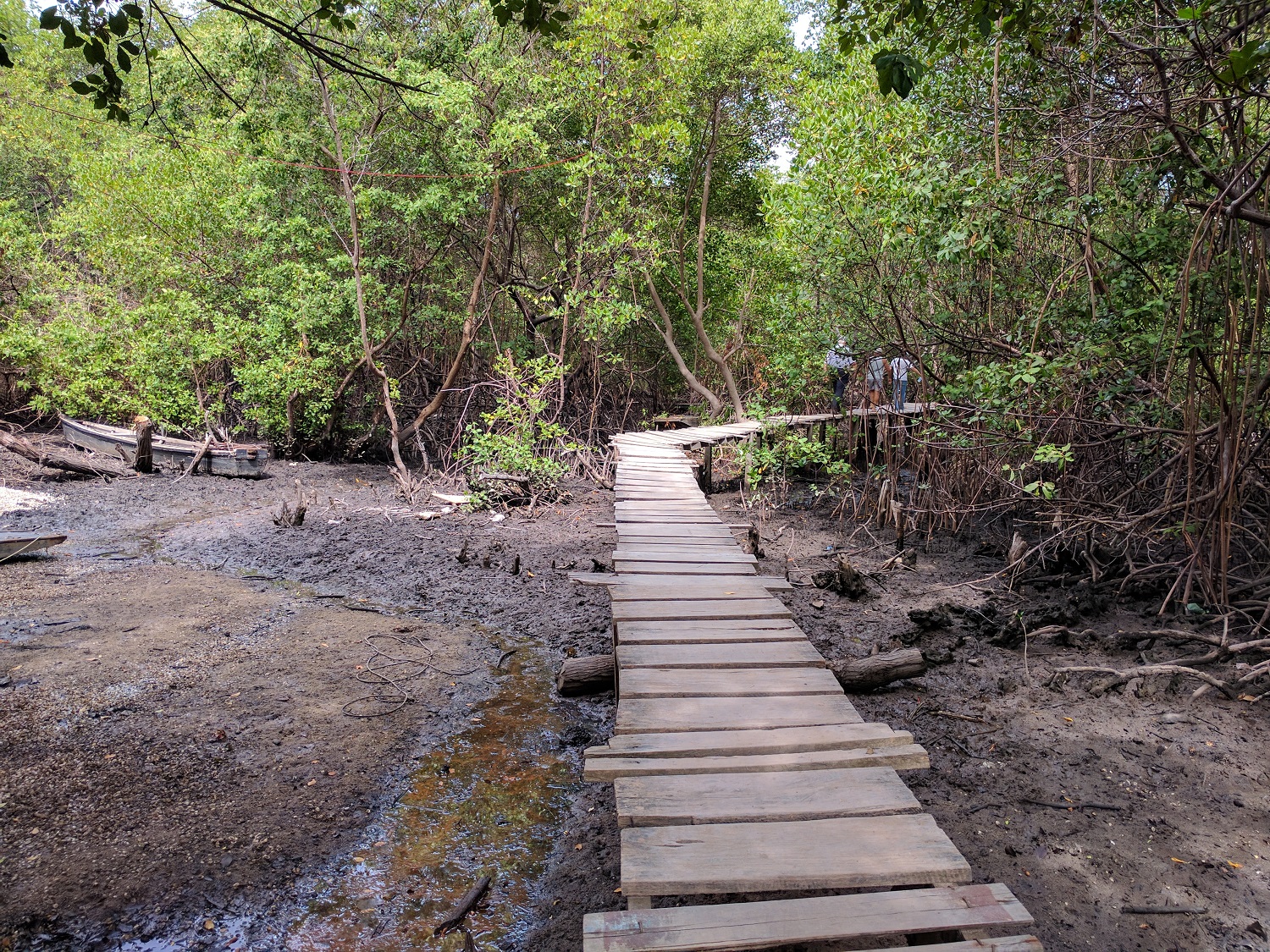
Pernambuco, is in the extreme northeast of Brazil, is one of the country's poorest regions. One of the most important projects aimed at stimulating development in the state is the expansion of the deep-sea port of Suape, complete with an oil refinery and shipyards. The port covers an enormous area; at 13,500 hectares it is bigger than all the different sites of the port of Rotterdam together. Unfortunately, the port lies in the middle of an exceptional and vulnerable ecosystem of mangrove forests and Atlantic rainforest, which are under serious threat from the expansion. Furthermore, the livelihoods of the approximately 25,000 people living in the area are at risk. Most of these people are so called 'traditional communities' of artisanal fisher folk including a number of Quilombola communities whose inhabitants are descended from enslaved people who have lived in this lands for hundreds of years. The communities' fishing catch is visibly declining as a consequence of industrial pollution, the most serious case of which was the oil spill that badly affected the whole coast of Northeast Brazil at the end of last year.
The COVID-19 crisis is striking these people especially hard. As in other parts of the country, the local health system is extremely fragile. The national government denies the severity of the pandemic while hundreds, or even thousands, of people die every day. Given that the resilience of local communities had already been seriously eroded by the impact of the port expansion, complete chaos now reigns in the poor areas around Suape. Many people have no access to clean water and in villages and slums there is an imminent danger of food shortages.
COVID-19 does not affect everyone equally
As everywhere else in the world, the crisis around Suape does not affect everyone equally. Here too, one can see the effects of structural racism; the poor, black communities in particular have been left to their fate and face disproportional impacts. And the crisis has exposed another inequality: women, who have traditionally dominated the shellfish market in the fishing communities, have lost their sources of income through pollution and shrinking access to the sea. Through the general crisis caused by the port expansion, they are also more frequently the victims of domestic and other forms of violence. It has therefore become even more e difficult for them to fulfil the role of main caretakers of their families, a role that is still generally expected of them.
Residents' groups provide emergency aid
In response to the port expansion, residents have formed support groups to strengthen their voices and to defend their rights. These groups – often formed and led by black women – currently fulfil another important function: with only limited financial resources available, they still manage to distribute emergency aid and buy food for the worst affected households. They are supported in these efforts by the Fórum Suape Espaço Socioambiental. The Forum is a platform of community- and women's' organisations with whom Both ENDS has been working since 2013. Besides providing emergency aid, the Fórum together with other local organisations has started a campaign to give residents access to information on COVID-19, who to prevent getting it and to teach them to make their own disinfectants.
Human rights violators have a free hand
However, while the residents' groups are desperately trying to find solutions to this acute crisis, the port company of Suape simply pushes ahead with its own plans. As there is much less attention to violations of the rights of the local population due to the COVID-19 emergency, the port's armed private security services clearly feel that they can do as they please. Physical violence and intimidation against community members are daily occurrences. The dialogue between the residents and the port company, which is essential for the future of the communities in this area, has now almost ground to a complete halt. The COVID crisis is therefore putting the local people in a double disadvantage: while the destruction of the land they live and work on continues unabated, the small space for dialogue they had laboriously created to prevent this destruction happening, is disappearing rapidly.
The curse of poor areas in less poor countries
The case of Suape shows the harsh reality of the poorest and most marginalised people, and especially those whose livelihoods are being eroded because they live in areas where large investments are made in the name of 'development'.
In these areas especially there is little funding available to fight poverty, while here often the need is the greatest. The communities around Suape have to survive basically without government support or funding from traditional aid organisations. Organisations like Fórum Suape Espaço Socioambiental are therefore essential and but are in urgent need for more funding. There is also a need for more international attention for forgotten areas like this. It appears that during this crisis human rights violations and the destruction of the environment in the name of development and modernisation, are more than ever the order of the day.
Read more about this subject
-
 Dossier /
Suape: port expansion threatens paradise
Two projects insured by Atradius DSB in the Brazilian port of Suape have caused serious social problems and environmental damage. Both ENDS is helping the local people to obtain justice.
-
 News / 27 februari 2026
Both ENDS strengthens the resilience of female environmental defenders worldwide thanks to multi-year contribution from the Postcode Lottery
In recent years, Both ENDS has received an additional contribution of €875,000 from the Postcode Lottery for the Autonomy & Resilience Fund (2022–2025), implemented in collaboration with the Global Alliance for Green and Gender Action (GAGGA). This support was essential because female environmental rights defenders around the world are increasingly facing climate change, repression and shrinking civil space. With this contribution, Both ENDS supports female activists and their communities with flexible, trust-based funding, enabling them to develop their own solutions to urgent environmental and climate problems.
-
 Dossier /
Export Credit Agencies: Who pays the price?
Both ENDS calls on the government only to provide export credit insurance to sustainable projects that cause no social and/or environmental damage in the countries where they take place.
-
 News / 24 juni 2025
Indigenous communities in Panama obtain recognition and partial mitigation measures by Development Banks FMO and DEG in relation to the Barro Blanco dam
Both ENDS and SOMO welcome the signing of the agreement of understanding between four Indigenous Ngäbe communities in Panama and the European development banks FMO and DEG on June 17th 2025. The arrangement includes a community development program that, together with a public statement issued by the banks, aims to recognize and mitigate some of the negative impacts caused by the Barro Blanco hydropower dam. We wish to congratulate the community-based organisation Movimiento 10 de Abril (M10) for its perseverance to seek justice for the affected communities, and we acknowledge the commitment of FMO and DEG to pursue a solution to their long-standing dispute with the communities arising from their partial financing of the hydropower project since 2011.
-
Publication / 25 maart 2024
-
Publication / 16 oktober 2023
-
Publication / 23 juni 2023
-
Publication / 23 mei 2023
-
 Dossier /
Paris Proof Export Support
Almost two-thirds of the export credit insurances that Atradius DSB provided in the 2012-2018 period went to the fossil energy sector. That is contrary to the climate agreements that the Netherlands signed in Paris.
-
 Dossier /
Large-scale infrastructure
Large-scale infrastructural projects have detrimental effects on local people and the environment, while their benefits are felt elsewhere. Both ENDS is working to ensure that local people have a greater say in decision-making and is investigating the way these projects are funded.
-
Publication / 10 oktober 2022
-
Publication / 23 augustus 2022
-
 External link / 15 juni 2022
Open letter to Trade Ministers at the World Trade Organization (WTO)
Joint CSO call to all WTO Trade Ministers to not accept the current draft of Ministerial Decision on the TRIPS Agreement and demand a real Waiver
-
 News / 13 juni 2022
The WTO and intellectual property rights: what it means for us
Intellectual property law is regulated at various levels around the world. At the international level, intellectual property rights are mainly laid down within the World Trade Organization (WTO) and in trade agreements. But what does this in practice mean for us? With this infographic, we've visualized what happens when a holder of intellectual property rights - usually a big company - thinks his rights are being violated.
-
Publication / 12 april 2022
-
Publication / 7 maart 2022
-
 News / 24 februari 2022
1,380,000 euros from the Dutch Postcode Lottery for local women’s groups
We are delighted that the Dutch Postcode Lottery has approved our proposal to support an extra project to the tune of 1,380,000 euros! The proposal, for an Autonomy and Resilience Fund (ARF), was submitted by the Global Alliance for Green and Gender Action (GAGGA), which comprises the Fondo Centroamericano de Mujeres (FCAM), Mama Cash and Both ENDS. With the ARF, GAGGA works with Small Grants Funds to help local women's groups become resilient in a changing world in which it is increasingly difficult for them to hold their heads above water. The award of this large sum of money means an enormous boost for many women's organisations, and this is badly needed at a time when economic, climate and health crises are constantly putting the resilience of women, their communities and their living environments around the world to the test!
-
 Blog / 2 februari 2022
On World Wetlands Day communities throughout the La Plata Basin are asking for support in their fight for their endangered wetland ecosystems
By Eva SchmitzThe new year has barely begun but already record high summer temperatures are being reported in parts of South America, especially Argentina, Paraguay and Southern Brazil. The latest heatwave, with temperatures of up to 45C, arrives on top of two years of severe drought which had a devastating effect on the entire region. It is a painful reminder of the immediacy of climate change and emblematic for what happens when vital ecosystems are not protected and for the catastrophic consequences as much on already endangered wildlife as on the local communities who depend on them for their livelihoods. One of the most affected areas are the regions wetlands – unique ecosystems, which are crucial ecological pressure points, vital for the regulation of river systems and huge carbon sinks. Their loss not only has ecological impacts but affects thousands of local communities which depend on their health for fishing, tourism and local agriculture. The threat to them by for example droughts and fires, can be directly linked to the large-scale production of soy, produced mainly for export. This in turn means responsibility for what is happening in the region needs to be acknowledged and shared by leaders around the world, and especially large importers such as the Netherlands.
-
 News / 6 januari 2022
How the mangroves in Suape are growing back
"The mangroves were choking, gasping for air. When the dam was partially opened, they could finally breathe again. It was the breath that the animals, the fish in the rivers, the crabs, shrimps and oysters had all been craving."
On the northeast coast of Brazil, activities have been underway since 2007 to develop and extend the port of Suape. The port is being developed partly to support oil drilling along the Brazilian coast. The project is controversial because of the disastrous impact it is having on the natural environment, the rivers, the mangroves, marine life and the people who have lived in the region for many generations. Together with Fórum Suape, specially set up to combat the development of the port, Both Ends has been working for almost ten years to protect the rights of local communities in and around Suape. Now there has been a breakthrough – literally. In August of last year, a controversial dam in the Rio Tatuoca that was destroying the mangroves and the aquatic life in the area was partially dismantled. We spoke to Mariana Vidal,* project coordinator at Fórum Suape, about how that came about and what changes have taken place in the area since.
-
 Blog / 10 december 2021
Vaccine apartheid is a violation of human rights
Pharmaceuticals hold on to their patents and (our) governments do not remove the barriers to free production that were raised under international trade agreements years ago.




