




Investment treaties
Investment treaties must be inclusive, sustainable and fair. That means that they must not put the interests of companies before those of people and their living environment.
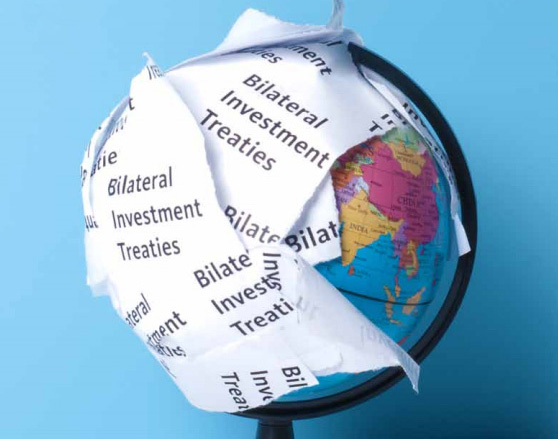
International investment flows are currently regulated by some 3,000 bilateral investment treaties (BITs) and other international investment (IIAs). These agreements and treaties were originally set up to promote foreign investment, but very little has come of their promised beneficial effects. The time has come to radically change the international system of investment treaties. It is not only clear that investment treaties do not promote foreign investment, but also that in many cases they seriously harm the interests of developing countries.
Far-reaching rights for investors
The treaties grant foreign investors far-reaching rights and are increasingly used to exert pressure on governments not to take measures that are not in the investors’ interests. The Investor-to-State-Dispute-Settlement (ISDS) system allows businesses or investors to lodge charges against states beyond the jurisdiction of international courts. ISDS tribunals are not subject to the laws of countries that are charged and only work in one direction: only businesses may submit complaints, without having to do anything to defend themselves.
Dispute settlement beyond the reach of international courts
Through ISDS, foreign investors can oppose a wide range of national government policies and measures, including social and environmental rules. The rulings of an ISDS tribunal are definitive, binding and internationally enforceable. A large proportion (around 60%) of all ISDS cases are brought by companies against poorer countries, and the number of complaints has risen sharply in the past 10-20 years. In the past five years, one new ISDS case has been submitted per week. At the end of 2017, UNCTAD reported that successful complainants received an average of $522 million in compensation. Countries will often decide not to introduce a certain measure rather than face such high penalties, with all the consequences that will have for its people.
Many ISDS claims from the Netherlands
ISDS claims have already caused considerably harm in many developing countries. The second highest number of ISDS procedures are initiated from the Netherlands, after the US. That is partly because of the almost 100 BITs that the Netherlands has concluded, including with developing countries. There are also many ‘letter-box’ companies registered in the Netherlands, which can use the Dutch BITs to lodge complaints against countries in which they invest. The increasingly negative effects of ISDS in investment treaties is one of the main reasons why more and more developing countries want to terminate their investment treaties with the Netherlands.
Both ENDS is working to reform and terminate BITs
Both ENDS has long been drawing attention to the negative consequences of investment treaties on developing countries and is particularly concerned about the ISDS mechanisms in the current treaties. To make investment policies fair and sustainable and to ensure that they do not harm people and the environment, the ISDS mechanism included in all these treaties must be removed as soon as possible.
Dutch model BIT
In 2018, the Netherlands is revising the model text of its BITs. As the text will serve as an example for many other European countries, it is important that it is as inclusive and sustainable as possible. Together with Dutch and foreign partners, Both ENDS is providing input for the new text, naturally in the hope that its recommendations are taken up. We are also working with our partners to raise awareness of the consequences of investment treaties and ISDS, with the aim of exerting public pressure on the decision-making process relating to the model text.
Terminating BITS
Outside the Netherlands, we are also making our concerns and criticisms clear in other institutions, like UNCTAD and the European Parliament. We are supporting local groups in Southern countries in their efforts to terminate existing treaties, so that new investment policies can be developed that put people and the environment first and ensure that investments make a positive contribution to sustainable development.
For more information
Read more about this subject
-
 Dossier /
Rights for People, Rules for Corporations – Stop ISDS!
Indigenous communities in Paraguay saw their attempts to regain their ancestral lands thwarted by German investors. In Indonesia, US-based mining companies succeeded to roll back new laws that were meant to boost the country’s economic development and protect its forests. This is the level of impact that investment treaties can have on social, environmental and economic development and rights. Why? Because of the ‘Investor-to-State Dispute Settlement’ clauses that are included in many such treaties.
-
 Dossier /
Trade agreements
International trade agreements often have far-reaching consequences not only for the economy of a country, but also for people and the environment. It is primarily the most vulnerable groups who suffer most from these agreements.
-
 Dossier /
International trade and investment with respect for people and planet
The network of international trade and investment treaties is large and complex. The Netherlands alone has signed more than 70 bilateral investment treaties (BITs) and is party to the trade and investment agreements concluded by the EU, like the EU-Mercosur and EU-Indonesia trade deals.
-
 Dossier /
Towards a socially and environmentally just energy transition
To address the climate crisis we need to urgently transition away from fossil fuels towards clean, renewable energy. However, this transition is not only about changing energy sources. It requires an inclusive and fair process that tackles systemic inequalities and demanding consumption patterns, prioritizes environmental and social justice, and which does not repeat mistakes from the past.
-
 Dossier /
Fair Green and Global Alliance (FGG)
Together with civil society organisations from all over the world, the Fair Green and Global (FGG) Alliance aims for socially just, inclusive and environmentally sustainable societies in the Netherlands and the Global South.
-
 News / 5 November 2025
Another ISDS claim hits the Netherlands: Petrogas sues over solidarity contribution and royalty regulations
SOMO and Both ENDS strongly condemn the newly revealed investor-state dispute settlement (ISDS) case filed by Petrogas, an Omani oil and gas company operating two shallow-water gas fields in the Dutch North Sea, against the Netherlands under the Netherlands-Oman bilateral investment treaty (BIT).
-
Publication / 16 October 2025
-
Publication / 16 October 2025
-
 News / 23 September 2025
With the undemocratic splitting of the EU-Mercosur deal, Europe is missing the chance to lead on fair trade
Recently, many newspapers have written about Brussels’ rush to finalize the trade agreement between the EU and the South American Mercosur countries. According to the European Commission, national parliaments do not need to approve it because the trade part and the “political” part have been separated. This “splitting” means that the trade part can be approved as an EU-only decision by the European Council and the European Parliament, while national parliaments are sidelined and the political-cooperation part is postponed. Both ENDS and its partners are deeply concerned and are calling on the Dutch government to vote against this outdated agreement.
-
 News / 22 September 2025
EU-Indonesia Trade Deal Threatens Communities and Environment
On September 23th the European Union and Indonesia concluded their negotiations of the EU-Indonesia Comprehensive Economic Partnership Agreement (CEPA), a free trade agreement between the EU and Indonesia. Both ENDS condemns this agreement for favoring corporate interests over those of local communities and the environment.
-
 News / 11 September 2025
EU-Mercosur: Small GDP Gain, Big Question Marks for Farmers and Democracy
A recent report by Wageningen Economic Research (WER) on the economic consequences of the trade agreement between the EU and Mercosur confirms what civil society organizations, policymakers, and trade unions have been signaling for years: this agreement does not offer a balanced perspective for farmers and the environment. Instead, it increases power inequalities and shifts burdens onto (small-scale) farmers. Moreover, the deal risks reinforcing unsustainable practices that complicate the climate transition and addressing environmental challenges in both the EU and Mercosur countries.
-
 Blog / 17 July 2025
A disaster for farmers: here and there
The trade agreement with South America is harmful to farmers, the climate, and biodiversity, on both sides of the Atlantic. It’s time to take this deal off the table once and for all, argues Fernando Hernandez, Senior Policy Officer for Trade and Investment at Both ENDS.
-
 News / 5 June 2025
Op-ed: New trading partners, but not on the same terms
Since President Trump's trade war and tariffs, international trade has once again been thrust into the spotlight. In Europe and the Netherlands, there are growing calls for new free trade agreements to be concluded as quickly as possible, as reflected in recent opinions in FD and de Volkskrant. But that is the wrong reflex, writes our colleague Marius Troost.
-
 Press release / 18 February 2025
Trade deal fueling resource grab? 120+ groups from Europe and Indonesia sound the alarm
Brussels, 18 February 2025 - Over 120 civil society organizations and trade unions from Indonesia and Europe today call on the Indonesian government and the European Union to stop the negotiations for the Indonesia-EU free trade agreement – the Comprehensive Economic Partnership Agreement (CEPA).
-
 News / 22 January 2025
 -
Letter / 9 December 2024
People and the Planet Entebbe Declaration: Reclaiming investment frameworks for people and the planet
The time for change is now. Civil society demands international investment
frameworks that are aligned with economic justice, social and environmental
sustainability, and the needs of communities worldwide. -
 News / 11 November 2024
Kenya Terminates Bilateral Investment Treaty with the Netherlands
The government of Kenya has officially terminated its bilateral investment treaty (BIT) with the Netherlands, marking a significant win for economic justice and environmental protection. Kenya’s decision reflects a growing global trend of rethinking outdated treaties that often prioritize corporate interests over public welfare. The Dutch Minister for Foreign Trade and Development recently confirmed that Kenya unilaterally ended the treaty in December 2023, rendering it inoperative from 11 June 2024. Kenya now joins South Africa, Tanzania, and Burkina Faso as the fourth African country to terminate its BIT with the Netherlands.
-
 News / 12 March 2024
Equality as a key for international trade
Trade has been in the global spotlight once again in recent times. Recently, ministers from around the world gathered in Abu Dhabi at the WTO for negotiations on world trade in the coming years. However, participants from civil society were silenced. Never before has their freedom been so severely restricted at the WTO. In a time when geopolitical tensions are escalating by the day, it is crucial to prioritize equality in international trade. -
Publication / 30 October 2023
-
 News / 17 July 2023
Counter summit in Brussels: civil society organisations call for sustainable and fair trade
On 17 and 18 July, representatives of the governments of Latin America, the Caribbean and the European Union meet in Brussels for the EU-CELAC summit. The European Commission and several EU Member States want to use this moment to accelerate the ratification of the trade and investment treaties between the EU and Mexico, the EU and Chile and the EU and the South American Mercosur countries*.



