




Barro Blanco floodings: enormous damage
The closing of the Barro Blanco dam last year caused not only material but also cultural damage in the affected Ngäbe-Buglé communities in Panama. So far, funder FMO is not taking responsibility for the human rights abuses caused by the project. So, what now?
The indigenous Ngäbe-Buglé have been opposing the dam for years, without success. The test floodings in May 2016 raised the water level of the reservoir to 103 meter, inundating large pieces of indigenous land. Both ENDS' colleague Anna van Ojik visited the community Kiad in March to seek a solution for this long-lasting conflict.
Material and immaterial damage
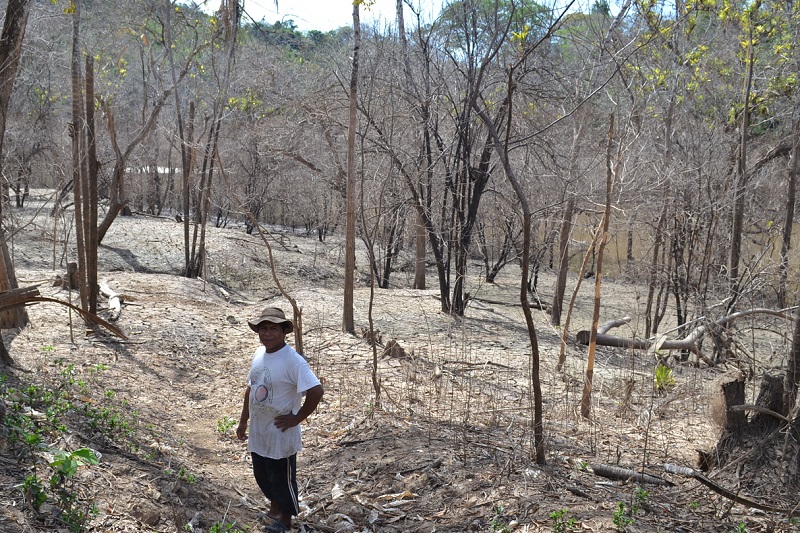
Some houses, cacao plantations and vegetable gardens have been destroyed by the water, part of the Ngäbe's food forests has died. The river bank is hardly accessible through the mud and the water is no longer suitable for consumption or doing laundry. The inhabitants now have to rely on a thin water trickle from a provisional tube.
At least as bad is the intangible damage, especially around Kiad, the cultural center of the Ngäbe. Here is the only school where the written version of the Ngäbe-language is taught. Because trails between the communities are no longer passable, many children now can not go to this school. In addition, a cemetery flooded and ancient rock drawings of the ancestors of the Ngäbe-Buglé are now under water.
(also see the pictures below this post)
Consultation proved difficult
The communities, united in the 'Movimiento 10 de abril' (M10), meanwhile seek ways to influence the project, that affects their life so directly. M10 has therefore made a counter-proposal to the Panamanian government, which is based on a water level of 80 meters. At this level, no land within their indigenous territory, the comarca, will be inundated. Their proposal is now being discussed.
Apart from that, the dialogue between the indigenous Ngäbe and the government is difficult. The government is trying to reach an agreement with the indigenous Ngäbe-Buglé Congress and negotiates it with its board, which however was fired by the same congress this March because of disagreements over mining concessions. Therefore, there is little chance that the congress will support the agreement, which may be presented this week already.
All national legal paths to stop the dam have been exhausted. The communities have now pinned their hopes on the Inter-American Commission on Human Rights (IACHR). With the support of Both ENDS, representatives of M10 and partner organization ACD traveled to Washington for a hearing on human rights in Panama. The outcome is at least a small step forward: the government should better consult the communities and must submit proof of the consultation process to the IACHR. Today, April 4 is the first meeting, where M10 will be present.
FMO should not accept human rights abuses
Even though Both ENDs has been involved for years in the Barro Blanco case and stays in close contact with our local partners M10 and ACD, it turns out that there are many things you won't learn from a distance. The Dutch development bank FMO, who has not visited the area recently, therefore has no clear view on the situation on the ground. Both ENDS has already informed FMO about the latest developments in Panama.
FMO now has to show that they do not accept the human rights abuses by their client GENISA, the company building the dam. Furthermore, FMO can no longer point to the dialogue between the government and the communities, now that it is very clear how arduous this process has been until now. FMO should visit the affected communities and recognize the human rights abuses that take place there. And FMO should ask their client GENISA to halt the project until a consultation process has been carried out correctly and the affected communities received fair compensation.
Read more:
- 23 March 2017, Global Sisters Report: Washington hearing is activists' last hope in battle over Panama dam
- 23 March 2017: A wall in their river: Flooded Ngäbe communities continue to fight dam
- 30 August 2016: Worrying new developments around Barro Blanco
- 2 June 2016: Indigenous land submerged by illegal clusure of dam
- 1 June 2015: FMO did not follow its own rules in financing Barro Blanco dam
- 18 May 2015: Dutch FMO pushed Panama to continue construction Barro Blanco dam
- 6 May 2015: Construction of Barro Blanco dam will be resumed
-
11 Feb 2015: Construction Barro Blanco dam finally suspended
-
Read our background story about Barro Blanco
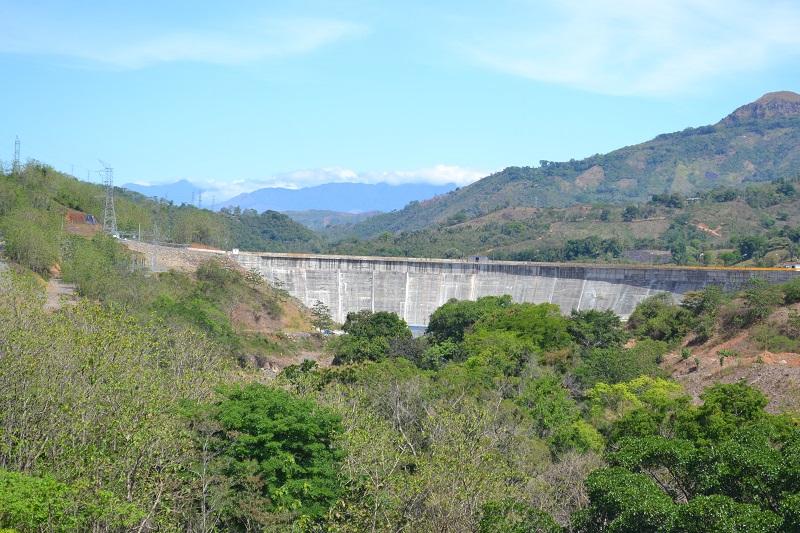
The Barro Blanco Dam
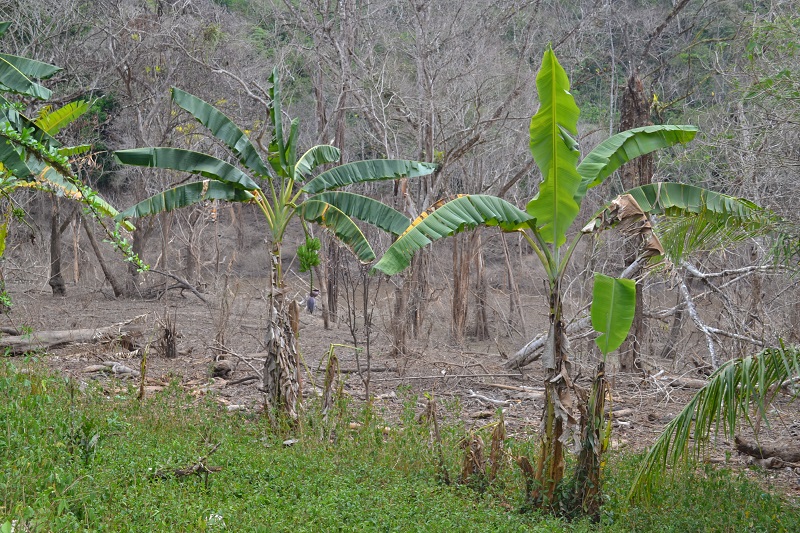
The dead trees clearly show until where the water rised. Although the water level has dropped somewhat, the damage is huge. According to the plan of the dam, the water can reach even higher.

The cocoa plantations of Kiad's inhabitants have been destroyed by the water. The fruits are left in the trees.
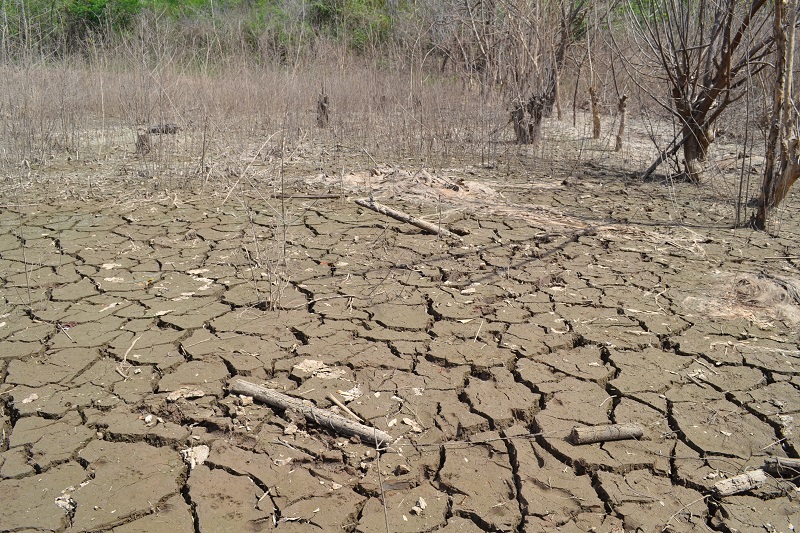
These are the remains of a house engulfed by the water. There remain only a few poles.

The water came until this house, causing the owners to abandon it.
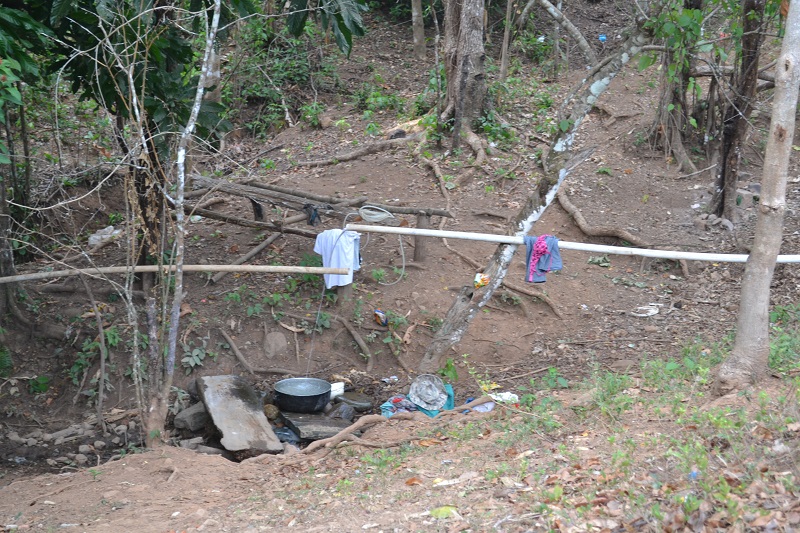
This temporarily laid tube is the only drinking water supply for the residents of Kiad. Previously, they used the water of the river, but that has become unusable by the closing of the dam.

Manolo with his youngest grandchild. 50 years ago, the illiterate Manolo invented the script of the Ngäbe language and founded this school in Kiad. It is the only school where the script is taught. Children from other communities can't reach the school any more because of the floods.
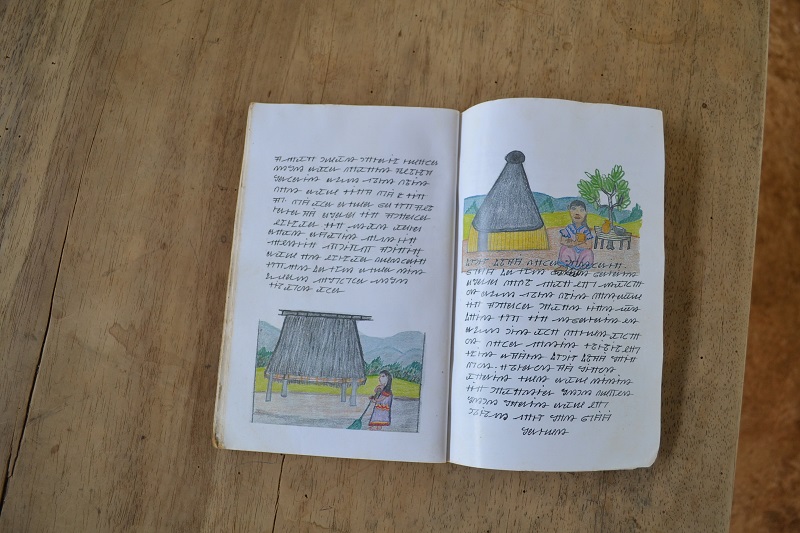
Schoolbook made by Manolo in the Ngäbe-script.
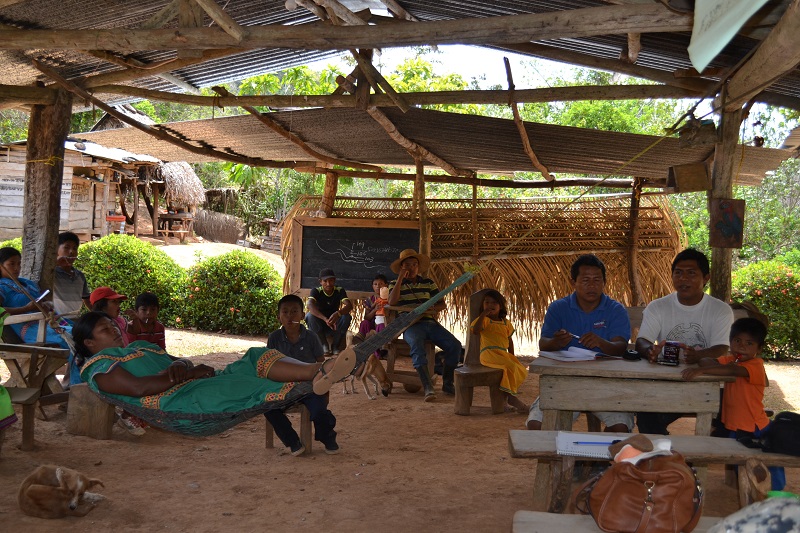
The school is also being used as a meeting room. Whoever wants to share their thoughts, often does so from the hammock.
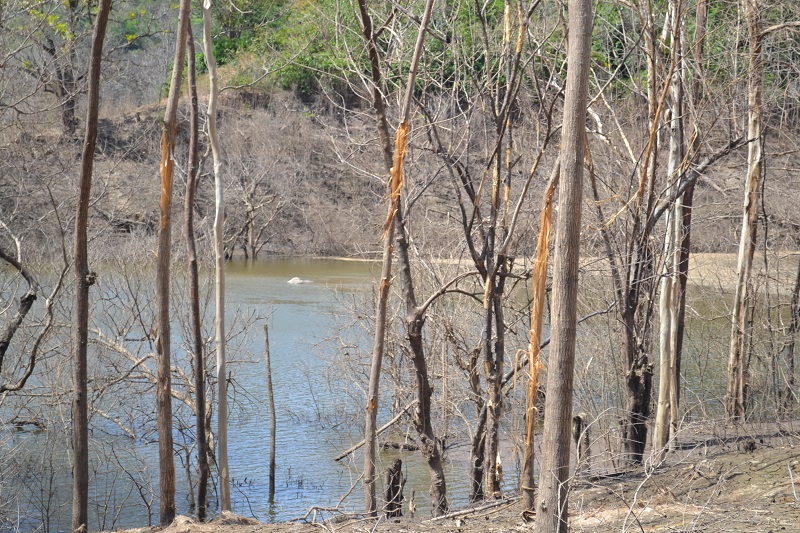
Only the top of the rock that carries (or carried) the ancient rock drawings of the ancestors of the Ngäbe is now visible.
Read more about this subject
-
 Dossier /
Indigenous communities threatened by Barro Blanco dam in Panama
The Barro Blanco dam project in Panama, which has Dutch financial support, is causing indigenous lands to disappear under water. Both ENDS is working to protect the rights of indigenous communities living near the dam.
-
Publication / 12 mei 2026
-
 Dossier /
Agua Zarca: indigenous fight against dam costs lives
Indigenous Hondurans are resisting the construction of the Agua Zarca hydrodam. Their fight has cost several lives, including that of Berta Cáceres. After considerable public pressure, Dutch development bank FMO withdrew from the project.
-
 Blog / 1 december 2025
The Long Road to Justice for the Ngäbe of Kiad
In October 2025 I travelled to Kiad, the Indigenous Ngäbe community that led the struggle against the FMO-financed Barro Blanco dam, for one last time. I went there to say my goodbyes, both personally and on behalf of Both ENDS, and to catch a first glimpse on how a community program financed by FMO and DEG – the result of a dialogue process that took several years – is giving a new impulse to the dam-affected communities. But how did we get here?
-
 Dossier /
Wetlands without Borders
With our Wetlands without Borders program, we work towards environmentally sustainable and socially responsible governance of the wetlands system of the La Plata Basin in South America.
-
Publication / 17 november 2025
-
 Press release / 13 november 2025
Global Alliance Urges Dutch Government to Reconsider Endorsement of Controversial Timber Certification Scheme
A coalition of Malaysian and international NGOs has released a memorandum in response to the recent TPAC report on the Malaysian Timber Certification Scheme (MTCS). The organizations express serious concerns about the independence, quality, and credibility of the assessment carried out by the Timber Procurement Assessment Committee (TPAC).
-
Publication / 16 oktober 2025
-
Publication / 16 oktober 2025
-
 News / 24 juni 2025
Indigenous communities in Panama obtain recognition and partial mitigation measures by Development Banks FMO and DEG in relation to the Barro Blanco dam
Both ENDS and SOMO welcome the signing of the agreement of understanding between four Indigenous Ngäbe communities in Panama and the European development banks FMO and DEG on June 17th 2025. The arrangement includes a community development program that, together with a public statement issued by the banks, aims to recognize and mitigate some of the negative impacts caused by the Barro Blanco hydropower dam. We wish to congratulate the community-based organisation Movimiento 10 de Abril (M10) for its perseverance to seek justice for the affected communities, and we acknowledge the commitment of FMO and DEG to pursue a solution to their long-standing dispute with the communities arising from their partial financing of the hydropower project since 2011.
-
 Dossier /
Advocating for responsible policies of development banks
Development banks should comply with strict environmental and human rights rules to ensure that their projects benefit and do not harm the poorest groups. Both ENDS monitors the banks to make sure they do.
-
Letter / 3 maart 2025
Input for FMO’s “investment approach to responsibly managed forest plantations”
Both ENDS has been asked by FMO to comment on its draft investment approach to responsibly managed forest plantations. To follow are a number of observations and recommendations, partially informed by Both ENDS long legacy of working in the forest & land arena, in dialogue with international donors, philanthropic foundations, companies, certification bodies and notably with forest dependent communities and other land users.
-
Publication / 16 januari 2025
-
Letter / 9 december 2024
People and the Planet Entebbe Declaration: Reclaiming investment frameworks for people and the planet
The time for change is now. Civil society demands international investment
frameworks that are aligned with economic justice, social and environmental
sustainability, and the needs of communities worldwide. -
 News / 2 december 2024
Ten recommendations for the UNCCD COP16 to strengthen its efforts in combating desertification, land degradation, and drought
For decades, our local partner organisations have been developing and promoting effective ways to combat land degradation, desertification, and drought. This includes regions like the drylands, as well as forests, and wetlands. Supporting these locally-led actions is essential to reversing negative trends. For COP16, Drynet has developed 10 recommendations to strengthen the implementation of the UNCCD. Success at COP16 would mean turning these recommendations into action, fostering inclusive land governance and sustainable land management practices globally. By enabling locally-led actions—particularly those led by women, youth, pastoralists, and Indigenous Peoples—we can build a more resilient future.
-
 News / 3 juli 2024
Illegal logging is devastating Suriname's forest: The Saamaka and their fight against deforestation
The Saamaka people of Suriname have long resisted the government's violation of their land rights. Despite a 2007 ruling by the Inter-American Court of Human Rights (IACHR) against such violations, the government continues to grant logging and mining concessions on Saamaka territory without free prior and informed consent (FPIC). New report shows this has led to deforestation, land dispossession, and disruption of their livelihoods. A recent example includes a 42.7 km road built through their lands for logging access.
-
 Press release / 4 maart 2024
Dutch government calls for investigation into Malaysian timber certification
The Dutch government expects PEFC International to undertake an investigation into its own role as a forest certification system, using the Malaysian Timber Certification Scheme (MTCS). "It is about time the Dutch government takes a leading role in ensuring Malaysian timber entering The Netherlands is not associated with deforestation and human rights abuses," states Paul Wolvekamp of Both ENDS. "Considering that the Dutch government has the ambition to build 900.000 houses in the immediate future, involving massive volumes of timber, such as timber from Malaysia for window frames, builders, contractors, timber merchants and local governments rely on the Dutch government to have its, mandatory, timber procurement better organised, i.e. from reliable, accountable sources'.
-
Publication / 13 november 2023
-
Publication / 25 mei 2023
-
Publication / 23 maart 2023




