




FMO did not follow its own rules in financing Barro Blanco dam
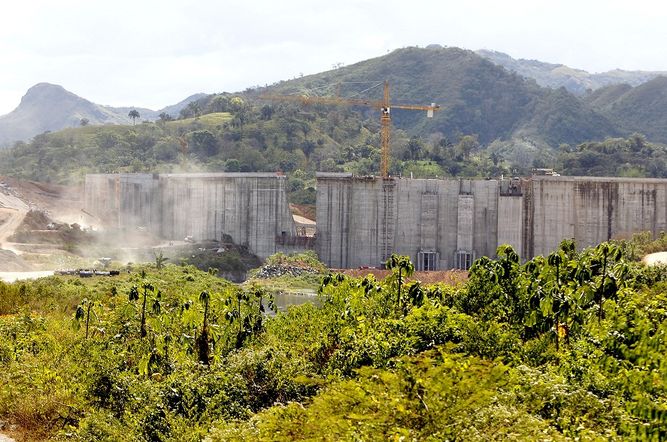
Dutch development bank FMO did not sufficiently take into account the rights of the local population and effects on the environment before approving a $ 25 million loan for the construction of the Barro Blanco dam in Panama. This is not in accordance with FMO’s own standards. This was revealed in the long-awaited report by the independent complaints mechanism (ICM) of the FMO and the German development bank DEG, released on May 29. The report was published in response to a complaint filed by the M-10, the movement representing the affected indigenous Ngöbe population, in May 2014. Both ENDS has been supporting the M-10 in its struggle against the dam for years, and was one of the organisations that supported the complaint.
We are pleased that the conclusions of the independent experts of the ICM support our view that the banks did not comply with their standards.
Failure to obtain consent
The dam’s artificial lake will partially flood the territory of the Ngäbe communities living on the shores of the Tabassará river. These people will be forced to leave their homes and places of religious and cultural value. Despite national and international obligations relating to human rights, project developer Genisa failed to obtainthe 'free, prior and informed consent' (FPIC) of the Ngäbe population. According to the report the “lenders should have sought greater clarity on whether there was consent to the project from the appropriate indigenous authorities prior to project approval”.” Another shortcoming relates to the Environmental and Social Action Plan that was appended to the credit agreement. This plan "contains no provision on land acquisition and resettlement and nothing on biodiversity and natural resources management. Neither does it contain any reference to issues related to cultural heritage. ."
FMO's role
In their public reaction to the report, FMO and DEG acknowledge the conclusion of the report that they were not fully appraised at credit approval, but they made no further concrete commitments to ensure that the rights of those affected by the dam will be respected.. The banks claim that they are “facing limitations in their influence” over government processes to come to a satisfactory agreement with all stakeholders involved. Earlier this year though, the development banks did try to influence the government. In February 2015 the Panamanian government suspended the construction of the dam on the basis of Genisa not acting in accordance with the agreed Environmental Impact Assessment. The breaches included the lack of a legitimate agreement between the Ngöbe and Genisa, and violations of environmental laws. In reaction to the decision to halt the project, the FMOsent a letter to the Vice President of Panama, urging the government to resume construction as soon as possible. According to the bank, closing down this project could "negatively influence future investment decisions in Panama."
Banks’ response is inadequate
Anouk Franck of Both ENDS is surprised by FMO's reaction: "Instead of insisting on resuming the project, the bank should have shown us that it takes the interests of the local population seriously and that it acts in accordance with its own policies. Whenever we have meetings with its representatives, FMO assures us that it supports its clients to improve their social and environmental policies and practices. But in the case of Barro Blanco, the bank has shown it does exactly the opposite. In light of the conclusion of the ICM’s reports, indicating the bank did not comply with its standards, we urge FMO to withdraw from the project. Furthermore, to prevent similar situations in the future human rights impact assessments should become standard procedure at FMO. This is an important instrument to ensure that human rights and environmental standards are guaranteed in future projects."
Also read the press release of Both ENDS, SOMO and others, published on the 1st of June.
Dutch newspaper 'De Volkskrant' also covered the story on the 1st of June (in Dutch): Nederlandse ontwikkelingsbank zat fout met stuwdam Panama
You can also read a summary of the report of the complaints mechanism.
For previous news on barro Blanco on our website:
19 May 2015: FMO pushed Panama to continue Barro Blanco dam
6 May 2015: Construction of Barro Blanco dam will be resumed
11 Feb 2015: Construction Barro Blanco dam finally suspended
7 May 2014: Complaint against FMO on grievance mechanism.org
3 March 2014: Parliamentary questions about construction Barro Blanco dam in Panama
18 Feb 2014: Situation tense for indigenous Ngäbe people near Barro Blanco dam
14 Feb 2014: Filing a complaint with the FMO?
19 June 2013: Will VN-rapporteur James Anaya investigate Barro Blanco dam in Panama?
In this 'long read' on Barro Blanco you can find a short overview of what has happened around the dam in in the past few years.
Read more about this subject
-
 Dossier /
Indigenous communities threatened by Barro Blanco dam in Panama
The Barro Blanco dam project in Panama, which has Dutch financial support, is causing indigenous lands to disappear under water. Both ENDS is working to protect the rights of indigenous communities living near the dam.
-
Publication / 3 July 2026
-
 Dossier /
Gas in Mozambique
In 2011 one of the world’s largest gas reserves was found in the coastal province of Cabo Delgado, in the north of Mozambique. A total of 35 billion dollars has been invested to extract the gas. Dozens of multinationals and financiers are involved in these rapid developments. It is very difficult for the people living in Cabo Delgado to exert influence on the plans and activities, while they experience the negative consequences. With the arrival of these companies, they are losing their land.
-
 Dossier /
Finance for agroecology
The lion's share of public budgets for climate, agriculture and development still goes to conventional agroindustrial projects that contribute to the current climate, food and biodiversity crises. Both ENDS and our partners are calling for a transition to agroecological practices that are people- and environment-friendly.
-
Publication / 12 May 2026
-
 Press release / 12 May 2026
UN report warns of a growing sand crisis - The Dutch dredging sector plays a key role in global sand extraction
GENEVA/UTRECHT, 12 May 2026 – A new report by the United Nations Environment Programme (UNEP), Sand and Sustainability: An Essential Resource for Nature and Development, warns that global demand for sand is exceeding ecological limits. Large-scale extraction of sand from marine and coastal ecosystems is leading to biodiversity loss, damage to coastal communities and increasing risks in an era of climate change. Dutch dredging companies play a prominent role in this as global market leaders in large-scale sand extraction and land reclamation. “Our analyses show that the dredging sector operates globally within a system in which ecological damage and the consequences for coastal communities are systematically underestimated, whilst transparency and effective oversight are often lacking,” says the Dutch environmental and human rights organisation Both ENDS, which contributed to the report.
-
Publication / 10 April 2026
-
 News / 10 April 2026
Both ENDS: strengthened FMO complaints mechanism is a step forward, but major gaps remain
Both ENDS welcomes the strengthened Independent Complaints Mechanism (ICM) of development finance institutions FMO, DEG and Proparco as an important step forward in accountability. Working directly with communities affected by development projects, we see daily how essential it is that people can access justice when they are harmed in the name of development. For many communities, this mechanism is one of the few avenues through which harm can be formally recognised and addressed in relation to these development banks.
-
 Dossier /
Agua Zarca: indigenous fight against dam costs lives
Indigenous Hondurans are resisting the construction of the Agua Zarca hydrodam. Their fight has cost several lives, including that of Berta Cáceres. After considerable public pressure, Dutch development bank FMO withdrew from the project.
-
 Press release / 13 January 2026
Investigation: FMO failed to exercise adequate control over project linked to the murder of Berta Cáceres
TEGUCIGALPA/UTRECHT, January 12, 2026 – The murder of indigenous environmental activist Berta Cáceres, which took place almost 10 years ago in Honduras, appears to be the result of an organized criminal operation, in which funds from the Dutch Development Bank FMO were misappropriated to finance illegal activities. This is the conclusion of the investigation report published today by the independent commission set up by the Inter-American Commission on Human Rights, the Honduran state, and the relatives of Berta Cáceres.
For years, FMO was a major financier of the Agua Zarca project. Berta Cáceres, an indigenous leader, fought against this controversial dam and was murdered for that reason in March 2016.
-
 Blog / 1 December 2025
The Long Road to Justice for the Ngäbe of Kiad
In October 2025 I travelled to Kiad, the Indigenous Ngäbe community that led the struggle against the FMO-financed Barro Blanco dam, for one last time. I went there to say my goodbyes, both personally and on behalf of Both ENDS, and to catch a first glimpse on how a community program financed by FMO and DEG – the result of a dialogue process that took several years – is giving a new impulse to the dam-affected communities. But how did we get here?
-
 News / 27 November 2025
Communities and International Consortium Present Community-Led Plan for Nature-Based Adaptation to Sea-Level Rise in Coastal Bangladesh
Local communities in the southwestern coastal region of Bangladesh—together with an international consortium including Uttaran, CEGIS, and Both ENDS—have presented a community-led plan to confront climate change and accelerating sea-level rise through nature-based adaptation. The People’s Plan for Upscaling Ecosystem-Based Adaptation outlines a scalable strategy rooted in local ownership and generations of lived experience. At its centre is Community-Based Tidal River Management (CBTRM), a proven approach that reduces waterlogging, raises land elevation, and restores ecological balance by working with natural tidal and sediment dynamics.
-
 News / 27 October 2025
New Step in FMO’s Complaint Policy – Civil Society Organizations Call for Further Strengthening
The updated complaint mechanism of the development banks FMO, DEG, and Proparco marks an important step forward. Organizations that participated in the consultation acknowledge the efforts to improve the mechanism. At the same time, they emphasize that much still needs to be done to make the policy truly effective, transparent, and independent.
-
Publication / 9 October 2025
-
 Dossier /
Towards a socially and environmentally just energy transition
To address the climate crisis we need to urgently transition away from fossil fuels towards clean, renewable energy. However, this transition is not only about changing energy sources. It requires an inclusive and fair process that tackles systemic inequalities and demanding consumption patterns, prioritizes environmental and social justice, and which does not repeat mistakes from the past.
-
 Dossier /
Fair Green and Global Alliance (FGG)
Together with civil society organisations from all over the world, the Fair Green and Global (FGG) Alliance aims for socially just, inclusive and environmentally sustainable societies in the Netherlands and the Global South.
-
 Blog / 2 July 2025
Women at the frontlines of climate action: local power for global change
By Tamara MohrLast week, GAGGA, the Global Alliance for Green and Gender Action, with Both ENDS as one of the Alliance members, together with FCAM and Mama Cash, organised its Global Meeting in Indonesia. The goal of this meeting was to recognise, celebrate and look ahead at cross-movement and cross-regional connections, to strengthen the collective power of gender, climate and environmental justice movements.
-
Publication / 1 July 2025
-
 News / 24 June 2025
Indigenous communities in Panama obtain recognition and partial mitigation measures by Development Banks FMO and DEG in relation to the Barro Blanco dam
Both ENDS and SOMO welcome the signing of the agreement of understanding between four Indigenous Ngäbe communities in Panama and the European development banks FMO and DEG on June 17th 2025. The arrangement includes a community development program that, together with a public statement issued by the banks, aims to recognize and mitigate some of the negative impacts caused by the Barro Blanco hydropower dam. We wish to congratulate the community-based organisation Movimiento 10 de Abril (M10) for its perseverance to seek justice for the affected communities, and we acknowledge the commitment of FMO and DEG to pursue a solution to their long-standing dispute with the communities arising from their partial financing of the hydropower project since 2011.
-
 Dossier /
Advocating for responsible policies of development banks
Development banks should comply with strict environmental and human rights rules to ensure that their projects benefit and do not harm the poorest groups. Both ENDS monitors the banks to make sure they do.




