




Shell files new arbitration against the Netherlands over Groningen gas field closure
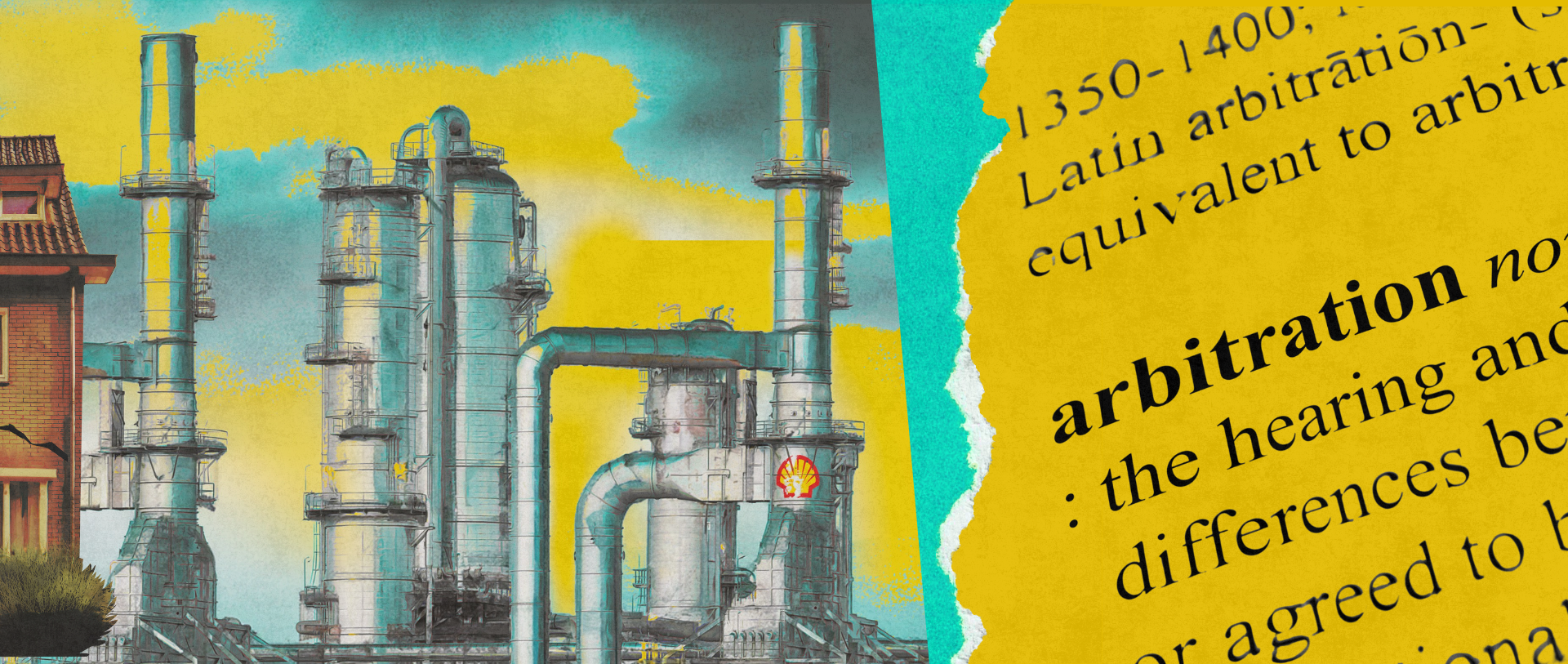
Shell is suing the Netherlands in yet another attempt to evade its responsibility for decades of gas extraction in Groningen. For years, gas production has triggered earthquakes, damaged over a hundred thousand homes, and left residents living in prolonged insecurity, still waiting for repairs, reinforcement, and justice.
SOMO, Both ENDS and the Handel Anders coalition strongly condemn Shell’s decision to launch an investor–state arbitration under the Energy Charter Treaty (ECT). Shell’s move comes on top of an already extensive web of ongoing international and domestic arbitration proceedings involving ExxonMobil and their joint venture, the Nederlandse Aardolie Maatschappij (NAM).
While the Dutch government keeps insisting that damage repair and home strengthening in the region will continue regardless of these disputes, the legal onslaught itself is draining public resources and undermining public trust in these key recovery operations. Shell’s decision to escalate the conflict internationally marks a new low in a long-running struggle over responsibility, justice, and accountability in Groningen.
Shell follows ExxonMobil into international arbitration
On 23 December 2025, Shell plc initiated arbitration proceedings against the Netherlands at the International Centre for Settlement of Investment Disputes (ICSID). The company claims that the Dutch state has breached the treaty and seeks “full compensation for damages” arising from the closure of the Groningen gas field and the allocation of associated costs, which run into the billions.
The arbitration follows earlier proceedings launched by ExxonMobil via its Belgian subsidiary EMPC and comes after consultations between Shell and the Dutch government failed to yield a settlement. The tribunal is not yet in place.
The case is particularly striking given that Shell, once headquartered in the Netherlands, moved to the United Kingdom in 2022. Now, it is using an investment treaty to sue the Netherlands over policies adopted to address the devastating consequences of gas extraction.
Ironically, the Netherlands and Shell themselves played a key role in shaping the modern investor-state dispute settlement (ISDS) system. Today, ISDS is quite literally coming home – in a deeply cynical way.
Bart-Jaap Verbeek, senior researcher at SOMO:
“This is exactly why ISDS needs to be abolished. Shell has made more than €32 billion in profits from six decades of gas extraction in Groningen, causing widespread damage and insecurity. The sheer audacity to now claim ‘full compensation for damages’ is a slap in the face of Groningers who are still waiting for repairs, safety, and justice.”
Although the Netherlands formally exited the Energy Charter Treaty on 28 June 2025, existing investments remain protected for another 20 years under the treaty’s sunset clause, allowing Shell and ExxonMobil to continue bringing claims. The Netherlands also has 69 bilateral investment treaties (BITs) with ISDS provisions remaining in place. Unfortunately, recent votes in the Dutch Parliament rejected proposals to terminate these treaties, leaving the legal framework that enables such claims fully intact, despite the growing financial risks for the public.
Fernando Hernández, senior policy officer at Both ENDS:
“As Colombia and the Netherlands prepare to co-host a conference on a just transition away from fossil fuels, Shell suing the Netherlands shows what is fundamentally at stake. You cannot deliver a just and orderly fossil fuel phase-out while companies are empowered to sue states for protecting people and the environment. ISDS locks countries in fossil fuel dependence by shielding corporate profits from democratic decisions. The Netherlands must start developing a sensible and legally sound strategy to exit these 69 legacy treaties.”
Djuna Farjon, coordinator of the Handel Anders coalition:
“Shell’s claim shows exactly why the Netherlands must urgently and decisively break with ISDS. As long as these treaties remain in force, multinational corporations can weaponise them to undermine democratic decisions, climate policy and social justice. Terminating Dutch investment treaties is not radical; it is necessary to ensure that public interests come before corporate profits.”
What is at stake: shifting the burden to taxpayers
Taken together, these legal actions reveal a clear pattern. Even where their requests are rejected, Shell, ExxonMobil and NAM are using litigation to delay payments, increase pressure on the state, and contest their financial responsibility for the damage caused by gas extraction.
The Dutch government itself has warned that suspending or blocking future levies would cause severe disruption to public finances, potentially forcing the state to borrow billions on capital markets, cut spending in other policy areas, or even breach EU budgetary rules. The state has already pre-financed billions in damage repair and building reinforcement and expects to continue doing so.
“These cases are not just about legal technicalities. They are about whether multinational fossil fuel companies can use arbitration to shift billions in costs onto taxpayers, while the people of Groningen continue to live with unsafe homes and ongoing damage,” says Bart-Jaap Verbeek.
NAM has already paid €5.31 billion under protest, but still owes €550 million for building reinforcement, and has refused to contribute further to regional development, while Shell and ExxonMobil still haven’t provided financial guarantees for NAM’s future liabilities. Meanwhile, earthquakes continue – even after production stopped – underscoring that the harm is ongoing.
In addition, NAM, Shell and ExxonMobil are also involved in multiple national arbitrations before the Netherlands Arbitration Institute (NAI), including over the costs of damage compensation and strengthening unsafe buildings, and the overall wind-down of the Groningen gas project. Key rulings in these proceedings have been delayed, with some decisions now expected only in 2026 or later.
Shell’s latest case will only add to an already dense web of litigation around the Groningen gas field, deepening legal uncertainty over key recovery operations, driving up public costs, and prolonging insecurity for residents who are still waiting for lasting safety and redress. The case is at an early stage and is likely to drag on for years.
For more information
Read more about this subject
-
Publication / 31 december 2020
-
 News / 26 november 2024
The Time to Rethink Investment Rules: Amplifying Civil Society Voices
At the core of the Fair, Green, and Global (FGG) Alliance’s mission is the commitment to building a just and sustainable world. As members of this alliance, Both ENDS, SOMO, and the Transnational Institute (TNI) recognise the urgent need to reimagine global investment frameworks. These frameworks, entrenched in outdated treaties such as Bilateral Investment Treaties (BITs) and the Energy Charter Treaty (ECT), often prioritise corporate profits over human rights, environmental sustainability, and social justice.
-
Letter / 9 december 2024
People and the Planet Entebbe Declaration: Reclaiming investment frameworks for people and the planet
The time for change is now. Civil society demands international investment
frameworks that are aligned with economic justice, social and environmental
sustainability, and the needs of communities worldwide. -
 News / 24 oktober 2022
Termination of Energy Charter Treaty by the Netherlands helps global energy transition
The decision of Minister for Climate and Energy Rob Jetten to withdraw from the Energy Charter Treaty (ECT) is good news for the energy transition in the Netherlands and beyond. Governments of countries that are party to this treaty can therefore shape the transition to sustainable energy without having to fear claims by Dutch-based businesses.
-
 News / 11 november 2024
Kenya Terminates Bilateral Investment Treaty with the Netherlands
The government of Kenya has officially terminated its bilateral investment treaty (BIT) with the Netherlands, marking a significant win for economic justice and environmental protection. Kenya’s decision reflects a growing global trend of rethinking outdated treaties that often prioritize corporate interests over public welfare. The Dutch Minister for Foreign Trade and Development recently confirmed that Kenya unilaterally ended the treaty in December 2023, rendering it inoperative from 11 June 2024. Kenya now joins South Africa, Tanzania, and Burkina Faso as the fourth African country to terminate its BIT with the Netherlands.
-
 News / 17 juli 2024
EU Exits Energy Charter Treaty (ECT): A Milestone for Climate Action
The European Union's decision to exit the Energy Charter Treaty (ECT) is a landmark victory for climate action. For years, the ECT's Investor-State Dispute Settlement (ISDS) mechanism has enabled fossil fuel companies to challenge climate policies, hindering progress towards sustainability.
-
 News / 6 oktober 2025
From Entebbe to Accra: civil society is rewriting the rules of investment
By Fernando Hernández Espino and Bart-Jaap Verbeek
Almost a year after African civil society gathered in Uganda to adopt the Entebbe Declaration, the call to transform international investment governance continues to gain strength. From the 6th to the 9th of October, over 50 civil society organisations from across West Africa, including from Ghana, Senegal, Nigeria, Côte d’Ivoire, Cameroon, Gambia, Sierra Leone, as well as from Kenya and Latin America, are convening in Accra to deepen and operationalise the Declaration’s vision.
-
 News / 25 november 2024
Empowering Civil Society: Shaping investment policies for climate and sustainable development in Africa
From 26-29 November 2024, Both ENDS and its partners will host the Civil Society Forum on Investment Policies, Climate and Sustainable Development Goals in Entebbe, Uganda. Our colleagues Iván and Fernando explain the importance of this event: “Through this event, we aim to provide an in-depth perspective on the impact of current investment policies on climate and environmental issues, with a strong focus on the African continent.”
-
 Dossier /
International trade and investment with respect for people and planet
The network of international trade and investment treaties is large and complex. The Netherlands alone has signed more than 70 bilateral investment treaties (BITs) and is party to the trade and investment agreements concluded by the EU, like the EU-Mercosur and EU-Indonesia trade deals.
-
Publication / 10 maart 2016
-
 Dossier /
Towards a socially and environmentally just energy transition
To address the climate crisis we need to urgently transition away from fossil fuels towards clean, renewable energy. However, this transition is not only about changing energy sources. It requires an inclusive and fair process that tackles systemic inequalities and demanding consumption patterns, prioritizes environmental and social justice, and which does not repeat mistakes from the past.
-
 Press release / 23 mei 2023
60th anniversary of Dutch bilateral investment treaties no cause for celebration
On 23 May, the Netherlands celebrates 60 years of bilateral investment treaties (BITs). The first BIT was signed with Tunisia in 1963. These treaties were intended to make an important contribution to protecting foreign investments by Dutch companies. A study by SOMO, Both ENDS and the Transnational Institute (TNI), however, shows that in practice they mainly give multinationals a powerful instrument that has far-reaching consequences people and the environment worldwide.
-
Publication / 14 april 2026
-
Publication / 23 mei 2023
-
Publication / 4 maart 2022
-
 News / 22 januari 2025
 -
 News / 19 december 2024
Trading Away the Future: How the EU-Mercosur deal fails people and the planet - and what needs to be done
On December 6, the visit of European Commission President Ursula von der Leyen to the Mercosur Summit sealed the agreement on the final text of the EU-Mercosur Association Agreement. Both ENDS condemns this damaging agreement for undermining human rights, the environment, and democracy in Europe, and in Mercosur countries. Should the agreement be ratified as it stands, it will have devastating consequences for the environment, indigenous communities, family farming and small-scale farmers on both sides of the Atlantic.
-
 Event / 22 februari 2022, 16:00 - 17:30
Webinar and launch of new publication about EU-Mercosur
What is the EU-Mercosur association treaty and why is it controversial? What could be the implications of the treaty for people and their livelihoods both in EU and Mercosur countries? For more information about these and other issues, see our new publication and join our interactive webinar next week!
Register here
-
Publication / 15 februari 2022
-
 Blog / 25 november 2025
COP30 shows why dismantling ISDS is essential for real climate action
Standing in Belém during COP30, I felt the weight of the moment. We came to the Amazon hoping for decisive progress on phasing out fossil fuels, yet the final outcome fell far short of the ambition science and justice demand. The agreement brought welcome commitments on adaptation finance and global indicators, but it refused to confront the structural forces that make climate action so difficult.




