




Fisher folk in Indonesia file a complaint against the Dutch Export Credit Agency Atradius DSB
At the end of November, the organisations WALHI South Sulawesi (part of Friends of the Earth) and Both ENDS filed a formal complaint with the Dutch export credit agency Atradius DSB. Despite the warnings from local communities for the negative consequences of a land reclamation project in the bay of Makassar, Atradius DSB advised the Dutch government to provide dredging company Boskalis with insurance for the execution of the project. The consequences for the fish stock, the beach and the lives of thousands of small-scale fishing communities are severe. Atradius DSB has not sufficiently investigated these harmful consequences beforehand.
"The fishing communities are not necessarily against land reclamation projects," says Muhammad Al Amin, director of WALHI South Sulawesi, who is visiting the Netherlands, "but they want to be involved in the design and implementation of such a project. It's quite possible to do this type of project without causing all sorts of harm to people and nature.
Involve fisher folk in the process
"Fisher folk's knowledge and expertise are very useful in the process of mapping out possible places where sand extraction would cause as little damage as possible. They know very well where their fishing areas are, which areas are vulnerable and how the surrounding ecosystem influences this. But, unfortunately, the fishers have not been involved in this process at all. Let alone their families. Everyone was confronted with a fait accompli when it was already too late and the damage had already occurred."
Families expelled
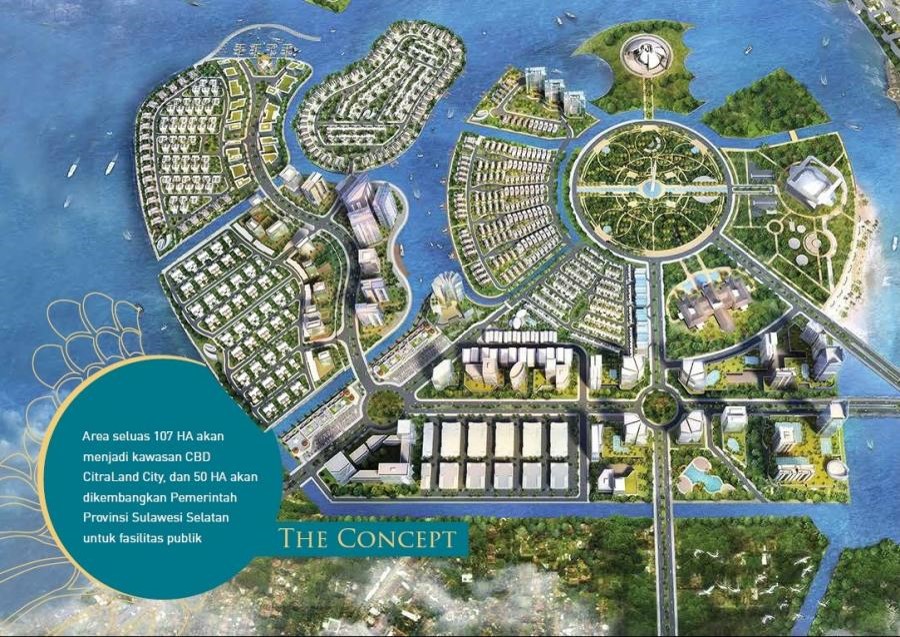
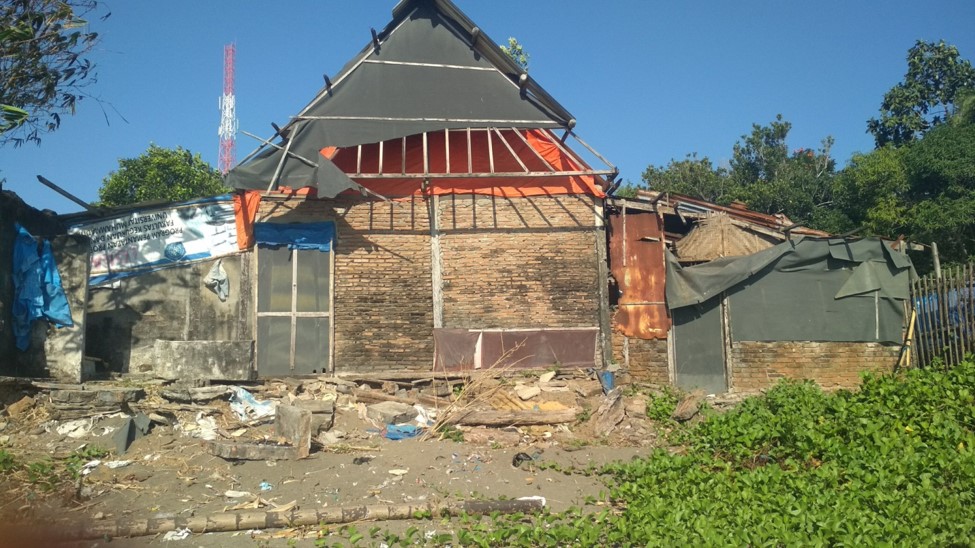
In this prestigious land reclamation plan, which originally stemmed from the Indonesian government, sand was extracted along the coast south of Makassar. That sand would be used to build five islands in the shape of a Garuda bird in the bay of Makassar. The project soon became highly controversial because neither the local government nor the Indonesian project developer took the rights of the people who already lived in the bay of Makassar very serious. In 2014, 43 families were expelled without any form of compensation from the land they had been living on for decades, but which had now been designated a "project area". Atradius DSB has always maintained that these families were expelled for "another project," but has never substantiated this argument.
Up to 80 percent less fish
The project only started in 2017, when the 2013 environmental impact assessment had expired. According to Indonesian law, a new assessment should have been done, but the project owner thought an annex to the old report suffice. When it became clear to the fishing communities along the coast that the sand extraction of Boskalis had enormous consequences, the protests intensified. Not without reason, as the fish stock dropped enormously. Some fisher folk saw their catch reduced by as much as 80%.
Coastal erosion
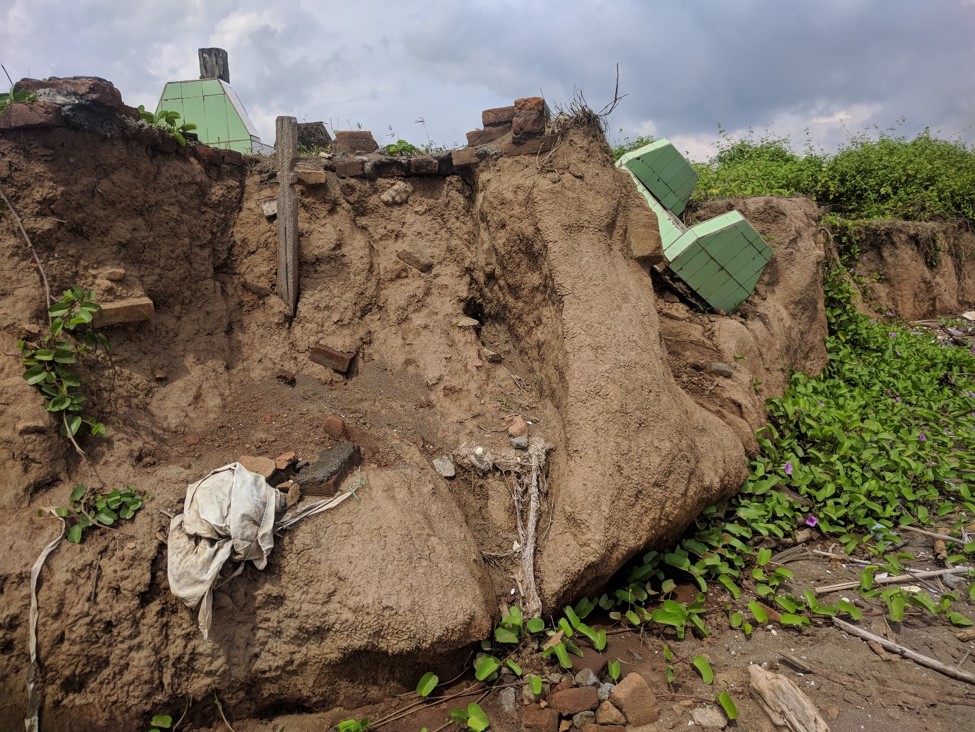
The sand extraction also caused enormous erosion; where previously the coast had eroded to about a meter inland, the erosion has now risen in some places to 15 to 20 meters. Two cemeteries along the coast were severely damaged, which caused the buried bodies to end up in the sea. Due to the loss of income, many families were forced to remove their children from school to have them sell things on the street.
Atradius DSB knew about the abuses
Boskalis started sand extraction on June 15th 2017, which led to protests from local fisher folk against the dredging ship. As a result, work stopped for three days, and only police intervention enabled Boskalis to continue. This should have been a clear signal to Atradius DSB and the Dutch government that local communities around Makassar had not been involved well in the project. Nevertheless, the Dutch government still granted the insurance on 27 June 2017.
Both ENDS link between fisher folk and Atradius DSB
Both ENDS has been supporting the fishing communities since 2016, together with WALHI South Sulawesi. On the one hand, together with them, we look at how the situation that has arisen can be improved, on the other hand, we point out to Atradius DSB its responsibility and the non-compliance with its own social and environmental policy.
Complaint
Despite their protests during many years, the affected fishing families have not been heard by project developers, executers and insurers. This is why they decided, together with WALHI and Both ENDS, to call upon Atradius DSB to improve its policies through a complaint. The complaint has two grounds: Atradius has not properly applied its own policy and Atradius is directly linked to the social and environmental effects of the project, which it could have at least partly prevented.
Demands
The fishing communities, above all, ask for recognition for the fact that they should have played an important role in the project, and for the suffering the project has caused. They also call on Atradius DSB to explore all possibilities to ensure compensation for the affected communities. They call on Atradius DSB to discuss this with them in Makassar. The communities hope that in the future, Atradius DSB will better ensure that, before insurance is given, local communities are involved in the project.


Read more about this subject
-
 External link / 29 mei 2019
Export credit agencies’ role in development finance (Annual Report 2018)
Export credit agencies (ECAs) play a central role within the complicated web of global development finance. In 2018, Both ENDS invested in strengthening cooperation among organisations working on ECAs, building a strategic global collaboration to stop ECAs' support of fossil fuels and improve their environment and human rights record.
-
 Dossier /
Export Credit Agencies: Who pays the price?
Both ENDS calls on the government only to provide export credit insurance to sustainable projects that cause no social and/or environmental damage in the countries where they take place.
-
Publication / 11 november 2020
-
 News / 4 mei 2021
Is the Netherlands’ export credit insurance support for fossil projects legal?
Today, two independent experts brought out a legal opinion on the obligations of countries and their export credit agencies under international law in relation to export support for fossil fuels. According to the report, emissions by fossil fuels and the related infrastructure need to be reduced urgently.
-
Letter / 4 mei 2023
Letter from NGOs to Dutch export credit agency: CSR policy must be strengthened
The Dutch government, through its export credit agency Atradius DSB (ADSB), provides export support to companies that undertake activities abroad. The state wants projects it insures to have no negative consequences for people and the environment and therefore sets requirements for corporate social responsibility (CSR). A consultation on CSR policy ran until the end of April, to which a coalition of thirteen social organisations from the Netherlands and abroad, including Both ENDS and Milieudefensie (Friends of the Earth the Netherlands), responded.
-
 Press release / 19 mei 2021
Despite violence, 900 million euros in Dutch export support to Van Oord in Mozambique
Amsterdam, 19 May 2021 – On 25 March, a day after violent attacks in northern Mozambique, the Dutch state decided to provide dredging company Van Oord with export credit insurance worth 900 million euros for its activities in the country. The company is conducting dredging operations for a highly controversial gas project that, according to Mozambican interest groups, is playing a prominent role in the escalating violence in the region. Civil society organisations Both ENDS, Milieudefensie and Oil Change International and their Mozambican partners are alarmed about the situation and have called the Dutch government and Dutch export credit agency Atradius DSB to account.
-
Letter / 15 december 2022
No export credit support for Santos FPSO
In October this year, the Dutch government published a policy to implement the COP26 statement in which it promised to stop public finance for fossil fuel projects abroad by the end of 2022 . In spite of this pledge, the Netherlands is considering granting an export credit insurance to a floating production storage and offloading (FPSO) vessel that will be used to produce oil and fossil gas in Brazil for a period of 30 years.
-
Publication / 17 november 2019
-
 Press release / 3 november 2022
The Netherlands breaks major climate promise to end public financing for international fossil fuel projects
Today, a week before the international climate summit in Egypt, the Dutch Government has broken a major climate promise it made last year to end public financing for international fossil fuel projects. International and Dutch NGOs argue that the new policy published by the Dutch Government on restricting finance for fossil fuels has such significant loopholes, that it essentially means The Netherlands has reneged on its promise.
-
 Press release / 25 mei 2022
Award of export support for controversial project in Manilla undermines the Netherlands’ environmental and CSR ambitions
Dutch export credit agency Atradius DSB announced yesterday that it is to provide export credit insurance worth 1,5 billion euros to Dutch dredging company Boskalis for a controversial land reclamation project in the Philippines. According to Dutch and international organisations, including Both ENDS, CARE Netherlands, IUCN NL, Kalikasan PNE and Oceana Philippines, the award of export credit insurance for this project runs contrary to the Netherlands' ambitions in the areas of environment and corporate social responsibility (CSR).
-
 News / 15 oktober 2021
German research confirms: Dutch Export Credit Agency is not Paris Proof
The Dutch export credit agency Atradius DSB is not aligned with the Paris Climate Agreement; on behalf of the Dutch State, it continues to strongly support investments in fossil fuels. This is the conclusion of a report by German research agency Perspectives Climate Research (PCR), in which the export credit agencies of the Netherlands and Japan are measured in terms of their climate ambitions and alignment with the Paris Agreement.
-
 Press release / 11 oktober 2021
Governments worsen climate crisis with USD billions in export finance
New website shines a light on the extent of export credit agencies' support for fossil fuels
Each year governments provide tens of billions of dollars in financial support to fossil fuel projects via export credit agencies (ECAs). Today, 18 civil society groups from 14 countries are launching a new website to shine a spotlight on how ECAs are undermining global climate goals. In advance of the November UN climate conference, the organisations are calling on governments around the world to end public financial support for coal, oil and gas projects, including support from ECAs. Ending this support and redirecting financial resources to sustainable alternatives is essential for a just energy transition.
-
 Event / 4 november 2021, 16:45 - 18:00
UNFCCC COP 26 side event ‘Aligning export finance with the Paris Agreement: high time to phase out fossil fuels’
Many countries heavily support fossil fuel investments abroad through their export credit agency (ECA). This contributes to carbon lock- in, whereby companies or even countries commit themselves to a certain amount of greenhouse gas emissions for the lifetime of the infrastructure — oftentimes years or even decades. This seriously delays the transition to renewable energy sources, and is certainly not in line with Art. 2.1c of the Paris Agreement.
Highlighting the impacts caused by export finance in the global South, this side event will provide concrete recommendations to decarbonize export credit agencies.
-
 Press release / 29 augustus 2022
Billions of euros a year in support for fossil exports underscores importance of Glasgow Declaration
Amsterdam, 29 August 2022 - A recent study by Both ENDS shows that, in the past decade, the Dutch government has provided on average a billion euros a year in insurance for fossil energy projects. At the end of last year, together with 33 other countries, the Netherlands agreed to stop providing this support by the end of 2022. Both ENDS calls on the government to formulate a resolute policy that leaves no room for exemptions that contribute to global warming by more than 1.5 degrees.
-
 News / 22 november 2021
E3F, 'Export finance for Future' is a great opportunity for the Netherlands
Export support – and especially that to fossil projects – has been in the spotlights quite often recently. This is a positive development, because the Netherlands alone provides fossil export support worth 1.5 billion euros per year. At the climate summit in Glasgow, the United Kingdom launched a statement promising to stop providing export support to fossil projects by the end of 2022. After having denied at first, the Netherlands decided to join the statement after all – which now has already been signed by nearly forty countries and financial institutions.
-
 News / 14 juli 2021
Call on government: present scenario for export support in line with climate goals
The government provides an average of 1.5 billion euros a year in export support for fossil projects by Dutch companies, in the form of insurance and guarantees. The climate crisis requires that the Netherlands and other countries stop providing export support for fossil energy projects, whether it be coal, oil or gas, before the end of this year.
-
 News / 15 april 2021
New initiative to phase out export support for fossil fuels lacks ambition
On Wednesday, April 14, seven countries, including the Netherlands, launched an initiative called Export Finance for Future (E3F), in which they set a number of ambitions with regard to phasing out export support for the fossil sector. Many NGOs worldwide, including Both ENDS in the Netherlands, have been calling for such an initiative in recent years and we are therefore pleased with this step. However, to achieve results and contribute to the Paris climate goals, countries will have to commit to much more ambitious goals than those now set. Concerned civil society organizations, including Both ENDS, therefore prepared a statement detailing the weaknesses they felt in the policy proposed by E3F, supplemented with recommendations for improvements.
-
 News / 30 november 2016
Dutch Export Credit Agency did not prevent damaging practices in Suape
Atradius Dutch State Business (Atradius DSB) remains responsible for observing social, environmental and human rights, also after providing export credit insurance. That is the conclusion of the Dutch National Contact Point (NCP) for the OECD Guidelines in its final statement, which was published today. Both ENDS issued a press release about this.
-
 News / 21 juli 2020
Is the Netherlands insuring a controversial gas extraction project in Mozambique?
At the end of last week, oil and gas company Total announced that, through its export credit insurer Atradius DSB, the Dutch government is participating in a funding package for a controversial gas extraction project in Mozambique. The project, in which various Dutch and foreign companies are involved, is having a deep impact on the local population and the natural environment in the area. Which Dutch companies the government will be insuring is not yet clear.
-
 News / 20 februari 2023
Almost 60 organisations send a letter about fossil export support to Dutch Parliament
Today, a letter, undersigned by almost 60 organisations from countries that face the consequences of fossil fuel projects or stand in solidarity, has been sent to the Dutch Members of Parliament. This Thursday, a debate about the export credit facility and the policies around it, will take place in the Dutch Parliament. The coalition calls upon Dutch politicians and policy makers to stand up against any form of export support for fossil fuel projects that are to be executed by Dutch companies abroad, expecially in the global South.


