




Rights for people, rules for corporations: the case of Paraguay
Indigenous communities in Paraguay saw their attempts to regain their ancestral lands thwarted by German investors. This is the level of impact that investment treaties can have on social, environmental and economic development and rights. Why? Because of the ‘Investor-to-State Dispute Settlement’ (ISDS) clauses that are included in many such treaties.
Bilateral Investment Treaties (BITs ) often guarantee rights to land to foreign companies and individuals. This creates a major problem, especially when ISDS is included in the treaty. Even if the treaty is never actually invoked for arbitration, the mere existence of ISDS often serves as a threat to the authorities who intend to enact land distribution reforms. The reason is that ISDS enables foreigners to claim economic compensation for what they consider expropriation, based on the clauses on 'compensation' and 'legitimate expectations' of investment agreements. Compensation should be aligned with current full market prices and often involves expectations over future profits. This is the more ironic given that investors may well have acquired rights over the land far below the full market price in first place.
In 1994, the state of Paraguay recognised in its constitution that indigenous peoples had inhabited the country's territory prior to the arrival of colonisers in the 16th century and the subsequent formation of the nation state. This milestone recognition opened the possibility for the 19 different indigenous groups in Paraguay to make a legal claim for the restitution of land that over the past centuries had been taken away from them. The hope among the indigenous people was that this marked a new beginning. Indigenous leaders had made it very clear that the lack of indigenous land rights was "the foundation of the indigenous peoples' misery". However, ISDS soon smothered their hope. The mechanism was the reason why the government refused to fulfil its constitutional duty to return ancestral land to its traditional owners.
The Palmital case
In 1992, Paraguay adopted a new agrarian law, which stipulated that land that does not serve a social function must be sold by the owners or either it will be expropriated. 120 landless families living in the Palmital settlement, an idle estate of 1000 hectares owned by German citizens, used this new law to request a transfer of the land titles to them. The Paraguayan Senate, however, refused to grant its consent, arguing that expropriation of the land from its German owners would violate the country's 1993 BIT with Germany. Consequently, the police violently expelled the families from their settlement several times, but each time they returned to the estate. There are rumours that the German Embassy in Paraguay had referred to the BIT in the Palmital context, suggesting that expropriation of the land would be interpreted as a violation of the treaty. In the end the landless peasants, the German owners and the state of Paraguay reached an out of court settlement that allowed the families to stay on the land.
The Sawhoyamaxa case
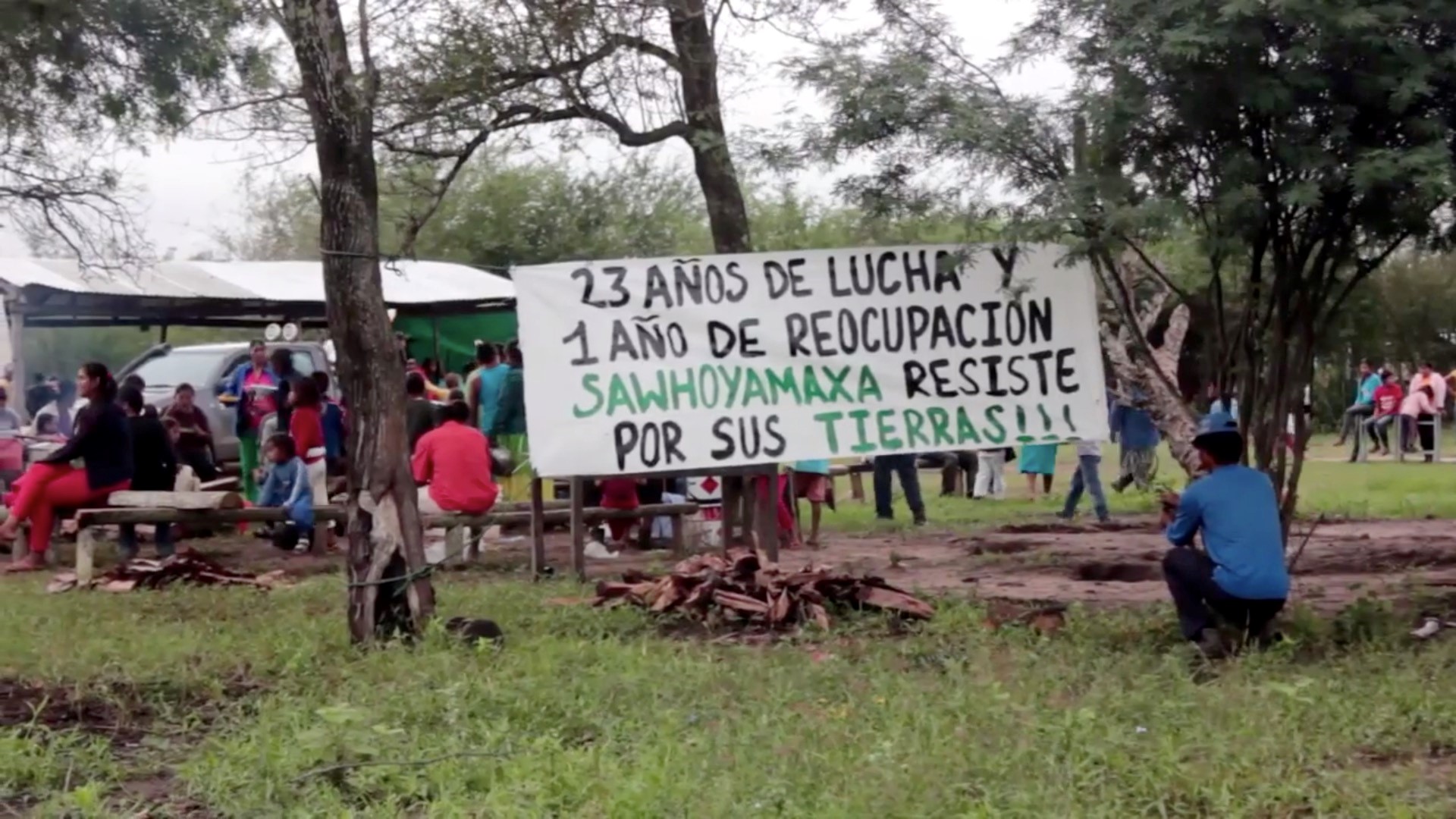
In the early 1990s, leaders of the Sawhoyamaxa indigenous community started requesting the authorities in Paraguay for the restitution of their ancestral land, which had been taken away from them by foreigners in the late 19th century. The Sawhoyamaxa had used these lands to hunt and fish, to produce traditional medicines and to perform cultural rituals. Without land, the communities became marginalised. Many of them were forced to enter paid employment with the new farm owners, who subjected them to degrading work conditions. The community ended up living on the roadside.
Because the Paraguayan state failed to protect their rights, the Sawhoyamaxa brought their case to the Inter-American Court of Human Rights (ICHR), supported by the NGO Tierra Viva. The state of Paraguay had argued that since the owner of the disputed land was a German citizen, expropriation of the land would imply a breach of the BIT between Paraguay and Germany. On 29 March 2006, however, the ICHR dismissed this argument. It ruled that the Paraguayan state was effectively violating the Sawhoyamaxa's rights to life, property and judicial protection. It ordered the state to return the ancestral lands to the community within three years.
Paraguay failed to follow through on this obligation and years of legal tug-of-war and massive mobilisations ensued. Complaints were filed even at the Constitutional Chamber of the Supreme Court of Justice. In October 2014, the Supreme Court unanimously rejected the estate owners' claims that the decision to expropriate 14,404 hectares and give them back to Sawhoyamaxa was 'unconstitutional'. On hearing this ruling, the community leaders said: "We feel as if we were just released from prison". Yet there was concern that the Germans might use the German BIT with Paraguay to challenge this final decision of the national courts of Paraguay. Fortunately, this did not happen. In 2015, the Sawhoyamaxa communities finally received the titles to the land that for centuries had been their home.
This case was highlighted as part of the
'Rights for People, Rules for Corporations – Stop ISDS' campaign week of 14-18 October 2019
Background on the 'Rights for People, Rules for Corporations - Stop ISDS' campaign
More information:
Also see the case of Indonesia
For more information
Read more about this subject
-
 Dossier /
Investment treaties
Investment treaties must be inclusive, sustainable and fair. That means that they must not put the interests of companies before those of people and their living environment.
-
Publication / 3 July 2026
-
 Dossier /
Trade agreements
International trade agreements often have far-reaching consequences not only for the economy of a country, but also for people and the environment. It is primarily the most vulnerable groups who suffer most from these agreements.
-
 News / 14 April 2026
New report: Phasing out ISDS in the Netherlands: a roadmap
Today, Both ENDS and SOMO are publishing the report Phasing out ISDS in the Netherlands: a roadmap. In the report, we highlight the Netherlands’ role in the ISDS system and offer practical guidance on phasing out ISDS.
-
 Dossier /
Rights for People, Rules for Corporations – Stop ISDS!
Indigenous communities in Paraguay saw their attempts to regain their ancestral lands thwarted by German investors. In Indonesia, US-based mining companies succeeded to roll back new laws that were meant to boost the country’s economic development and protect its forests. This is the level of impact that investment treaties can have on social, environmental and economic development and rights. Why? Because of the ‘Investor-to-State Dispute Settlement’ clauses that are included in many such treaties.
-
Publication / 14 April 2026
-
 News / 26 March 2026
New project: Climate Accountability in EU Trade
Through its new project “Climate Accountability in EU Trade: Testing the SEP and DAGs for Climate-Linked FTA Enforcement” Both ENDS, with support from the European Climate Foundation, is exploring how the European complaints mechanism (SEP) and Domestic Advisory Groups (DAGs) can be more effectively used to advance climate accountability. The project runs for 13 months, until end of 2026.
-
 Dossier /
Seeking justice for the affected communities of Vale’s mining disasters in Mariana and Brumadinho
In 2015 and 2019, the Brazilian state of Minas Gerais experienced two severe mining tragedies in Mariana and Brumadinho, due to the same mining company: Vale. Since then, the affected communities have been seeking justice, via the criminal punishment of the responsible parties, and a fair compensation for the loss of their loved ones, their homes and their livelihoods. Both ENDS supports local CSOs by amplifying their quest for justice within an international audience and, more specifically, by raising awareness amongst Dutch investors in Vale about the high risks this company’s activities pose for people and the environment.
-
 News / 22 January 2026
Shell files new arbitration against the Netherlands over Groningen gas field closure
Shell is suing the Netherlands in yet another attempt to evade its responsibility for decades of gas extraction in Groningen. For years, gas production has triggered earthquakes, damaged over a hundred thousand homes, and left residents living in prolonged insecurity, still waiting for repairs, reinforcement, and justice.
-
 Blog / 11 December 2025
Reflections on working on Dutch finance for Mozambique LNG
Last Tuesday, I received a short text message with big news: the minister had just announced that the financing policy for the Mozambique LNG project was stopped. It was a decision that I – along with so many others – have fought for for years. Only now, more than a week later, it is slowly sinking in that we have really won. The years of perseverance, frustration, discussions and investigations have finally led to this result. It still feels a bit surreal.
-
 Blog / 25 November 2025
COP30 shows why dismantling ISDS is essential for real climate action
Standing in Belém during COP30, I felt the weight of the moment. We came to the Amazon hoping for decisive progress on phasing out fossil fuels, yet the final outcome fell far short of the ambition science and justice demand. The agreement brought welcome commitments on adaptation finance and global indicators, but it refused to confront the structural forces that make climate action so difficult.
-
 Dossier /
Wetlands without Borders
With our Wetlands without Borders program, we work towards environmentally sustainable and socially responsible governance of the wetlands system of the La Plata Basin in South America.
-
 News / 5 November 2025
Another ISDS claim hits the Netherlands: Petrogas sues over solidarity contribution and royalty regulations
SOMO and Both ENDS strongly condemn the newly revealed investor-state dispute settlement (ISDS) case filed by Petrogas, an Omani oil and gas company operating two shallow-water gas fields in the Dutch North Sea, against the Netherlands under the Netherlands-Oman bilateral investment treaty (BIT).
-
 News / 5 November 2025
Interview: Both ENDS at COP30 for Climate Justice and Systemic Change
Both ENDS is present at COP30 to advocate for genuine access to climate finance for locally led, gender-just climate solutions and the mechanisms that facilitate this, including those for farmer-led restoration. Furthermore, the organisation participates to ensure the crucial connection between the climate negotiations and the trade and investment frameworks that shape them.
Learn more about the Both ENDS team at COP30 below, and find all the activities and side-events in which Both ENDS will participate.
-
 News / 5 November 2025
Overview of Both ENDS events at COP30 in Belem, Brazil
Both ENDS is present at COP30 to advocate for genuine access to climate finance for locally led, gender-just climate solutions, and for the mechanisms that make these possible, including those supporting farmer-led restoration. The organisation also engages to highlight the crucial connection between climate negotiations and the trade and investment frameworks that shape them.
Below is an overview of the Both ENDS team at COP30 and a detailed look at the activities and side-events in which Both ENDS will participate.
-
Publication / 16 October 2025
-
Publication / 16 October 2025
-
 Dossier /
International trade and investment with respect for people and planet
The network of international trade and investment treaties is large and complex. The Netherlands alone has signed more than 70 bilateral investment treaties (BITs) and is party to the trade and investment agreements concluded by the EU, like the EU-Mercosur and EU-Indonesia trade deals.
-
 News / 6 October 2025
From Entebbe to Accra: civil society is rewriting the rules of investment
By Fernando Hernández Espino and Bart-Jaap Verbeek
Almost a year after African civil society gathered in Uganda to adopt the Entebbe Declaration, the call to transform international investment governance continues to gain strength. From the 6th to the 9th of October, over 50 civil society organisations from across West Africa, including from Ghana, Senegal, Nigeria, Côte d’Ivoire, Cameroon, Gambia, Sierra Leone, as well as from Kenya and Latin America, are convening in Accra to deepen and operationalise the Declaration’s vision.
-
 News / 23 September 2025
With the undemocratic splitting of the EU-Mercosur deal, Europe is missing the chance to lead on fair trade
Recently, many newspapers have written about Brussels’ rush to finalize the trade agreement between the EU and the South American Mercosur countries. According to the European Commission, national parliaments do not need to approve it because the trade part and the “political” part have been separated. This “splitting” means that the trade part can be approved as an EU-only decision by the European Council and the European Parliament, while national parliaments are sidelined and the political-cooperation part is postponed. Both ENDS and its partners are deeply concerned and are calling on the Dutch government to vote against this outdated agreement.




