


Dredging destruction; worldwide research into Dutch dredgers
Dredging Destruction: Report reveals how Dutch dredging companies are systematically destroying human lives and the environment around the world with the help of taxpayers’ money
The Netherlands is providing billions of euros in support for dredging projects by Boskalis and Van Oord around the world. All of these projects are destroying human lives and the environment. The Dutch government’s policy to protect people and planet is failing systemically. And after twelve years of studies and talking, there are no real improvements. It is time for a thorough clean-up of government support for the dredging sector.
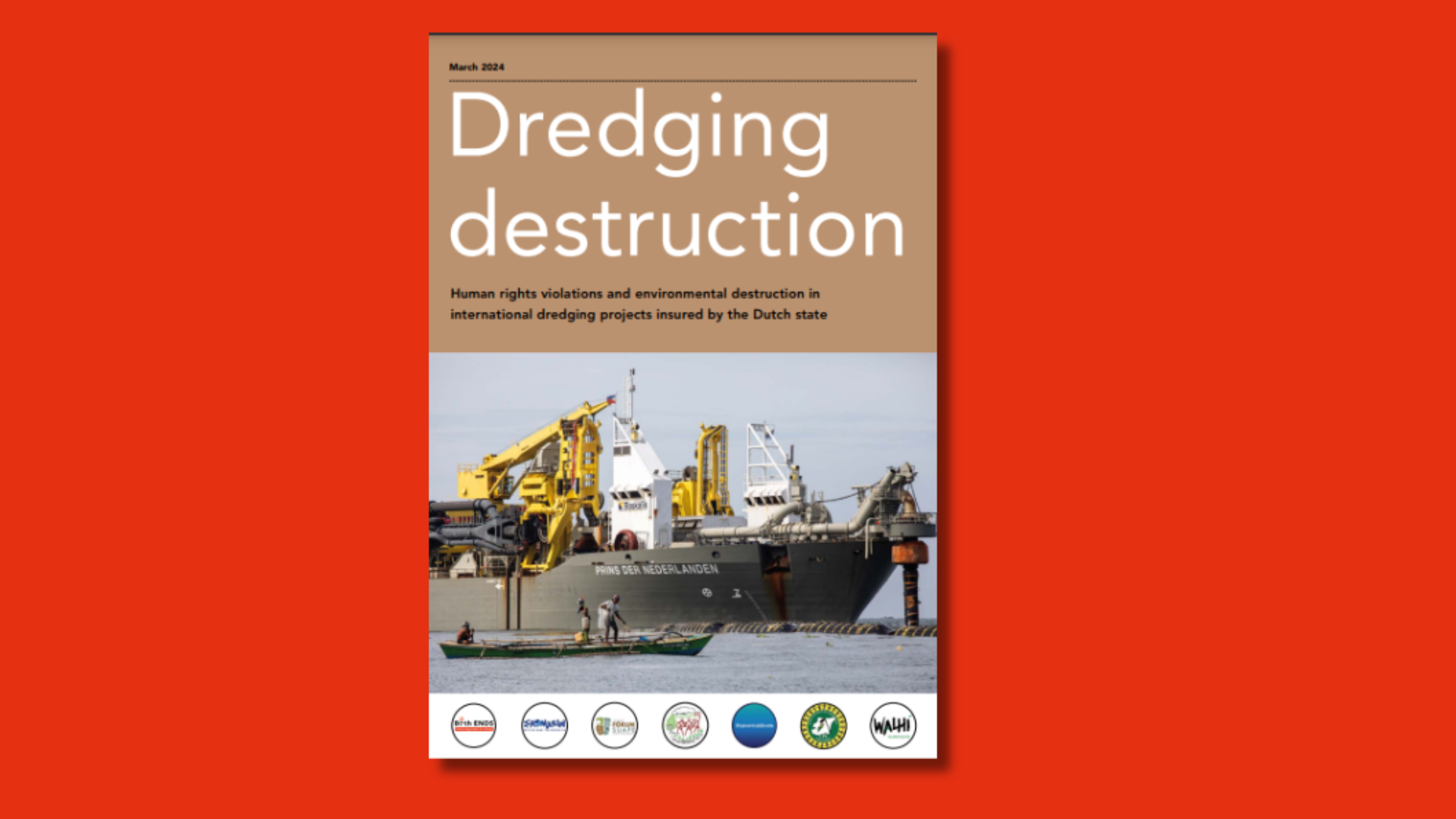
These are the hard conclusions of the report, ‘Dredging Destruction’, which was published today. The report presents the findings of a joint international study by civil society organizations from the Netherlands and countries where the dredging companies are active. The organizations describe the negative consequences for people and the environment of twelve years of export support for dredging projects in seven locations around the world. Their message to the Dutch government is: “Stop support for three ongoing projects immediately.”
Partners respond
“In the north of Mozambique, fishing communities are being forced to relocate far from the sea. At the same time, there are terrorist attacks, and the area is completely unsafe. That makes fishers and farmers victims twice over”, says Julio Ernesto of farmers’ union UPC, Mozambique.
“The coral reef system in the Maldives is our natural line of defence and source of life. But Boskalis is dredging it to death”, says Humay Abdulghafoor of the Save Maldives Campaign.
“Dredging companies are making profits by destroying the natural environment. Ecosystems off the coast of Jakarta are being damaged and the rights of small-scale traditional fishers are being violated,” says Martin Hadiwinata of EKOMARIN, Indonesia.
“Dredging has a direct impact on food security of fishing communities”, adds Simone Lourenço of Forum Suape, Brazil.
Systemic issue
The Dutch government supports companies with projects abroad by providing export credit insurance via Atradius DSB. In the past twelve years, 32% of this financial support - €8.4 billion – has gone to dredging companies, Boskalis and Van Oord, who together account for almost half of the worldwide dredging sector. Dredging projects have a great impact on land and water, and therefore on the people who live, grow food, or fish there. Atradius DSB and the government are obliged to check whether the dredging activities are harmful for people, wildlife, and the environment.
But that is going wrong, and it is a systemic issue. Due to terrorist attacks, for example, Atradius DSB staff had to conduct field research in Mozambique from a helicopter and wearing bulletproof vests. “That must set off a very loud alarm bell that everything is not okay,” says Niels Hazekamp of Both ENDS. Yet, Atradius DSB and the government found that the project could go ahead. An independent enquiry later concluded that Atradius DSB had not assessed the security situation in Mozambique correctly. “They did not listen sufficiently to warnings from local organizations and their own embassy.”
Thorough clean-up of policy
“We have no objection to foreign companies doing business here and making profits, but they must do it honestly and fairly,” says Muhammad al Amin of environmental organization, WALHI, in Indonesia. “We want to see a fundamental change in policy and practice. The government and companies must, for example, ensure that local people are genuinely heard and participate in decision-making.”
Jon Bonifacio of Kalikasan PNE from the Philippines adds: “This report is a clear indication of the scale of the ecological and social disruption caused by the lack of regulation of the Dutch dredging sector all around the world. We call on policymakers in the Netherlands, the Philippines and other countries to take our demands seriously and hold companies and institutions that are guilty of malpractice liable for the environmental and human rights violations of dredging projects.”
Completely against international standards
The Netherlands has signed important frameworks that promote corporate social responsibility, biodiversity and sustainable development. The export support for dredging projects goes completely against these international standards. The government should ensure that its export policy is completely in line with its pledges to protect human rights and the environment.
Stop supporting ongoing projects immediately
The civil society organizations also call for a complete withdrawal of government support for three projects currently underway in Mozambique, the Philippines, and the Maldives.
For more information
Read more about this subject
-
 News / 29 maart 2024
Both ENDS visit Tweede Kamer to talk about destructiveness of dredging worldwide
This week several Both ENDS colleagues visit Tweede Kamer der Staten-Generaal to meet Christine Teunissen and Luc Stultiens with partners from Mozambique, Indonesia and the Filippines to talk about the destructiveness of dredging worldwide and especially in projects with the aid of the Dutch government.
Read their plea
-
Publication / 25 maart 2024
-
 Environmentally Just Practice /
A Negotiated Approach for Inclusive Water Governance
A Negotiated Approach envisages the meaningful and long-term participation of communities in all aspects of managing the water and other natural resources on which their lives depend. It seeks to achieve healthy ecosystems and equitable sharing of benefits among all stakeholders within a river basin. This inclusive way of working is an essential precondition for the Transformative Practices that are promoted by Both ENDS and partners.
-
 News / 10 juli 2025
Both ENDS and Global Witness condemn harassment of anti-reclamation activists in Manila Bay
Global Witness and Both ENDS strongly condemn the reported of harassment and surveillance by the Armed Forces of the Philippines of environmental activists and fishing communities in Navotas, Philippines. Pamalakaya-Pilipinas, a National Federation of Small Fisherfolk Organisation in the Philippines, has received credible reports that the Armed Forces of the Philippines (AFP) are engaged in “red-tagging” their members.
-
 News / 23 juni 2025
Who benefits from better protection of our oceans?
The ocean emerged strengthened from the UN Ocean Conference in Nice. More countries are supporting a ban on deep-sea mining, more marine protected areas are being established, and more pledges are being made to fight pollution. The question now is whether countries will follow through on their commitments. Because the ocean movement faces a camp of powerful interests.
This article was originally posted in Dutch on MO*Magazine.
-
 Blog / 28 januari 2025
Sinking promises in Manila
Yesterday, Global Witness published a new report, "Sunk Costs" - in which I had a modest role to play - that comes up with new facts about the disastrous New Manila International Airport project in the Philippines, for which the Dutch dredging multinational Boskalis received Dutch export credit insurance (ekv) of €1.5 billion.
-
 News / 16 augustus 2024
Statement on the denial of legal protection by the Philippines Court of Appeals towards environmental defenders Jonila Castro and Jhed Tamano
Both ENDS expresses its profound concern over the recent decision by the Philippines Court of Appeals to deny legal protection to Jonila Castro and Jhed Tamano against unlawful harassment and reprisals from state forces. Castro and Jhed are two young environmental human rights defenders who were violently abducted by Filipino armed forces in September 2023, for almost 17 days, in a case that made international headlines. The two women had been working as community organizers in Northern Manila Bay, where large-scale land reclamation's have wreaked havoc on communities and ecosystems.
-
Publication / 12 mei 2026
-
 Press release / 12 mei 2026
UN report warns of a growing sand crisis - The Dutch dredging sector plays a key role in global sand extraction
GENEVA/UTRECHT, 12 May 2026 – A new report by the United Nations Environment Programme (UNEP), Sand and Sustainability: An Essential Resource for Nature and Development, warns that global demand for sand is exceeding ecological limits. Large-scale extraction of sand from marine and coastal ecosystems is leading to biodiversity loss, damage to coastal communities and increasing risks in an era of climate change. Dutch dredging companies play a prominent role in this as global market leaders in large-scale sand extraction and land reclamation. “Our analyses show that the dredging sector operates globally within a system in which ecological damage and the consequences for coastal communities are systematically underestimated, whilst transparency and effective oversight are often lacking,” says the Dutch environmental and human rights organisation Both ENDS, which contributed to the report.
-
 News / 6 juni 2025
Both ENDS at the UN Ocean Conference: voicing our environmental justice concerns about the “Blue Economy”
Next week, the United Nations Ocean Conference will take place in Nice, France. This conference is focused on the conservation and sustainable use of coasts, seas and marine resources. Both ENDS colleague Murtah Shannon will be attending. We’ve asked him to explain a bit more about his plans.
-
 News / 22 januari 2024
Is the Netherlands’ reputation as a world leader in the field of water knowledge deserved?
The Netherlands is a major player in the global water sector, but our investments can quite often lead to human rights violations and environmental problems in the countries where they are made. What can a new Dutch government do to reduce the Netherlands’ footprint beyond our borders? Ellen Mangnus spoke to various experts about this issue: today, part 3.
-
 Event / 23 maart 2023, 09:00 - 11:00
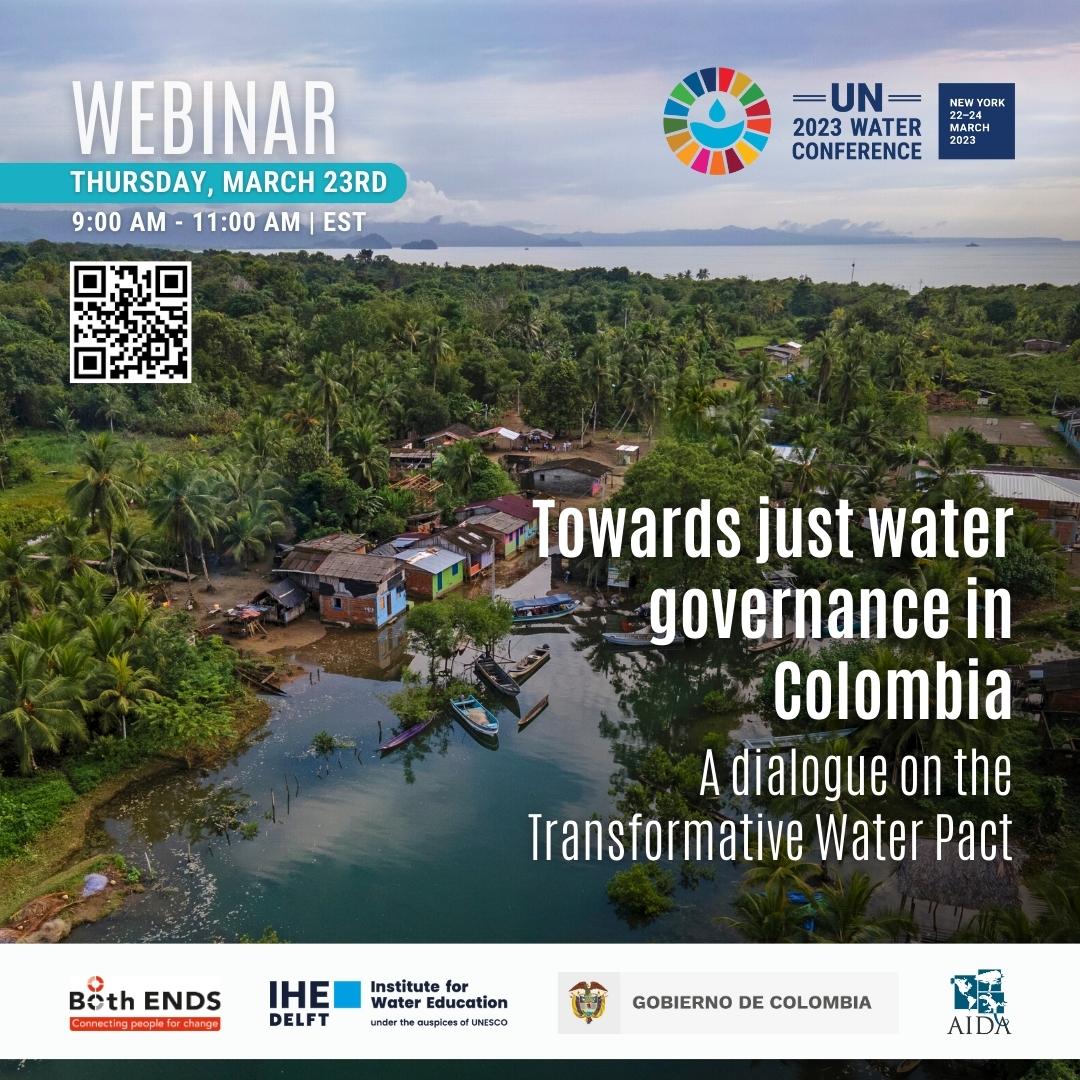
Towards just water governance in Colombia; a dialogue on the Transformative Water Pact
Online side event at the UN Water conference in New York
This event will present The Transformative Water Pact (TWP), an innovative framework for water governance that has been developed by environmental justice experts from around the world. The TWP will serve as a starting point for dialogue between representatives of the government of Colombia, academia, regional and international NGOs in relation to Colombia's current ambitions in multi-scalar water governance.
-
Publication / 21 maart 2023
-
 News / 21 maart 2023
Agua es vida: Both ENDS and water governance
Water is literally life, the lifeblood of ecosystems, of nature, of humans. However, in many places the distribution and use of water is unjust and unsustainable. Water management is generally focused on short-term economic interests, on maximizing the profit of a well-connected few at the expense of people and nature. This dominant view of water and water management has its origins in the European industrial revolution, which became the global norm through colonialism and globalization. But according to Melvin van der Veen and Murtah Shannon, water experts at Both ENDS, this view will have to give way to equitable, sustainable and inclusive water management. Both ENDS cooperates with and supports communities and organisations worldwide who are working to this end.
-
 Press release / 20 maart 2023
A Transformative Water Pact : A radical response to the global water governance crisis
Academics and civil society representatives from around the world came together to articulate an alternative vision and framework for water governance, in the run-up to the UN Water Conference 2023 in New York. The Transformative Water Pact was developed in response to the continued exploitation of nature, neglect of human rights and the extreme power-imbalances that characterize contemporary water governance throughout the world. It details an alternative vision of water governance based on the tenets of environmental justice, equality and care.
-
 News / 22 maart 2022
World Water Day: just climate solutions already exist
These past weeks we have been joining the #WeWomenAreWater campaign to put the spotlights on just climate solutions of and for women, girls, trans, intersex and non-binary people around the world. The campaign started on International Women's Day (March 8th) and ends today, on World Water Day. Just climate solutions already exist but these initiatives are grossly underfunded, and the people implementing them are also those most impacted by climate change and climate-related water scarcity. Therefore, we would like to highlight, especially today on World Water Day, some of these solutions below. And we also have a special message from the colleagues at Both ENDS working on inclusive water governance.
-
 Dossier /
Gas in Mozambique
In 2011 one of the world’s largest gas reserves was found in the coastal province of Cabo Delgado, in the north of Mozambique. A total of 35 billion dollars has been invested to extract the gas. Dozens of multinationals and financiers are involved in these rapid developments. It is very difficult for the people living in Cabo Delgado to exert influence on the plans and activities, while they experience the negative consequences. With the arrival of these companies, they are losing their land.
-
 News / 12 juli 2021
WOB applications relating to export support for gas project in Mozambique
At the beginning of this year, the Dutch government provided Dutch companies with export insurance worth 903 million euros to enable them to participate in a gigantic natural gas project in the north of Mozambique. Together with partners from Mozambique and the Netherlands, Both ENDS has been conducting a dialogue with export credit agency Atradius DSB and the responsible Ministries of Finance and Foreign Affairs on the possible financial, environmental and social risks of the gas project.
-
 Press release / 19 mei 2021
Despite violence, 900 million euros in Dutch export support to Van Oord in Mozambique
Amsterdam, 19 May 2021 – On 25 March, a day after violent attacks in northern Mozambique, the Dutch state decided to provide dredging company Van Oord with export credit insurance worth 900 million euros for its activities in the country. The company is conducting dredging operations for a highly controversial gas project that, according to Mozambican interest groups, is playing a prominent role in the escalating violence in the region. Civil society organisations Both ENDS, Milieudefensie and Oil Change International and their Mozambican partners are alarmed about the situation and have called the Dutch government and Dutch export credit agency Atradius DSB to account.
-
 News / 1 april 2021
Gas extraction worsened already dire situation in the North of Mozambique
Both ENDS is shocked by the dramatic news in the past days coming from Palma, Cabo Delgado, Mozambique. Our thoughts go to those who lost their lives or who are still missing, and their loved ones. Both ENDS is in close contact with our local partners to support them wherever we can. Many people are still missing, among whom members of farmers union UPC.



